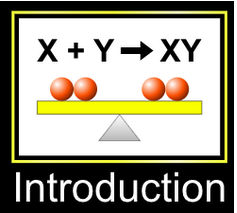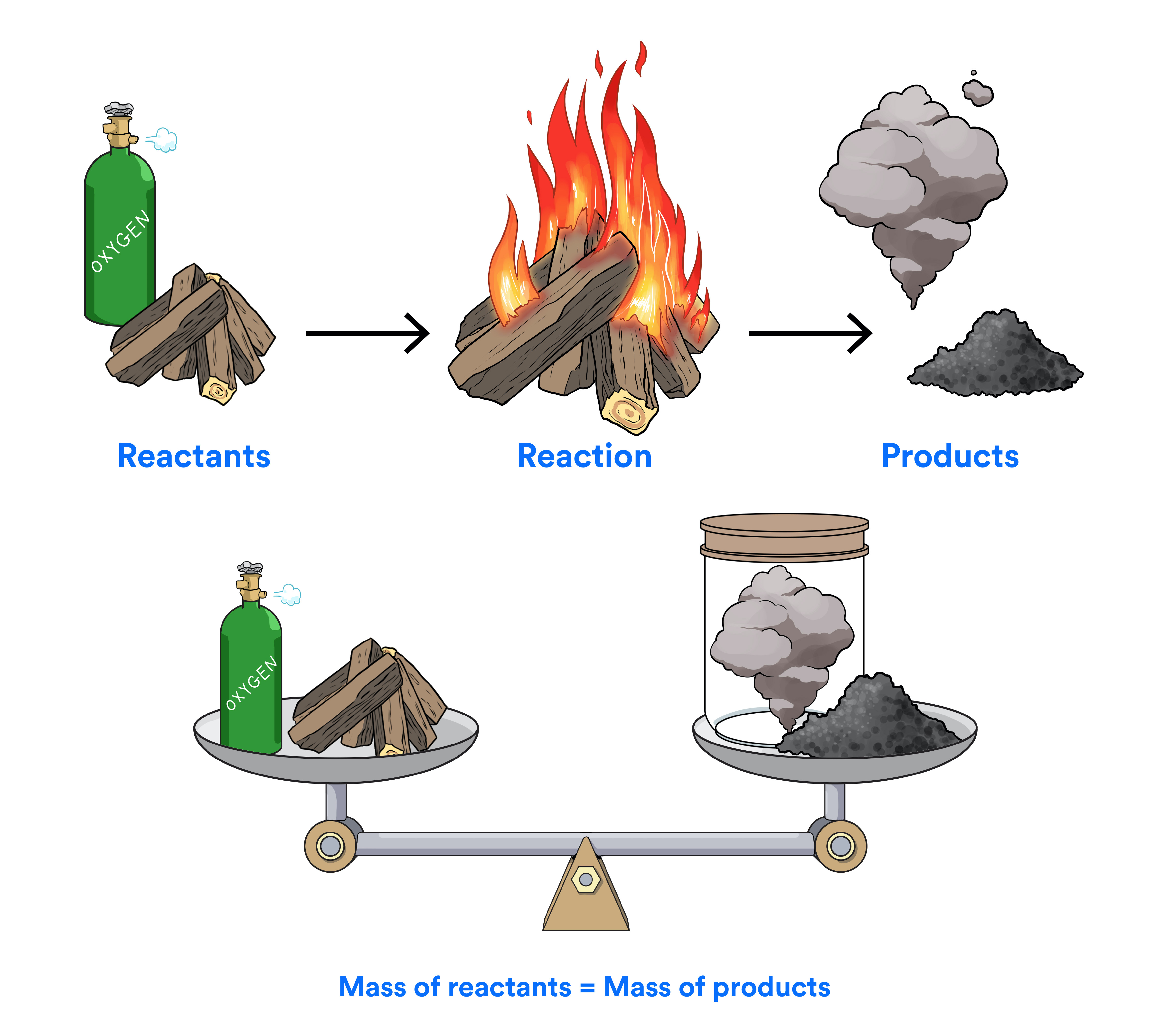
I start with 200g of reactants, but when I weigh my reactants they don't weight 200g! Why is that?
A pupil heated 1.24g of copper carbonate strongly.
The chemical reaction, which took place, is represented
by the equation:
CuCO3(s) --> CuO(s) + CO2(g)
After the solid, which remained, had cooled, he weighed it. He found that its mass was 0.80g
1 point
1
Question 27
27.
Why did the pupil find a decrease in mass in this experiment?
1 point
1
Question 28
28.
He then heated the 0.80g of solid again. When he weighed it after cooling, its mass was still 0.80g. Explain why it had not changed in mass this time.
1 point
1
Question 29
29.
In another experiment, he burnt magnesium ribbon in air. He found that the mass of the powder formed was greater than the original mass of the ribbon. Explain this.
1 point
1
Question 30
30.
Write a balanced equation for the reaction, which takes place when the magnesium burns in oxygen.
1 point
1
Question 31
31.
Carbon monoxide is produced by the incomplete combustion of methane.
Balance the equation for the reaction.
2CH4 + 3O2 →_______CO + 4H2O
1 point
1
Question 32
32.
This question is about displacement reactions.
Iron is extracted from iron oxide by a displacement reaction with carbon.
Balance the equation for the reaction.
Fe2O3 + 3C → _______Fe + _______CO
1 point
1
Question 33
33.
The Haber Process is used to produce ammonia from nitrogen and hydrogen.
The equation for the reaction is:
N2 + 3H2 ⇌ 2NH3
An ammonia molecule has the formula NH3
How many atoms are there in one molecule of ammonia?
Tick (✔) one box
1 point
1
Question 34
34.
Maria fills a bowl with 200 g of water. She puts the bowl of water in the freezer, and the water freezes. Which will most likely be the mass of the frozen water?
1 point
1
Question 35
35.
If reaction starts with 20g of reactants it should produce...
1 point
1
Question 36
36.
If you put 200 grams of ice into a pitcher with 900 grams of water. Then get distracted and come back later to find that the ice has melted in the water. How many grams of water do you now have in the pitcher?
1 point
1
Question 37
37.
A student mixes 125 grams of sugar, 250 grams of water and 5 grams of flavoring. The solution weighs...
1 point
1
Question 38
38.
24 g of magnesium reacts with 38 g of fluorine to produce _____ g magnesium fluoride
1 point
1
Question 39
39.
In the reaction AB-----> A + B reactant AB has 12g and product B has 5g. How many grams should product A have?
5 points
5
Question 40
40.
This question is worth 5 points. Take some time to create your own infographic of the law of conservation of mass.
Must have:
* "The Law of Conservation of Mass" definition
* a written example of the law of conservation of mass
* a picture or pictures to go with your examples
Here are some helpful examples:
Example 1 link
Example 2 link
Required
1 point
1
Question 41
41.
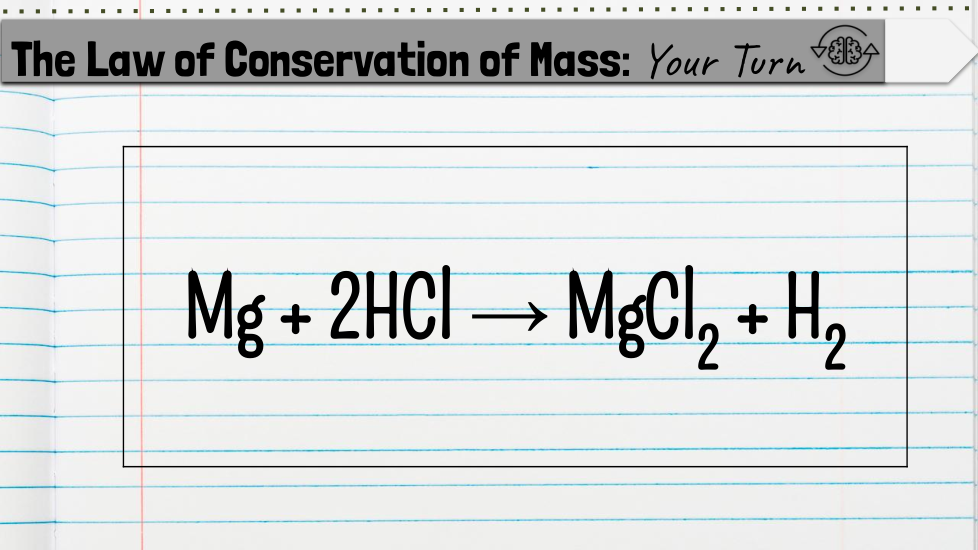
Indicate whether the chemical equation supports the law of conservation of mass.
Required
1 point
1
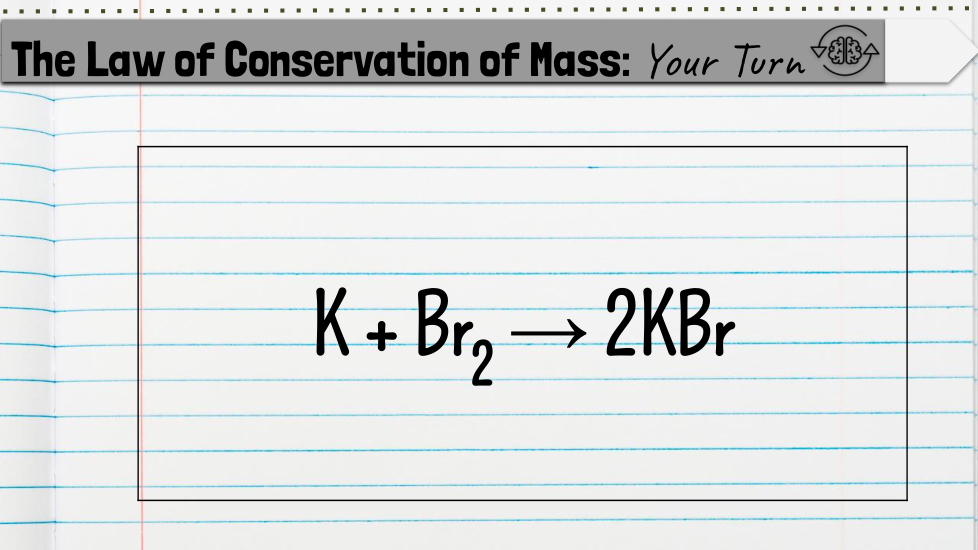
Question 42
42.
Indicate whether the chemical equation supports the law of conservation of mass.
Required
1 point
1
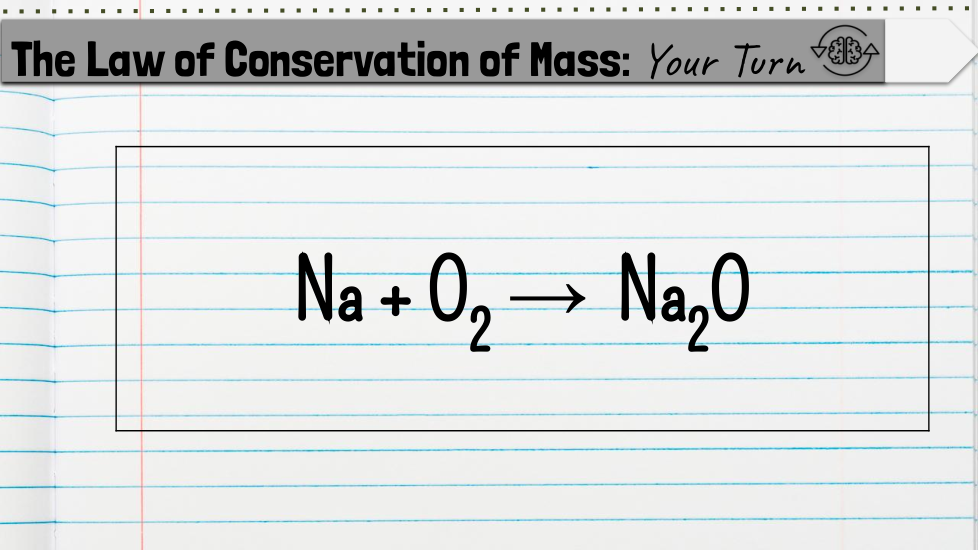
Question 43
43.
Indicate whether the chemical equation supports the law of conservation of mass.
Ecosystems have many chemical and physical changes happening all at once, and matter is conserved in each and everyone—no exceptions. Consider a stream flowing through a canyon—how many chemical and physical changes are happening at any given moment? What would happen if matter continuously disappeared during these reactions?
You just finished learning how balancing chemical equations is required to uphold the law of conservation of matter. Now it's time to put your knowledge to the test. Using PhET's Balancing Chemical Equations Simulation.
Directions:
Enter the PhET Simulation website or use the interactive embedded below.
Start with the Introduction section.
1. Check out the simulation's controls.
2. Answer each pre-lab question.
Enter the game section, by clicking "Game" on the simulation's bottom black menu bar.
Test your balancing ability at all three levels. Each level requires you to balance 5 equations. You must score at least 4 stars at each level to earn full credit.
Take a screenshot of your Game Results screen with all three levels for the last question.
Add a screenshot of your Game Results screen with all three levels.
1 point
1
Question 44
44.
What law is being demonstrated by the simulation?
3 points
3
Question 45
45.
Match each substance to its correct coefficient to balance the chemical equation for ammonia.
N2 + H2 --> NH3
Draggable item
arrow_right_alt
Corresponding Item
H2
arrow_right_alt
3
N2
arrow_right_alt
1
NH3
arrow_right_alt
2
2 points
2
Question 46
46.
Which compounds have a coefficent of 2 to separate water?
1 point
1
Question 47
47.
It is possible to balance the provided equations by leaving a substance with a coefficient of 0.
4 points
4
Question 48
48.
Drag each substance to its correct coefficient to balance the chemical equation for methane.
O2
CO2
CH4
H2O
1
2
3
1 point
1
Question 49
49.
Carbon monoxide is produced by the incomplete combustion of methane.
Balance the equation for the reaction.
2CH4 + 3O2 →_______CO + 4H2O
1 point
1
Question 50
50.
This question is about displacement reactions.
Iron is extracted from iron oxide by a displacement reaction with carbon.
Balance the equation for the reaction.
Fe2O3 + 3C → _______Fe + _______CO
1 point
1
Question 51
51.
Balance the equation below so that it follows the Law of Conservation of Mass?
Balance this chemical equation by adding the correct coefficients
4Al+3O₂-----> _______ Al₂O₃
1 point
1
Question 53
53.
Balance the equation below so that it follows the Law of Conservation of Mass?
__________H2+ O2 → __________H2O
2 points
2
Question 54
54.
Balance the following equation, use (1, 2, 3, 4) to input the balanced equation.
2 points
2
Question 55
55.
Balance the following equation, use (1, 2, 3, 4) to input the balanced equation.
2 points
2
Question 56
56.
Balance the following equation, use (1, 2, 3, 4) to input the balanced equation.
2 points
2
Question 57
57.
Balance the following equation, use (1, 2, 3, 4) to input the balanced equation.
2 points
2
Question 58
58.
Balance the following equation, use (1, 2, 3, 4) to input the balanced equation.
1 point
1
Question 59
59.
What are the coefficients for the reaction N2 + O2 → NO2, in the order in which the reaction is written?
1 point
1
Question 60
60.
What are the coefficients for the reaction CH4 + O2 → CO2 + H2O, in the order in which the reaction is written?
1 point
1
Question 61
61.
What are the coefficients for the reaction H2O → H2 + O2, in the order in which the reaction is written?
4.3.1.2 Relative Formula Mass
2 points
2
Question 62
62.
Calculate the molar mass of Li2S. Specifically rounded to the tenth. Work is worth one point.
1 point
1
Question 63
63.
The atomic mass of N is 14, and the atomic mass of H is 1.0. What is the formula mass of NH3?
1 point
1
Question 64
64.
Given the atomic masses O=16, Na=23, find the relative formula mass of Na2O.
1 point
1
Question 65
65.
If the atomic masses are C=12, H=1, and O=16, calculate the relative formula mass of H2O.
1 point
1
Question 66
66.
Given the atomic masses S=32, H=1, O=32, calculate the relative formula mass of H2SO4.
1 point
1
Question 67
67.
Given that F=19, Na=23, calculate the relative formula mass of NaF.
1 point
1
Question 68
68.
Calculate the relative formula mass of F2
1 point
1
Question 69
69.
Calculate the relative formula mass of Fe
1 point
1
Question 70
70.
Calculate the relative formula mass of H2SO4
1 point
1
Question 71
71.
Calculate the relative formula mass of Al2O3
1 point
1
Question 72
72.
Calculate the relative formula mass of Mg(OH)2
1 point
1
Question 73
73.
Calculate the relative formula mass of Al(NO3)3
1 point
1
Question 74
74.
Calculate the relative formula mass of (NH4)2SO4
1 point
1
Question 75
75.
Calculate the relative formula mass of CuCO3
1 point
1
Question 76
76.
Calculate the relative formula mass of AgNO3
1 point
1
Question 77
77.
Calculate the relative formula mass of NH4NO3
1 point
1
Question 78
78.
Calculate the relative formula mass of CuSO4.5H2O
1 point
1
Question 79
79.
Calculate the relative formula mass of magnesium.
1 point
1
Question 80
80.
Calculate the relative formula mass of oxygen.
1 point
1
Question 81
81.
Calculate the relative formula mass of sodium bromide.
1 point
1
Question 82
82.
Calculate the relative formula mass of calcium fluoride.
1 point
1
Question 83
83.
Calculate the relative formula mass of potassium sulfate.
1 point
1
Question 84
84.
Calculate the relative formula mass of chlorine.
1 point
1
Question 85
85.
Calculate the relative formula mass of chromium(III) oxide.
1 point
1
Question 86
86.
Calculate the relative formula mass of sodium.
1 point
1
Question 87
87.
Calculate the relative formula mass of iron(III) sulfate.
4.3.1.3 Mass changes when a reactant or product is a gas
4.3.1.4 Chemical measurements
4.3.2.1 Moles
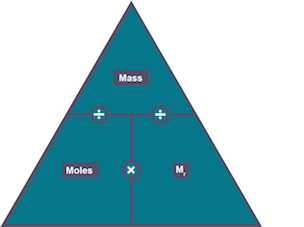
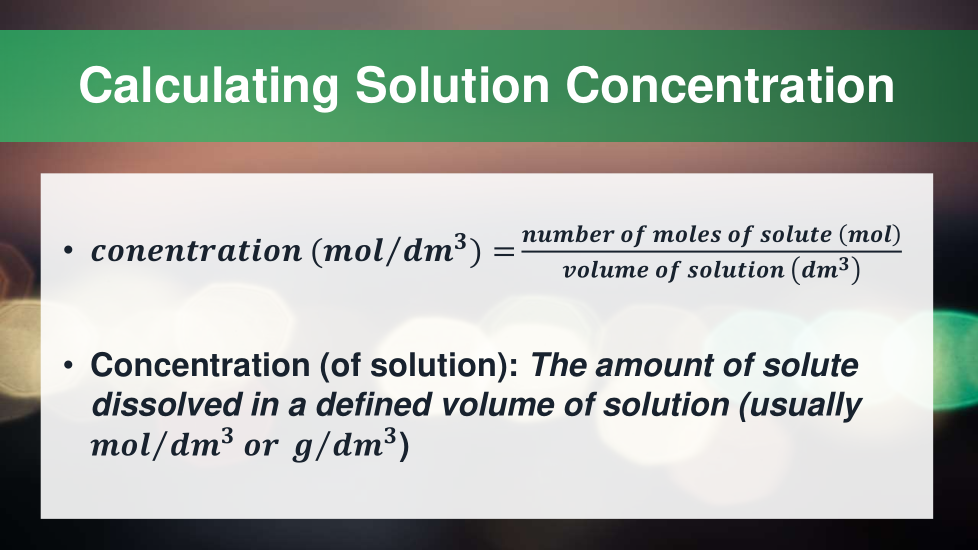
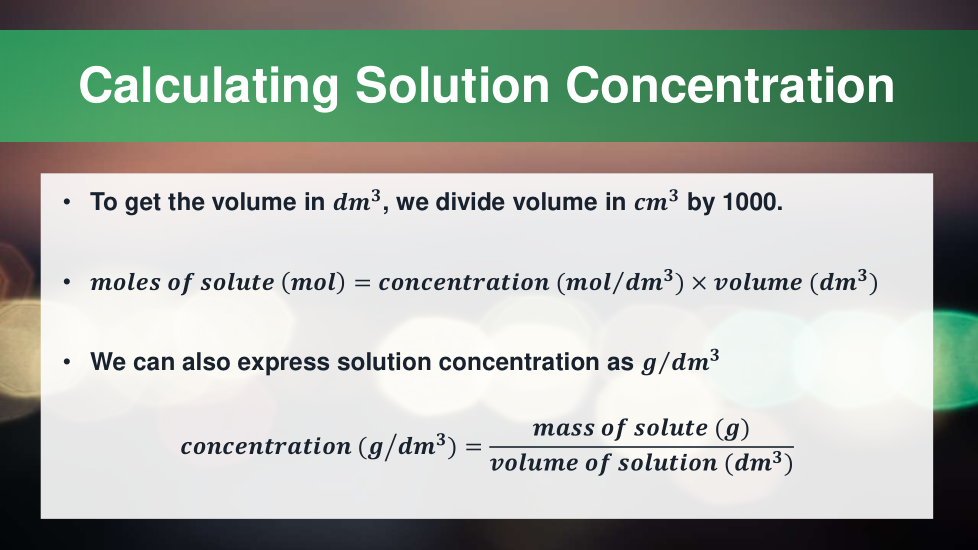
For the following questions, you'll need to use this formula to work out mass or moles for the following questions.
2 points
2
Question 88
88.
How many moles is 25.1 g H2O given the molar mass of H2O is 18.0 g/mol?
1 point
1
Question 89
89.
What is the mass of 2.75 moles of CaO? CaO=56
1 point
1
Question 90
90.
Calculate the moles of NaCl in 200 g. NaCl=58.5
1 point
1
Question 91
91.
Determine the mass of 7.88 moles of copper
1 point
1
Question 92
92.
Convert 25.0 grams of NaCl into moles. NaCl = 58.5
1 point
1
Question 93
93.
Calculate the mass of epsom salt that would contain 0.085 moles of magnesium sulfate (MgSO4). Mg=12, S=32, O=16
1 point
1
Question 94
94.
How many moles are in 85 g of AgNO3? (round to two decimal places)
1 point
1
Question 95
95.
How many grams are there in 1.3 moles of BaO?
1 point
1
Question 96
96.
The Hope Diamond has a mass of 9.10 grams. Diamonds have a very simple chemical formula, they only contain carbon. How many moles of carbon are in the Hope Diamond?
1 point
1
Question 97
97.
Calculate the number of moles in 220g of CO2
1 point
1
Question 98
98.
Calculate the number of moles in 168g of CO
1 point
1
Question 99
99.
Calculate the number of moles in 234g of NaCl
1 point
1
Question 100
100.
Calculate the number of moles in 26g of LiF
1 point
1
Question 101
101.
Calculate the number of moles in 128g of SO2
4.3.2.2 Amounts of substances in equations
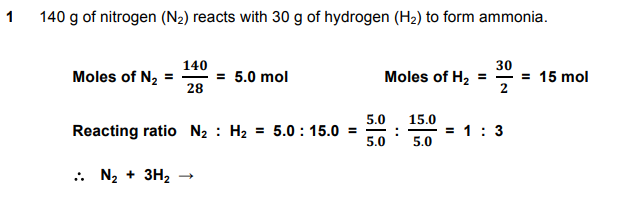
Hello! I'm Miss Bryant - In the AQA Spec, this is called 'Reacting Masses'. Our American friends describe this as 'Stoichiometry'.
But when I teach this, using the method below, I call it 'Down Across and Up', which I think is unique to me.
It is essentially 3 calculations
1) Convert known mass into moles
2) Account for the ratio
2) Use these moles and convert into mass - this is your answer
1 point
1
Question 102
102.
Calculate the mass of aluminium that can be formed from1020 g of aluminium oxide.
2Al2O3 → 4Al + 3O2
1 point
1
Question 103
103.
Calculate the mass of oxygen needed to react 10.0 g of calcium to form calcium oxide.
2Ca + O2 → 2CaO
1 point
1
Question 104
104.
What mass of propane could burn in 48.0 g of oxygen? 1 dp please!
C3H8 + 5O2 → 3CO2 + 4H2O
1 point
1
Question 105
105.
What mass of ammonia can be made from 20.0 g of hydrogen? Please round to a whole number
3H2 + N2 → 2NH3
1 point
1
Question 106
106.
What mass of sodium hydroxide is needed to neutralise 24.5 kg of sulfuric acid? Please include units!
H2SO4 + 2NaOH → Na2SO4 + 2H2O
1 point
1
Question 107
107.
What mass of carbon dioxide is formed when 7.41 g of copper(II) carbonate decomposes on heating? 2 dp please!
CuCO3 → CuO + CO2
1 point
1
Question 108
108.
What mass of carbon monoxide is needed to react with 2.08 kg of iron oxide? Please answer in grams
Fe2O3 + 3CO → 2Fe + 3CO2
1 point
1
Question 109
109.
What mass of chlorine reacts with 20.0 g of iron to form iron(III) chloride?
2Fe + 3Cl2 → 2FeCl3
1 point
1
Question 110
110.
Hydrazine (N2H4) is used as a rocket fuel. It can be made by reacting ammonia with hydrogen peroxide. What mass of ammonia is needed to make 148 g of hydrazine?
2NH3 + H2O2 → N2H4 + 2H2O
4.3.2.3 Using moles to balance equations
1 point
1
Question 111
111.
5.8 g of butane (C4H10) reacts with 20.8 g of oxygen (O2) during complete combustion.
Find the ratio of Butane:Oxygen
1 point
1
Question 112
112.
11.6 g of tungsten oxide (WO3) reacts with 0.30 g of hydrogen (H2) during the extraction of tungsten.
Find the ratio Tungen Oxide: Hydrogen
1 point
1
Question 113
113.
2.56 g of sulfur dioxide (SO2) reacts with 0.64 g of oxygen (O2) to form sulfur trioxide.
Find the ratio of Sulfur Dioxide:Oxygen
1 point
1
Question 114
114.
0.920 g of silver carbonate (Ag2CO3) decomposes to form 0.773 g of silver oxide (Ag2O) and 0.147 g of carbon dioxide (CO2).
Find the ratio of Silver Carbonate : Silver Oxide : Carbon Dioxide
1 point
1
Question 115
115.
10.00 g of octadecane (C18H38) decomposes on heating in a cracking reaction to form 2.28 g of butane (C4H10), 3.31 g of propene (C3H6) and 4.41 g of ethene (C2H4).
Find the ratio of Octadecane:Butane:Propene:Ethene
1 point
1
Question 116
116.
4.00 g of potassium hydrogencarbonate (KHCO3) decomposes on heating to form 2.76 g of potassium carbonate (K2CO3), 0.88 g of carbon dioxide (CO2) and some water (H2O).
Find the ratio of Potassium Hydrogencarbonate:Potassium Carbonate:Carbon Dioxide:Water
4.3.2.4 Limiting reactants
1 point
1
Question 117
117.
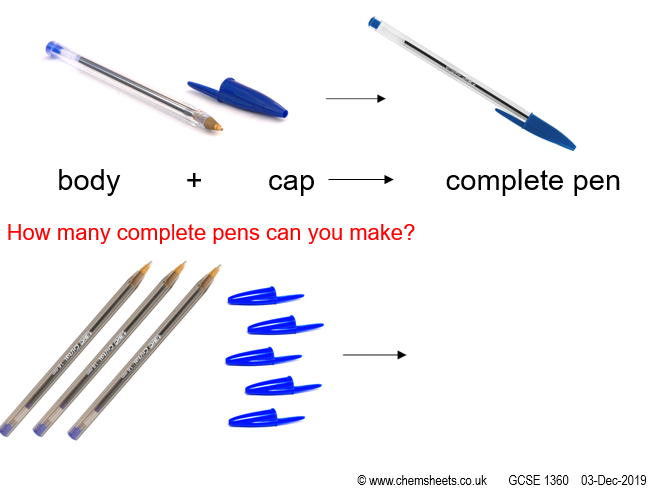
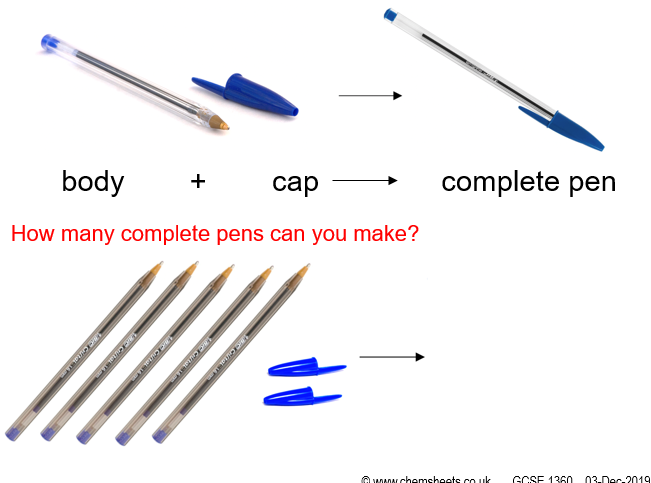
How many complete pens can you make?
1 point
1
Question 118
118.
What is the limiting factor?
1 point
1
Question 119
119.
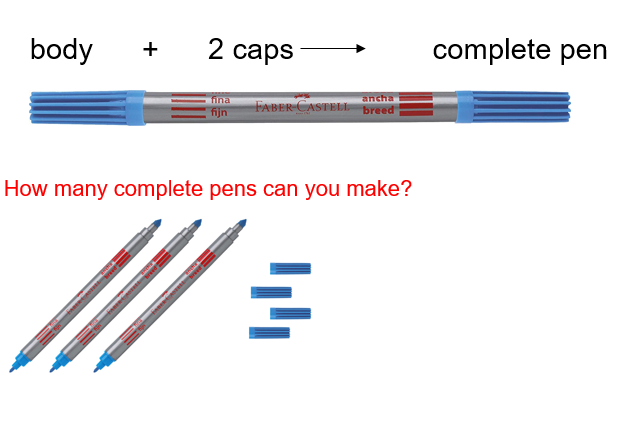
How many pens can you make?
1 point
1
Question 120
120.
What is the limiting factor?
1 point
1
Question 121
121.
How many pens can you make?
1 point
1
Question 122
122.
What is in excess?
1 point
1
Question 123
123.
A + B --> C
How much C can you make if...
3 mol of A and 5 mol of B
1 point
1
Question 124
124.
A + B --> C
How much C can you make if...
8 mol of A and 6 mol of B
1 point
1
Question 125
125.
A + B --> C
How much C can you make if...
0.2 mol of A and 0.15 mol of B
1 point
1
Question 126
126.
P + 2Q --> R
How much R can you make if....
4 mol of P and 6 mol of Q
1 point
1
Question 127
127.
P + 2Q --> R
How much R can you make if....
10 mol of P and 24 mol of Q
1 point
1
Question 128
128.
P + 2Q --> R
How much R can you make if....
0.2 mol of P and 0.5 mol of Q
4.3.2.5 Concentration of solutions
1 point
1
Question 129
129.
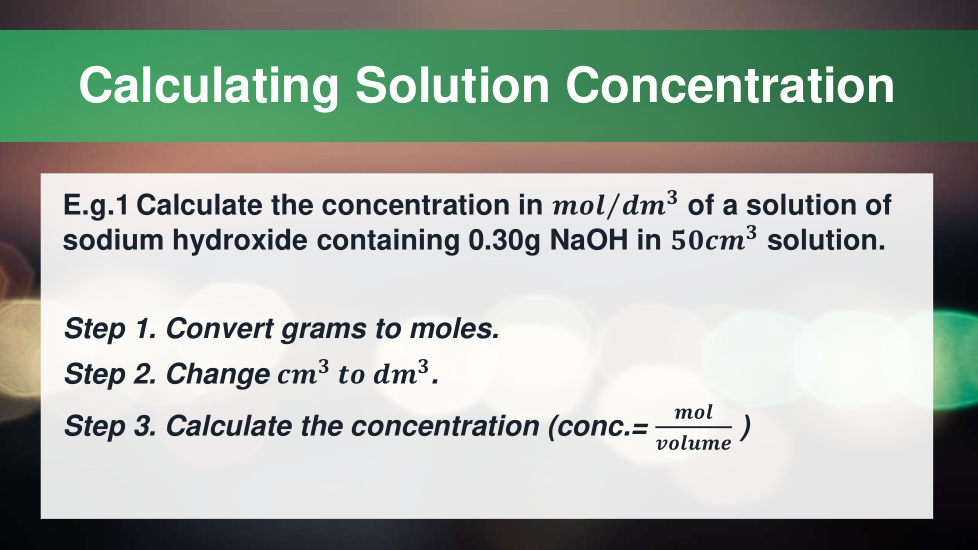
Convert 200 cm3 to dm3.
1 point
1
Question 130
130.
Convert 750 cm3 to dm3.
1 point
1
Question 131
131.
Convert 1500 cm3 to dm3.
1 point
1
Question 132
132.
Convert 85 cm3 to dm3.
1 point
1
Question 133
133.
Convert 2.5 dm3 to cm3.
1 point
1
Question 134
134.
What is 3.2 dm3 in cm3?
1 point
1
Question 135
135.
Change 1.7 dm3 to cm3.
1 point
1
Question 136
136.
Transform 4.8 dm3 into cm3.
9 points
9
Question 137
137.
Match the following terms with the correct definition
Draggable item
arrow_right_alt
Corresponding Item
hydration
arrow_right_alt
A homogeneous mixture of solute and solvent
saturated solution
arrow_right_alt
The substance that is dissolved in the solution
solution
arrow_right_alt
The substance, usually water, in which another substance is dissolved
solvent
arrow_right_alt
The amount of solute per unit volume of solution
concentrated solution
arrow_right_alt
A solution of known concentration
dissociation
arrow_right_alt
A solution with a lots of moles of solute per unit volume
standard solution
arrow_right_alt
A solution that has more solute than it can dissolve.
concentration
arrow_right_alt
Process where existing ions of an ionic compound are separated in solution
solute
arrow_right_alt
Achieved when ions are completely dissolved in a solution
Required
1 point
1
Question 138
138.
Convert 10 cm3 to dm3
Required
1 point
1
Question 139
139.
Convert 25 cm3 to dm3
Required
1 point
1
Question 140
140.
Convert 0.064 dm3 to cm3
Required
1 point
1
Question 141
141.
Step 1
Required
1 point
1
Question 142
142.
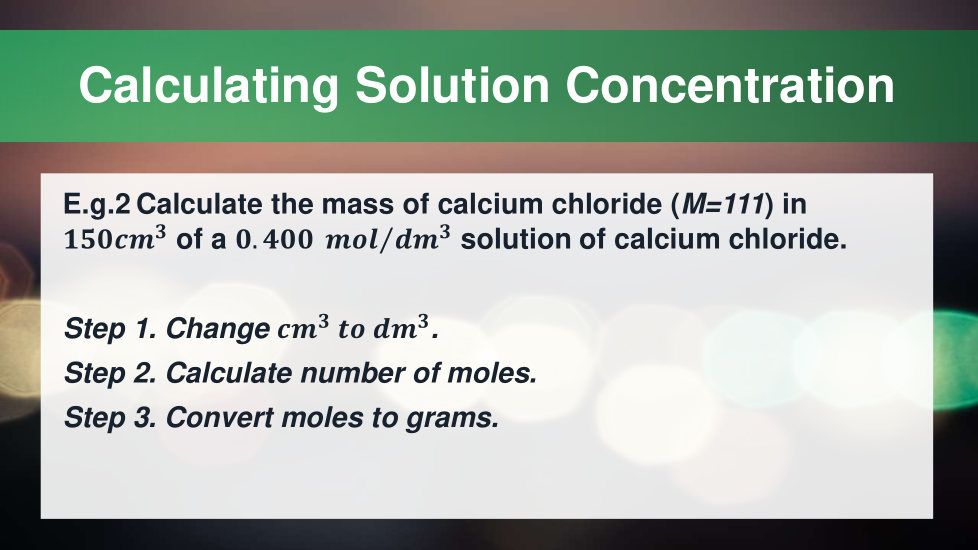
Step 2
Required
1 point
1
Question 143
143.
Step 3
Required
1 point
1
Question 144
144.
Step 1
Required
1 point
1
Question 145
145.
Step 2
Required
1 point
1
Question 146
146.
Step 3
Required
3 points
3
Question 147
147.
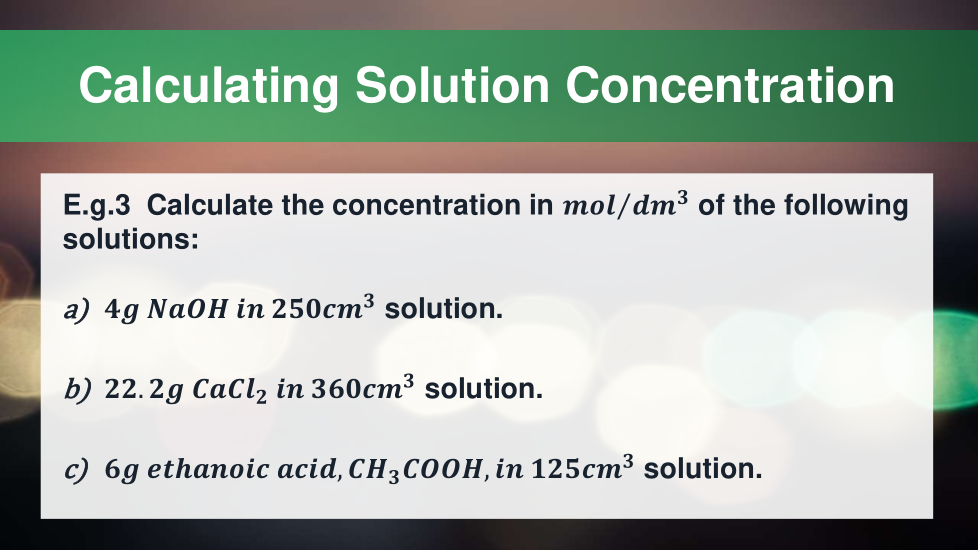
(a) Either use the canvas directly to show your work or complete in your notebook & upload a picture into the canvas.
Required
3 points
3
Question 148
148.
(b) Either use the canvas directly to show your work or complete in your notebook & upload a picture into the canvas.
Required
3 points
3
Question 149
149.
(c) Either use the canvas directly to show your work or complete in your notebook & upload a picture into the canvas.
Required
2 points
2
Question 150
150.
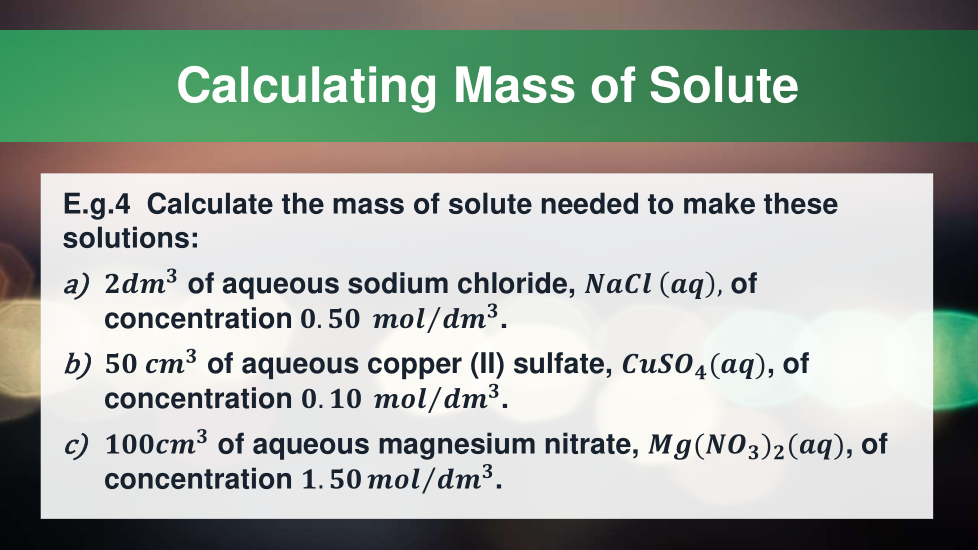
(a) Either use the canvas directly to show your work or complete in your notebook & upload a picture into the canvas.
Required
3 points
3
Question 151
151.
(b) Either use the canvas directly to show your work or complete in your notebook & upload a picture into the canvas.
Required
3 points
3
Question 152
152.
(c) Either use the canvas directly to show your work or complete in your notebook & upload a picture into the canvas.
4.3.3.1 Percentage yield
1 point
1
Question 153
153.
A chemist performs a reaction expected to yield 50g of product but collects only 40g. Determine the percentage yield of the reaction.
1 point
1
Question 154
154.
If an experiment results in 30g of product with a theoretical yield of 60g, what is the percentage yield?
1 point
1
Question 155
155.
A reaction has a theoretical yield of 75g but 25g of product is actually recovered. Calculate the percentage yield of the reaction.
1 point
1
Question 156
156.
A reaction has an actual yield of 20g and a theoretical yield of 80g. What is the percentage yield?
1 point
1
Question 157
157.
In this reaction, the theoretical yield of copper sulfate was 14.5 g. However, only 8.6 g were produced. Calculate the percentage yield.
1 point
1
Question 158
158.
Calculate the percentage yield for each of the following reactions given the actual and theoretical yields.
a Zoe makes 20.5 g of copper chloride.
The maximum possible amount she could have made is 35.6 g.
1 point
1
Question 159
159.
George isolates 5.6 g of a clean, dry precipitate of iron(II) hydroxide.
The maximum possible amount he could have isolated is 15.3 g.
1 point
1
Question 160
160.
The teacher tells Aivija that she could theoretically make 1.26 mol of aspirin.
When she carries out the reaction she finds she has made 0.87 mol.
1 point
1
Question 161
161.
Iron is made by reduction of iron oxide with carbon monoxide.
Fe2O3 + 3CO → 2Fe + 3CO2
a) Calculate the mass of iron that can be formed from 126 g of iron oxide
1 point
1
Question 162
162.
b) 78.5 g of iron was formed in this reaction. Calculate the percentage yield.
1 point
1
Question 163
163.
Chlorine can be made by the electrolysis of sodium chloride solution.
2NaCl + 2H2O → 2NaOH + Cl2 + H2
a) Calculate the mass of chlorine that can be formed from 50.0 g of sodium chloride.
1 point
1
Question 164
164.
b) 25.0 g of chlorine was formed in this reaction. Calculate the percentage yield.
1 point
1
Question 165
165.
Chromium is a useful metal. It is extracted from chromium oxide by reaction with aluminium.
Cr2O3 + 2Al → 2Cr + Al2O3
a) Calculate the mass of chromium that can be formed from 1.25 kg of chromium oxide.
1 point
1
Question 166
166.
b) 756 g of chromium was formed in this reaction. Calculate the percentage yield.
4.3.3.2 Atom economy
1 point
1
Question 167
167.
The reaction between ethene and steam to produce ethanol is represented by the equation: C2H4 + H2O --> C2H5OH
If 98 g of ethene is used, what is the maximum mass of ethanol that can be produced?
(Ar values: C = 12.0, H = 1.0, O = 16.0)
1 point
1
Question 168
168.
The reaction between ethene and steam to produce ethanol is represented by the equation: C2H4 + H2O --> C2H5OH
Which statement is true?
1 point
1
Question 169
169.
1. The hydrogen used in the Haber process is produced from natural gas, containing methane. The equation for this stage of the process is: CH4 + 2H2O --> CO2 + 4H2
Calculate the atom economy for the production of hydrogen.
(Ar values: C = 12.0, H = 1.0, O = 16.0)
1 point
1
Question 170
170.
Calculate the atom economy to form copper(II) oxide from copper(II) carbonate. CuCO3 → CuO + CO2
1 point
1
Question 171
171.
Calculate the atom economy to form aluminium from aluminium oxide. 2Al2O3 → 4Al + 3O2
1 point
1
Question 172
172.
Calculate the atom economy to form iron from iron oxide. Fe2O3 + 3CO → 2Fe + 3CO2
1 point
1
Question 173
173.
Calculate the atom economy to form aluminium chloride from aluminium in this reaction. 2Al + 3Cl2 → 2AlCl3
1 point
1
Question 174
174.
Calculate the atom economy to form oxygen from hydrogen peroxide. 2H2O2 → 2H2O + O2
1 point
1
Question 175
175.
Hydrogen (H2) has many uses, including as the fuel in many fuel cells. It can be made in several ways. a) Calculate the atom economy to form hydrogen by method 1. CO + H2O → CO2 + H2
1 point
1
Question 176
176.
b) Calculate the atom economy to form hydrogen by method 2. CH4 + 2H2O → CO2 + 4H2
1 point
1
Question 177
177.
When choosing which method to use, one factor to consider is the atom economy. In terms of atom economy, which method is preferable.
1 point
1
Question 178
178.
What, apart from atom economy, be considered when choosing between methods?
4.3.4 Using concentrations of solutions in mol/dm 3
4.3.5 Use of amount of substance in relation to volumes of gases
1 point
1
Question 179
179.
Find the volume of the following gas, at room temperature and pressure (assume answer is in dm3):
4.00 moles of oxygen
1 point
1
Question 180
180.
Find the volume of the following gas, at room temperature and pressure (assume answer is in dm3):
0.250 moles of methane
1 point
1
Question 181
181.
Find the volume of the following gas, at room temperature and pressure (assume answer is in dm3):
15 moles of Argon
1 point
1
Question 182
182.
Find the volume of the following gas, at room temperature and pressure (assume answer is in dm3):
0.220 g of Carbon Dioxide (CO2)
1 point
1
Question 183
183.
Find the number of moles of the following gas, at room temperature and pressure (assume answer is in moles):
48.0 dm3 of Carbon Monoxide
1 point
1
Question 184
184.
Find the number of moles of the following gas, at room temperature and pressure (assume answer is in moles):
1.20 dm3 of Hydrogen
1 point
1
Question 185
185.
Find the number of moles of the following gas, at room temperature and pressure (assume answer is in moles):
360 cm3 of Oxygen
1 point
1
Question 186
186.
Find the volume of oxygen gas that reacts with 10 dm3 of sulfur dioxide gas measured at the same temperature and pressure.
2SO2(g) + O2(g) → 2SO3(g)
1 point
1
Question 187
187.
Find the volume of hydrogen gas that reacts with 200 cm3 of nitrogen gas measured at the same temperature and pressure. Please answer in dm3
N2(g) + 3H2(g) → 2NH3(g)
1 point
1
Question 188
188.
Find the volume of oxygen that reacts with 4.0 dm3 of butane (C4H10) gas measured at same temperature & pressure.
2C4H10(g) + 13O2(g) → 8CO2(g) + 10H2O(l)
1 point
1
Question 189
189.
I want to make some oxygen for my Yr 9, so they can learn the gas test for it. I have 100g of Hydrogen Peroxide.
H2O2 --> H2 + O2
How much Oxygen can I produce?
1 point
1
Question 190
190.
What size of measuring cylinder would I need to invert to catch all the oxygen?