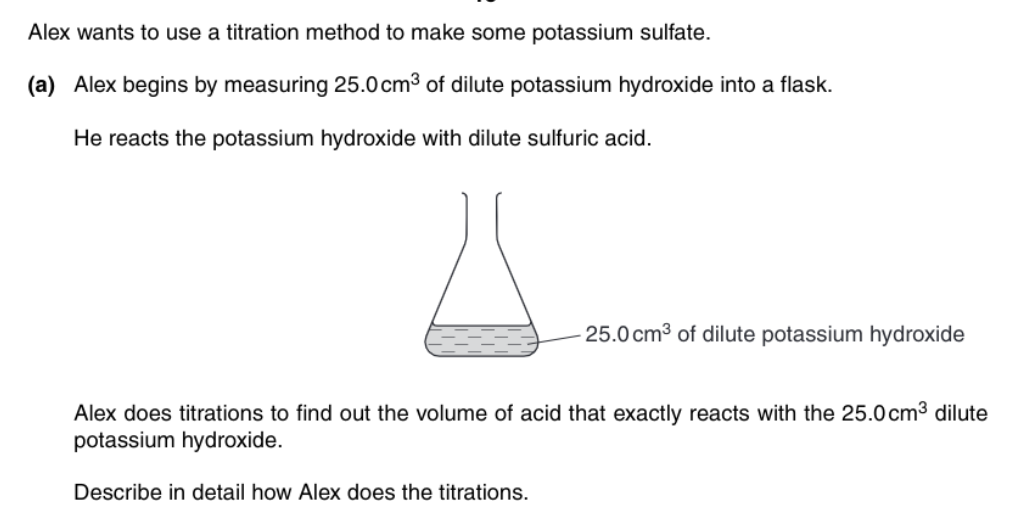
How can aluminium be extracted from aluminium compounds in an aluminium ore?
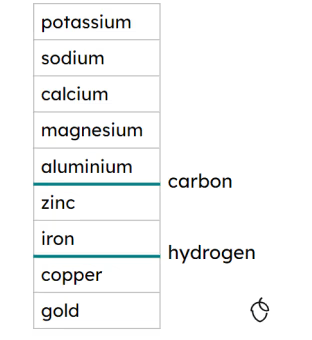
How can aluminium be extracted from aluminium compounds in an aluminium ore?
Magnesium + Oxygen --> ?
Calcium + Oxygen --> ?
Iron + Oxygen --> ?
Zinc + Oxygen --> ?
Copper + Oxygen --> ?
What do you predict when magnesium reacts with oxygen?
Calcium + water --> ?
Sodium + water --> ?
Aluminum + water --> ?
Iron + water --> ?
Zinc + copper sulfate --> ?
Aluminum + lead nitrate --> ?
Copper + silver nitrate --> ?
Aluminum + lead(II) chloride --> ?
Iron + silver nitrate --> ?
Does this reaction happen?
Zinc + copper sulfate --> copper and zinc sulfate
Does this reaction happen?
Iron + magnesium oxide --> magnesium and iron oxide
Does this reaction happen?
Aluminum + iron(III) chloride --> iron and aluminum chloride
What happens when sodium reacts with water?
What are the products of iron reacting with copper sulfate?
What do you expect when iron interacts with water?
What results when copper displaces silver from silver nitrate?
What is the name of the reaction where a more reactive element will take the place of a less reactive element in a compound?
Which of the following statements about the reaction shown are correct?
calcium + iron sulfate → calcium sulfate + iron
Why is potassium more reactive than iron?
The non-metal carbon is positioned between which two metals in the reactivity series?
Which of the following substances are products of the reaction between zinc and hydrochloric acid?
Which of the following substances are products of the reaction between lithium and water?
True or false: Silver cannot be extracted using carbon monoxide because it is too reactive.
How do you extract the following metals?
Ag
Zn
Au
Na
Fe
Al
Pure metals don't need extracting
Reduction using carbon (or carbon monoxide)
Electrolysis
What is the name for a type of reaction in which a substance loses oxygen or gains electrons?
Which of the following methods can we use to extract platinum?
Which statements about the following reaction are correct?
Zinc oxide + carbon → carbon dioxide + zinc
In the following reaction, which substance has been oxidised and which substance has been reduced?
Lithium + copper oxide → lithium oxide and copper
How can aluminium be extracted from aluminium compounds in an aluminium ore?
Why can we extract zinc from zinc ore by heating with carbon, but not extract magnesium from magnesium ore?
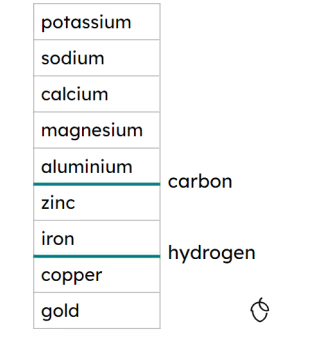
In the reaction Zn -> Zn2+ + 2e-, what is the process called?
Oxidation is the
Hydrogen atoms are oxidised. Which equation is correct to represent this?
Oxygen is reduced. Which equation is correct to represent this?
Which of the following statements are true? Tick 3 correct answers
What is the name of a reaction which involves both reduction and oxidation? Fill in the blank
Which of the following statements are true for this half equation:
Which is the correct half equation for the reduction of Li? Tick 1 correct answer
What do we not include in ionic equations for reactions? Tick 1 correct answer
What is the missing product in this overall ionic equation:
Magnesium reacts with hydrochloric acid to produce magnesium chloride and a gas.
Which gas is produced?
Tick (✓) one box
Acids react with
What is missing from the word equation below?
calcium oxide + nitric acid → __________ + water
What is the salt formed when potassium reacts with hydrochloric acid?
What do you get when copper oxide reacts with sulfuric acid?
Which salt is formed when sodium hydroxide is neutralized by hydrochloric acid?
When ammonia reacts with sulfuric acid, what type of salt is produced?
What is the name for the salt formed from the reaction of Hydrochloric acid and Sodium Hydroxide?
What is the salt produced when Sulfuric acid reacts with Zinc?
Which of the following salts is formed by the reaction of Nitric acid and Potassium Hydroxide?
Ammonia reacts with Hydrochloric acid to form which salt?
Calcium chloride is a salt that can be named from hydrochloric acid.
All salts need to come from a reaction with a Metal.
Potassium sulfate can be generated from sulfuric acid.
What is the name of the salt produced from hydrochloric acid and sodium carbonate?
What is the name of the salt formed when sulfuric acid reacts with calcium oxide?
What salt forms when nitric acid reacts with magnesium hydroxide?
What is the salt produced when ammonia reacts with hydrochloric acid?
What type of salt is created when hydrochloric acid reacts with sodium?
What is the common name for the salt created when sulfuric acid reacts with potassium?
What salt is formed when nitric acid reacts with calcium?
Calcium hydroxide solution reacts with an acid to form calcium chloride.
Complete the word equation for the reaction.
calcium hydroxide +
Soluble salts are formed by reacting metal oxides with acids.(a)
Give one other type of substance that can react with an acid to form a soluble salt.
Name the salt produced by the neutralisation of hydrochloric acid with potassium hydroxide.
Write a balanced symbol equation for the reaction of dilute hydrochloric acid with calcium oxide.
Zinc + hydrochloric acid --> ?
Iron + sulfuric acid --> ?
Copper + nitric acid --> ?
Aluminum + hydrochloric acid --> ?
Predict the products of zinc reacting with hydrochloric acid.
What products are produced when zinc is placed in hydrochloric acid?
What salt is produced when hydrochloric acid reacts with sodium hydroxide?
What salt is produced from the reaction of sulfuric acid and potassium hydroxide?
Which salt forms when nitric acid interacts with calcium hydroxide?
When a metal reacts with oxygen, the common product is typically a type of metal oxide.
Plan a method to make pure, dry crystals of zinc chloride from zinc carbonate and a dilute acid.
What is the difference between hazard and risk? (1:06)
What do these symbols mean and what precautions should be taken? (1:15)
Identify any hazards associated with this experiment. (1:15)
What can we do to minimize any risks during this experiment? (1:15, 2:49)
To make copper sulfate, what will we need to react with the sulfuric acid? (2:00-2:12)
Write the word and symbol equation for the reaction. (2:00, 3:19) Word Equation: ____________________ + ____________________ → ____________________ + ____________________ Symbol Equation: _______________ + _______________ → _______________ + __________
What substances are now present in the boiling tube? Identify any ions present. (2:32-3:19)
Look at the boiling tube. Name the particle responsible for: (2:49) (a) The blue color: _________________________________________ (b) The black color: ________________________________________
Explain what is meant by a limiting reactant. (3:35)
How can we separate the product from the unreacted copper oxide? (3:43)
What is the benefit of using fluted filter paper over a conical filter? (4:01)
Describe what you see happening during the separation process. Explain your observations. (5:02-5:13)
How and why do we need to remove excess water from the filtrate? (5:14-5:20)
Why do we add anti-bumping crystals to the solution before heating? (5:24-5:40)
What health and safety problems do you think may result if the solution is allowed to boil dry? (6:12)
If there are no heat proof gloves available, what other safety precautions could be taken? (6:27)
What conditions are needed to produce larger crystals? What conditions are needed to produce smaller crystals? (6:58)
Write a method for preparing a sample of pure dry zinc sulfate crystals from a metal oxide and acid.
Categorize the following pH values as acidic, neutral, or basic.
pH 7
pH 2
pH 5
pH 9
Neutral
Acidic
Basic
Pair each term with its definition
| Draggable item | arrow_right_alt | Corresponding Item |
|---|---|---|
Indicator | arrow_right_alt | Reaction between an acid and a base |
Neutralisation | arrow_right_alt | Measure of acidity or alkalinity |
pH | arrow_right_alt | Substance that changes color in an acid or base |
Match the pH value with its description
| Draggable item | arrow_right_alt | Corresponding Item |
|---|---|---|
pH 2 | arrow_right_alt | Neutral |
pH 10 | arrow_right_alt | Strongly acidic |
pH 7 | arrow_right_alt | Moderately alkaline |
Match the substances with their pH levels
| Draggable item | arrow_right_alt | Corresponding Item |
|---|---|---|
Baking Soda | arrow_right_alt | pH 7 |
Distilled Water | arrow_right_alt | pH 3 |
Vinegar | arrow_right_alt | pH 9 |
Pair the reaction type with its effect on pH
| Draggable item | arrow_right_alt | Corresponding Item |
|---|---|---|
Adding an Acid | arrow_right_alt | Brings pH to 7 |
Neutralisation Reaction | arrow_right_alt | Raises pH |
Adding a Base | arrow_right_alt | Lowers pH |
What does a pH value of 7 represent?
What does the neutralisation process involve?
Acids have a pH...
Strong acids are closest to...
Alkalis have a pH...
Strong Alkalis have a pH closest to....
What color indicates a strong acid in universal indicator?
What color indicates a weak alkali in universal indicator?
What color shows a strong alkali in universal indicator?
What color indicates a weak acid in universal indicator?
Which ion do all acids produce in aqueous solution?
Write an ionic equation for the neutralisation of hydrochloric acid with potassium hydroxide.
Name the type of reaction that takes place when dilute hydrochloric acid reacts with calcium oxide.

Name apparatus A.
What is the reading on apparatus A?
Use a for the sulfuric acid.
Take the volume reading
Add a few drops of to the potassium hydroxide in the flask.
Add acid to potassium hydroxide until the indicator changes (use a to make the colour change more obvious).
Take the volume reading.
Calculate the rough titre using the formula:
= final volume - initial volume
Repeat the titration and add acid (near the end)
the flask to mix the solutions .
Repeat the titration until you get results (within of each other)
dropwise
titre
indicator
burette
concordant
colour
final
white tile
initial
swirl
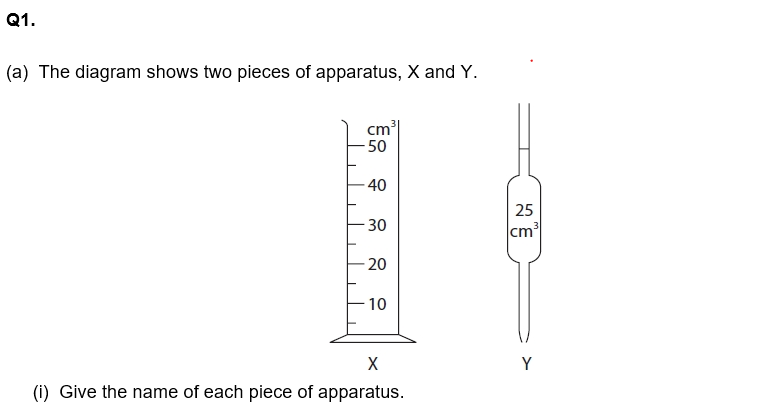
(ii) In a titration, a student adds 25.0 cm3 of barium hydroxide solution to a conical flask.
Give a reason why it is better to use Y rather than X.
C
D
E
F
Strong acid
Weak acid
Concentrated AND strong
Weak AND dilute
How does the pH scale change with each unit?
If a solution has a Hydrogen ion concentration ([H+]) of 10^-7 M, what is its pH?
A sample of orange juice has a pH of 5. If lemon juice is 100 times more acidic, what is the pH of the lemon juice?
Ethanoic acid is a weak acid.
What is meant by ‘weak acid’?
Answer in terms of ionisation
Explain why the pH of an acid depends on:
the strength of the acid
the concentration of the acid.
A 1.0 × 10⁻³ mol/dm3 solution of hydrochloric acid has a pH of 3.0
What is the pH of a 1.0 × 10⁻⁵ mol/dm3 solution of hydrochloric acid?
Are simple molecular, giant molecular or ionic compounds used in electrolysis?
What is the basic process during electrolysis?
What are two main components required for electrolysis?
Identify whether the following are cations or anions:
Oxygen (O2-)
Chlorine (Cl-)
Sodium (Na+)
Hydrogen (H+)
Potassium (K+)
Bromide (Br-)
Lithium (Li+)
Zinc (Zn2+)
Fluoride (F-)
Ammonium (NH4+)
Anions
Cations
On this diagram, label the anode, cathode, electrolyte, wires, and power source
In this example, water (H2O) is being electrolysed. What are the 2 gases being produced?
What is electrolysis?
What is the name of the electrode that positive ions move to?
What is the name of the electrode that the negative ions move to?
What is meant by the term ‘cation’?
What is the anode made of?
Match the term with its description
| Draggable item | arrow_right_alt | Corresponding Item |
|---|---|---|
Electrolysis | arrow_right_alt | Positive electrode where oxidation occurs. |
Anode | arrow_right_alt | Charged particle that can be positive or negative. |
Electrolyte | arrow_right_alt | Negative electrode where reduction occurs. |
Ion | arrow_right_alt | Substance that produces an electrically conducting solution when dissolved or molten |
Cathode | arrow_right_alt | Chemical decomposition produced by passing an electric current. |
What will the electrolysis of Sodium Chloride produce?
What will the electrolysis of Copper Chloride produce?
What will the electrolysis of Potassium Iodide produce?
What will the electrolysis of Magnesium Fluoride produce?
What does the electrolysis of Potassium Chloride produce?
What will the electrolysis of Sodium Iodide result in?
What are the products of the electrolysis of Copper Chloride?
What will the electrolysis of Calcium Bromide lead to?

Explain why electrolysis would not take place in the apparatus shown in Figure 1.
Explain why graphite conducts electricity.
Answer in terms of the structure and bonding in graphite.
True or false: Electrolysis is the separation of a compound using electricity?
What is the name for the positive electrode in electrolysis?
What type of current is used in electrolysis?
What is the charge on the cathode?
True or false: Electricity is used to separate a compound during electrolysis?
What is the charge on the anode?
What is the substance that is broken down during electrolysis called?
What is the negative electrode in electrolysis known as?
What state does the electrolyte need to be in for electrolysis?
What charge are the metal ions in an ionic compound?
Why do ionic compounds conduct electricity when molten or dissolved?
What substances form negative ions?
Which electrode do the negative ions move towards?
What is the name given to positive ions?
Which electrode do the cations move towards?
What is the name given to negative ions?
Which electrode do the anions move towards?
Which electrode do positive ions move to?
What charged ions do non-metals form?
Which electrode do positive ions move to?
Which electrode do the anions move towards?
Which electrode do the anions move towards?
What is the basic process during electrolysis?
Match the term with its definition.
| Draggable item | arrow_right_alt | Corresponding Item |
|---|---|---|
Electrolyte | arrow_right_alt | Electrode where reduction occurs in an electrolytic cell. |
Cathode | arrow_right_alt | Electrode where oxidation occurs in an electrolytic cell. |
Anode | arrow_right_alt | A substance that produces an electrically conducting solution when dissolved in a polar solvent. |
True or false: Electrolysis is the separation of a compound using electricity?
What type of current is used in electrolysis?
What is the name for the positive electrode in electrolysis?
What is the charge on the anode?
What is the negative electrode in electrolysis known as?
What state does the electrolyte need to be in for electrolysis?
Which electrode do the negative ions move towards?
Which electrode do the cations move towards?
Which electrode do positive ions move to?
What is used to break down compounds into elements during electrolysis?
True or false? Electrolysis can only happen if the ions are free to move.
What name is given to the substance that is broken down during electrolysis?
Name the charged particles that carry the current through a solution during electrolysis.
True or false? During electrolysis positively charged ions move to the positive electrode
Ions can conduct electricity during electrolysis because they are free to move and they are... what?
This symbol is used in half equations. What does it represent?

The equipment shown below can be used to carry out which process?

True or false? Electrolysis can only happen if the ions are free to move.
What name is given to the substance that is broken down during electrolysis?
What is produced at the cathode when lead bromide is electrolysed?
What is produced at the anode when lead bromide is electrolysed?
What would form at the cathode in the electrolysis of magnesium bromide?
What would form at the anode in the electrolysis of lithium chloride?
What would form at the anode in the electrolysis of molten sodium bromide?
What would form at the cathode in the electrolysis of molten aluminium chloride?
What would form at the cathode in the electrolysis of magnesium bromide?
What will the electrolysis of Magnesium Fluoride produce?
What will the electrolysis of Copper Chloride produce?
What would form at the anode in the electrolysis of molten sodium bromide?
What would form at the cathode in the electrolysis of molten aluminium chloride?
Identify the products of molten electrolysis for Calcium Bromide.
For electrolysis to work, substances must either be in solution or be in a __________ state. What one word completes this sentence?
Why is electrolysis used to extract aluminium form its ore?
Why is electrolysis an expensive way to extract metal from its ore?
Name the compound from which aluminium is extracted.
What is this compound dissolved in before electrolysis?
Describe what happens at the positive electrode during the electrolysis of aluminium oxide.
What is produced at the cathode?
What is (or should be) produced at the anode?
What are the electrodes made of?
1. Why is it more economical to extract aluminium from ores rather than minerals that are not ores?
To extract aluminium, molten bauxite and another ore, cryolite, undergo electrolysis.
Explain, in terms of the environment, why cryolite is added to the electrolyte.
Explain, in terms of the economic reasons, why cryolite is added to the electrolyte.
Some people think that extracting aluminium contributes negatively to climate change.
Explain why someone might think this, without discussing energy use.
What is the half equation at the cathode?
What is the half equation at the anode?
What would be the products of molten electrolysis for Aluminum Oxide?
What will be the products of molten electrolysis for Potassium Iodide?
Explain why the electrolysis of Aluminium oxide contributes to climate change. (hand mark)
A metal will always be produced at one electrode during electrolysis.
What is produced at the cathode is the metal in the solution is more reactive than hydrogen?
What is produced at the anode if the solution does not contain halide ions?
Predict the products of electrolysis of copper sulfate solution
When electrolysis of a solution is done, if the metal is too reactive, what gas is produced instead?
When electrolysis of a solution is done, if the none-metal isn't from Group 7, what gas is produced instead?
HT Only: Write half equations for the reactions that happen at the
electrodes during the electrolysis of molten copper chloride.
HT Only: Write a half equation for the reactions that happen at the
electrodes during the electrolysis of copper bromide solution
HT Only: Write half equations for the reactions that occur at the positive and negative electrodes during the production of aluminium.
What is reduction in terms of electrons?
What does oxidation involve in terms of electrons?
An atom that loses an electron during a reaction is...
Rewrite the equation with number of electrons on the correct side:
Cu2+ (aq) --> Cu (s)
Rewrite the equation with number of electrons on the correct side:
Mg2+ (aq) --> Mg (s)
Rewrite the equation with number of electrons on the correct side:
Al3+ (aq) --> Al (s)
Rewrite the equation with number of electrons on the correct side:
Li+(l) -->Li(s)
Rewrite the equation with number of electrons on the correct side:
H+(aq) -->H2(g)
Rewrite the equation with number of electrons on the correct side:
Br-(aq) --> Br2(g)
Rewrite the equation with number of electrons on the correct side:
O2-(aq) --> O2(g)

Magnesium chloride can be electrolysed.The diagram below shows two experiments for electrolysing magnesium chloride.
Explain why magnesium chloride must be molten or dissolved in water to be electrolysed.
Explain how magnesium is produced at the negative electrode in Experiment 1.
Cu2+ +
Mg2+ +
Al3+ +
Li1+ +
2H1+ +
2Br1- --> Br2 +
2O2- --> O2 +

Zinc chloride is an ionic substance.
Complete the sentence.
When zinc chloride is molten, it will conduct
Zinc ions move towards the negative electrode where they gain electrons to produce zinc.
Name the product formed at the positive electrode.
Explain why zinc ions move towards the negative electrode.
What does oxidation involve in terms of electrons?
Look at the diagram. Which electrode will the positively charged ions in the solution move to?

The equipment shown below can be used to carry out which process?
Look at the diagram. Which is the positive electrode? 
Look at the diagram below. Which is the positive electrode?
The apparatus shown below can be used to investigate the electrolysis of brine. Which gas will collect in the tube above the negative electrode (cathode)?

The apparatus shown below can be used to investigate the electrolysis of brine. Which gas will collect in the tube above the positive electrode (anode)?
What is electrolysis?
What is the correct unit of volume?
What are electrodes made of?
What is the charge of the anode?
What is the charge of the cathode?
What is the general name of the solution being electrolysed?
What are the products of a solution of Copper Chloride
What does damp blue litmus paper test for?
What is the balanced half equation at the anode?
What is the half equation at the cathode?
In solutions, which metals can be electrolysed out?
Explain your previous choice?
What are the bubbles in the electrolysing the solution of Sodium Sulfate?
What is the test for hydrogen?
What type of reaction occurs when the zinc ions gain electrons?