1
4.8.1.3
1
4.8.1.3
1
4.8.1.3
MS1a
1
4.8.1.3
MS1a
1
4.8.1.3
MS1a
1
4.8.1.3
MS1a
2
4.8.1.1
4.8.1.3
A pure substance has to be an element
A mixture is always an impure substance.
Impure substances have higher boiling points
Salt is put on ice to increase the melting point.
Identify 2 differences between pure and impure substances
What happens to the melting point of water when impurities are added?
Many people would say that spring water is pure. Is this a pure substance? Explain your answer.
A student compared a sample of isooctane with some petrol. The student found that the octane boiled at 99°C while the petrol boiled between 45 and 95°C. Which of these is a pure substance? Explain your answer.
Explain why salt is placed on roads in winter months?
At what temperature does water freeze?
What is a pure substance made up of only one type of atom?
A green ink contains 85% yellow dye and 15% blue dye.
Determine the simplest whole number ratio of yellow dye : blue dye in the green ink.
Yellow dye : Blue dye =
A fertiliser contains 0.225 g of iron per 3.0 g of fertiliser.
Which calculation gives the percentage of iron in the fertiliser?
Tick one
Formulations have specific amounts of each chemical
Diesel is a formulation. What is a formulation?
Simple distillation allows us to separate liquids with different boiling points.
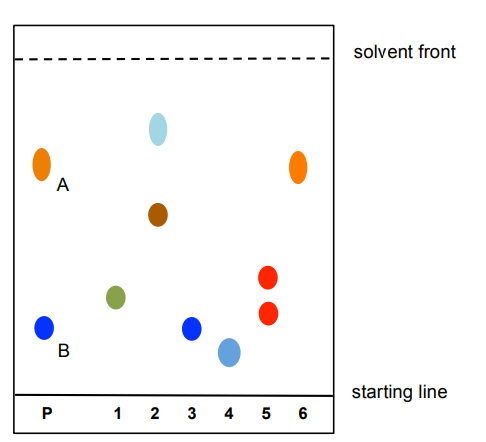
Use the ruler tool on this chromatogram - you will need this to answer the next questions.
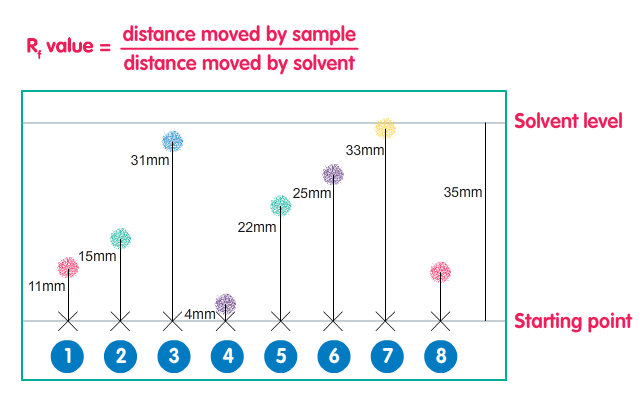 Find the Rf value of spot 1
In chromatography, ink is the solvent.
Why is the start line drawn in pencil rather than pen?
Chromatography allows us to separate different elements in a compound.
In chromatography, the dyes are soluble in water.
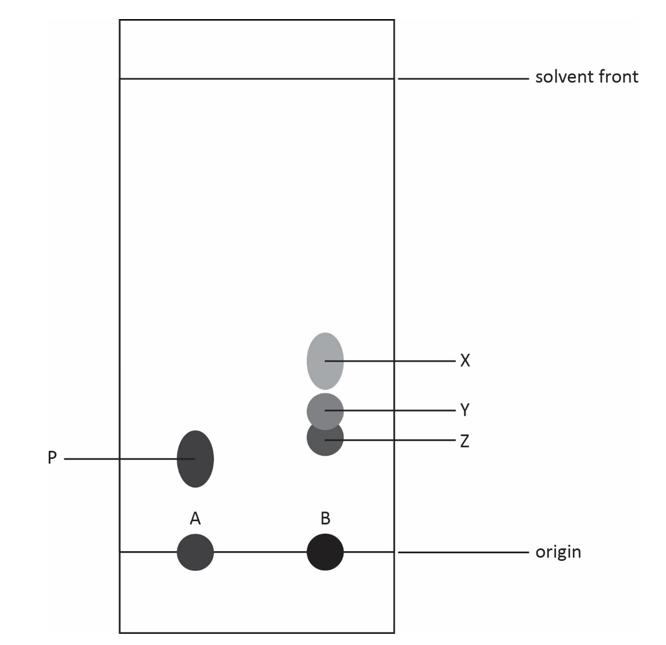
What colours are in substance P?
Match the gas test to its positive result
| Draggable item | arrow_right_alt | Corresponding Item |
|---|---|---|
Hold a burning splint at the open end of a test tube of the gas | arrow_right_alt | Limewater turns milky (cloudy) |
Place a glowing splint in a test tube of the gas | arrow_right_alt | Litmus paper is bleached and turns white |
Put Damp litmus paper into the gas | arrow_right_alt | A squeaky pop sound is produced |
Shakes or bubble the gas through limewater | arrow_right_alt | The splint relights. |
This question is about gas tests - sort into Tests and Results
Litmus paper is bleached and turns white
Hold a burning splint at the open end of a test tube of the gas
The splint relights
A squeaky pop sound is produced
Limewater turns milky (cloudy)
Shakes or bubble the gas through limewater
Place a glowing splint in a test tube of the gas
Put Damp litmus paper into the gas
Test
Result
Put the order of Chromatography in order
Use a ruler to measure the distance the ink spot has travelled (Rf values)
Place a spot of ink on the pencil line
Cover the beaker and wait a few minutes
Suspend the filter paper in a beaker so it isn't touching the sides or the bottom
Carefully add the solvent to a level just below the ink spot, taking care not to splash the paper
When the solvent has almost reached the top of the filter paper, remove it from the beaker
Draw a line with a pencil and ruler to one end of the strip of filter paper
Lay the paper flat and leave it to dry
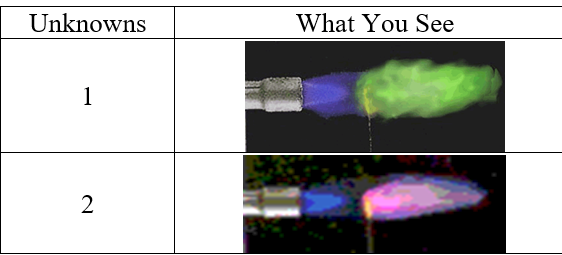
Based on the table in question 1, what are these 2 unkown samples?
https://www.focuselearning.co.uk/s/4rfozrfumgv1
Describe flame tests to identify the following ions in solids:
a lithium ion, Li+
b sodium ion, Na+
c potassium ion, K+
d calcium ion, Ca+2
e copper ion, Cu+2
red
lilac
blue-green
yellow
orange-red
https://www.focuselearning.co.uk/s/4rfozrfumgv1
Match the ion to its colour
| Draggable item | arrow_right_alt | Corresponding Item |
|---|---|---|
K+ | arrow_right_alt | red |
Cu2+ | arrow_right_alt | yellow |
Ca2+ | arrow_right_alt | Lilac |
Na+ | arrow_right_alt | orange-red |
Li+ | arrow_right_alt | blue-green |
A compound is tested using a flame test. The resulting flame is yellow. What metal did the compound contain? Give the full name, not the symbol.
A substance taken from a crime scene burns with a lilac flame during a flame test. Name the metal in this substance.
A compound is tested by dipping a wire loop in a solution of the compound and holding it at the edge of a Bunsen flame. What name is given to this type of test?
A metal compound gives a crimson flame in a flame test. Name the metal that this compound contains.
A patient in hospital is thought to have bone cancer that releases excess calcium ions into the blood. A machine is used to perform a very sensitive flame test on a blood sample. What colour flame would the machine be set to detect?
Potash alum is a chemical compound.
Potash alum contains potassium ions, aluminium ions and sulfate ions.
Sodium hydroxide solution is used to test for some metal ions.
Sodium hydroxide solution is added to a solution of potash alum until a precipitate forms.
Complete the sentence.
The colour of the precipitate formed is
Look at the table. What is the name of metal ion 1? Use the name, not the symbol.
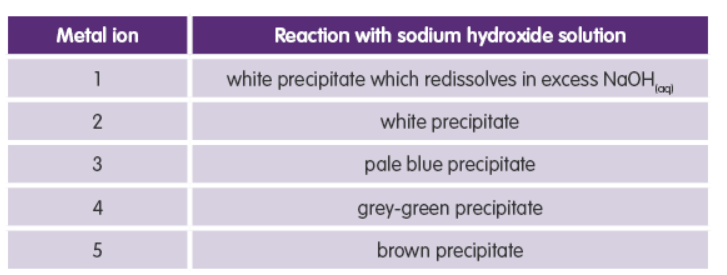
Hiroto suspects that a compound contains copper. He adds sodium hydroxide solution to a solution of the compound. What colour precipitate will he see if the compound does contain copper?
A substance known to contain iron forms a precipitate when tested with sodium hydroxide solution. What colour will the precipitate be if it contains iron(II)?
Carmen obtains a red flame in a flame test on a metal compound, but she isn't sure whether it is lithium or calcium. She adds sodium hydroxide solution to a solution of the compound. What will she see if the compound contains calcium?
If you suspect that a substance contains a metal you could carry out a flame test or you could add a solution to help identify it. Name the solution you could add.
A substance known to contain iron forms a precipitate when tested with sodium hydroxide solution. The precipitate is brown. What form of iron does the substance contain?
Match the metal hydroxide with its color reaction.
| Draggable item | arrow_right_alt | Corresponding Item |
|---|---|---|
Iron(III) hydroxide | arrow_right_alt | White precipitate |
Aluminium hydroxide | arrow_right_alt | Blue precipitate |
Copper(II) hydroxide | arrow_right_alt | Brown precipitate |
What is the ionic equation for forming Magnesium hydroxide?
Which ionic equation represents the forming of copper hydroxide?
What is the ionic equation for Fe(III) hydroxide?
Complete the sentence.
Sulfate ions can be identified using dilute hydrochloric acid
and
Match the reagent/test and chemical to the substance it will react with positively
| Draggable item | arrow_right_alt | Corresponding Item |
|---|---|---|
Using (any) Acid - usually hydrochloric | arrow_right_alt | Halogens ions (Chloride, Bromide, Iodide) |
Using Nitric Acid and Silver Nitrate | arrow_right_alt | Sulfate ions |
Using Barium Chloride | arrow_right_alt | Carbonate ions |
When you add any acid to a carbonate, it neutralises the solution.
It also produces a gas.
Name the gas.
When test for the halide ions, each make a specific colour of precipitate.
Silver chloride =
Silver bromide =
Silver iodide =
Potash alum is a chemical compound.
Potash alum contains potassium ions, aluminium ions and sulfate ions.
Which two methods can be used to identify the presence of potassium ions in potash alum solution?
Tick (✓) two boxes.
Part 2: Emission Spectra
In the flame test you saw a single color as the excited atoms released the energy they gained. But there are billions of excited atoms releasing energy. The excited atoms do not all emit the same energy light because the amount of energy that excited them may differ. The kinds of light energy that can be emitted by excited atoms is unique for an element. The pattern of "lines' or colors emitted is called an emission spectrum can be used to identify an element. Astronomers also have the ability to measure amounts of an element by measuring the brightness of the emitted light.
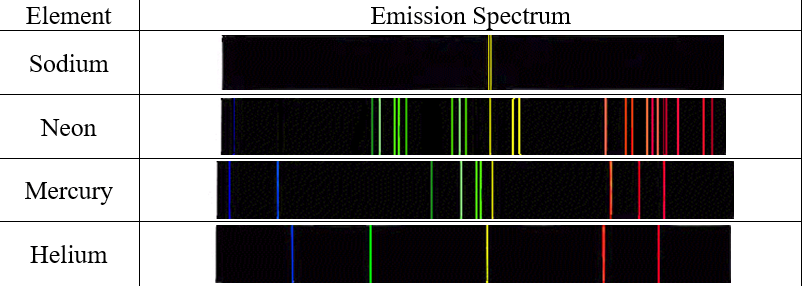
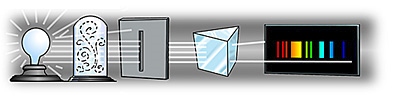
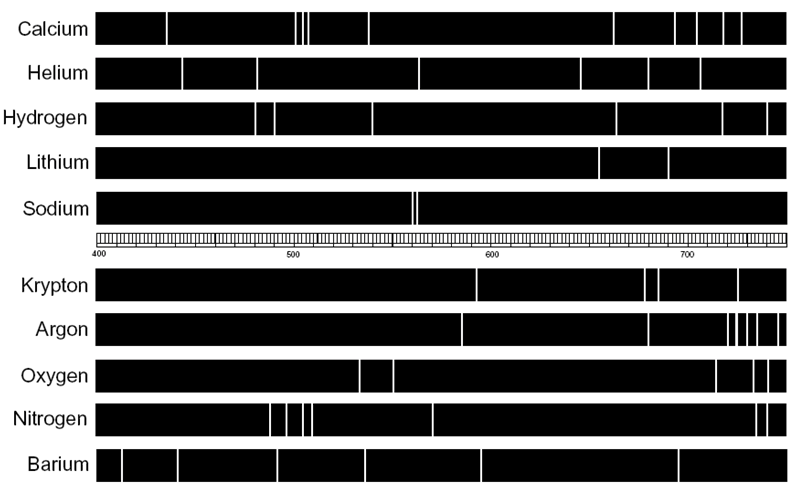
What you need to do: Colored light is emitted by excited gases of elements in sealed glass tubes called "spectrum" tubes. (Direct current, DC, high voltage electrons are used to excite the atoms in the spectrum tube. High voltage means 1000 to 2000 volts. This is more than 10 times normal household voltage which is 120 volts AC.) A spectroscope can separate the light produced by a spectrum tube. The color seen by the naked eye is a combination of a number of colors of light. These are separated by the spectroscope’s diffraction grating to produce an emission spectrum. Use the Virtual Spectroscopy Lab (Part 2: Emission line spectra for selected elements) to observe the emission spectra for known elements and then use this information to figure out the identity of unknown elements.
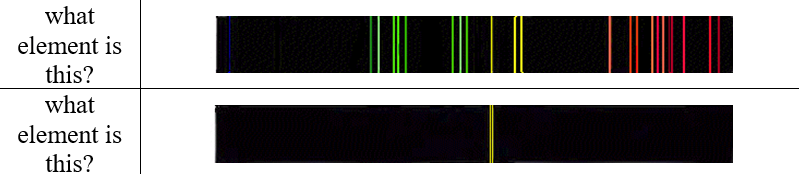
Use the table above to determine what these two elements are.
Part 3: Fingerprinting the Stars
There is another way in which elements can produce spectra. Suppose that instead of a heated sample of some element, you have the element in the form of a relatively cool gas. Now let's say that a source of white light-- containing all visible wavelengths--is shining behind the gas. When photons (bursts of light) from the light source make their way through this gas, some of them can interact with the atoms--provided that they have just the right frequency to bump an electron of that element up to a higher energy level.
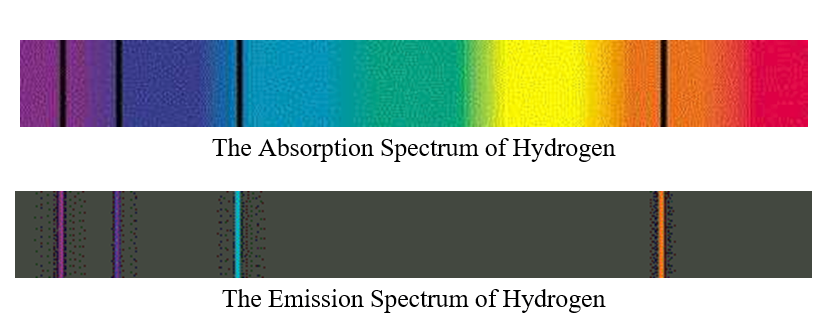
Photons at those particular frequencies are thus absorbedby the gas and all those other frequencies would come through okay. Then the spectrum of light that had been through the gas would just have some gaps in it, at the frequencies that were absorbed. The spectrum with these missing frequencies is called an absorption spectrum. Note that the dark lines in an absorption spectrum appear at exactly the same frequencies as the bright lines in the corresponding emission spectrum.
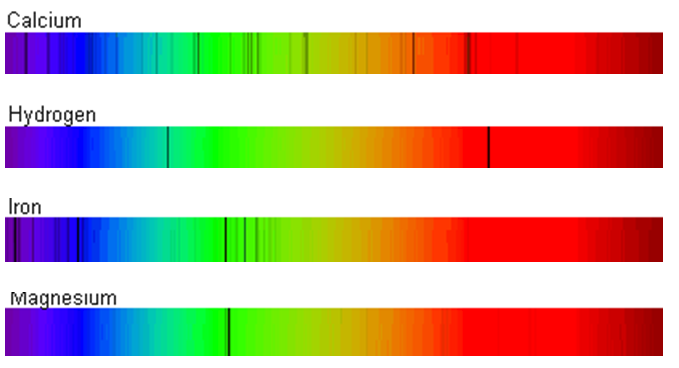
What does this have to do with stars? If you look more closely at the Sun's spectrum, you will notice the presence of dark lines. These lines are caused by the Sun's atmosphere absorbing light at certain wavelengths, causing the intensity of the light at this wavelength to drop and appear dark. The atoms and molecules in a gas will absorb only certain wavelengths of light. The pattern of these lines is unique to each element and tells us what elements make up the atmosphere of the Sun. We usually see absorption spectra from regions in space where a cooler gas lies between us and a hotter source. We usually see absorption spectra from stars, planets with atmospheres, and galaxies. Astronomers also have the ability to measure amounts of an element present in an object by measuring the thickness of the dark lines.
Here are spectra for some elements common in the atmospheres of stars:
Below you will see both the elements for comparison and a star's spectrum. Your job is to identify all the elements you can detect in the star's atmosphere.
Elements present
Identify the elements present in A, and B by comparing the bright lines present with the bright lines in the spectra for known elements.
How many substances are in dye A?
How many substances are in Dye B?
Calculate the Rf value for substance P
Calculate the Rf value for substance Z
Calculate the Rf value for substance Y
Calculate the Rf value for substance X
Explain how the chromatogram shows that A is a pure substance and B is a mixture.