Log in
Sign up for FREE
arrow_back
Library

Biology Unit One Assessment

star
star
star
star
star
Last updated 9 months ago
25 questions
1
1
1
1
1
1
1
1
1
1
1
1
1
1
1
1
1
1
1
1
B.C.8B
Required
1
Required
1
Required
1
BIO.4.A
Required
1
BIO.4.A
BIO.4.C
Required
1
Question 1
1.

Question 2
2.

Question 3
3.

Question 4
4.

Question 5
5.

Question 6
6.

Question 7
7.

Question 8
8.

Question 9
9.

Question 10
10.

Question 11
11.

Question 12
12.

Question 13
13.

Question 14
14.

Question 15
15.

Question 16
16.

Question 17
17.

Question 18
18.

Question 19
19.

Question 20
20.

Question 21
21.

Draggable itemarrow_right_altCorresponding Item
arrow_right_alt
arrow_right_alt
arrow_right_alt
arrow_right_alt
arrow_right_alt
arrow_right_alt
Question 22
22.

Question 23
23.

Question 24
24.
Draggable itemarrow_right_altCorresponding Item
arrow_right_alt
arrow_right_alt
arrow_right_alt
Question 25
25.

What is the basic unit of life according to the cell theory?
Atom
Cell
Organism
Tissue
Which process explains the origin of mitochondria and chloroplasts?
Cell division
Mutation
Endosymbiotic theory
Natural selection
What do you call organisms that have a complex cell structure?
Bacteria
Eukaryotes
Prokaryotes
Viruses
Which of the following structures is found in eukaryotic cells?
Capsid
Plasmid
Nucleus
Flagellum
What is the primary purpose of taxonomy in biology?
Explaining physiology
Classifying organisms
Studying evolution
Analyzing genetics
What defines a prokaryotic organism?
No nucleus
Large size
Multicellular
Presence of mitochondria
What do chloroplasts do in plant cells?
Help with cell division
Maintain cell shape
Convert sunlight to energy
Store genetic material
What does the endosymbiotic theory suggest about cell evolution?
Cells change structure rapidly
Cells remain isolated
Only eukaryotes evolved
Cells merged with others
A node on a cladogram indicates what?
New species
Extinction event
Branch length
Common ancestor
What component of cells is involved in energy production?
Nucleolus
Ribosomes
Lysosomes
Mitochondria
Which is an example of a eukaryote?
Archaea
Fungi
Bacteria
Virus
What is a characteristic of all living organisms?
Respond to stimuli
Multicellularity
Photosynthesis
Presence of DNA
Which of the following is a type of fungi?
Grasses found in gardens.
Bacteria present in soil.
Algae found in ponds.
Mushrooms and molds are both fungi.
Which organism is an autotroph?
Bacteria
Fungi
Humans
Green plants
What is an example of a heterotroph?
Algae
Cactus
Corn
Deer
Autotrophs obtain energy primarily from:
Other organisms
Mechanical digestion
Decay of organic matter
Sunlight or inorganic substances
Plants are classified as autotrophs because they can:
Absorb nutrients directly
Make their own food
Digest other organisms
Store food in roots
Put the taxa in order from broadest to most specific.
Class
Species
Order
Family
Domain
Genus
Phylum
Kingdom
The bullfrog, Rana catesbeiana, is most closely related to the...
Spotted chorus frog, Pseudacris clarki
Asian flying frog, Polypedates leucomystax
Northern leopard frog, Rana pipiens
African bullfrog, Pyxicephalus adspersus
The taxonomic classifications of four species of amphibians are shown.
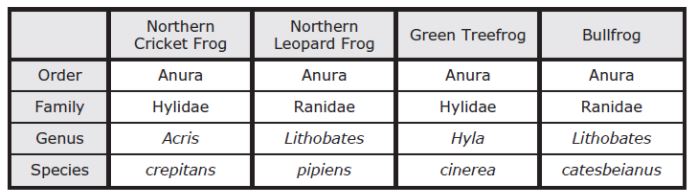

Based on the information provided, which two species are most closely related?
(2021)
Northern cricket frogg and green treefrog
Northern leopard frog and bullfrog
North leopard frog and green treefrog
Norther cricket frog and bullfrog
Match the kingdom with the correct characteristic
Kingdom Animalia
Live in extreme environments
Kingdom Fungi
Live inside living organisms
Kingdom Plantae
Known as the "junk drawer" kingdom
Kingdom Bacteria
Autotrophic, multicellular, Asexual & Sexual reproduction
Kingdom Archeabacteria
saprotrophic, uni & multicellular, yeast, mushrooms
Kingdom Prostista
Ability to move, Heterotrophic, multicellular
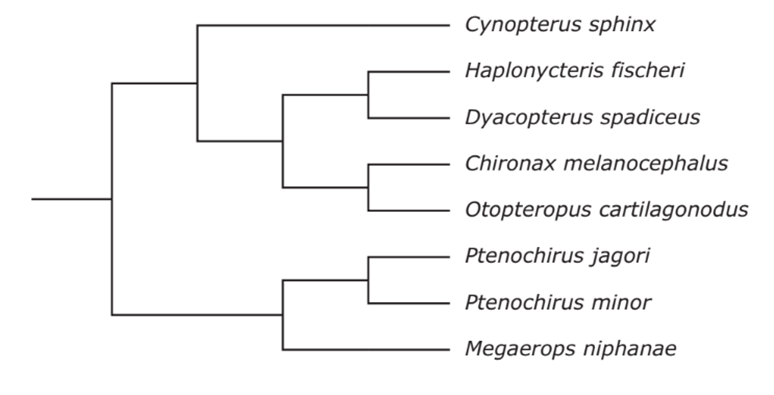
Researchers analyzed a mitochondrial gene of different bat species to determine relatedness. A cladogram of their results is shown.


Based on the cladogram, which set of bat species is the least related?
Ptenochirus minor and Megaerops niphanae
Dyacopterus spadiceus and Otopteropus cartilagonodus
Haplonycteris fischeri and Ptenochirus jagori
Cynopterus sphinx and Chironax melanocephalus
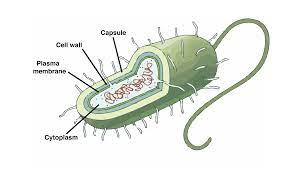
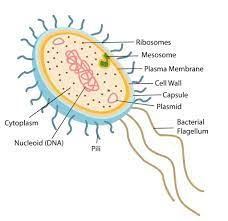
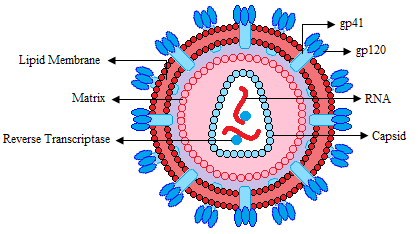
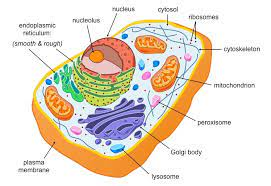
This is a picture of a virus
This is a picture of a eukaryotic cell
This is a picture of a prokaryotic cell
virus
animal cell
bacteria
How do chloroplasts relate to the endosymbiotic theory?
They are formed during photosynthesis.
They evolved from cyanobacteria.
They are exclusive to animal cells.
They only exist in multicellular organisms.