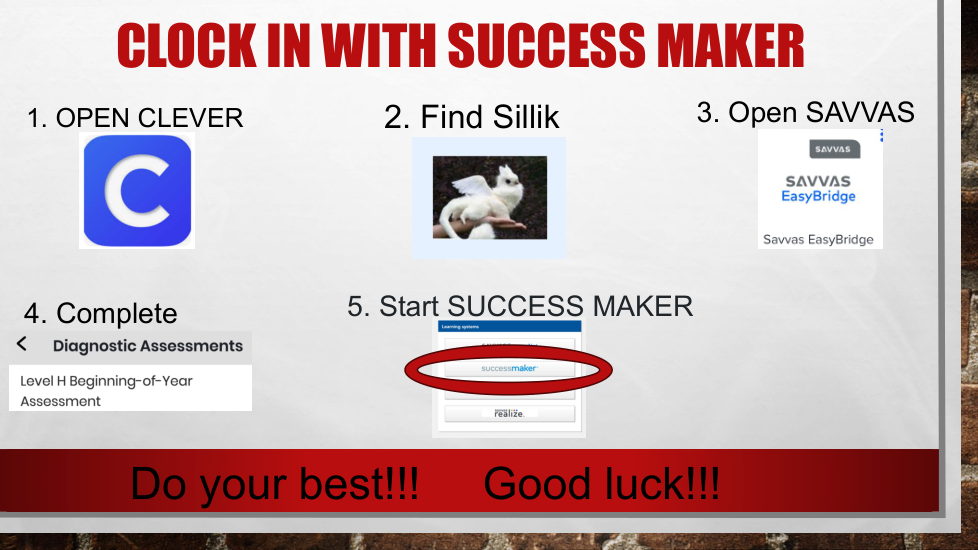
SEL Check: 🌟 How are you feeling today? Please select the emoji that best represents your mood.
Take a screenshot of your completed mins of Success Maker mins.
Screen shot must have
Name
Time completed
Date
Preparing Students for the Workforce
Today's students are tomorrow's designers, engineers, programmers, and scientists. Implementing building activities within the classroom cultivates both hard skills and soft skills that will benefit students in the workplaces of the future, both within the science, technology, engineering, and mathematics (STEM) field and beyond. Hard skills include the technical and practical skills required to successfully complete a task, while soft skills are the behavioral skills necessary for effective communication and collaboration. While hard skills are often explicitly taught, soft skills are mainly learned through experience and exposure. Let's take a closer look at what hard skills and soft skills you can help students cultivate as they complete robotics activities within the classroom.
Which term means practical abilities like coding or using tools?
Hard Skills
Coding: As students construct VEX robots, they will learn to code the robots to complete specific challenges that align with real-world use cases. Through the coding platform VEXcode, designed by VEX Robotics, students can code using block-based coding or Python commands. As students develop competency in coding and improve their skills, they will grow increasingly prepared for the workforce.
Which coding languages does VEXcode let students use to control their robots?
Scientific Inquiry: Through conducting experiments, gathering data, and drawing scientific conclusions, students will grow in science inquiry skills. As students build robots and complete STEM activities, students have opportunities to observe, predict, check, record, and communicate outcomes. Scientific inquiry and analysis are important for employees across all fields. Through scientific inquiry and analysis, students will learn to formulate and find the answers to questions about the natural and physical world. For more information on fostering science inquiry, see these VEX Library articles:
When following scientific inquiry while testing a robot, which actions are required?
Data Analysis: Whether students are completing industrial automation activities with the VEX CTE Workcell or completing STEM Labs using VEX GO, IQ, or EXP/V5, students will collect, analyze, interpret, and draw significant conclusions from data. With recent advancements in technology, especially in artificial intelligence(AI), data-driven decision making has become increasingly important in the workplace to identify patterns, trends, and correlations within workforce data.
Match reasoning skills to what students practice during data analysis.
| Draggable item | arrow_right_alt | Corresponding Item |
|---|---|---|
estimating | arrow_right_alt | finding exact answer |
calculating | arrow_right_alt | representing situation mathematically |
modeling | arrow_right_alt | quickly predicting value |
Engineering Design: As students build, test, and run projects, they will grow in fundamental engineering design skills. Through activities using the VEX Continuum, students will identify problems, develop solutions, and optimize solutions through testing and evaluation. For more information about the Engineering Design Process (EDP) and methods to effectively implement the EDP in the classroom, view the following VEX Library articles:
Match engineering design steps to what students do in each step.
| Draggable item | arrow_right_alt | Corresponding Item |
|---|---|---|
evaluate | arrow_right_alt | state need or challenge |
identify problem | arrow_right_alt | build testable model |
prototype | arrow_right_alt | judge solution performance |
Mathematical Reasoning: As students operate the 6-Axis Arm, they will gain proficiency in mathematical concepts and problem-solving through using the Arm's coordinate system. While mathematical reasoning is a skill that will especially benefit those who plan to enter STEM professions, this skill is also important within non-STEM professions, as it helps people develop critical thinking skills, and logical reasoning skills. For more on fostering mathematical reasoning, see the following VEX Library articles:
Match the mathematical concepts with their benefits in professions.
| Draggable item | arrow_right_alt | Corresponding Item |
|---|---|---|
Mathematical reasoning | arrow_right_alt | Ability to tackle real-world challenges |
Problem-solving | arrow_right_alt | Application in STEM and non-STEM fields |
Coordinate system | arrow_right_alt | Critical thinking and logical reasoning skills |
Match the skills gained from operating the Arm.
| Draggable item | arrow_right_alt | Corresponding Item |
|---|---|---|
Proficiency in mathematical concepts | arrow_right_alt | Applicable in various professions |
Gaining problem-solving skills | arrow_right_alt | Fostering critical thinking skills |
Using the Arm | arrow_right_alt | Skills benefitting STEM professions |
Soft Skills
The most important soft skills identified by industry experts include the following:
Communication: Effective communication in the workplace is crucial to ensure projects flow efficiently and that all colleagues have the information they need to perform well. As students work together to construct robots, they will need to learn how to effectively ask for what they need, determine who is responsible for which tasks, and provide constructive feedback or clarification when necessary. For more information, see the following resources on how to facilitate effective communication amongst your students during STEM activities:
Match each soft skill with the classroom activity it improves.
| Draggable item | arrow_right_alt | Corresponding Item |
|---|---|---|
Critical Thinking | arrow_right_alt | status updates among teammates |
Communication | arrow_right_alt | joint robot construction |
Collaboration | arrow_right_alt | analyze sensor data |
Creativity: The ability to think outside of the box and develop innovative solutions is critical to success in the workplace. As students encounter challenges and obstacles, resist the urge to immediately give students the correct answer or solve the problem for them. Allow students to work together to develop unique solutions to the challenges they encounter. To learn more about the importance of iterative problem solving in the classroom and ways that you can foster creative problem solving, see the following VEX Library articles:
What are key elements of creativity in the workplace?
Adaptability: Employees must easily adapt to change to solve problems and increase efficiency in the workplace. In the cutting-edge world of the STEM field where new technologies are frequently designed and implemented, employees must be able to respond quickly to change, embrace innovation, and build resilience. Through trial and error within STEM activities, students will learn to adapt their robot builds to meet new challenges, change their focus to new priorities, and create new strategies to overcome unexpected obstacles. Exploration and experimentation will be the gateways to continuous learning as students adapt their approaches to completing specific tasks based on new information.
What skills enhance adaptability in STEM activities?
quick response to change
building resilience
embracing innovation
testing strategies
skills
outcomes
What methods support continuous learning in engineering?
experimentation
exploration
robot design
trial and error
methods
According to a survey of STEM employers, 72% stated that soft skills are as important as technical skills when making hiring decisions. This shift highlights the importance of well-rounded professionals who can navigate the challenges of the modern workplace. Through teaching STEM and career and technical education (CTE) courses, you can empower the next generation to succeed in the workforce within STEM fields and beyond. For engaging resources organized by VEX platform, explore the VEX Library's Education Resources, and join the PD+ Community to converse with educators from all around the world!
Why are soft skills considered important alongside technical skills for STEM employers?
Question must be answered with at least one complete sentence.
Correct Grammar, Punctuation, and Spelling is graded.
What are the key skills involved in Computational Thinking, and how do they contribute to problem-solving in engineering?
Question must be answered with at least one complete sentence.
Correct Grammar, Punctuation, and Spelling is graded.
When students listen and speak kindly while building, they use ______.
Designing the robot's metal frame relates most to which STEM field?
Sketching a plan before assembly shows which stage of the design cycle?
Asking a partner for feedback best demonstrates which soft skill?
A robot completes 45 tasks in 9 min. Which options show its average tasks per minute?
Place each item into Team Role, Workspace Item, or Collaborative Action.
laptop
facilitator
analyst
coffee mug
brainstorming
Workspace Item
Team Role
Collaborative Action
Match each engineering role to its primary responsibility on team.
| Draggable item | arrow_right_alt | Corresponding Item |
|---|---|---|
builder | arrow_right_alt | draft model |
programmer | arrow_right_alt | assemble drive base |
designer | arrow_right_alt | write autonomous code |
Pair each project phase with the communication tool best suited.
| Draggable item | arrow_right_alt | Corresponding Item |
|---|---|---|
building | arrow_right_alt | bug report log |
testing | arrow_right_alt | task assignment chart |
planning | arrow_right_alt | real-time verbal updates |
What is important for students when facing challenges?