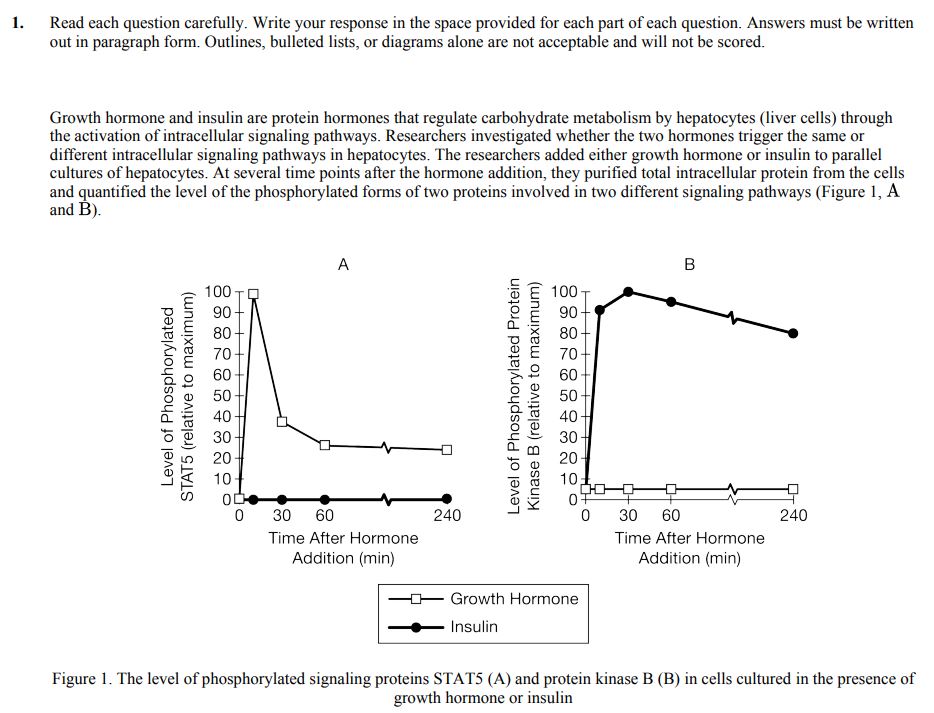
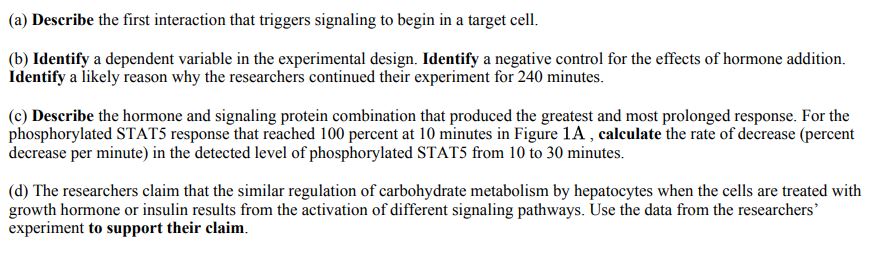
A: ANALYZE THE PROMPT: Before writing you must understand what the question is asking. Reading the prompt thoroughly helps you avoid losing points for not directly answering the question.
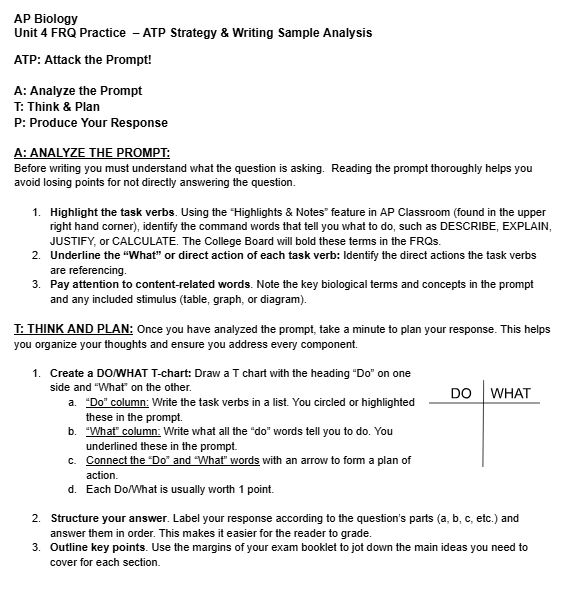
Highlight the task verbs. Using the “Highlights & Notes” feature in AP Classroom (found in the upper right hand corner), identify the command words that tell you what to do, such as DESCRIBE, EXPLAIN, JUSTIFY, or CALCULATE. The College Board will bold these terms in the FRQs.
Underline the “What” or direct action of each task verb: Identify the direct actions the task verbs are referencing.
Pay attention to content-related words. Note the key biological terms and concepts in the prompt and any included stimulus (table, graph, or diagram).
Upload a photo of your FRQ response here.
What task verbs will be on the DO side of your DO/WHAT Chart?
Match each DO task verb to the WHAT (direct action) in the FRQ prompt.
| Draggable item | arrow_right_alt | Corresponding Item |
|---|---|---|
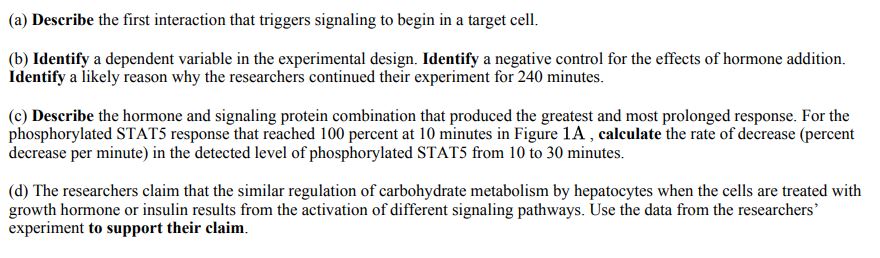
Identify | arrow_right_alt | the first interaction that triggers signaling to begin. |
Describe | arrow_right_alt | a dependent variable. |
Identify | arrow_right_alt | a negative control for the effects of hormone addition. |
Identify | arrow_right_alt | a likely reason why the researchers continued their experiment for 240 minutes. |
Support the Claim | arrow_right_alt | the hormone and signaling protein combination that produced the greatest and most prolonged response. |
Describe | arrow_right_alt | the rate of decrease (percent decrease per minute) in the detected level of phosphorylated STAT5 from 10 to 30 minutes. |
Calculate | arrow_right_alt | using data, that cells treated with growth hormone or insulin result in the activation of different signaling pathways. |
Self-Reflection
Based on the points you earned on your FRQ, how well did you “Attack the Prompt” and use the task verbs (describe, identify, calculate, support a claim) in your response? Rate your mastery level below.
What is one strategy you will use next time you write an FRQ?
T: THINK AND PLAN: Once you have analyzed the prompt, take a minute to plan your response. This helps you organize your thoughts and ensure you address every component.
Create a DO/WHAT T-chart: Draw a T chart with the heading “Do” on one side and “What” on the other.
a. “Do” column: Write the task verbs in a list. You circled or highlighted these in the prompt.
b. “What” column: Write what all the “do” words tell you to do. You underlined these in the prompt.
c. Connect the “Do” and “What” words with an arrow to form a plan of action.
d. Each Do/What is usually worth 1 point.
Structure your answer. Label your response according to the question’s parts (a, b, c, etc.) and answer them in order. This makes it easier for the reader to grade.
Outline key points. Use the margins of your exam booklet to jot down the main ideas you need to cover for each section.
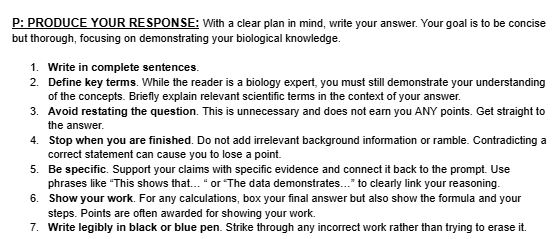
P: PRODUCE YOUR RESPONSE: With a clear plan in mind, write your answer on the paper your teacher provides. Your goal is to be concise but thorough, focusing on demonstrating your biological knowledge.
Write in complete sentences.
Define key terms. While the reader is a biology expert, you must still demonstrate your understanding of the concepts. Briefly explain relevant scientific terms in the context of your answer.
Avoid restating the question. This is unnecessary and does not earn you ANY points. Get straight to the answer.
Stop when you are finished. Do not add irrelevant background information or ramble. Contradicting a correct statement can cause you to lose a point.
Be specific. Support your claims with specific evidence and connect it back to the prompt. Use phrases like “This shows that… “ or “The data demonstrates…” to clearly link your reasoning.
Show your work. For any calculations, box your final answer but also show the formula and your steps. Points are often awarded for showing your work.
Write legibly in black or blue pen. Strike through any incorrect work rather than trying to erase it.
ATP: Attack the Prompt Checklist: Check each item that you have completed.
Analyze the Prompt:
Think and Plan: Check each item that you have completed.
Produce your Response: Check each item that you have completed.
Student Writing Sample Analysis
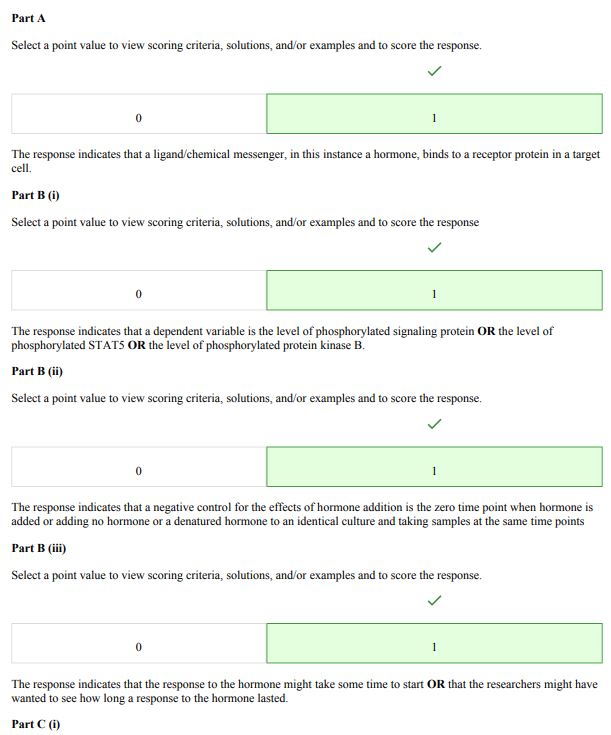
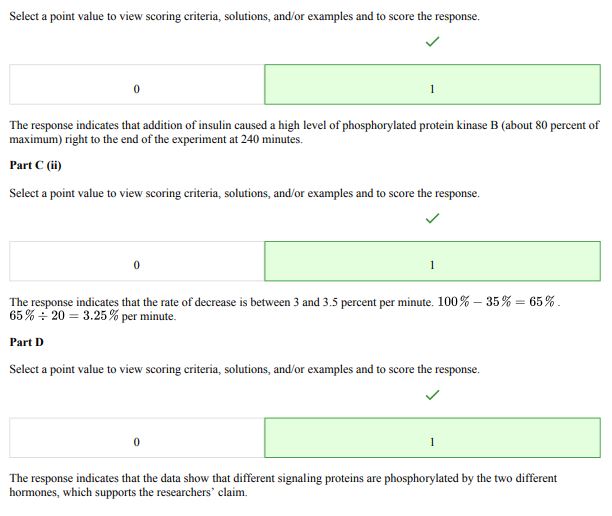
Refer to the Scoring Guide below when scoring student writing samples.
Underline parts of the student response that earned a point.
Then, select 1 point.
For any part of a student response that loses a point, select 0 points.
Scoring Guide |
|
Student 1 writing sample part a earns
Student 1 writing sample part b (i) earns
Student 1 writing sample part b (ii) earns
Student 1 writing sample part b (iii) earns
Student 1 writing sample part c (i) earns
Student 1 writing sample part c (ii) earns
Student 1 writing sample part d earns
Student 2 writing sample part a earns
Student 2 writing sample part b (i) earns
Student 2 writing sample part b (ii) earns
Student 2 writing sample part b (iii) earns
Student 2 writing sample part c (i) earns
Student 2 writing sample part c (ii) earns
Student 2 writing sample part d earns