Preskoči na glavni sadržaj
Prijava
Sign up for FREE
arrow_back
Biblioteka

2025 (June): NY Regents - ELA

star
star
star
star
star
Posljednje ažuriranje 4 months ago
26

Part 1

Directions (1–24): Closely read each of the three passages below. After each passage, there are several multiple-choice questions. Select the best suggested answer to each question and record your answer on the separate answer sheet provided for you. You may use the margins to take notes as you read.

Reading Comprehension Passage A

The Possibility of Evil 

...She [Miss Adela Strangeworth] knew everyone in town, of course; she was fond of telling strangers—tourists who sometimes passed through the town and stopped to admire Miss Strangeworth’s roses—that she had never spent more than a day outside this town in all her long life. She was seventy-one, Miss Strangeworth told the tourists, with a pretty little dimple showing by her lip, and she sometimes found herself thinking that the town belonged to her. “My grandfather built the first house on Pleasant Street,” she would say, opening her blue eyes wide with the wonder of it. “This house, right here. My family has lived here for better than a hundred years. My grandmother planted these roses, and my mother tended them, just as I do. I've watched my town grow; I can remember when Mr. Lewis, Senior, opened the grocery store, and the year the river flooded out the shanties on the low road, and the excitement when some young folks wanted to move the park over to the space in front of where the new post office is today. They wanted to put up a statue of Ethan Allen”—Miss Strangeworth would frown a little and sound stern—“but it should have been a statue of my grandfather. There wouldn’t have been a town here at all if it hadn’t been for my grandfather and the lumber mill.” ...

Walking down Main Street on a summer morning, Miss Strangeworth had to stop every minute or so to say good morning to someone or to ask after someone’s health. When she came into the grocery, half a dozen people turned away from the shelves and the counters to wave at her or call out good morning. ...

“Good morning,” Mr. Lewis said, and added politely, “lovely day.”

“It is a very nice day,” Miss Strangeworth said as though she had only just decided it would do after all. “I would like a chop, please, Mr. Lewis, a small, lean veal chop. Are those strawberries from Arthur Parker’s garden? They’re early this year.”

“He brought them in this morning,” Mr. Lewis said.

“I shall have a box,” Miss Strangeworth said. Mr. Lewis looked worried, she thought, and for a minute she hesitated, but then she decided that he surely could not be worried over the strawberries. He looked very tired indeed. He was usually so chipper, Miss Strangeworth thought, and almost commented, but it was far too personal a subject to be introduced to Mr. Lewis, the grocer, so she only said, “And a can of cat food and, I think, a tomato.” ...

Miss Strangeworth moved slightly to make room for Mrs. Harper at the counter. “Morning, Adela,” Mrs. Harper said, and Miss Strangeworth said, “Good morning, Martha.” ...

“Ran out of sugar for my cake frosting,” Mrs. Harper explained. Her hand shook slightly as she opened her pocketbook. Miss Strangeworth wondered, glancing at her quickly, if she had been taking proper care of herself. Martha Harper was not as young as she used to be, Miss Strangeworth thought. She probably could use a good, strong tonic.

“Martha,” she said, “you don’t look well.”
“I'm perfectly all right,” Mrs. Harper said shortly. She handed her money to Mr. Lewis, took her change and her sugar, and went out without speaking again. Looking after her, Miss Strangeworth shook her head slightly. Martha definitely did not look well. …

Many people seemed disturbed recently, Miss Strangeworth thought. Only yesterday the Stewarts’ fifteen-year-old Linda had run crying down her own front walk and all the way to school, not caring who saw her. People around town thought she might have had a fight with the Harris boy, but they showed up together at the soda shop after school as usual, both of them looking grim and bleak. Trouble at home, people concluded, and sighed over the problems of trying to raise kids right these days.

From halfway down the block Miss Strangeworth could catch the heavy accent of her roses, and she moved a little more quickly. The perfume of roses meant home, and home meant the Strangeworth House on Pleasant Street. Miss Strangeworth stopped at her own front gate, as she always did, and looked with deep pleasure at her house, with the red and pink and white roses massed along the narrow lawn, and the rambler1 going up along the porch; and the neat, the unbelievably trim lines of the house itself, with its slimness and its washed white look. Every window sparkled, every curtain hung stiff and straight, and even the stones of the front walk were swept and clear. People around town wondered how old Miss Strangeworth managed to keep the house looking the way it did, and there was a legend about a tourist once mistaking it for the local museum and going all through the place without finding out about his mistake. But the town was proud of Miss Strangeworth and her roses and her house. They had all grown together. Miss Strangeworth went up her front steps, unlocked her front door with her key, and went into the kitchen to put away her groceries. She debated having a cup of tea and then decided that it was too close to midday dinnertime; she would not have the appetite for her little chop if she had tea now. Instead she went into the light, lovely sitting room, which still glowed from the hands of her mother and her grandmother, who had covered the chairs with bright chintz and hung the curtains. All the furniture was spare and shining, and the round hooked rugs on the floor had been the work of Miss Strangeworth’s grandmother and her mother. Miss Strangeworth had put a bowl of her red roses on the low table before the window, and the room was full of their scent.

Miss Strangeworth went to the narrow desk in the corner, and unlocked it with her key. She never knew when she might feel like writing letters, so she kept her notepaper inside, and the desk locked. Miss Strangeworth’s usual stationery was heavy and cream-colored, with “Strangeworth House” engraved across the top, but, when she felt like writing her other letters, Miss Strangeworth used a pad of various-colored paper, bought from the local newspaper shop. It was almost a town joke, that colored paper, layered in pink and green and blue and yellow; everyone in town bought it and used it for odd, informal notes and shopping lists. It was usual to remark, upon receiving a note written on a blue page, that so-and-so would be needing a new pad soon—here she was, down to the blue already. Everyone used the matching envelopes for tucking away recipes, or keeping odd little things in, or even to hold cookies in the school lunch boxes. Mr. Lewis sometimes gave them to the children for carrying home penny candy. …

After thinking for a minute, she decided that she would like to write another letter, perhaps to go to Mrs. Harper, to follow up the ones she had already mailed. She selected a green sheet this time and wrote quickly: Have you found out yet what they were all laughing about after you left the bridge club on Thursday? Or is the wife really always the last one to know?

1 rambler — vine

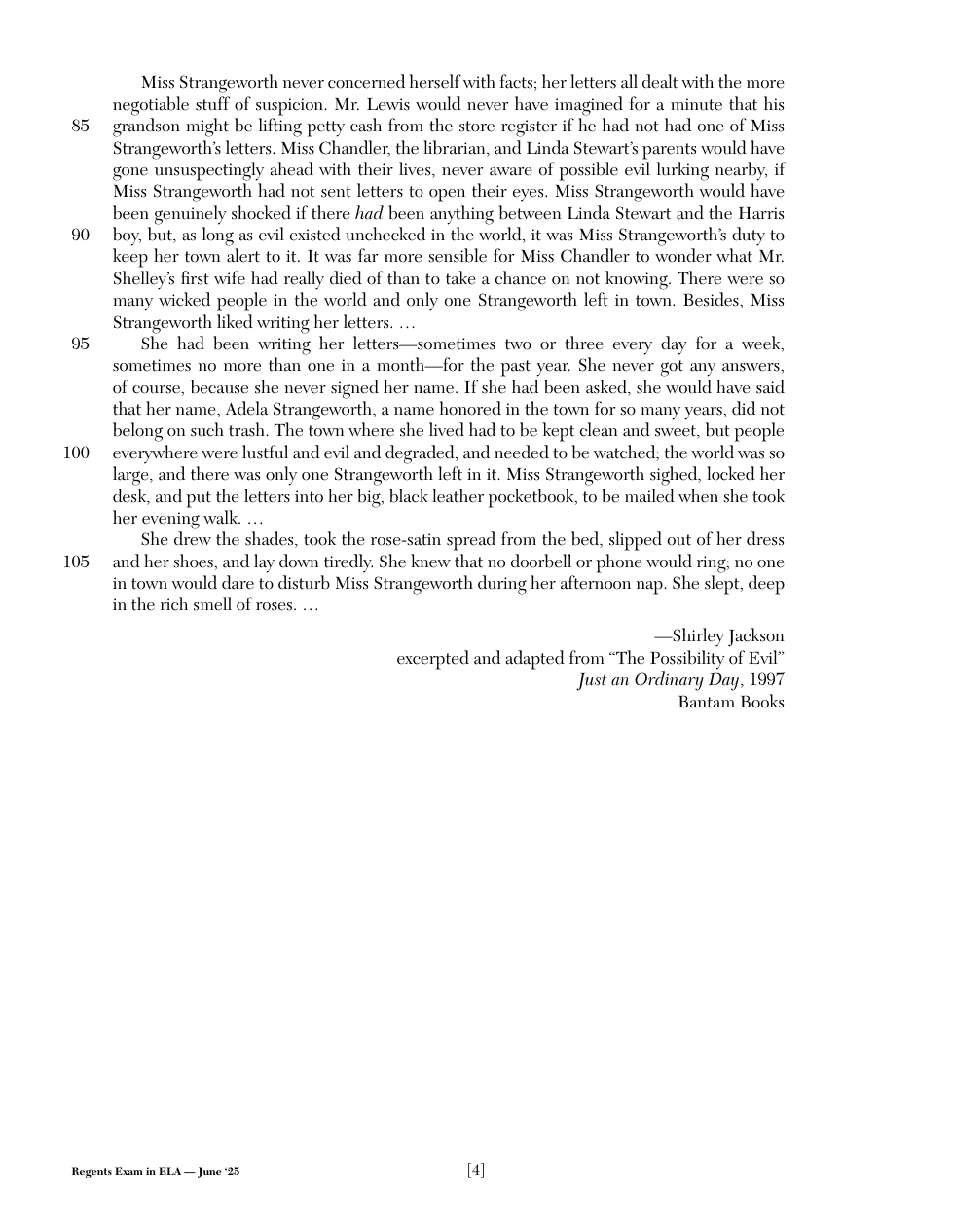
Miss Strangeworth never concerned herself with facts; her letters all dealt with the more negotiable stuff of suspicion. Mr. Lewis would never have imagined for a minute that his grandson might be lifting petty cash from the store register if he had not had one of Miss Strangeworth’s letters. Miss Chandler, the librarian, and Linda Stewart’s parents would have gone unsuspectingly ahead with their lives, never aware of possible evil lurking nearby, if Miss Strangeworth had not sent letters to open their eyes. Miss Strangeworth would have been genuinely shocked if there had been anything between Linda Stewart and the Harris boy, but, as long as evil existed unchecked in the world, it was Miss Strangeworth’s duty to keep her town alert to it. It was far more sensible for Miss Chandler to wonder what Mr. Shelley’s first wife had really died of than to take a chance on not knowing. There were so many wicked people in the world and only one Strangeworth left in town. Besides, Miss Strangeworth liked writing her letters. …

She had been writing her letters—sometimes two or three every day for a week, sometimes no more than one in a month—for the past year. She never got any answers, of course, because she never signed her name. If she had been asked, she would have said that her name, Adele Strangeworth, a name honored in the town for so many years, did not belong on such trash. The town where she lived had to be kept clean and sweet, but people everywhere were lustful and evil and degraded, and needed to be watched; the world was so large, and there was only one Strangeworth left in it. Miss Strangeworth sighed, locked her desk, and put the letters into her big, black leather pocketbook, to be mailed when she took her evening walk. …

She drew the shades, took the rose-satin spread from the bed, slipped out of her dress and her shoes, and lay down tiredly. She knew that no doorbell or phone would ring; no one in town would dare to disturb Miss Strangeworth during her afternoon nap. She slept, deep in the rich smell of roses. …

-Shirley Jackson
excerpted and adapted from “The Possibility of Evil”
Just an Ordinary Day, 1997
Bantam Books

1
RL.11-12.2
1
RL.11-12.6
1
RL.11-12.4
1
RL.11-12.3
1
RL.11-12.2
1
RL.11-12.6
1
RL.11-12.5
1
L.11-12.5.a
1
RL.11-12.3
1
L.11-12.5.b

Reading Comprehension Passage B

Naming the Birds

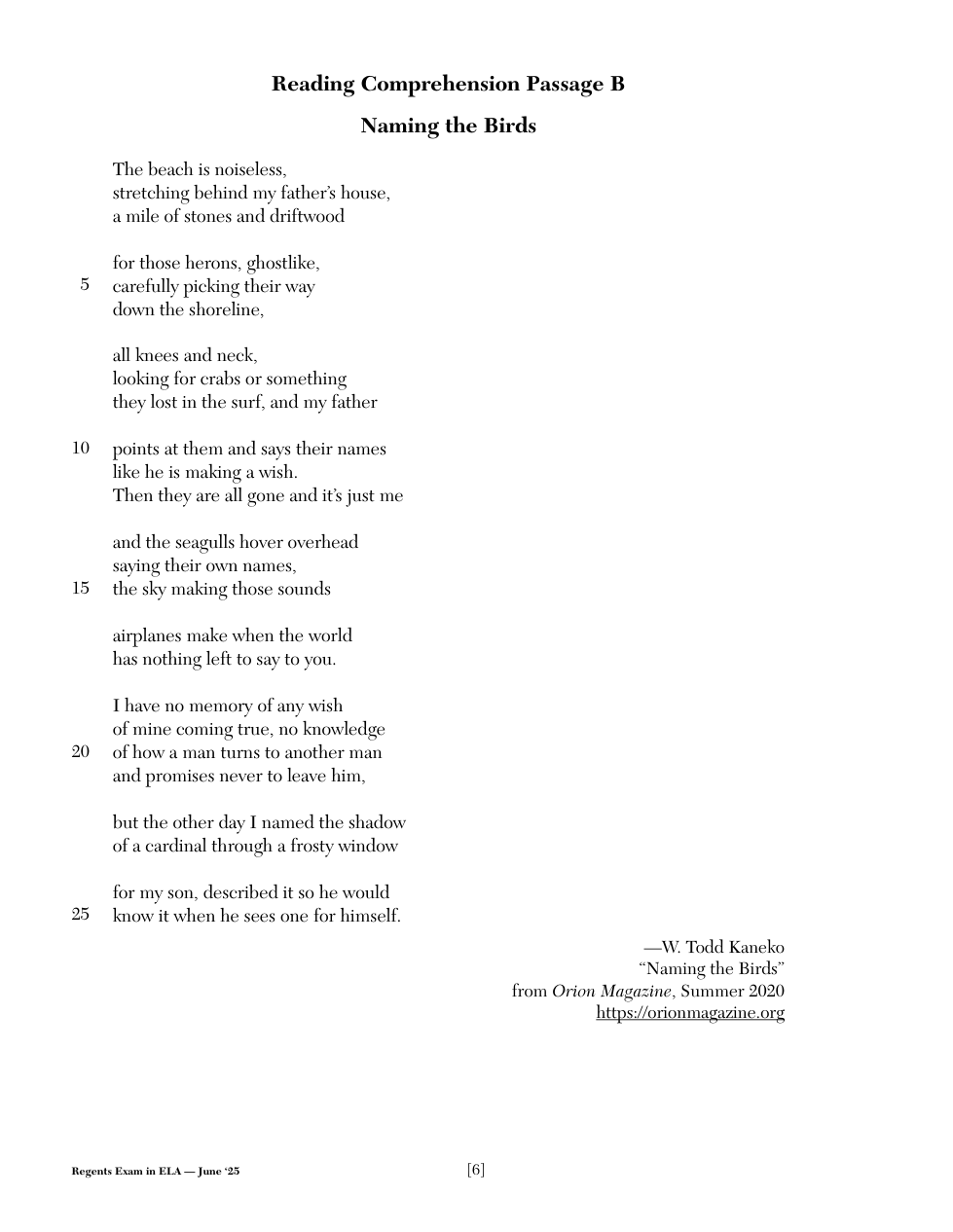
The beach is noiseless,
stretching behind my father’s house,
a mile of stones and driftwood

for those herons, ghostlike,
carefully picking their way
down the shoreline,

all knees and neck,
looking for crabs or something
they lost in the surf, and my father

points at them and says their names
like he is making a wish.
Then they are all gone and it’s just me

and the seagulls hover overhead
saying their own names,
the sky making those sounds

airplanes make when the world
has nothing left to say to you.

I have no memory of any wish
of mine coming true, no knowledge
of how a man turns to another man
and promises never to leave him,

but the other day I named the shadow
of a cardinal through a frosty window

for my son, described it so he would
know it when he sees one for himself.

—W. Todd Kaneko
“Naming the Birds”
from Orion Magazine, Summer 2020

1
RL.11-12.4
1
RL.11-12.6
1
RL.11-12.3
1
L.11-12.5.b

Reading Comprehension Passage C

A Forgotten Black Founding Father: Why I’ve Made it My Mission to Teach Others About Prince Hall

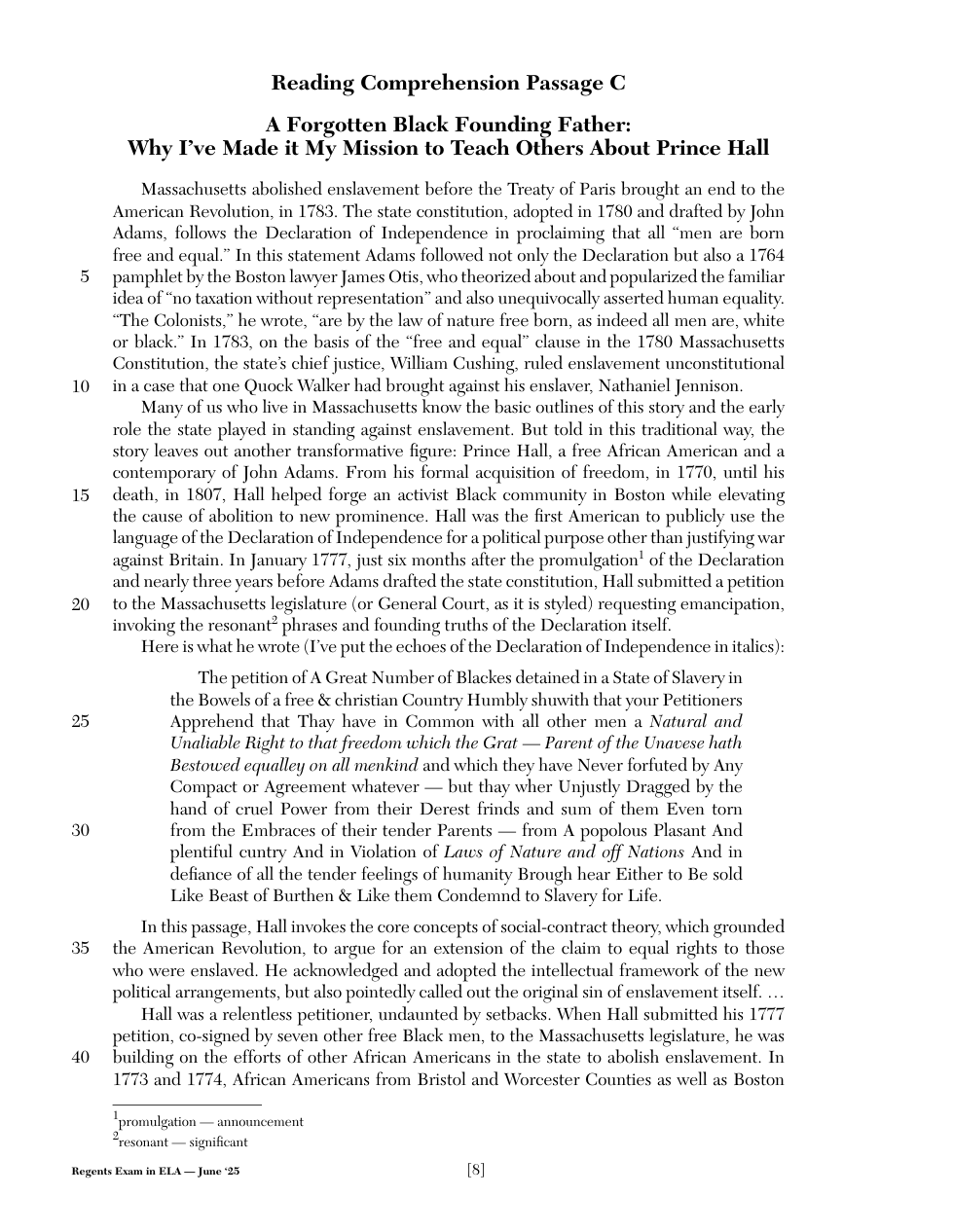
Massachusetts abolished enslavement before the Treaty of Paris brought an end to the American Revolution, in 1783. The state constitution, adopted in 1780 and drafted by John Adams, follows the Declaration of Independence in proclaiming that all “men are born free and equal.” In this statement Adams followed not only the Declaration but also a 1764 pamphlet by the Boston lawyer James Otis, who theorized about and popularized the familiar idea of “no taxation without representation” and also unequivocally asserted human equality. “The Colonists,” he wrote, “are by the law of nature free born, as indeed all men are, white or black.” In 1783, on the basis of the “free and equal” clause in the 1780 Massachusetts Constitution, the state’s chief justice, William Cushing, ruled enslavement unconstitutional in a case that one Quock Walker had brought against his enslaver, Nathaniel Jennison.

Many of us who live in Massachusetts know the basic outlines of this story and the early role the state played in standing against enslavement. But told in this traditional way, the story leaves out another transformative figure: Prince Hall, a free African American and a contemporary of John Adams. From his formal acquisition of freedom, in 1770, until his death, in 1807, Hall helped forge an activist Black community in Boston while elevating the cause of abolition to new prominence. Hall was the first American to publicly use the language of the Declaration of Independence for a political purpose other than justifying war against Britain. In January 1777, just six months after the promulgation1 of the Declaration and nearly three years before Adams drafted the state constitution, Hall submitted a petition to the Massachusetts legislature (or General Court, as it is styled) requesting emancipation, invoking the resonant2 phrases and founding truths of the Declaration itself.

Here is what he wrote (I’ve put the echoes of the Declaration of Independence in italics):

The petition of a Great Number of Blackes detained in a State of Slavery in the Bowels of a free & christian Country Humbly shuwth that your Petitioners Apprehend that Thay have in Common with all other men a Natural and Unaliable Right to that freedom in which the Grat — Parent of the Unavase hath Bestowed equallely on all menkind and which they have Never forfuted by Any Compact or Agreement whatever — but thay wher Unjustly Dragged by the hand of cruel Power from their Derest frinds and sum of them Even torn from the Embraces of their tender Parents — from A popelous Plasant And plentiful cuntry And in Violation of Laws of Nature and off Nations And in defiance of all the tender feelings of humanity Brougth hear Either to Be sold Like Beast of Burthen & Like them Condemnd to Slavery for Life.

In this passage, Hall invokes the core concepts of social-contract theory, which grounded the American Revolution, to argue for an extension of the claim to equal rights to those who were enslaved. He acknowledged and adopted the intellectual framework of the new political arrangements, but also pointedly called out the original sin of enslavement itself.

Hall was a relentless petitioner, undaunted by setbacks. When Hall submitted his 1777 petition, co-signed by seven other free Black men, to the Massachusetts legislature, he was building on the efforts of other African Americans in the state to abolish enslavement. In 1773 and 1774, African Americans from Bristol and Worcester Counties as well as Boston

1 promulgation — announcement
2 resonant — significant

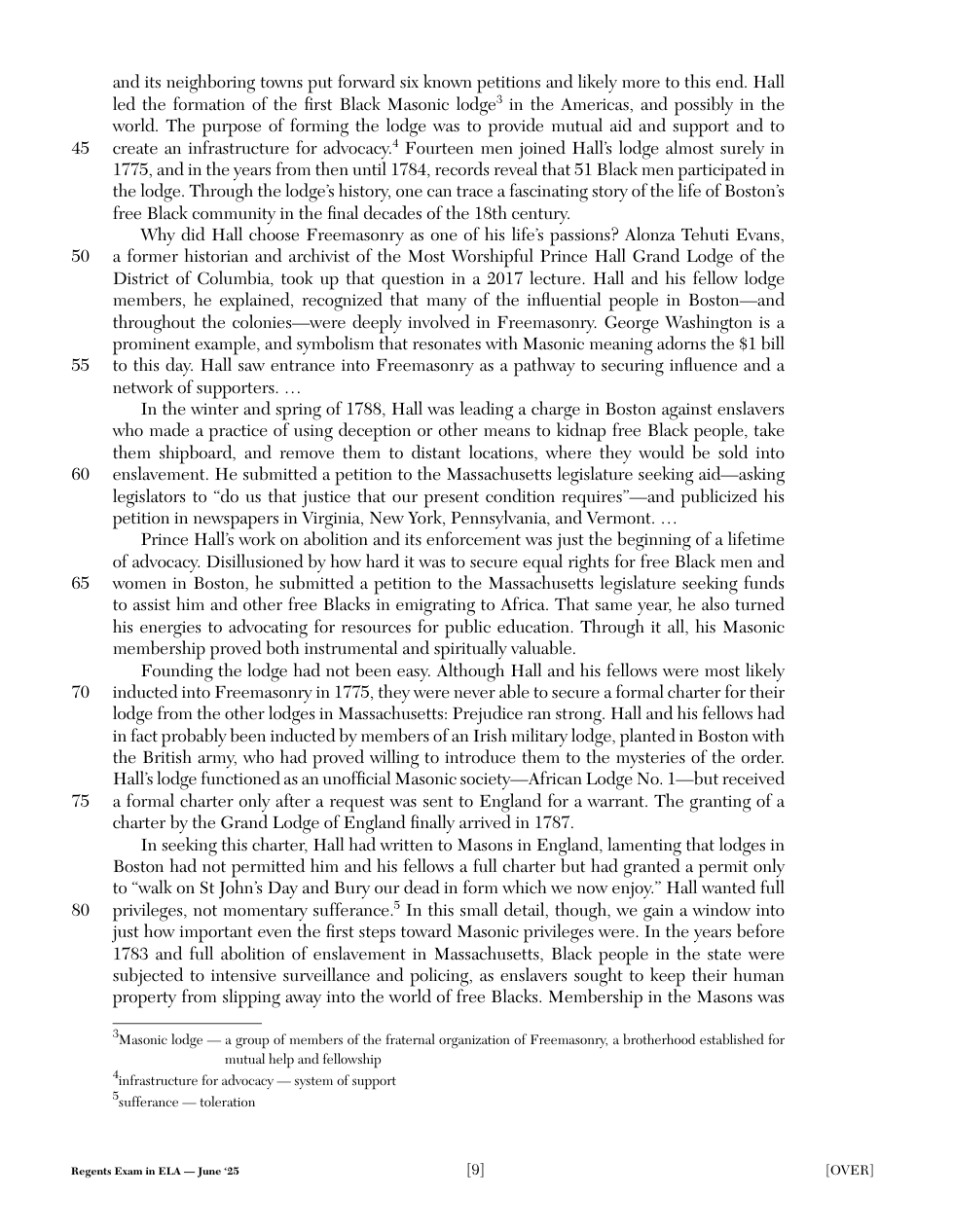
and its neighboring towns put forward six known petitions and likely more to this end. Hall led the formation of the first Black Masonic lodge3 in the Americas, and possibly in the world. The purpose of forming the lodge was to provide mutual aid and support and to create an infrastructure for advocacy.4 Fourteen men joined Hall's lodge almost surely in 1775, and in the years from then until 1784, records reveal that 51 Black men participated in the lodge. Through the lodge's history, one can trace a fascinating story of the life of Boston's free Black community in the final decades of the 18th century.

Why did Hall choose Freemasonry as one of his life's passions? Alonza Tehuti Evans, a former historian and archivist of the Most Worshipful Prince Hall Grand Lodge of the District of Columbia, took up that question in a 2017 lecture. Hall and his fellow lodge members, he explained, recognized that many of the influential people in Boston—and throughout the colonies—were deeply involved in Freemasonry. George Washington is a prominent example, and symbolism that resonates with Masonic meaning adorns the $1 bill to this day. Hall saw entrance into Freemasonry as a pathway to securing influence and a network of supporters. …

In the winter and spring of 1758, Hall was leading a charge in Boston against enslavers who made a practice of using deception or other means to kidnap free Black people, take them shipboard, and remove them to distant locations, where they would be sold into enslavement. He submitted a petition to the Massachusetts legislature seeking aid—asking legislators to “do us that justice that our present condition requires”—and publicized his petition in newspapers in Virginia, New York, Pennsylvania, and Vermont. …

Prince Hall's work on abolition and its enforcement was just the beginning of a lifetime of advocacy. Disillusioned by how hard it was to secure equal rights for free Black men and women in Boston, he submitted a petition to the Massachusetts legislature seeking funds to assist him and other free Blacks in emigrating to Africa. That same year, he also turned his energies to advocating for resources for public education. Through it all, his Masonic membership proved both instrumental and spiritually valuable.

Founding the lodge had not been easy. Although Hall and his fellows were most likely inducted into Freemasonry in 1775, they were never able to secure a formal charter for their lodge from the other lodges in Massachusetts: Prejudice ran strong. Hall and his fellows had in fact probably been inducted by members of an Irish military lodge, planted in Boston with the British army, who had proved willing to introduce them to the mysteries of the order. Hall's lodge functioned as an unofficial Masonic society—African Lodge No. 1—but received a formal charter only after a request was sent to England for a warrant. The granting of a charter by the Grand Lodge of England finally arrived in 1787.

In seeking this charter, Hall had written to Masons in England, lamenting that lodges in Boston had not permitted him and his fellows a full charter but had granted a permit only to “walk on St John's Day and Bury our dead in form which we now enjoy.” Hall wanted full privileges, not momentary sufferance.5 In this small detail, though, we gain a window into just how important even the first steps toward Masonic privileges were. In the years before 1783 and full abolition of enslavement in Massachusetts, Black people in the state were subjected to intensive surveillance and policing, as enslavers sought to keep their human property from slipping away into the world of free Blacks. Membership in the Masons was like a hall pass—an opportunity to have a parade as a community, to come out and step high, without harassment. That's what it meant to walk on Saint John’s Day—June 24—and to hold funeral parades for the dead. …

—Danielle Allen
excerpted from “A Forgotten Black Founding Father: Why I’ve Made it My Mission to Teach Others About Prince Hall”

March 2021

3 Masonic lodge - a group of members of the fraternal organizartion of Freemasonry, a brotherhood established for mutual help and fellowship

4 infrastructure for advocacy - system of support

5 sufferance - toleration

1
L.11-12.4.a
1
RI.11-12.4
1
RI.11-12.2
1
RI.11-12.3
1
RI.11-12.3
1
L.11-12.4.a
1
RI.11-12.2
1
RI.11-12.2
1
Pitanje 23
23.

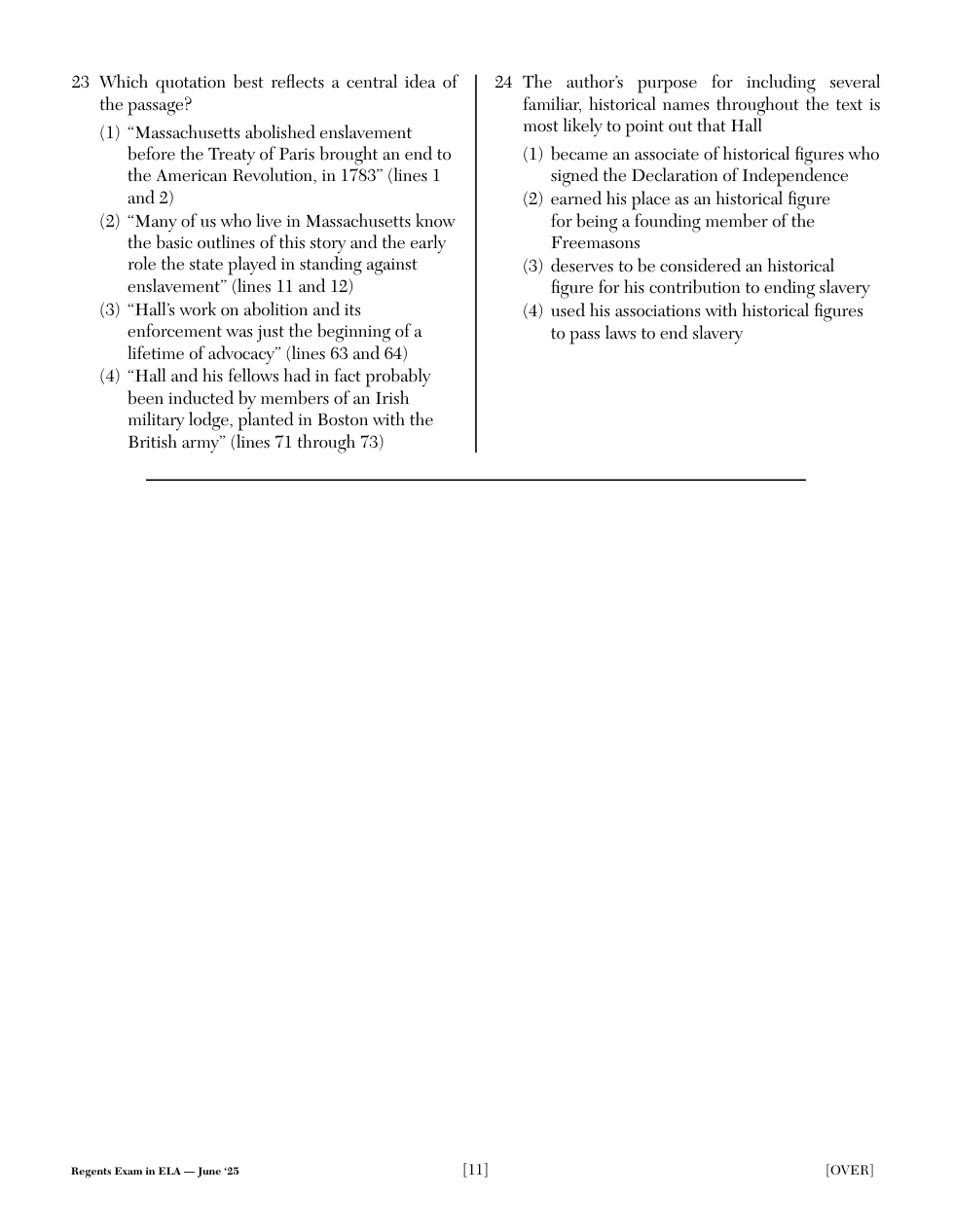
Which quotation best reflects a central idea of the passage?

RI.11-12.2
1
RI.11-12.5

Part 2

Argument

Directions: Closely read each of the four texts provided and write a source-based argument on the topic below.

Topic: Are video games a positive activity for adolescents?

Your Task: Carefully read each of the four texts provided. Then, using evidence from at least three of the texts, write a well-developed argument regarding whether or not video games are a positive activity for adolescents. Clearly establish your claim, distinguish your claim from alternate or opposing claims, and use specific, relevant, and sufficient evidence from at least three of the texts to develop your argument. Do not simply summarize each text.

Guidelines:

Be sure to...

  • Establish your claim regarding whether or not video games are a positive activity for adolescents

  • Distinguish your claim from alternate or opposing claims

  • Use specific, relevant, and sufficient evidence from at least three of the texts to develop your argument

  • Identify each source that you reference by text number and line number(s) or graphic (for example: Text 1, line 4 or Text 2, graphic)

  • Organize your ideas in a cohesive and coherent manner

  • Maintain a formal style of writing

  • Follow the conventions of standard written English

Texts:

  • Text 1 – Video Games: Pros and Cons

  • Text 2 – Playing Video Games is Good For Your Brain — Here’s How

  • Text 3 – Game Theory: The Effects of Video Games on the Brain

  • Text 4 – Playing Video Games Makes Us Fully Human

1
Pitanje 25
25.

Write your Part 2 Argument Essay here.

Topic: Are video games a positive activity for adolescents?

L.11-12.1.a
L.11-12.2.b
…

Text 1

Video Games: Pros and Cons

Kids have been wild about video games for decades. But the introduction of mobile game systems and smartphone apps took that to new heights.

Mobility brought gaming into the car, the bedroom, and even to the bus stop. With roughly 95% of U.S. teens owning smartphones, it’s hard to find a kid who isn’t playing some kind of game.

Although video games get a lot of bad press, they do have some benefits. The trick is to strike the right balance of good content and appropriate limits. After all, video games should enhance your child’s life, not take it over.

Video Game Pros:

Education

Studies have found that video games can improve learning. When video games have been used in the classroom, teachers see improved test scores. Games also allow students to learn and then apply what they have learned in a real-life situation. Medical and military training programs both use simulation-style games to teach tools and strategy.

Life Skills

Many video games teach kids how to delegate, work as a team, and prioritize. Internet-enabled games that let kids play with their real-life friends often require collaboration and division of tasks to beat the level.

Improved Brain Function

Video games have been shown to help us improve our ability to reason and solve problems. They help us make split-second decisions, process information more quickly, and multitask effectively. Games can also improve hand-eye coordination and boost auditory perception.

Exercise

Motion-controlled games like the Nintendo Wii were once thought to be the answer to parental concerns about video games leading to obesity. But studies have shown these video games alone don’t increase kids’ overall activity level.

However, there is some hope in the form of smartphone games that encourage kids to leave the house. Pokemon Go is one example, but your kids may also enjoy the real-life treasure hunt appeal of activities like Geocaching.1 Some apps like The Walk, blend storytelling and exercise to get players moving.

Job Skills

The Federation of American Scientists (FAS) argues that kids need to play more video games in order to be competitive in the current job market. In a report they released in 2010, the FAS said games helped teach higher-order thinking skills like problem solving, interpretive analysis, and more.


1. Geocaching — an activity that requires GPS to find hidden items

Video Game Cons:

Violence

While every other study seems to draw opposite conclusions about the social effects of playing violent video games, studies involving brain scans are concerning.

Simply put, children playing violent video games show decreased activity in areas of the brain dedicated to self-control and an increase in emotional arousal. …

Addiction…

What makes video games addictive? Playing releases dopamine2 into our systems, which gives us a feeling of pleasure and tells our brain to “do it again.”

In fact, video games are designed to be addictive. John Hopson, a games researcher at Microsoft Game Studios, is also a doctor of behavioral and brain sciences who writes about game design.

In “Behavioral Game Design” he explained how game designers can control behavior by providing simple stimuli and rewards at strategic times and places. …

Social Replacement…

Kids with Internet-connected games can easily “hang out” with friends after school without ever leaving home. But this type of virtual get-together is no replacement for actual face-to-face interaction.

Setting aside the potential problems of online predators and cyber-bullying, virtual hangouts rob kids of the opportunity to practice their social skills and to move their bodies from one house to another. …

Remember, even though video games have their place, they should occupy less time than what kids need to devote to exercising, socializing, studying, and sleeping. In our ever-more-connected world, we could all use a little more practice just being unplugged. …

—Jonathen Bartholomew, D.O. excerpted from “Video Games: Pros and Cons”
November 21, 2019

2 dopamine — a chemical used by the nervous system to send messages between nerve cells

Text 2

Playing Video Games is Good For Your Brain - Here's How

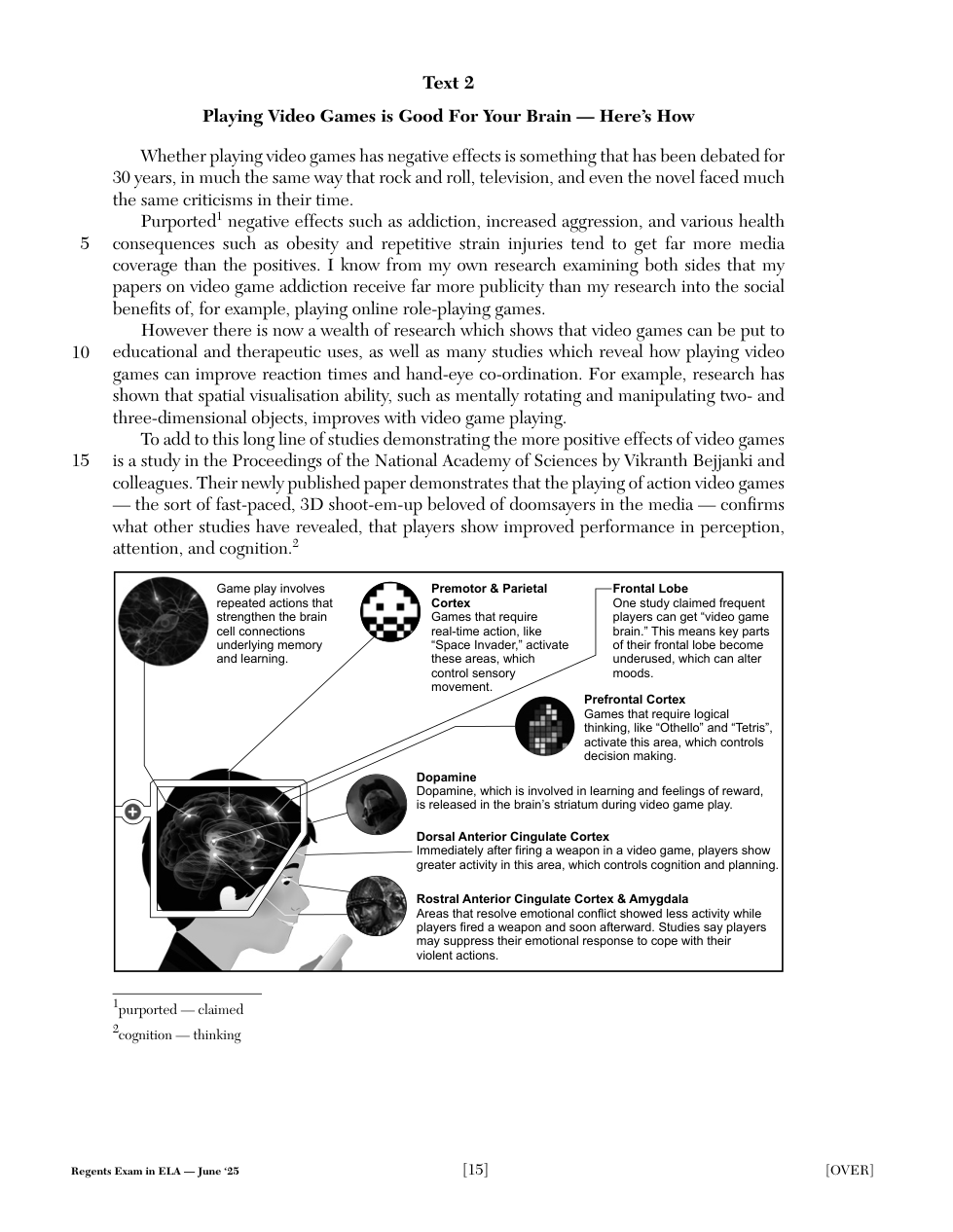
  • Premotor & Parietal Cortex - Games that require real-time action, like "Space Invader," activate these areas, which control sensory movement.

  • Frontal Lobe - One study claimed frequent players can get "video game brain." This means key parts of their frontal lobe become underused, which can alter moods.

  • Prefrontal Cortex - Games that require logical thinking, like "Othello" and "Tetris", activate this area, which controls decision making.

  • Dopamine - Dopamine, which is involved in learning and feelings of reward, is released in the brain's striatum during video game play.

  • Dorsal Anterior Cingulate Cortex - Immediately after firing a weapon in a video game, players show greater activity in this area, which controls cognition and planning.

  • Rostral Anterior Cingulate Cortex & Amygdala - Areas that resolve emotional conflict showed less activity while players fired a weapon and soon afterward. Studies say players may suppress their emotional response to cope with their violent actions.

In a series of experiments on small numbers of gamers (10 to 14 people in each study), the researchers reported that gamers with previous experience of playing such action video games were better at perceptual tasks such as pattern discrimination than gamers with less experience. …

In my own papers, I have pointed out many features and qualities that make video games potentially useful. For instance, in an educational context, video games can be fun and stimulating, which means it’s easier to maintain a pupil’s undivided attention for longer. Because of the excitement, video games may also be a more appealing way of learning than traditional methods for some.

Video games have an appeal that crosses many demographic boundaries, such as age, gender, ethnicity, or educational attainment. They can be used to help set goals and rehearse working towards them, provide feedback, reinforcement, self-esteem, and maintain a record of behavioural change.

Their interactivity can stimulate learning, allowing individuals to experience novelty, curiosity and challenge that stimulates learning. There is the opportunity to develop transferable skills, or practice challenging or extraordinary activities, such as flight simulators, or simulated operations.

Because video games can be so engaging, they can also be used therapeutically. For instance, they can be used as a form of physiotherapy as well as in more innovative contexts. A number of studies have shown that when children play video games following chemotherapy they need fewer painkillers than others.

Video games have great educational potential in addition to their entertainment value. Games specifically designed to address a specific problem or teach a specific skill have been very successful, precisely because they are motivating, engaging, interactive, and provide rewards and reinforcement to improve.

But the transferability of skills outside the game-playing context is an important factor. What’s also clear from the scientific literature is that the negative consequences of playing almost always involve people that are excessive video game players. There is little evidence of serious acute adverse effects on health from moderate play.

—Mark Griffiths

excerpted and adapted from “Playing Video Games is Good For Your Brain — Here’s How”
November 11, 2014

Text 3

Game Theory: The Effects of Video Games on the Brain

At age 17, Anthony Rosner of London, England, was a hero in the World of Warcraft online gaming community. He built empires, led raids, and submerged himself in a fantasy world that seemingly fulfilled his every need. Meanwhile, his real life was virtually nonexistent. He neglected his schoolwork, relationships, health, even his hygiene. ...

Rosner nearly threw away a university degree in pursuit of the game. According to a study by the NPD Group, a global market research firm, his gaming obsession isn’t unique. Nine out of 10 children play video games. That’s 64 million kids—and some of them hit the keyboard or smartphone before they can even string together a sentence. The problem: many researchers believe that excessive gaming before age 21 or 22 can physically rewire the brain.

Researchers in China, for example, performed magnetic resonance imaging (MRI) studies on the brains of 18 college students who spent an average of 10 hours a day online, primarily playing games like World of Warcraft. Compared with a control group who spent less than two hours a day online, gamers had less gray matter (the thinking part of the brain). As far back as the early 1990s, scientists warned that because video games only stimulate brain regions that control vision and movement, other parts of the mind responsible for behavior, emotion, and learning could become underdeveloped. ...

“Playing video games floods the pleasure center of the brain with dopamine,” says David Greenfield, Ph.D., founder of The Center for Internet and Technology Addiction and assistant clinical professor of psychiatry at the University of Connecticut School of Medicine. That gives gamers a rush—but only temporarily, he explains. With all that extra dopamine lurking around, the brain gets the message to produce less of this critical neurotransmitter. The end result: players can end up with a diminished supply of dopamine.

Take a game like that away from addicted adolescents and they often show behavioral problems, withdrawal symptoms, even aggression, according to Dr. Greenfield. ...

The Developing Brain on Games

Video games are designed with a reward structure that’s completely unpredictable. The tension of knowing you might score (or kill a warlock), but not knowing exactly when, keeps you in the game. “It’s exactly the same reward structure as a slot machine,” says Dr. Greenfield. The player develops an unshakeable faith, after a while, that “this will be the time I hit it big.”

Your Brain on Games: Experimental Evidence

“That’s a powerful draw for an adolescent’s developing brain, which is impressionable. ‘The prefrontal cortex—the locus1 of judgment, decision-making, and impulse control—undergoes major reorganization during adolescence,’ explains Tom A. Hummer, Ph.D., assistant research professor in the department of psychiatry at Indiana University School of Medicine in Indianapolis. That executive control center is essential for weighing risks and rewards and for putting the brakes on the pursuit of immediate rewards (like gaming) in favor of more adaptive longer-term goals (like next week’s chemistry test).

This region of the brain doesn’t reach maximum capacity until age 25 or 30, which may explain why young people are more likely to engage in hours of play while ignoring basic needs like food, sleep, and hygiene. Without mature frontal lobes to draw on, adolescents and teens are less able to weigh negative consequences and curb potentially harmful behavior like excessive video gaming, which also impacts frontal lobe development.

1 locus - center

Violent video games are of concern to many experts. In a study of 45 adolescents, playing violent video games for only 30 minutes immediately lowered activity in the prefrontal regions of the brain compared to those who participated in a non-violent game. Previous research showed that just 10-20 minutes of violent gaming increased activity in the brain regions associated with arousal, anxiety, and emotional reaction, while simultaneously reducing activity in the frontal lobes associated with emotion regulation and executive control.

The dopamine release that comes from gaming is so powerful, say researchers, it can almost shut the prefrontal regions down. That's one reason why gamers like Rosner can play for 18 hours straight. "Kids plop themselves in front of a computer and they'll stay there for 8, 10, 25, 36 hours," says Dr. Greenfield. …

Practicing anything repetitively physically changes the brain. With time and effort, you get better at the specific task you're practicing, whether it's shooting at the enemy in a video game or hitting a baseball. Those repetitive actions and thoughts stimulate connections between brain cells, creating neural pathways between different parts of your brain. The more you practice a certain activity, the stronger that neural pathway becomes. That's the structural basis of learning.

"Use it or lose it" applies not just to muscles in the body, but also the brain. Neural pathways that are not used eventually get pruned.2

—Amy Paturel MS, MPH
excerpted from “Game Theory: The Effects of Video Games on the Brain”
June/July 2014

2 pruned - trimmed

Text 4

Playing Video Games Makes Us Fully Human

…I wouldn’t blame you for thinking video games are like potent drugs, offering escapist fantasies that deprive teenagers of sleep and food until they are strung out and incapable of functioning in the real world. There have certainly been enough horror stories in the psychological literature over the years to raise concern that video games are eating the brains of the world’s youth. But this negative portrait is outdated.

Pete Etchells, a professor of psychology and communications in England, and author of a new book, Lost in a Good Game, thinks video games tap into the reaches of emotional and moral faculties that traditional arts and entertainment can’t reach. The player can drive action, exert agency1 and explore imagined worlds freely. Video games, Etchells says, “embody the principles of existentialism."2 A story can be cathartic3 but only a game can make you feel guilty for what you’ve done or were compelled to do. A 2010 paper in Review of General Psychology states, “Compared with other media such as books, films, and radio, electronic games appear to have an unusually expansive appeal and serve a surprising number of emotional, social, and intellectual needs.” For Etchells, an avid gamer, video games are a “creative medium” that can “offer us unparalleled opportunities for exploring what it means to be human.”

In the past decade, the study of video games and their effects has become a veritable4 wing of psychology departments. Leading the defense is “self-determination theory.” The theory was conceived in the 1980s by two psychologists at the University of Rochester, Richard Ryan and Edward Deci. In their 2017 book, Self-Determination Theory: Basic Psychological Needs in Motivation, Development, and Wellness, they explain self-determination is what “humans really need from their psychological and social environments to be fully functioning and thrive.”

Ryan and Deci say that this boils down to competence, autonomy,5 and relatedness. Mastering something, feeling free to follow your interests and values, and having ways to bond with others give you the sense you are living well—no matter your cultural heritage. People everywhere—Europe, Asia, South America—need these things like they need vitamin C, Ryan and Deci say. Since we evolved to be “inherently curious, physically active, and deeply social beings,” Ryan and Deci write, we are intrinsically6 motivated to “take an interest in, learn about, and gain mastery with respect to both [our] inner and outer worlds,” the social and physical. We thrive when we realize our human capacities and overcome the forces that might stultify7 us. …

1 agency — influence

2 existentialism — a philosophical theory emphasizing individual free will and personal responsibility

3 cathartic — emotional

4 veritable — genuine

5 autonomy — independence

6 intrinsically — naturally

7 stultify — frustrate

Cognitive science has detailed the rich experience of playing video games. A 2017 paper analyzed 116 scientific studies of video game effects, and the conclusions were impressive. Yes, video games can become a fixation, but gamers tap into brain areas associated with improved attention spans, visuospatial skills, and motor systems8 more effectively than non- gamers. Further studies have argued that playing video games can help overcome depression and improve memory. ...

Like Etchells, video games take me to places that music and movies, as much as I love them, don’t. More to the point, they allow me to explore on my own. Video games “tap into that deeply-seated human desire to travel, seek out new experiences, and absorb new knowledge about the world—and about ourselves,” Etchells writes. They free us to explore unfamiliar emotional and geographical territory and learn new things without too much fear or anxiety. Video games “provide a safe place where we can relax as digital tourists within the comfort of our own home, visiting places that might only otherwise be accessible in the wildest reaches of our imagination.” I might go further and say traveling in imaginary spaces rivals the experiences of traveling in real ones, like Venice and Rome, Lima and Machu Picchu, as I have in my life. Both the imaginary and real are emotionally moving and immersive. ...

—Brian Gallagher
excerpted from “Playing Video Games Makes Us Fully Human”
June 27, 2019

8motor systems — the part of the nervous system that controls movement

Part 3

Text-Analysis Response

Your Task: Closely read the text provided and write a well-developed, text-based response of two to three paragraphs. In your response, identify a central idea in the text and analyze how the author’s use of one writing strategy (literary element or literary technique or rhetorical device) develops this central idea. Use strong and thorough evidence from the text to support your analysis. Do not simply summarize the text.

Guidelines:

Be sure to...

  • Identify a central idea in the text

  • Analyze how the author’s use of one writing strategy (literary element or literary technique or rhetorical device) develops this central idea. Examples include: characterization, conflict, denotation/connotation, metaphor, simile, irony, language use, point-of-view, setting, structure, symbolism, theme, tone, etc.

  • Use strong and thorough evidence from the text to support your analysis

  • Organize your ideas in a cohesive and coherent manner

  • Maintain a formal style of writing

  • Follow the conventions of standard written English

1
Pitanje 26
26.

Write your Part 3 Text-Analysis Response here.

L.11-12.1.a
L.11-12.2.b
…

Text

Goalie

When he isn’t playing, he hates the equipment. It’s heavy and awkward and bulky. It smells. He avoids it, scorns it. It disgusts him. Before a game, he gathers it together on the floor and stares at it. He lays each piece out carefully, obsessively, growling and snarling at anyone who comes too close. His mother calls him a gladiator, a bullfighter. But you know the truth, that gathering the equipment is a ritual of hatred, that every piece represents, to him, a particular variety of pain.

Without the game, he’s miserable. He spends his summers restless and morose,1 skating every morning, lifting weights at night. He juggles absentmindedly; tennis balls, coins, apples, tossing them behind his back and under his leg, see-sawing two in one hand as he talks on the phone, bouncing them off walls and knees and feet. He plays golf and tennis with great fervour, but you suspect, underneath, he is indifferent to these games.

As fall approaches, you begin to find him in the basement, cleaning his skates, oiling his glove, taping his sticks. His hands move with precision and care. You sit with him and talk. He tells you stories. This save. That goal. Funny stories. He laughs. The funniest stories are about failure: the goal scored from centre ice, the goal scored on him by his own defenceman, the goal scored through a shattered stick. There is always a moral, the same moral every time. “You try your best and you lose.”

He starts wearing the leg pads in September. Every evening, he wanders the house in them, wearing them with shorts and a T-shirt. He hops in them, does leg lifts and jumping jacks. He takes them off and sits on them, folding them into a squat pile to limber them up. He starts to shoot tennis balls against the fence with his stick.

As practices begin, he comes home overwhelmed by despair. His skill is an illusion, a lie, a magic trick. Nothing you say reassures him. You’re his father. Your praise is empty, invalid.

You remember him in the back yard, six years old, standing in a ragged net, wearing a parka2 and a baseball glove, holding an ordinary hockey stick, sawed off at the top. The puck is a tennis ball. The ice is cement. He falls down every time you shoot, ignoring the ball, trying to look like the goalies on TV. You score, even when you don’t want to. He’s too busy play-acting. He smiles, laughs, shouts.

You buy him a mask. He paints it. Yellow and black. Blue and white. Red and blue. It changes every month, as his heroes change. You make him a blocker out of cardboard and leg pads out of foam rubber. His mother makes him a chest protector. You play in the backyard, every evening, taking shot after shot, all winter.

It’s hard to recall when you realize he’s good. You come to a point where he starts to surprise you, snatching the ball out of the air with his glove, kicking it away with his shoe. You watch him one Saturday, playing with his friends. He humiliates them, stopping everything. They shout and curse. He comes in, frozen, tired and spellbound. “Did you see?” he says.

He learns to skate, moving off the street and onto the ice. The pain begins. A shot to the shoulder paralyzes his arm for ten minutes. You buy him pads, protectors, thinking it will stop the pain. He begins to lose. Game after game. Fast reflexes are no longer enough. He is suddenly alone, separate from you, miserable. Nothing you say helps. Keep trying. Stop. Concentrate. Hold your stick blade flat on the ice.

1morose — moody

2parka — a well-insulated long coat

He begins to practice. He begins to realize that he is alone. You can’t help him. His mother can’t help him. That part of his life detaches from you, becoming independent, free. You fool yourself, going to his games, cheering, believing you’re being supportive, refusing to understand that here, in the rink, you’re irrelevant. When you’re happy for him, he’s angry. When you’re sad for him, he’s indifferent. He begins to collect trophies. …

You try to see the game through his eyes, aware of everything, constantly alert. It’s not enough to follow the puck. The position of the puck is old news. The game. You try to understand the game. You fail.

He seems unearthly, moving to cut down the angle, chopping the puck with his stick. Nothing is wasted. You can almost feel his mind at work, watching, calculating. Where does it come from, you wonder, this strange mind? You try to move with him, watching his eyes through his cage, and his hands. You remember the way he watches games on television, cross-legged, hands fluttering, eyes seeing everything.

Suddenly you succeed, or you think you do. Suddenly, you see the game, not as a series of events, but as a state, with every moment in time potentially a goal. Potentially. Probability. These are words you think of afterwards. As you watch, there is only the game, pressing against you, soft now, then sharp, then rough, biting, shocking, burning, dull, cold. No players. Only forces, feelings, the white ice, the cold, the echo, all joined. A shot crashes into his helmet. He falls to his knees. You cry out.

He stands slowly, shaking his head, hacking at the ice furiously with his stick. They scored. You never noticed. Seeing the game is not enough. Feeling it is not enough. He wants more, to understand completely, to control. You look out at the ice. The game is chaos again.

He comes home, angry, limping up the driveway, victorious. You watch him, dragging his tired limbs, thick, bandaged pads over his shoulder. You wonder when it happened, when he became this sullen, driven young man. You hear whispers about scouts, rumours. Everyone adores him, adores his skill. But when you see his stiff, swollen hands, when he walks slowly into the kitchen in the mornings, every movement agony, you want to ask him why. Why does he do it? Why does he go on?

But you don’t ask. Because you think you know the answer. You imagine him, looking at you and saying quietly, “What choice do I have? What else have I ever wanted to do?”

—Rudy Thauberger
excerpted from “Goalie”
The Last Map Is The Heart, 1989
Thistledown Press Limited

Pitanje 1
1.

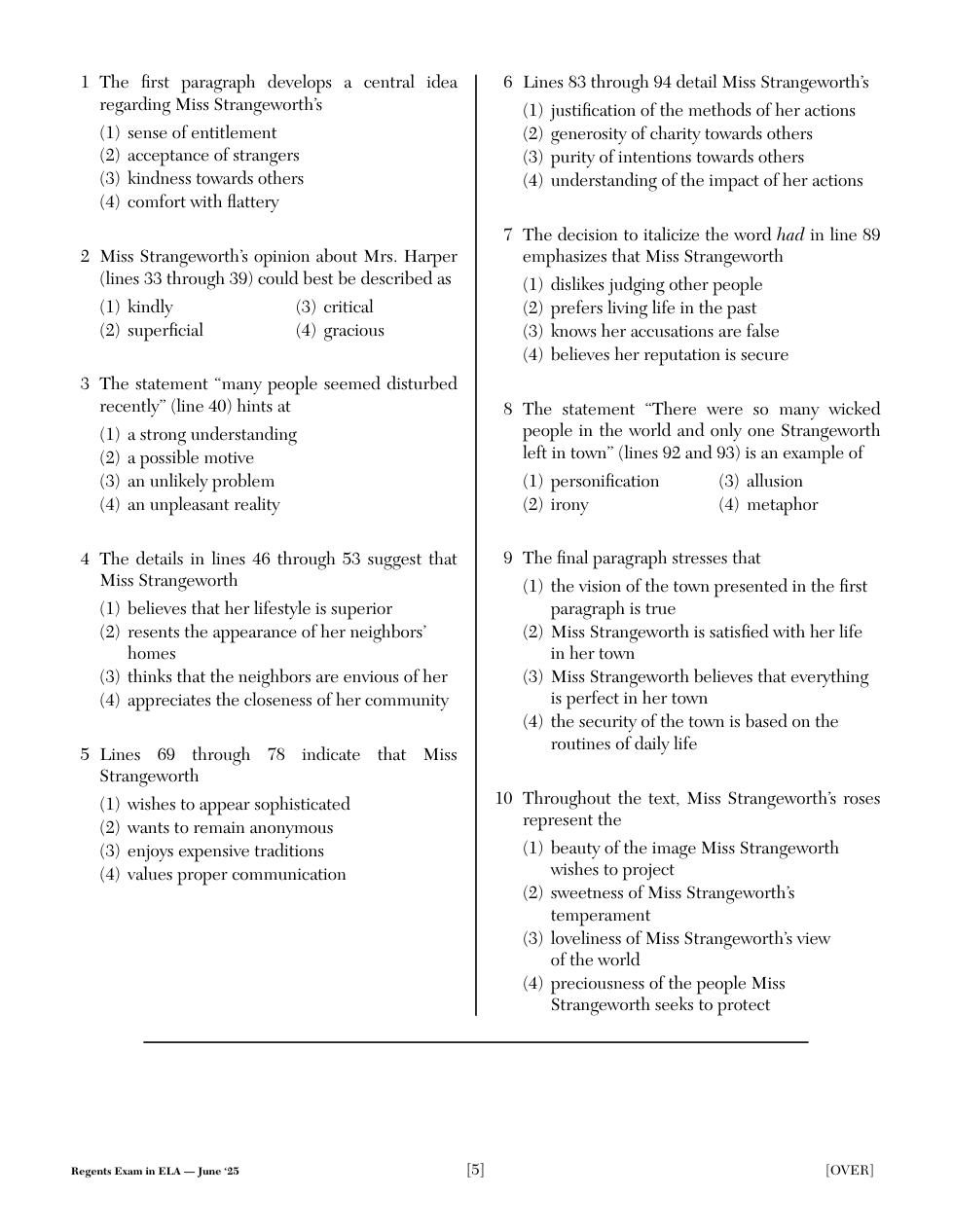
The first paragraph develops a central idea regarding Miss Strangeworth’s

Pitanje 2
2.

Miss Strangeworth’s opinion about Mrs. Harper (lines 33 through 39) could best be described as

Pitanje 3
3.

The statement “many people seemed disturbed recently” (line 40) hints at

Pitanje 4
4.

The details in lines 46 through 53 suggest that Miss Strangeworth

Pitanje 5
5.

Lines 69 through 78 indicate that Miss Strangeworth

Pitanje 6
6.

Lines 83 through 94 detail Miss Strangeworth’s

Pitanje 7
7.

The decision to italicize the word had in line 89 emphasizes that Miss Strangeworth

Pitanje 8
8.

The statement “There were so many wicked people in the world and only one Strangeworth left in town” (lines 92 and 93) is an example of

Pitanje 9
9.

The final paragraph stresses that

Pitanje 10
10.

Throughout the text, Miss Strangeworth’s roses represent the

Pitanje 11
11.

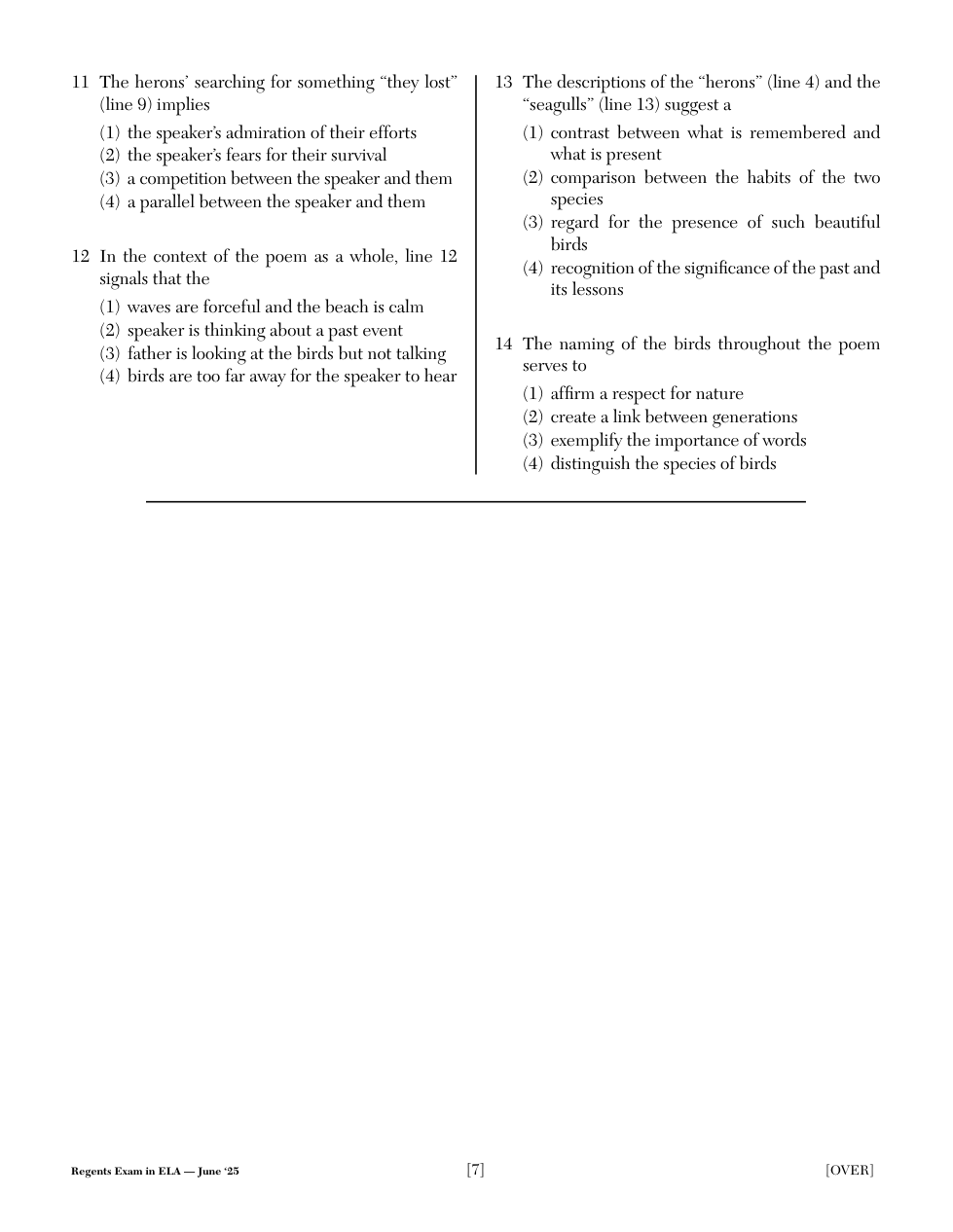
The herons’ searching for something “they lost” (line 9) implies

Pitanje 12
12.

In the context of the poem as a whole, line 12 signals that the

Pitanje 13
13.

The descriptions of the “herons” (line 4) and the “seagulls” (line 13) suggest a

Pitanje 14
14.

The naming of the birds throughout the poem serves to

Pitanje 15
15.

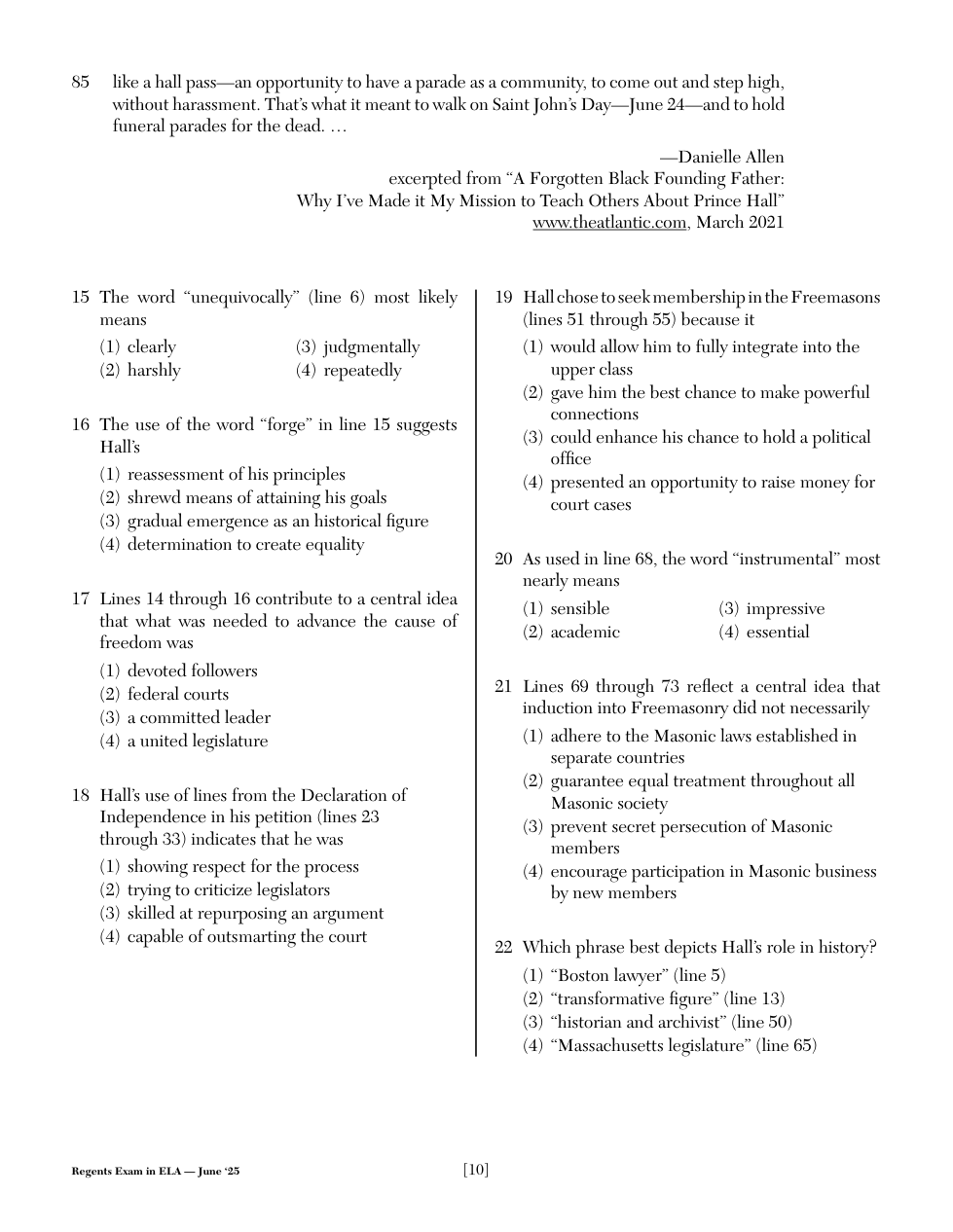
The word “unequivocally” (line 6) most likely means

Pitanje 16
16.

The use of the word “forge” in line 15 suggests Hall’s

Pitanje 17
17.

Lines 14 through 16 contribute to a central idea that what was needed to advance the cause of freedom was

Pitanje 18
18.

Hall’s use of lines from the Declaration of Independence in his petition (lines 23 through 33) indicates that he was

Pitanje 19
19.

Hall chose to seek membership in the Freemasons (lines 51 through 55) because it

Pitanje 20
20.

As used in line 68, the word “instrumental” most nearly means

Pitanje 21
21.

Lines 69 through 73 reflect a central idea that induction into Freemasonry did not necessarily

Pitanje 22
22.

Which phrase best depicts Hall’s role in history?

Pitanje 24
24.

The author’s purpose for including several familiar, historical names throughout the text is most likely to point out that Hall

Whether playing video games has negative effects is something that has been debated for 30 years, in much the same way that rock and roll, television, and even the novel faced much the same criticisms in their time.

Purported1 negative effects such as addiction, increased aggression, and various health consequences such as obesity and repetitive strain injuries tend to get far more media coverage than the positives. I know from my own research examining both sides that my papers on video game addiction receive far more publicity than my research into the social benefits of, for example, playing online role-playing games.

However there is now a wealth of research which shows that video games can be put to educational and therapeutic uses, as well as many studies which reveal how playing video games can improve reaction times and hand-eye coordination. For example, research has shown that spatial visualization ability, such as mentally rotating and manipulating two- and three-dimensional objects, improves with video game playing.

To add to this long line of studies demonstrating the more positive effects of video games is a study in the Proceedings of the National Academy of Sciences by Vikranth Bejjanki and colleagues. Their newly published paper demonstrates that the playing of action video games — the sort of fast-paced, 3D shoot-em-up beloved of doomsayers in the media — confirms what other studies have revealed, that players show improved performance in perception, attention, and cognition.2

1 purported - claimed

2 cognition - thinking