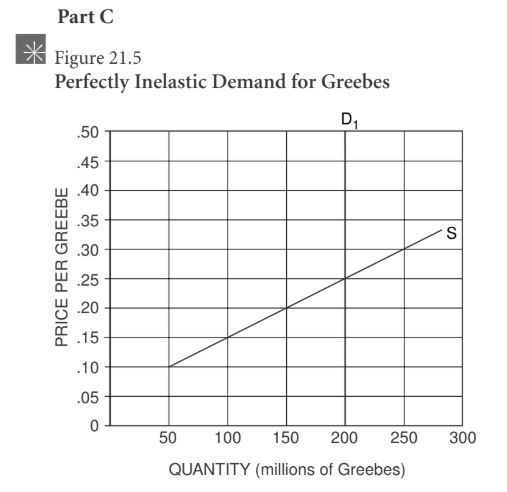
If an excise tax of $0.15 for each Greebe sold is levied on the sellers of Greebes, the equilibrium price paid by buyers (PB) will differ from the equilibrium price received by sellers (PS) by the amount of the tax. This $0.15 goes to the government. Add the new supply curve incorporating the tax to the graph, and indicate PB and PS. (Answer provided on next problem. Please check your graph.)
On Figure 21.5, the equilibrium quantity of Greebes is __________ million.
On Figure 21.5, the equilibrium price of Greebes is $__________ per Greebe.
Buyers are spending a total of $__________ million on Greebes.
Sellers are receiving a total of $__________ million from selling Greebes.
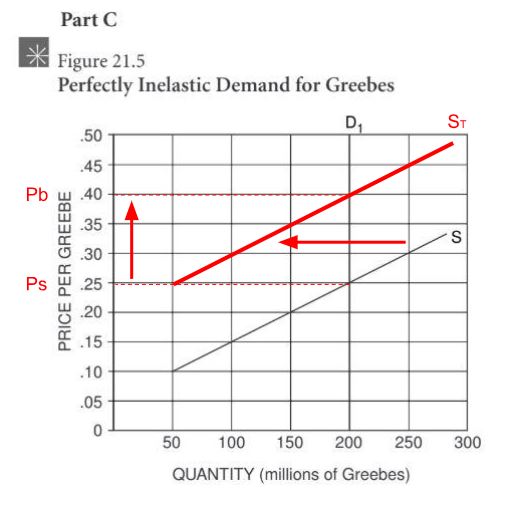
Under these excise tax circumstances, The new equilibrium quantity of Greebes would be __________ million.
The new equilibrium price paid by buyers would be $__________ per Greebe.
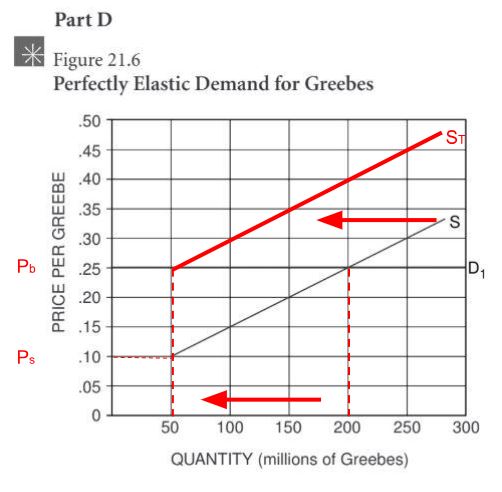
On Figure 21.6, the equilibrium quantity of Greebes is _________million.
On Figure 21.6, the equilibrium price of Greebes is $__________ per Greebe.
Buyers are spending a total of $__________ million on Greebes.
Sellers are receiving a total of $__________ million from selling Greebes.
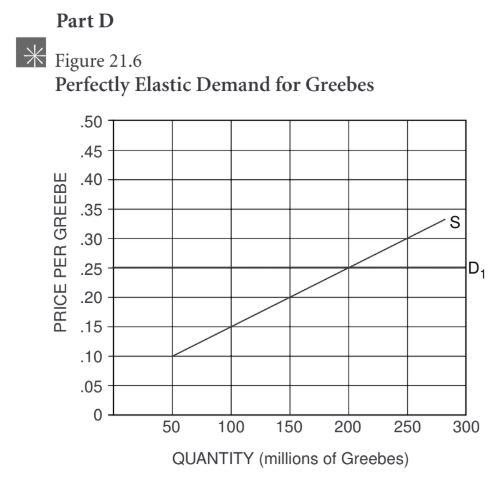
If an excise tax of $0.15 for each Greebe sold is levied on the sellers of Greebes, the equilibrium price paid by buyers (PB) will differ from the equilibrium price received by sellers (PS) by the amount of the tax. This $0.15 goes to the government. Add the new supply curve incorporating the tax to the graph and indicate PB and PS. (Answer provided on next problem. Please check your graph.)
Under these circumstances, the new equilibrium quantity of Greebes would be __________ million.
The new equilibrium price paid by buyers would be $__________ per Greebe.
The new equilibrium price received by sellers (after tax) would be $__________ per Greebe.
Buyers would spend a total of $__________ million on Greebes.
Sellers would receive a total of $__________ million (after tax) from selling Greebes.
The government revenue from this tax would be $__________ million.
$__________ million of this revenue would be paid by buyers in the form of higher prices.
$__________ million of this revenue would be paid by sellers in the form of reduced revenue.
Typically, as a result of an excise tax, buyers will buy a smaller quantity than before the tax. If so, the sellers
would also have a loss of revenue that is not collected by the government. However, the elasticities in this problem make it unique. In this case, the uncollected revenue loss would be equal to $__________ million.
The new equilibrium price received by sellers (after tax) would be $__________ per Greebe.
Buyers would spend a total of $__________ million on Greebes.
Sellers would receive a total of $__________ million (after tax) from selling Greebes.
The government revenue from this tax would be $__________ million.
$__________ million of this revenue would be paid by buyers in the form of higher prices.
$__________ million of this revenue would be paid by sellers in the form of reduced income.
As a result of the tax, buyers will buy a smaller quantity than before the tax. If so, the sellers would also have a loss of revenue that is not collected by the government. In this case, the
uncollected revenue loss would be equal to $__________ million.