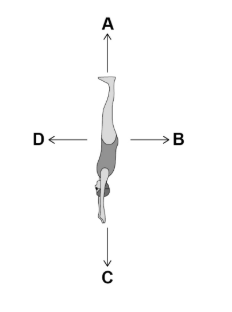
 What force is represented by A?
What force is represented by A?
Velocity is a scalar quantity.
Speed is a vector quantity.
Displacement includes direction.
Weight is a vector quantity.
Distance is a vector quantity.
Acceleration is a vector quantity.
Temperature is a scalar quantity.
Force is a scalar quantity.
Mass is a scalar quantity.
Which of the following are vectors?
Which of the following represent scalar quantities?
Select the vectors from this list:
Which of the following is NOT a vector quantity?
Why is distance a scalar quantity?
| Draggable item | arrow_right_alt | Corresponding Item |
|---|---|---|
Vector | arrow_right_alt | Magnitude (number value) only |
Scalar | arrow_right_alt | Magnitude and direction |
Sort your scalar and vector quantities
distance
displacement
speed
velocity
mass
weight
energy
acceleration
power
force
time
length, area, volume
temperature
Vector
Scalar
Which of the following are vectors?
Select the vectors from this list:
Which of the following represent scalar quantities?
Scalars have magnitude but vectors have magnitude and __________. What one word completes the sentence?
True or false? There is no difference between speed and velocity.
What force is represented by A?
What force is represented by C?
Sort contact and non-contact forces
Magnetic force
Electrostatic force
Gravitational Force
Friction
Air Resistance
Water Resistance
Contact Force
Non-Contact Force
A kilogram is a measure of an object's
What is the unit of measurement for mass?
What does the term 'mass' refer to in science?
The bicycle had a mass of 15 kg.
gravitational field strength = 9.8 N/kg
Calculate the weight of the bicycle.
Use the equation:
weight = mass × gravitational field strength
A kilogram is a measure of an object's
To calculate resultant force:
The Newton is a unit of
A box of textbooks is pulled to the right by a force of 10 Newtons and to the left by a force of 5 Newtons. The net force is
The mass of the person was 75 kg.
Calculate the resultant force on the person when the deceleration was 60 m/s2
Use the equation:
resultant force = mass × deceleration
At the start of the race, 6 dogs pulled on the rope.
The average forward force on the sled from each dog was 370 N.
The backwards force on the sled from friction was 520 N.
Calculate the resultant force on the sled.
Later in the race, the sled moved at a constant speed along a flat, horizontal path.
What was the relationship between the size of the horizontal forces acting when the sled moved at a constant speed?
To calculate resultant force:
The Newton is a unit of
A box of textbooks is pulled to the right by a force of 10 Newtons and to the left by a force of 5 Newtons. The net force is
At the start of the race, 6 dogs pulled on the rope.
The average forward force on the sled from each dog was 370 N.
The backwards force on the sled from friction was 520 N.
Calculate the resultant force on the sled.
Later in the race, the sled moved at a constant speed along a flat, horizontal path.
What was the relationship between the size of the horizontal forces acting when the sled moved at a constant speed?
As the student accelerated downhill, the forward force on the student was 250 N.
The work done by the forward force was 4500 J.
Calculate the distance travelled as the student accelerated downhill.
Use the equation:
distance travelled = work done / force
Which of the following is the unit for distance?
Distance is how
What type of quantity is displacement?
A student went on a cycling journey that lasted for three days.
The student recorded information about the journey using a cycling app on a mobile phone.
At the start of the journey, the student travelled along a straight road to a road junction.
A map on the cycling app showed the road.
Figure 5 shows the map.
The scale of the map is 1 cm : 20 m
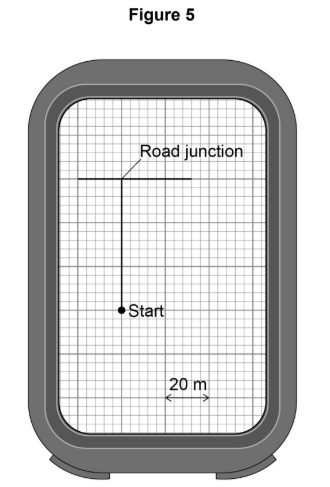 Calculate the distance travelled by the student between the start and the box road junction.
If the cyclist had gone 4 squares worth, have far would that be?
Most of the roads on the journey were not straight.
Figure 7 shows a map of the route taken for the whole journey.
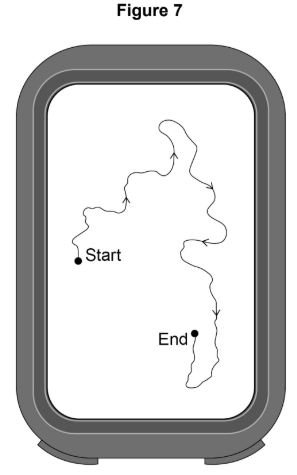 The line in Figure 7 represents the total distance travelled when the student reached the end of the journey.
How does the total distance travelled compare with the magnitude of the displacement of the student from the start?
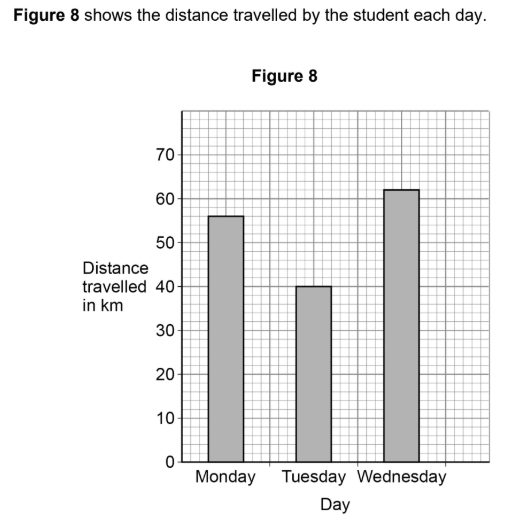 Calculate the total distance travelled by the student.
Distance is how
What type of quantity is displacement?
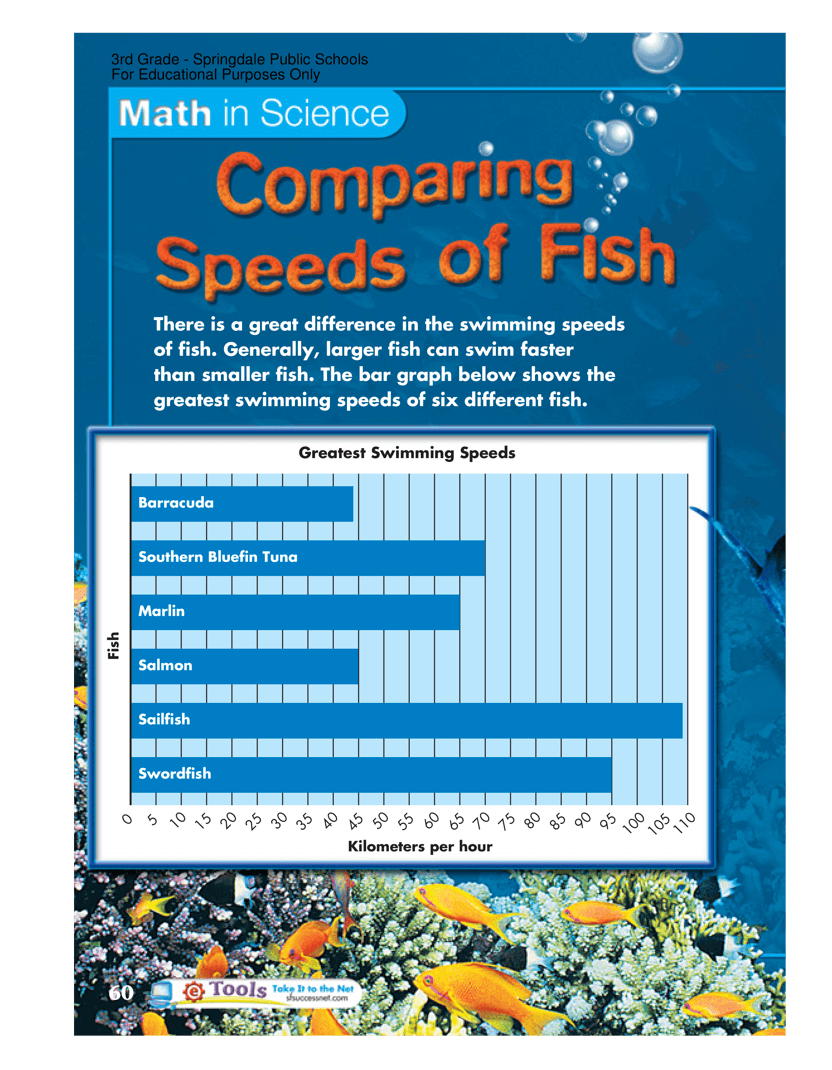
Use the data in the graph to list the six fish in order from slowest to fastest.
What is speed?
Total distance divided by total time is
If a person walked at 2 m/s for 12 s he/she would travel a distance of ________.
What are the units used in physics for speed?
A runner completes a 300 meter race with a time of 13.75 seconds. What is the runner’s speed? (2 d.p. please)
Calculate the average speed of a lion that runs 45 meters in 5 seconds . What is the speed of the lion?
Which of the following is a factor in a person's walking speed?
What is the speed of sound in air at 0°C?
What is a typical speed for a person cycling?
What is a typical speed for a person walking?
What are the SI units for speed?
What is the approximate speed of sound in air in metres per second?
A teacher tells his class that a train is moving at 40 miles per hour. Does this tell them the speed of the train, the velocity of the train, or both?
Two cars are travelling side by side down a straight road in the same direction. Both cars are travelling at a speed of 22m/s. What is their relative speed?
A car completes a journey in 2 hours. Its average speed over this journey was 45 mph. Calculate the distance travelled by the car in miles. Answer in mph
A cyclist travels at 6 m/s for 12 s. What distance has she travelled?
What is a typical speed for a person running?
What is a typical speed for a person walking?
A cyclist travels at 6 m/s for 12 s. What distance has she travelled?

After entering the water, the person decelerated for a time of 0.35 s.
The deceleration of the person was 60 m/s2
Calculate the change in velocity of the person.
Use the equation:
change in velocity = deceleration × time
In a dog-sled race, a team of dogs pull on a rope attached to a sled.
Figure 12 shows a dog-sled team.
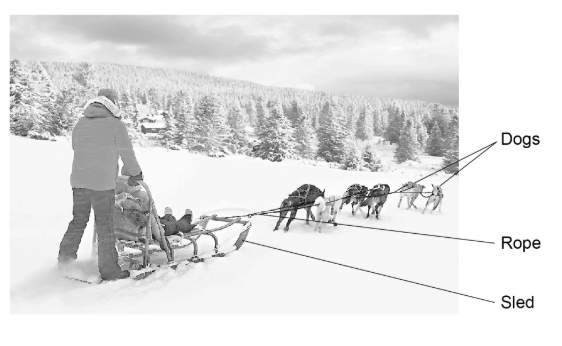 Use the Physics Equations Sheet to answer questions 06.1 and 06.2.
The longest dog-sled race in the world covers a distance of 1 500 000 m.
One team finished the race in a time of 670 000 s.
Calculate the average speed of this team during the race.
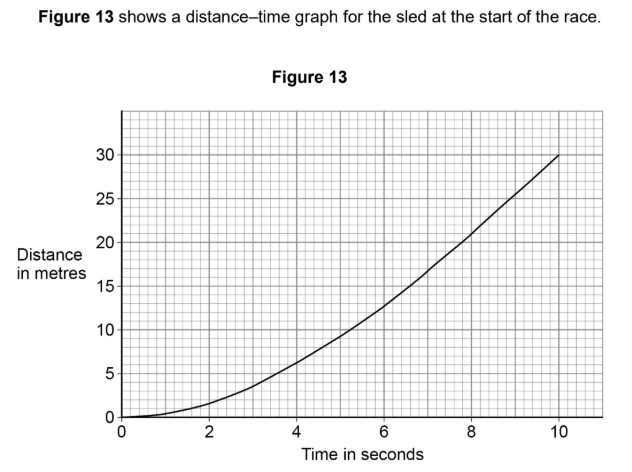 What does the gradient of the graph in Figure 13 represent?
What is speed?
Total distance divided by total time is
If a person walked at 2 m/s for 12 s he/she would travel a distance of ________.
What are the units used in physics for speed?
A runner completes a 300 meter race with a time of 13.75 seconds. What is the runner’s speed? (2 d.p. please)
Calculate the average speed of a lion that runs 45 meters in 5 seconds . What is the speed of the lion?
Which of the following is a factor in a person's walking speed?
What is the speed of sound in air at 0°C?
What is a typical speed for a person cycling?
What is a typical speed for a person running?
What are the SI units for speed?
A teacher tells his class that a train is moving at 40 miles per hour. Does this tell them the speed of the train, the velocity of the train, or both?
Two cars are travelling side by side down a straight road in the same direction. Both cars are travelling at a speed of 22m/s. What is their relative speed?
A cyclist travels at 6 m/s for 12 s. What distance has she travelled?
A car completes a journey in 2 hours. Its average speed over this journey was 45 mph. Calculate the distance travelled by the car in miles. Answer in mph
What is a typical speed for a person running?
What is a typical speed for a person walking?
A cyclist travels at 6 m/s for 12 s. What distance has she travelled?
The longest dog-sled race in the world covers a distance of 1 500 000 m.
One team finished the race in a time of 670 000 s.
Calculate the average speed of this team during the race.
Velocity is different from speed because it has both size and... what?
What type of quantity is velocity?
Velocity is
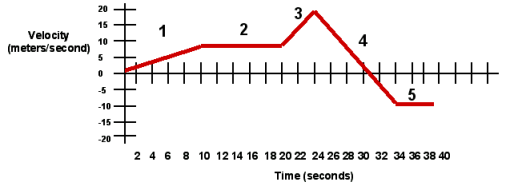
According to the Velocity vs Time graph, what is the object's motion for Segment 1?
According to the Velocity vs Time graph, what is the object's motion for Segment 2?
According to the Velocity vs Time graph, what is the object's motion for Segment 3?
According to the Velocity vs Time graph, what is the object's motion for Segment 4?
According to the Velocity vs Time graph, what is the object's motion for Segment 5?
According to the Velocity vs Time graph, does the object rest at any point?
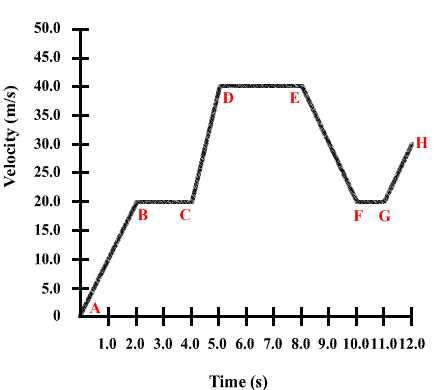
During which segment(s) is the object accelerating?

Calculate the acceleration between 0s and 4s.

Describe the motion of the object between 4s and 8s.
Velocity is different from speed because it has both size and... what?
What type of quantity is velocity?
Velocity is
Below is a graph showing the motion of a person.
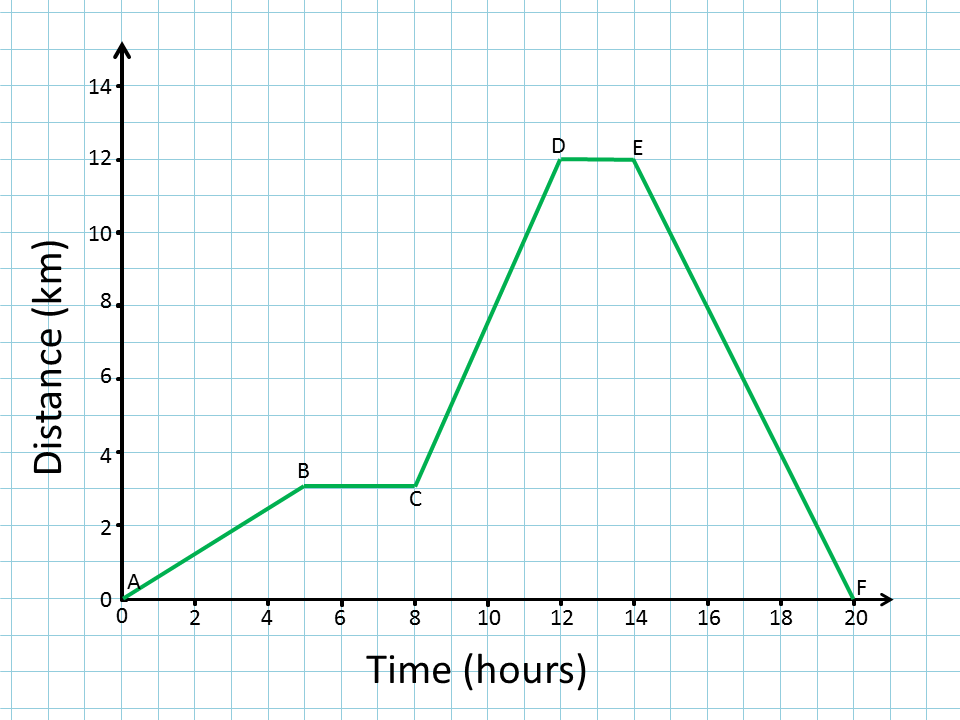
What is the person doing from A to B?
Below is a graph showing the motion of a person.
What is the person doing from E to F?
Below is a graph showing the motion of a person.
What is the person doing from B to C?
Below is a graph showing the motion of a person.
at what point he person is moving with a fast cosntant speed ?
Changes in our speed and direction are called _________.
Why does a car accelerate as it rounds a corner at a constant speed?
What causes a great change in acceleration?
Two students investigated how the acceleration of a trolley depends on the force applied to the trolley.
Before starting the investigation, each student wrote a hypothesis.
Hypothesis of student A:
‘The acceleration of the trolley is directly proportional to the force applied to the trolley.'
Hypothesis of student B:
‘Changing the force applied to the trolley will change the acceleration of the trolley.'
(a) Consider the hypothesis of student A.
Predict what would happen to the acceleration of the trolley if the force applied to the trolley is doubled.
b) Why is it difficult to make a valid prediction using the hypothesis of student B?
Figure 1 shows some of the equipment used by the students.
Figure 1
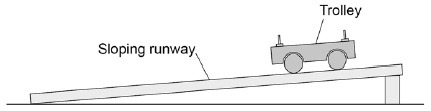
(c) Write a list of any other equipment the students will need to complete the investigation.
Why should the students use a sloping runway?
d) Describe a method the students could have used for their investigation.
The students used the same trolley throughout the investigation.
Suggest why.
State what happens to an object in free fall initially.
Which of the following is not a terminal velocity from the graph

What has happened to a skydiver at Point B?
As the velocity of a falling object increases, the air resistance on that object…
A parachute protects a skydiver by…
Explain what is happening to a skydiver at point A

A parachute will make a skydiver move upwards in the air.
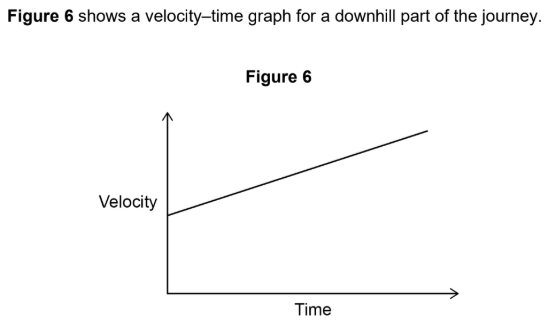
The gradient of the graph represents acceleration.
How does Figure 6 show that the acceleration was constant?
What is the equation for acceleration from your equation sheet?
The stopping distance of a car is affected by the condition of the brakes and tyres.
A car is being driven around a corner when the driver sees some roadworks.
The driver applies the brakes when the car is 24 m away from the roadworks.
The velocity of the car changes from 18 m/s to 0 m/s.
Calculate the constant deceleration needed to stop the car in a distance of 24 m.
Changes in our speed and direction are called _________.
Why does a car accelerate as it rounds a corner at a constant speed?
What causes a great change in acceleration?
Which statement is true?
To calculate resultant force:
Newton’s First Law is also known as the law of
If an object is at rest, what must be applied to get it moving?
Define all Three of Newton's Law
For every action, there is an opposite and equal reaction.
Force equals mass times acceleration
An object in motion remains in motion, an object at rest remains at rest.
Newton's 1st Law
Newton's 2nd Law
Newton's 3rd Law
Which statement is true?
To calculate resultant force:
If an object is at rest, what must be applied to get it moving?
Force is the product of ...
Define all Three of Newton's Law
For every action, there is an opposite and equal reaction.
Force equals mass times acceleration
An object in motion remains in motion, an object at rest remains at rest.
Newton's 1st Law
Newton's 2nd Law
Newton's 3rd Law
Force is the product of ...
According to Newton's Third Law, for every action there is an equal and opposite
Define all Three of Newton's Law
For every action, there is an opposite and equal reaction.
Force equals mass times acceleration
An object in motion remains in motion, an object at rest remains at rest.
Newton's 1st Law
Newton's 2nd Law
Newton's 3rd Law
The rope exerted a force on the sled when the sled was moving.
What is the Newton’s Third Law pair to the force of the rope on the sled?
According to Newton's Third Law, for every action there is an equal and opposite
The rope exerted a force on the sled when the sled was moving.
What is the Newton’s Third Law pair to the force of the rope on the sled?
As a safety measure, the speed limit on the road was reduced.
Explain how the safety of road users is affected by:
• the condition of the brakes and tyres
• reduced speed.
Sort the reasons into thinking and braking
decreased speed
condition of tyres
poor condition of breaks
Thinking Distance
Breaking Distance
Two identical cars were driven along a straight, level road.
One car had a greater speed than the other car.
The driver of each car applied the brakes until the cars stopped.
Both cars travelled the same distance while braking.
Explain how braking from a greater speed affected the risk of the brakes overheating.
The faster car has more kinetic
A robot moves from point A to point B following the path shown in the diagram below. What is the magnitude of the robot's displacement when it reaches point B?

Which of the six fish is the fastest swimmer?
Which of the six fish is the slowest swimmer?
What is the formula for speed?
How far did Ian walk?
What is the speed?
How long was the journey?