Using the below diagram, explain how packet switching works when sending a 500 KiB file from computer 'A' to computer 'B'.
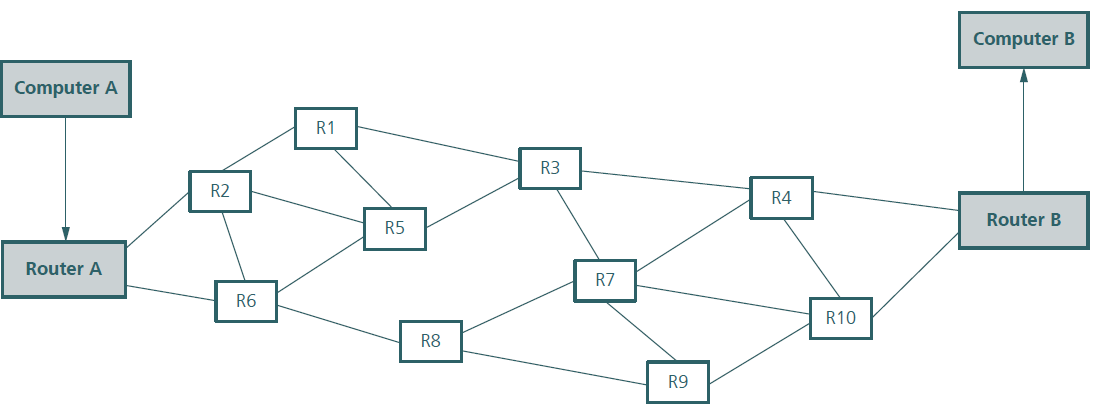
Using the below diagram, explain how packet switching works when sending a 500 KiB file from computer 'A' to computer 'B'.
Answer all the questions.
You may NOT use a calculator.
Explain the term data packet.
Data packets contain a header.
Name three components that you would expect to find in a header.
Data packets also have a payload and a trailer.
Explain these two terms.
What does 'bps' stand for in terms of data transmission?
Which transmission allows data to be sent and received at the same time?
Using the below diagram, explain how packet switching works when sending a 500 KiB file from computer 'A' to computer 'B'.
Match the description of transmission taking place with correct term:
| Draggable item | arrow_right_alt | Corresponding Item |
|---|---|---|
Data sent 16 bits at a time down 16 wires in both directions, but not at the same time | arrow_right_alt | Simplex, Serial |
Data sent one bit at a time down a single wire in one direction only | arrow_right_alt | Full duplex, Serial |
Data sent one bit at a time down a single wire in both directions simultaneously | arrow_right_alt | Half duplex, Serial |
Data sent 16 bits at a time down 16 wires in both directions simultaneously | arrow_right_alt | Half duplex, Parallel |
Data sent 8 bits at a time down 8 wires in one direction only | arrow_right_alt | Full duplex, Parallel |
Data sent one bit at a time down a single wire in both directions, but not at the same time | arrow_right_alt | Simplex, Parallel |
Indicate which statements about USB are True and which statements are False:
True | False | |
|---|---|---|
USBs use a protocol that allows for error-free data transmission between device and computer | ||
USBs can support any cable length between device and computer | ||
USBs use serial data transfer | ||
USB connections can transfer data using half-duplex or full-duplex | ||
It is difficult to add more USB ports to a computer using USB hubs | ||
USB data transfer rates are much faster than, for example, Ethernet connections | ||
There is no need for devices to have a power source because USB cable supplies 5V of power |
A system uses even parity.
Indicate whether the following bytes would fail or pass an even parity check:
a)
b)
c)
Check digits are used to check data during data entry.
Give two types of error that check digits can identify.
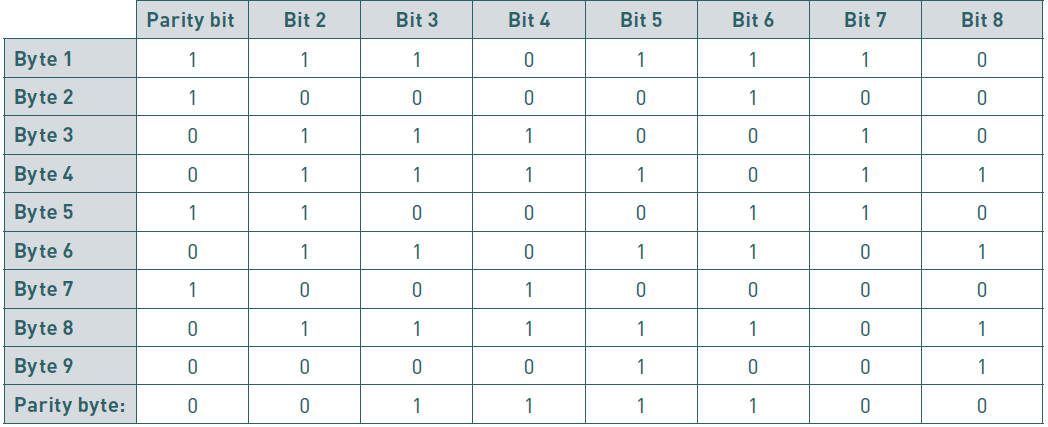
Nine bytes of data were transmitted from one computer to another computer.
Even parity was used by both systems. An additional byte, called the parity byte was also sent at the end of the transmission.
The following table shows the nine bytes and parity byte following transmission.
One of the bits has been transmitted incorrectly. Indicate which bit is incorrect by
giving its bit number and byte number:
a) bit number:
b) byte number:
Data can be encrypted using asymmetric encryption.
Use the terms from the list. Some of the terms in the list will not be used. You may use a term more than once.
algorithm binary cipher text compression error hardware
hexadecimal meaningless plain text private public
readable transmission unreadable
Data is encrypted using an encryption key. This is a type of
A
Write an algorithm using pseudocode to ask for a password and check that the length of the password is between 8 and 12 characters inclusive.
Your pseudocode should prompt "too short" or "too long" if password entered in outside the above range, and should continue asking until correct password length is entered.
State, with reasons, which validation checks you could use for the following inputs.
You may decide that more than one validation check is required.
– Entering a telephone number
– Entering a pupil’s name
– Entering a part number in the form XXX999, when X must be a letter and 9 must be a digit.