Preskoči na glavni sadržaj
Prijava
Sign up for FREE
arrow_back
Biblioteka

Lesson 3: The Cell Cycle

star
star
star
star
star
Posljednje ažuriranje 10 months ago
4 questions
1
Pitanje 1
1.

Your Turn!

Match the cell activity to the correct stage of interphase.

Cell Activity

Stage

a. The cell duplicates cell structures

b. The checkpoint ensures resources for DNA replication

c. The cell undergoes DNA replicated

1
1
Pitanje 3
3.

1

Overview: Every day, millions of your cells are replaced. Existing cells divide to form new cells. For all organisms, the continuation of life from one generation to the next depends on cell division. In this lesson, you will learn about the events that happen in the cell cycle-the life cycle in which cells grow and divide.

3.1 The Eukaryotic Cell Cycle Has Several Phases

The eukaryotic cell describes the sequence of stages in the lifetime of the cell. The cycle begins when a new cell forms due to the divisions of a parent cell and continues until that cell's own division.

Phases of the Cell Cycle

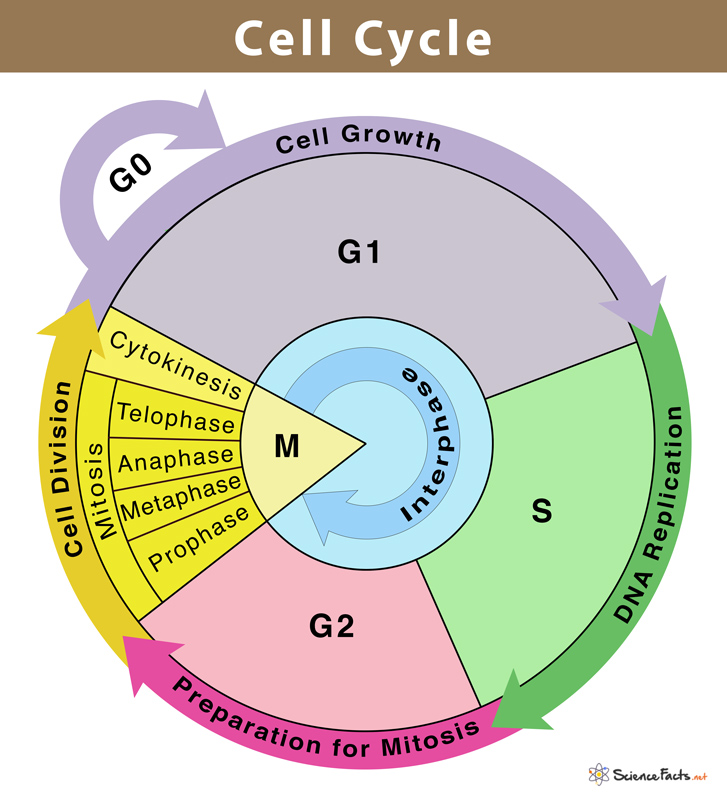
The diagram shows the two major stages and the total of five parts in the cell cycle-interphase (G1, S, and G2) and cell division (M phase and cytokinesis).
Cell Cycle: Definition, Phases, and Diagram

Interphase The stage in which a cell grow and matures is interphase, the longest part of the cell cycle. A cell spends about 90 percent of its lifetime in interphase. Throughout the stage, a cell prepares for division by copying its internal parts and expanding its cytoplasm. During interphase, the preparations for cell division happen in three phases.

-The

(G1 stands for "first gap") is a period of time in which the cell grows, mainly by making carbohydrates, lipids and proteins. It is a checkpoint that ensures the cell has the resources available for the next stage. If it does not have the resources, it will stay in G1until the cell makes the resources. Some cells exit the cell cycle at this phase and enter G0. Cells that enter G0, such as nerve cells, do not make more cells.

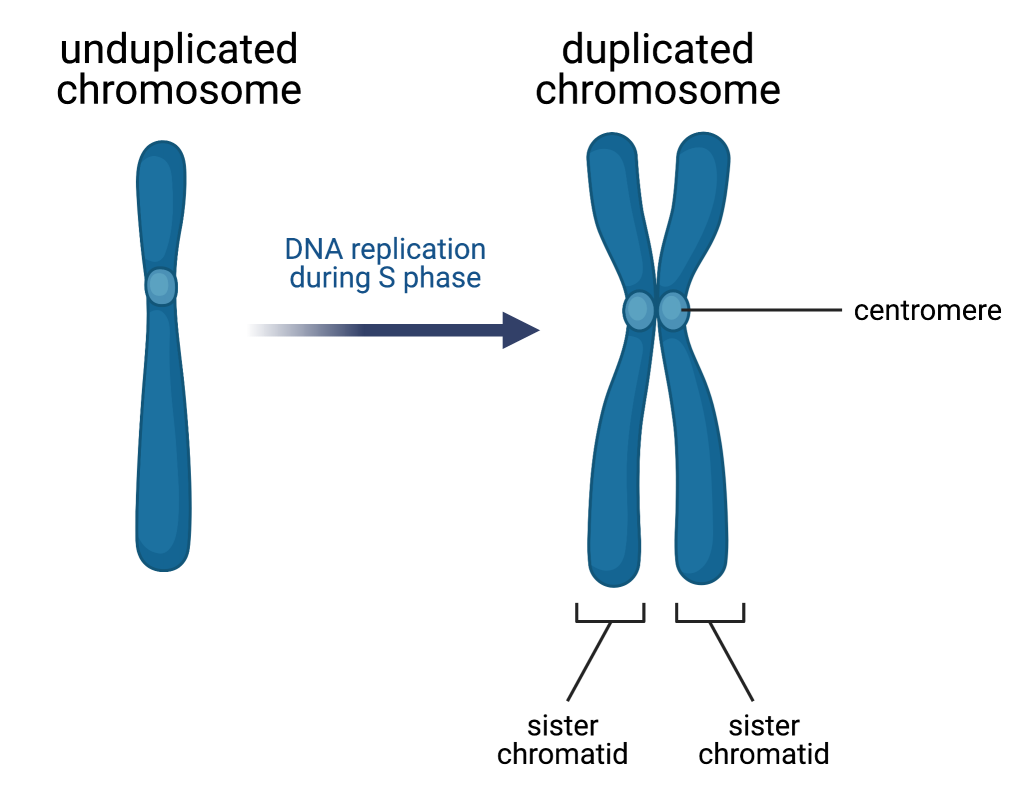
-The S phase (S stands for "synthesis") is a period of DNA replication in which two identical copies of the cell's DNA are made. This forms a duplicated chromosome, with two sister chromatids held together at the centromere, as shown. Each chromatid is made of a complete DNA molecule.
16.2 The Cell Cycle – College Biology I

During the S phase, each chromosome replicates to form two identical sister chromatids

-The G2 Phase (G2 stands for "second gap") is another period of growth. All organelles and membranes are copied as a cell prepares to divide. This is another checkpoint for the cell before the cell divides. This checkpoint ensures that the cell has the resources it needs for a cell that is identical to the parent cell.

Cell Division The M Phase (M stands for mitosis) is the period in which the sister chromatids separate into two new nuclei, each now with an identical set of chromosomes. Mitosis has four main stages (prophase, metaphase, anaphase, and telophase). Cytokinesis follows mitosis and splits the cytoplasm and organelles of the parent cell. Two identical daughter cells form, each with its own nucleus and the same number of chromosomes.

Pitanje 2
2.

Cells spend most of their lives in interphase|cell division but the nucleus divides during cytokinesis|mitosis

3.2 Eukaryotic Cells Undergo Mitotic Cell Division

Cell division is the basic process by which cells make more of themselves. The proper division of the nucleus is a very important part of cell division in eukaryotic cells. Shown in the cells below, this stage of the cell cycle, when the nucleus of the cell divides, is called mitosis. This process leads to the formation of two identical new cells from one parent cell after cell division, each called a daughter cell.

Cell Division

Stages of Mitosis

Before mitosis begins, each chromosome in the nucleus is copied (during the S part of interphase). Then, during mitosis, the two copies of each chromosome separate and move to opposite sides of the cell. As a result, each new nucleus has a set of DNA identical to that of the parent cell. After mitosis, the cytoplasm of the parent cell divides, forming two separate and identical daughter cells. Biologists divide the process of mitosis into four stages.

-Prophase The longest stage of mitosis is prophase. Early in prophase, the chromosomes condense by coiling up into visible rods. At the same time, the nuclear membrane breaks down. Also, two centrioles, part of the cytoskeleton found only in animal cells, move to the opposite sides, or poles, of the cell. Spindle fibers, made of proteins like those in the cytoskeleton, form as the centrioles move to the poles. Later in prophase, the spindle fibers attach to the centromeres of each chromosome.

-Metaphase During metaphase, a chromosome containing two identical sister chromatids lines up along the equator, or middle, of the cell

-Anaphase During anaphase, the chromosome separates at the centromere, separating the sister chromatids. The spindle fibers pull the sister chromatids towards opposite poles.

-Telophase During telophase, the sister chromatids reach opposite poles. Then, a nuclear membrane forms. The nucleus of each cells is genetically identical. Cytokinesis follows telophase, leading to two genetically identical daughter cells.

All body cells except for the gametes divide by mitotic cell division. The gametes divide by meiosis to cut the chromosome number in half. The division of the nucleus by mitosis ensures that every new body cells receives all the same genetic information that its parent cell had. Each new body cell must have a full set of an individuals genetic information in order to survive and function normally. Otherwise, the individuals that the cell is part of may not be able to repair its damaged parts or grow.

Identify the stage and order of the following images of mitosis.

Stage:

Stage:

Stage:

Stage:

Order:

Order:

Order:

Order:

Pitanje 4
4.

Develop your own mneumonic (like an acronym) for all the phases or stages of the cell cycle.