🪨→🌳Stages of Succession (Primary, Secondary, Pond)

Last updated 3 months ago
27 questions
Note from the author:
This lesson includes metacognitive steps (sorting vocabulary based on familiarity), review of linked concepts (a/biotic factors, levels of organization, biome basics) and then introduces ecological succession as a dynamic process according to College Board AP Standards.
We will be introduced to this assignment together, and then we will work as partners or independent students to learn the concepts.

To be sure you learn:
  • GO IN ORDER!
  • Use the hints and check answer button!
  • Focus on interactives with deep engagement, do thoughtful quickwrites.
  • No Google, except for as spellcheck.

You must have completed #012 before you begin this assignment.

Introduction: Metacognition - Thinking about our Thinking
0

Take 2 minutes or less to sort.

Sort the terms below based on whether you think you
  • know them, (could respond to free response questions using this term and use in context... if it takes you long to decide, then you don't know it!)
  • are familiar with them (might struggle interacting with different parts of the definition or writing freely with the term, but have an idea of the meaning)
  • do not know them at all, and couldn't make a solid guess at their meaning
Bold words will be introduced within this assignment but you may know them from elsewhere, italic words are recent, plain text are old or 'expected general vocabulary' (and therefore your highest priority to learn soon!)

All these words will be reinforced today so you do not need to start writing definitions yet.

  • biosphere
  • biome
  • abiotic
  • biodiversity
  • climate
  • primary consumer
  • biomass
  • biotic
  • community
  • arctic
  • dynamic
  • species richness
  • climax community
  • primary succession
  • secondary succession
  • terrestrial
  • precipitation
  • tertiary consumer
  • pioneer species
  • disruption
  • secondary consumer
  • equator
  • population
  • stable
  • primary producer
  • Know
  • Familiar
  • Unknown
0

Sort the biomes below based on whether you think you
  • know them, (could respond to free response questions using this term and use in context)
  • are familiar with them (might struggle interacting with different parts of the definition or writing freely with the term)
  • do not know them
Bold words are new and you will learn them within this assignment so don't feel the need to research them. Italic words are recent, plain text are old (and therefore your highest priority to learn soon!) All these words will be reinforced today so you do not need to start writing definitions yet.

For biomes: Knowing means knowing from memory their general
  • precipitation (low, moderate, high), and eventually seasonality
  • temperature (low, moderate, and high), and eventually seasonality
  • general latitude (arctic, equatorial, or 'somewhere between') and eventually geographic references like countries
But memorizing these facts about biomes is less important than your ability to use the skills of graph analysis we will exercise today to learn information about the biomes.

  • temperate rainforests
  • desert
  • tundra
  • temperate seasonal forests
  • shrubland
  • tropical rainforests
  • savanna
  • temperate grassland
  • taiga
  • Know
  • Familiar
  • Unknown
0
Before you begin, pledge to use the check answer and hints buttons well. To do so:

The CHECK ANSWER button should be clicked slowly, and only after you have given a completely thought through answer. If you attempt an item more than 3-4 times, you probably need to seek help.

The HINT button should be used often. You should think before you use a hint, but once you use a hint you should reference the question and try to apply the hint; you can read hints aloud to each other. The hints are what I often say when I talk to you as students. There are multiple hints and you should pause in between using each, just like I do when talking to you. The hint button helps you think through a question and is a better solution than pressing check answer 4+ times. Make sure you're using your hint after the 2nd or 3rd time you've checked your answer.

I, _______ will use my hints and check answers to help me understand the answer and how to use the skill I am being asked to use, not to click mindlessly until I get the correct answer.

(This won't immediately turn green.)
0

Before I start answering a fill-in or dropdown or drag & drop question, I need to

0

If I encounter a word I don't know, I should

Content Introduction
0.5

INDEPENDENT Basic Vocabulary REVIEW: Match the term to its definition.

If you have trouble here, click the mark question in the upper right corner so you know where to find these words to write them in your notes later, or to help when you are writing FRQ and responding to items.

Draggable itemCorresponding Item
non-living
abiotic
living
biotic
1

INDEPENDENT Basic Vocabulary REVIEW: Match the level of biological organization to the example. These terms should be memorized by this point!

If you have trouble here, click the mark question in the upper right corner so you know where to find these words to write them in your notes later, or to help when you are writing FRQ and responding to items.

Draggable itemCorresponding Item
all the grasses of a specific species in a grassland
population
the grasslands, the tundra, the rainforests, and everything else on planet Earth
community
the grasses and the herbivores
biome
grasslands across south and central Africa, etc
biosphere
2.5

INDEPENDENT Vocabulary/example review
Sort the concepts into abiotic and biotic factors. If you're stuck, check the question above this.

  • grasses
  • rainfall (precipitation)
  • herbivores
  • temperature
  • carnivores
  • Abiotic Factors
  • Biotic Factors
1
From the AP essential knowledge statements, you must know that:

Major _______ biomes include taiga (boreal forest) , temperate rainforests, temperate seasonal forests, tropical rainforests, shrubland, temperate grassland, savanna, desert, and tundra.

If you have trouble here, click the mark question in the upper right corner so you know where to find these words to write them in your notes later, or to help when you are writing FRQ and responding to items.
4.5

PARTNER

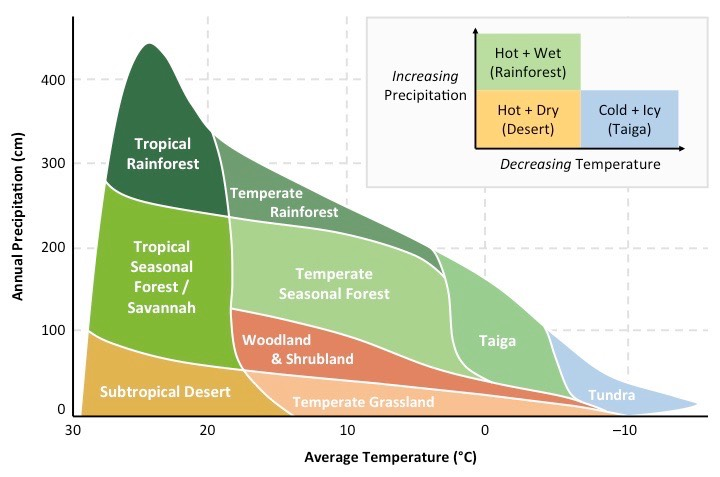
Sort these biomes according to their temperatures, using the biome graph. Like the previous graph, you must take careful notice of the axes, because they are non-traditional!

  • taiga (boreal forest)
  • tropical rainforests
  • shrubland
  • desert
  • temperate seasonal forests
  • temperate rainforests
  • temperate grassland
  • savanna
  • tundra
  • Lower Temperatures
  • Higher Temperatures
  • "Temperate"; Moderate Temperatures, or a 'Spread' of Four Seasons
4.5

PARTNER

Sort these biomes according to their annual precipitation levels, using the biome graph.

  • tropical rainforests
  • tundra
  • savanna
  • shrubland
  • desert
  • taiga (boreal forest)
  • temperate seasonal forests
  • temperate rainforests
  • temperate grassland
  • Lower Precipitation
  • Higher Precipitation
  • 'Medium' Precipitation, relative to the others
1.5

Other Relevant AP Essential Knowledge Statements:


A biome contains characteristic __________of plants and animals that result from, and are adapted to, its climate.

The worldwide distribution of biomes is __________; the distribution has changed in the past and may again shift as a result of global __________ changes.
1
The _______ has very low biodiversity, because it is very cold and has little precipitation.

However, it has lava flows that can serve as the basis for further biome development. We will see those today.
1
Zones of temperate grassland may undergo changes that generally increase biodiversity.

IDENTIFY a biome that a temperate grassland is likely to convert to that would likely have higher biodiversity.

DESCRIBE the changes that would be necessary to cause this transformation.

__________ rates of precipitation and stable temperatures may convert a temperate grassland into __________ , which has higher biodiversity than the grassland.
1
Zones of temperate grassland may undergo changes that decrease biodiversity.

IDENTIFY a biome that a temperate grassland is likely to convert to that would have lower biodiversity.

DESCRIBE the changes that would be necessary to cause this transformation.

__________ temperatures may convert a temperate grassland into __________ , which has lower biodiversity than the grassland.
1
Today's Essential Questions:

How do _______ develop from land without life?
How do _______ transform over time?

The broad answer you will investigate and explain using this interactive:

The process of ecological succession explains how biomes develop initially and transform.
The Tundra is a Clear Example of "Arrested" Primary Succession
1

Relevent Essential Knowledge:

There are two main types of ecological succession: primary and secondary succession.

Draggable itemCorresponding Item
as in producers and consumers and school years 1-5 and the colors red, blue, and yellow
primary
as in producers and consumers and the school you are in and the colors green, purple, and orange
secondary
0

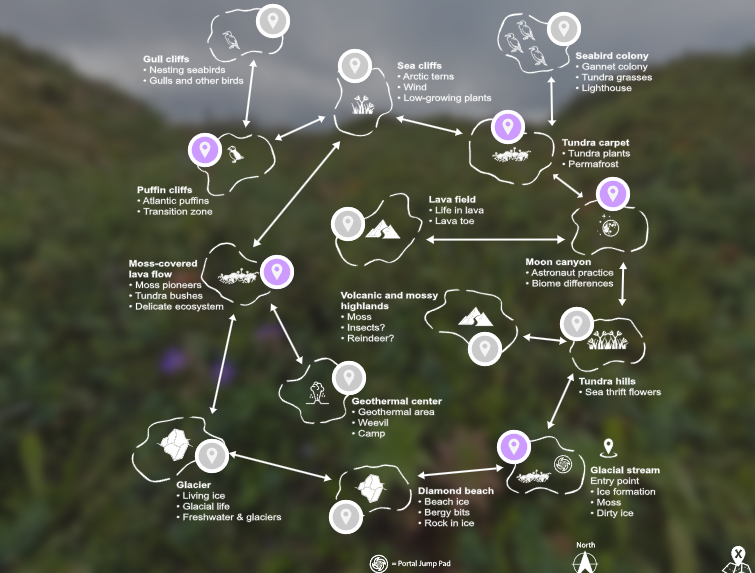
Visit the tundra in the viewer below. Tour each of the following areas (use the map!) Check each area off when you are done.

Remember, audio makes this better! If you already visited the tundra, you do not have to do this again, but I'd check through these and make sure you've seen the concepts.

1

Match the vocabulary with the images, until you earn 100%, above.


From recall, without writing 'side by side', write at least TWO sentences or questions connecting, comparing, and/or contrasting with the tundra biome you saw. Try to focus your writing on what fascinated you visually or made you make connections to what we've learned so far.

0

Go here: BiomanBio Succession Game

Choose PRIMARY SUCCESSION and play the game. The game works. If you're struggling, check that you've followed instructions. Do not play SECONDARY yet.

4

Copy-paste your writing from question 19, and add information from the BiomanBio game. Don't copy-paste or write directly what the game said; just do a quickwrite! If you need to go back to find vocabulary from the game or a peer, use bold or capslock to indicate your thought process.

Secondary Succession is common in Grasslands
0

Go on the Grasslands biome field trip below, and complete the following tasks.

1

Go here: BiomanBio Succession Game

Choose SECONDARY SUCCESSION and play the game. The game works. If you're struggling, check that you've followed instructions.

4

When you are done playing the game, write what you learned here. Don't copy-paste or write directly what the game said; just do a quickwrite! If you need to go back to find vocabulary from the game or a peer, use bold or capslock or another color to indicate your thought process.

3

Relevant Essential Knowledge:

There are two main types of ecological succession: primary and secondary succession.

Succession in a disturbed ecosystem will affect the total biomass, species richness, and net productivity over time.

These words are new, but you should be able to use the descriptions and your recall of the recent games to match successfully - or the meanings of the words in regular life, or the prefix/suffix.

Draggable itemCorresponding Item
net productivity
primary succession
the living material present
secondary succession
begins from bare rock, without soil
pioneer species
happens after disruption, soil present
biomass; a trophic pyramid represents this in scale
lichens, mosses; first arrival
how many different species; the kinds present; when you added new levels of organisms, you increased this
species richness
how much matter the plants can make; you had to get this high before you could introduce consumers
Ponds can also undergo a type of Succession
4

Sort the stages of pond succession using the simulation above. Then, DESCRIBE the stages of pond succession in your own words, using the images above as your guidance. COMPARE to the other forms of succession you have studied.

Ecological Succession Lecture
4

REVISE your previous understanding by copy/pasting what you have already written and reported about your succession observations and ADDING or clarifying information here using bold and color-coding.

If you have hand-written notes already, or would prefer to hand-write notes here and click the + in the textbox, image, take a photo button, you can do so.