
What is the length of
What is the length of
a conveyor belt at an airport is travelling west to east at a constant velocity. a cart is moving along the pavement at a similar, but somewhat smaller velocity. The cart enters the conveyor belt at the west entrance and the wind picks up blowing against the cart.
this is the scenario shown in the vectors above. which of the following would be the total velocity of the cart?
you can express the vector a+b as two vectors, one horizontal and one vertical. Which is the horizontal. please use the

Rosa Boat is paddling upstream at 1.4 m/s relative to the water in a river which is flowing at 0.50 m/s relative to the banks of the river. which diagram shows the resultant velocity of Rosa's boat (relative to the banks)?
Rosa's boat is paddling upstream at 125 cm/s relative to the water in a river which is flowing at 50 cm/s relative to the banks of the river. What is the resultant velocity of Rosa's boat (relative to the banks)?
The following is a position-time graph of an object being thrown up in the air. the ball is released with an initial velocity at time=0
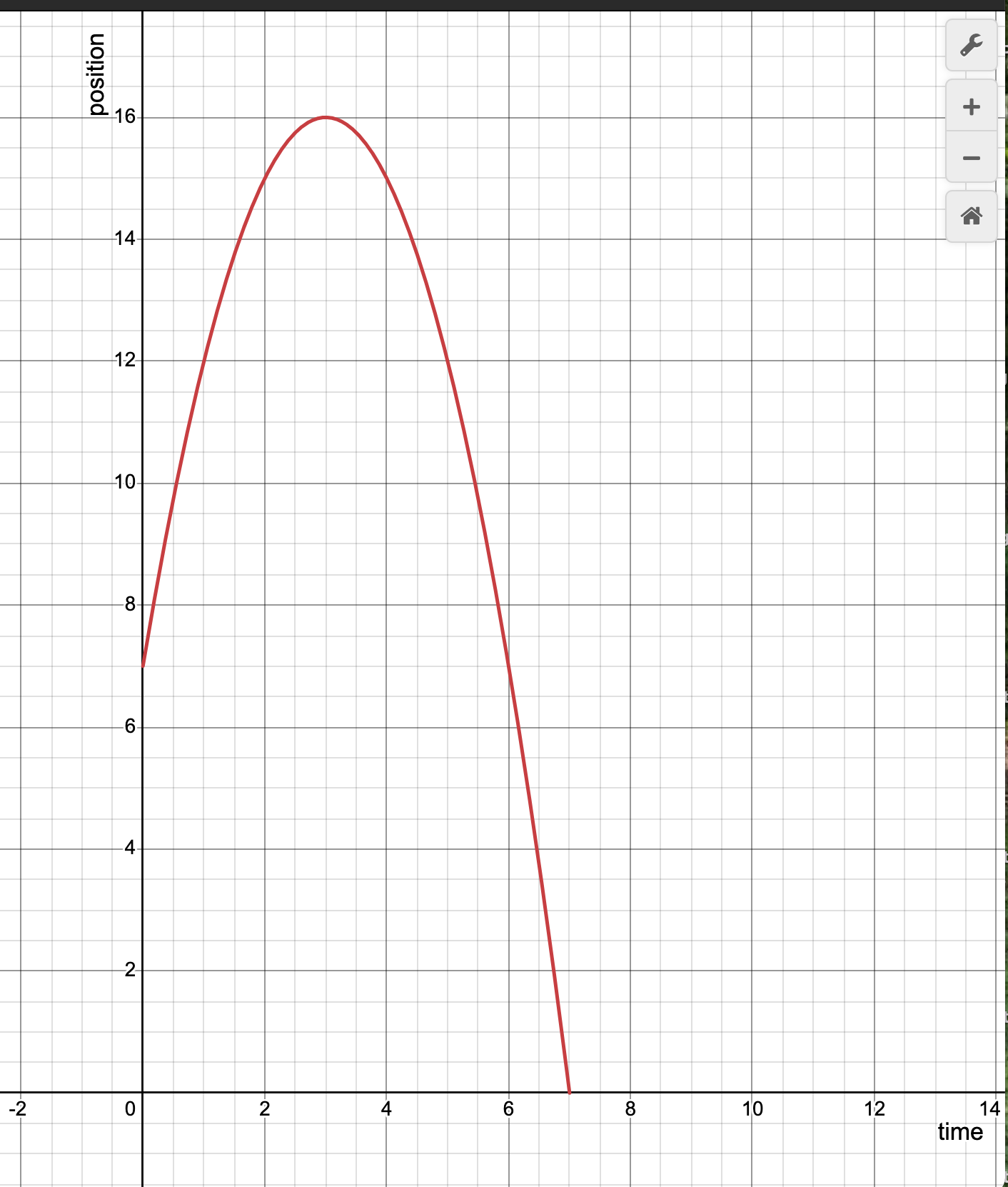
The graph starts at time=0 and position=9 because
The graph ends at time=7 and position=0 because
in the time between time=0 and time=3 the ball's velocity is
between time=3 and time=7 the ball's velocity is
in the time between time=0 and time=3 the ball's acceleration is
between time=3 and time=7 the ball's velocity is
The force accelerating the ball after time=0 is
what would you guess roughly the velocity vs time graph would look like? Consider: when does the velocity change from positive to negative? when is the velocity 0?
What does the acceleration graph look like?
Notice the graph above is a 1d graph. the ball is going straight up and down. not side to side at all. remember, the x-axis is time, not left and right. a hockey puck is sliding on a completely frictionless ice rink. The moment it leaves the hockey stick is time=0 and position=0
it moves at a constant velocity until it is caught by the goalie 6 meters away. which of the following graphs shows the position time of hockey puck
From the discussion in class and your lab from last weekend, does the horizontal velocity of something moving in the horizontal direction change how long it takes that something to fall to the ground?
click on intro and shoot the cannon a few times at different velocities (don't change the angle of the cannon yet). Then use the measurement tool for when the different trajectories hit the ground. What do you find?
if you point the cannon into the air at an angle, each trajectory hits at a different time, why?
click "components" under velocity vectors, and shoot the cannon with a low velocity. What do you notice about the horizontal velocity as the ball follows the trajectory?
What do you notice about the vertical velocity as the ball follows the trajectory?
Watch the following video on Projectile motion. Do you have any questions?
Take a section you think you understood pretty well from the video and summarize it here.
Every projectile motion curve with only one constant acceleration is a quadratic equation that looks like this:
what do
John is given the acceleration due to gravity, the initial velocity in the y-direction :40 m/s, and the initial position of the projectile: 10m. he takes the equation
and turns it into
and uses the quadratic formula to find t. What is he trying to figure out?
what would he have to do differently if he was told that the initial velocity was 40 m/s at a 45 degree angle from the horizontal?
Adding 1D vectors
Adding 2D vectors
subtracting any kind of vector
how to read position time graphs
what graphs look like with acceleration vs with no acceleration
Thinking about 2D motion by looking at the vertical motion separately from the horizontal motion
I've got this
im fuzzy
so confused
Click on the "component" under acceleration vector. and watch it when you fire the cannon. What do you notice?
Just play with the simulation for a while. what are some things you notice
What questions do you have from the simulation?