
1
The target market for Timezone Arcade is
The target market for Timezone Arcade is
1
Tastes/values of this target market?
Tastes/values of this target market?
This test has different types of questions- some are mix and match, some need you to fill in gaps. This is to be done in exam conditions. This means no communication with other students, raise your hand for help from your teacher.
How does business affect society
What is an employee?
How can negative publicity threaten the success of a business?
What is a consumer?
What is an entrepreneur?
The 4 Ps are...
| Draggable item | arrow_right_alt | Corresponding Item |
|---|---|---|
Place | arrow_right_alt | something that can be seen or experienced, created to meet the needs or desires of consumers. |
Promotion | arrow_right_alt | this is not one of the 4 Ps |
Price | arrow_right_alt | to boost or recommend a product or service to generate sales |
Profit | arrow_right_alt | where a product is sold e.g. online vs in-store |
Product | arrow_right_alt | the amount a customer has to pay for a product or service |
The target market for Timezone Arcade is
Tastes/values of this target market?
Write one advantage to Rachel if she bought the fish’n’chip shop with her own savings.
Write one disadvantage to Rachel if she bought the fish’n’chip shop with her own savings.
Select OTHER ways Rachel could finance the purchase of the fish'n'chip shop
Match the pros and cons of each source of finance
| Draggable item | arrow_right_alt | Corresponding Item |
|---|---|---|
Finance Company | arrow_right_alt | A safe place to get a loan from. They are fussy on who they loan to. |
Friends and family | arrow_right_alt | Tend to have very high interest rates but are not very fussy on who they loan money to. |
A bank | arrow_right_alt | Would give money quickly, usually without interest. Could end in disputes or tension. |
Why is location important for a fish'n'chip shop
Below are Rachel’s estimates of income and expenses she would face on an ongoing basis if she bought the fish and chip shop.
Use her figures to create a monthly budget for her.
Staff (per week) $135 Monthly amount =
Electricity (per month) $105 Monthly amount =
Sales from food (per week) $650 Monthly amount =
Rates to pay (per month) $80 Monthly amount =
Insurance to pay (per year) $240 Monthly amount =
Ingredients (per week) $320 Monthly amount =
Sales from drinks (per week) $110 Monthly amount =
Advertising costs (per month) $100 Monthly amount =
Cleaning (per week) $25 Monthly amount =
Using the information from your previous answers (you can go back to look):
Total income for Rachel's business =
Using the information from your previous answers (you can go back to look):
Total expenses for Rachel's business =
Using the information from your previous answers (you can go back to look):
What profit would Rachel be making?

The pūtake of Tayla’s business is just to make her money
Manaakitanga means:
Tayla could show manaakitanga in her cafe by
Tino Rangatiratanga means:
Tayla could show Tino Rangatiratanga in her cafe by:
Read or listen to this text. You will be asked questions about it but can return back to this page to read or listen again.
Jeremy wants to leave his office job as a tax inspector to go into business by himself. He is sick of boring work and being stuck indoors. He wants a job with regular hours working five days a week. He wants to be active and has done running in the past but he does not think he will be able to do heavy lifting or lots of manual labour due to a previous injury. Getting home in the evening and having time for his family and pets is important to him.
He is yet to figure out his budget but has checked Seek.co.nz and found four potential options.
Jeremy is comfortable taking on physically demanding work.
Flexible hours are important to Jeremy.
Select the best job for Jeremy
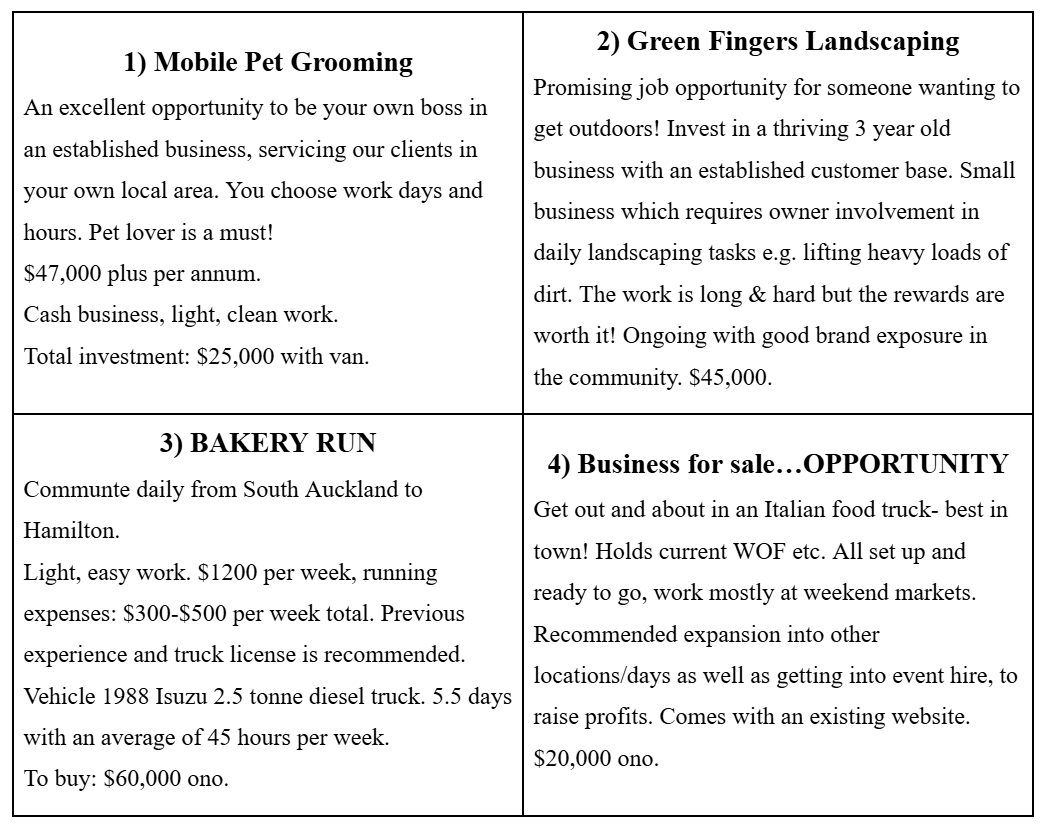
What other details would Jeremy need to find out before committing himself?
Jane shares her story of her six-month business adventure.
“I definitely bit off more than I could chew” she says “I became obsessed and it was the only thing that was important. I lost my identity. I was so stressed..”
After attending a short business course at ARA, Jane decided to buy a small cafe. She had done Hospitality at high school and loved it. The cafe she settled on was in Central Wellington and had a bakery as well as a cafe next door.
“I did not see that it could be hard to run two businesses that were so closely related. I see now that that was pretty naïve.”
Before buying the place, she looked over the accounts. But in hindsight she realised that the accounts (which looked good), did not show the businesses operation in the final months. In these final months a competitor had opened down the road selling similar products and services and was too much for her cafe to survive. The previous owner was helpful but blamed Jane for not checking the final accounts. She urges people looking to buy businesses to check the accounts very carefully and talk things over with an accountant before making the big decisions.
Jane found she was spending 12 to 16 hours there a day. The book work took hours and she spent the evenings cleaning and tidying up. There were costs she hadn’t considered like the need for a new bathroom. It was a big job getting a variety of food ready for the cafe/bakery and she did most of it. She can now laugh at the effort she put in one day to make two chocolate cakes only to have them squashed by the box in her car on the way to a customer. “My staff worked hard but I was exhausted because I was doing too much and I took it out on my staff, which I regret.”
In the end Jane was not making much profit and due to unexpected events like two freezers dying, she had to fork out repair costs. Thankfully insurance covered most of it but it was the final straw and Jane sold the business. She reflected that in the end she had broken even but only by putting in more hours than she’d ever be paid for. “This all came at such a personal cost but I have learned a lot.”
What was the first thing Jane did to improve her business skills?
Match Jane's mistake to the consequence
| Draggable item | arrow_right_alt | Corresponding Item |
|---|---|---|
Jane underestimated the workload and tried to do everything herself. | arrow_right_alt | She missed the fact that a new competitor had opened and was taking the business' customers. |
Jane didn’t plan for hidden costs like a new bathroom. | arrow_right_alt | She worked 12–16 hours a day, spending evenings cleaning and preparing food. |
Jane became exhausted and took her stress out on staff. | arrow_right_alt | She had to pay for unexpected repairs and improvements, cutting into profits. |
Jane didn’t check out competition in the area | arrow_right_alt | She damaged staff relationships and regretted how she treated them. |
Drag the solutions to these problems
Hire more staff and share jobs
Outsource some jobs (e.g. accounts)
Develop a USP to be more competitive
Create a loyalty program for customers
Jane was doing too many hours unpaid
She found out a competitor was taking her customers
What qualities has Jane shown through this experience?
What discoveries did she make when she bought her new business?