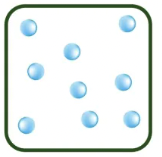
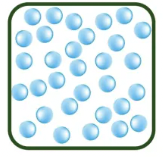
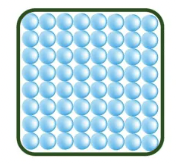
Vibrating in place
Moving freely over and around each other
Move in all directions freely
Solid
Liquid
Gas
Vibrating in place
Moving freely over and around each other
Move in all directions freely
Solid
Liquid
Gas
What causes a gas to become a plasma?
In plasma, the break free of the .
nucleus
electrons
container
List two places where substances that are in the plasma state can be found.
What will happen to the molecules of a substance as you add thermal energy (heat)?
Use the menu on the right side of the program to select Water and Solid. Submit a screenshot of the substance.
How do the particles move in the solid?
Use the menu on the right side of the program to select Water and liquid. Submit a screenshot of the substance.
How do the particles move in the liquid?
Use the menu on the right side of the program to select Water and gas. Submit a screenshot of the substance.
How do the particles move in the gas?
Now go back to solid water.
Use the slider under the container to add heat. Gradually add heat to the water until it becomes a liquid then a gas.
Describe what you observe as you add heat.
Now bring the slider down toward "cool" to remove heat. Continue cooling until the water is in the solid form.
Describe what you observe as you remove heat.
Select a new substance from the choices on the right: Neon, Argon or Oxygen.
Click the down arrow next to the thermometer and change the temperature to Celsius.
Start in the solid state and gradually add heat. Based on the motion of the particles, try to determine the temperature where the substance becomes a liquid, and then a gas. In "show your work" submit a screenshot of your substance as a solid, a liquid and a gas. Be sure to label which is which.
The substance I picked:
Becomes a liquid at:
Becomes a gas at:
I chose:
The melting point is:
The boiling point is:
How close did you get to the actual numbers?
Before we go, let's review the vocabulary for when a substance changes state.
Melting is when changes to .
Evaporation is when changes to .
Sublimation is when changes to .
Condensation is when changes to .
Freezing is when changes to .
Deposition is when changes to .
solid
gas