TEXT: Gravity
1
Why do all objects fall back to Earth?
Why do all objects fall back to Earth?
1
How do scientists detect more distant planets outside of our solar system?
How do scientists detect more distant planets outside of our solar system?
Watch the video above and answer the question below.
What does gravity do?
Watch the video above and answer the question below.
If more mass produces more gravity, which planet has the strongest gravity?
Watch the video above and answer the question below.
Why do astronauts appear to float in space?
Watch the video above and answer the question below.
What two things affect the strength of gravity?
Watch the video above and answer the question below.
What causes the ocean tides?
Watch the video above and answer the question below.
What happens to gravity as you move farther from Earth?
Watch the video above and answer the question below.
Which of the following are effects of gravity? (Choose all that apply)
Watch the video above and answer the question below.
What makes gravity stronger? (Choose all that apply)
Watch the video above and answer the question below.
Which of these are examples of gravitational force? (Choose all that apply)
Watch the video above and answer the question below.
Which of these objects experience gravity? (Choose all that apply)
Gravity only exists on Earth.
Gravity is the reason we have weight.
The Moon has gravity.
Gravity can push objects away.
Gravity is stronger on smaller planets.
Why do all objects fall back to Earth?
How do scientists detect more distant planets outside of our solar system?
What would happen if you threw a 2kg (kilogram) backpack of rocks and a 4kg backpack of rocks off a tall building?
It seems like backpack of rocks with greater mass should get to the ground faster. However, there is more to consider when gravity pulls at falling objects.
Gravity is the force that pulls objects (backpacks) toward the center of another object (Earth). The force of gravity increases for greater mass, but the greater mass also requires more force to pull it.
A backpack that is 4 kg has two times the mass as the backpack that is 2 kg. But, the force of gravity is twice as strong on the 4 kg backpack than the 2 kg backpack. So, they reach the ground at the same time.
What is the relationship between gravity and mass?
Watch the video above. Then answer the question.
What force pulls objects downhill?
Watch the video above. Then answer the question.
Which surface would likely slow you down the most?
Watch the video above. Then answer the question.
What happens when friction increases?
Watch the video above. Then answer the question.
Which factor affects how fast you coast down a hill?
Watch the video above. Then answer the question.
What does mass do when coasting downhill?
Watch the video above. Then answer the question.
Why might a heavier person coast faster than a lighter one?
Watch the video above. Then answer the question.
What role does slope play in coasting speed?
Watch the video above. Then answer the question.
What is friction?
Watch the video above. Then answer the question.
What are the four fundamental forces of nature?
Watch the video above. Then answer the question.
Which force keeps Earth orbiting the Sun?
Watch the video above. Then answer the question.
What happens when you drop a watermelon?
Watch the video above. Then answer the question.
Which force holds electrons around the nucleus of an atom?
Watch the video above. Then answer the question.
What is the strongest of the four forces?
Watch the video above. Then answer the question.
Which force keeps protons and neutrons together in the nucleus?
is the governing force in the universe. Gravity keeps the planets orbiting the Sun, the Moon in orbit with the Earth, and us from away from our planet.
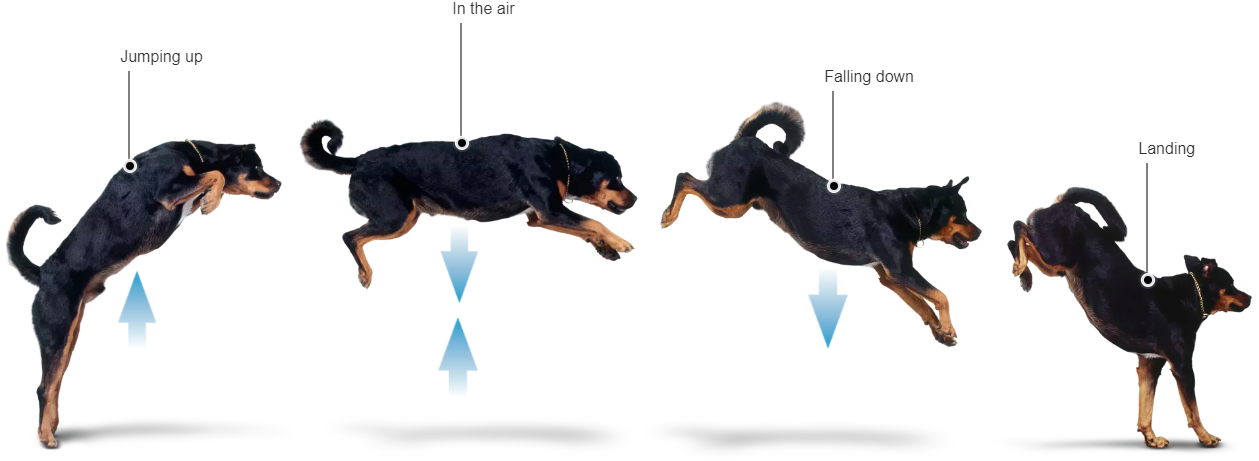
Gravity is not something we can see, but we can its effects. When a dog leaps off the ground or we throw a baseball, we can observe how they both return to the ground. This happens because gravity is a force of between two bodies. Gravitational attraction depends on two factors: and distance. The greater the mass and the closer two objects are, the greater the attraction. One example of evidence of this attraction on a large scale is the . Because bodies of water are fluid, they can move freely and in sync with the Moon as it orbits our planet.
Gravity is also responsible for the thrill associated with acceleration. proved that objects, regardless of mass, fall at the same acceleration. However, objects on Earth experience air resistance and friction. Because of this, we see lighter objects fall more
slowly and heavier objects fall faster. In a like space, friction is not a factor, so all objects fall at the same rate. We use the law of gravity and in our favor when we coast downhill on our bikes, ride a roller coaster, and skydive.
Gravity’s pull on a body provides us with the property of . When gravity’s effect is less, you weigh less. When gravity’s effect is greater, your weight is greater. This helps us understand why who visit the Moon seem to bounce about the surface.