When dealing with two dimensional motion, you can decompose all vectors into horizontal and vertical and deal with each one separately.
Let's review the equations we have seen so far.
this equation tells you that velocity v is
in 1D, a question using this equation might look like this - Hannah starts her sprint at 10m left of the door and ends her spring after 5 seconds 15m right of the door. Assume 0 acceleration, Find Hannah's velocity and show her position and velocity on the position-time graph and her velocity vs time graph in your "show your work"
I'm stepping you through that one just to make sure - The initial position is -10 (because it is to the left of the door, it is negative). and the final position is 15, which is positive because it is to the right of the door. If I want to find the distance between them, I would subtract .
what does finding the displacement look like in 2D? Saw you start at
show the vector addition in the graph below, and give the displacement in vector form. you can use \hat to prompt the calculator to let you write it as a vector
give a scenario where you would want to add the two vectors above instead of subtract them?
If you have a plane that has a velocity of
The final velocity for the above problem is
If you have a plane that in a windless day has a velocity of
Watch the following video
do you have any questions?
I actually disagree with what he says at one point when he says the equations for constant velocity are different from the equations for uniformly accelerating motion equations. Constant velocity situations have a uniform acceleration. and it is 0. so we are going to solve UAM eqautions for when a=0
What does that look like when a=0?the next UAM equation is just using the first two to get rid of the t.
Solve
for t.t=
then sub in that equation for t into
put it in here before you start manipulating it. note that the above equation is typically for
thats ugly, once you have that lets simplify. You will need to foil.
what do you get?
i'll be honest, I don't think I ever memorized this one. I thought it was easier, if given the other variables to solve the one equation for t, and then plug t into the second equation to find whatever else i was missing. I probably could have saved myself a ton of algebra if I just bothered to remember to look at the equation sheet though.
Let's use it! How far has our ball traveled when its velocity in the y direction becomes 0? It is thrown up at a velocity of 4 m/s. use
The last equation just uses the concept of average velocity, it only works if you are dealing with a beginning and end, not if you want to find position anytime along the journey. Let's start with this one graphically. what does your intuition tell you is the average point on this line?
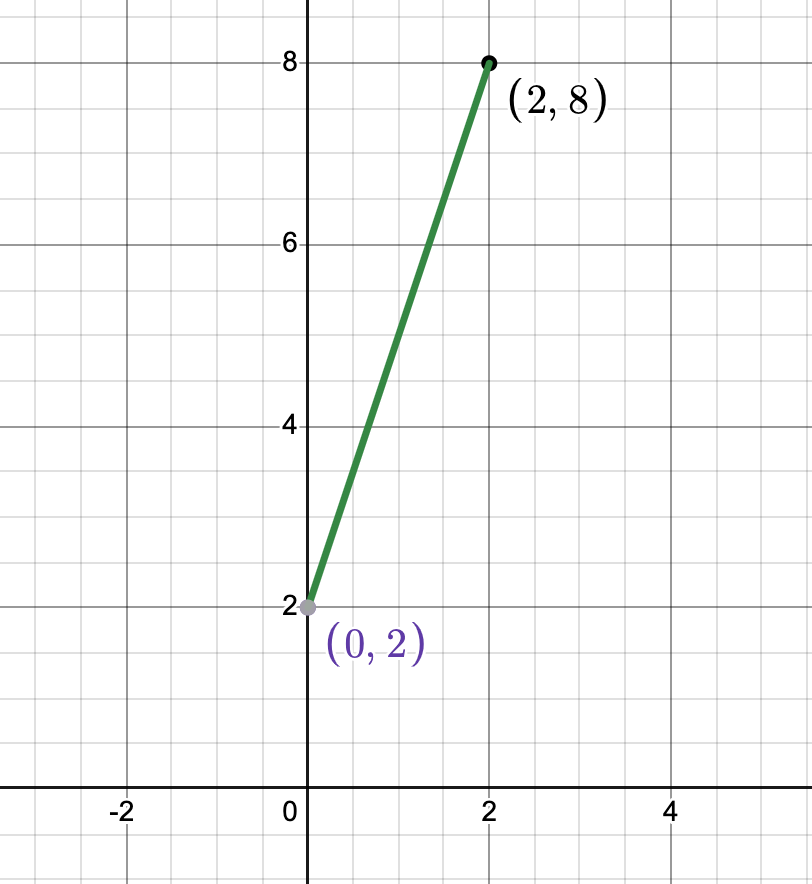
looks like the average point is
ok remember that the average velocity is different from instantaneous velocity. it is the following equation
, which I can solve forwe have another
Substitute
solve and simplify and you get
That should jive with your intuition above. once you have an average velocity, you can use the equation for displacement
Again, for total displacement, nothing midway.projectile motion also works with frames of reference. A clown in a glass train throws a ball straight into the air. compare how the motion looks to the clown vs to the man on the platform watching the train go by.
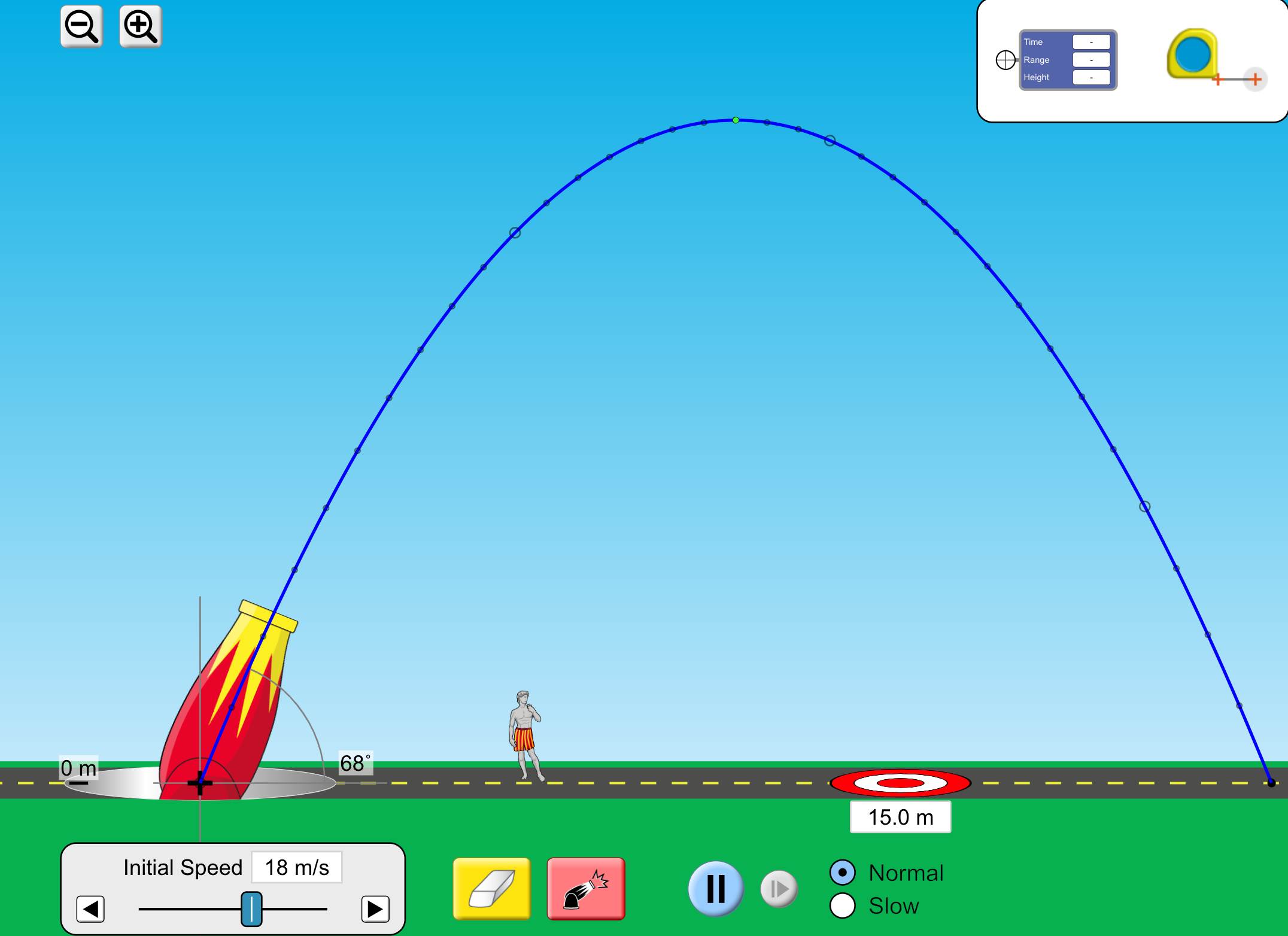
how would the motion change to the platform viewer compared to the train viewer if there are two clowns throwing balls to each other as the train passes by?
drag the descriptions of motion to the proper place

when the velocity in the y direction is 0
a point where my y velocity is negative
a point where my y velocity is positive
when the y position is 0
initial x and y direction, and where the initial velocities in the x and y directions would be measured.
Consider the following question - a cannon is shot with an initial velocity of
Consider the following question - a cannon is shot with an initial velocity of 2
consider the following problem: the hangtime of a basketball player who jumps a vertical distance of 2 feet (0.6 m) is about 2/3 s. what will be the hangtime of a player that can jump 1.4 feet (1.2 m) horizontally?
A cannonball is fired and you are given the following information
Initial velocity =
total horizontal distance when it hits the ground = 7 m
acceleration due to gravity = 10 m/s^2
acceleration in the x direction = 0
you are asked how far off the ground the cannonball is fired from.
You may have to use a couple different equations for this one. talk through what you would do, don't actually do it.
How are you feeling about each of these
how to determine what your givens are
how to determine what your unknown is
how to figure out which equation to use
how to use the equations
whether or add or subtract vectors
Using two equations to solve one problem
I've got this
I'm fuzzy
so confused