Review question: A man runs with a velocity of 10 mph, and then runs with a velocity of -10 mph. In simple terms this means
Review question: A man runs with a speed of 10 mph, and then runs with a speed of -10 mph. In simple terms this means
Plug and chug practice: The longer something falls, the faster its speed (in a vacuum). If a rock is dropped on the moon from a tower, and it takes 5 seconds to fall with the acceleration due to gravity being 1.6
If I drop two balls that are different masses, which one will land first, assuming no air resistance?
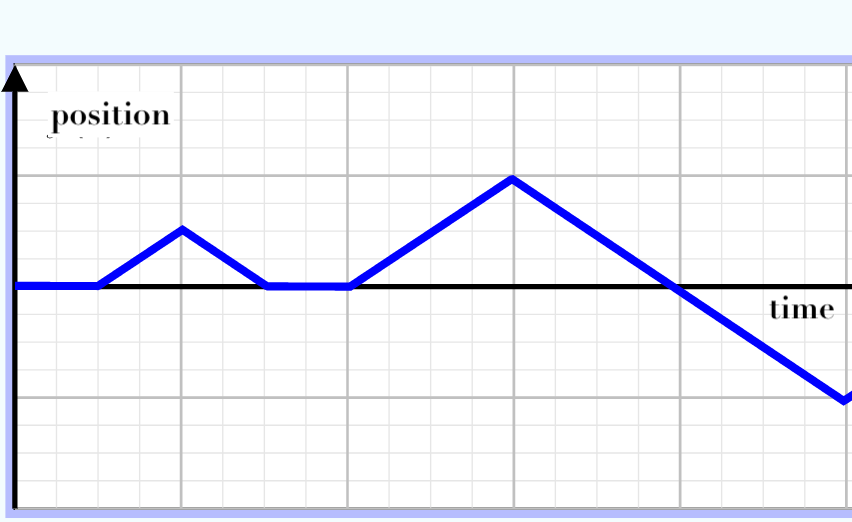
A man is running up and down his street. his displacement from his front door is shown on the graph above. explain his movement in words.
A man, starting at his front door he walks slowly up the street for 3 seconds, sprints for 4 seconds, then turns around and jogs for 6 seconds. he then walks back to his front door. give a rough sketch of this on the position time graph below.
how did you show that his velocity changed?
A man, starting at his front door he walks slowly up the street for 3 seconds going 2 meters per second. He then stays still for 10 seconds. sketch that on the graph.
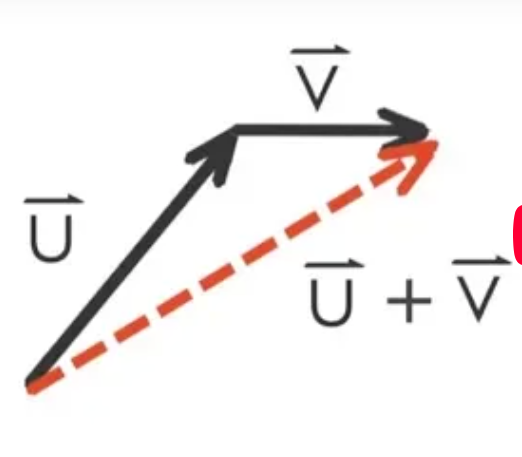
We have been talking about vectors, now we need to talk about how to add and subtract them. There are two basic ways - geometric or algebraic. here is a video explaining geometric.
do you have any questions?Review from the last lesson consider the following vectors
| Stavka koja se može prevući | arrow_right_alt | Odgovarajuća stavka |
|---|---|---|
| arrow_right_alt | the distance travelled | |
| arrow_right_alt | the displacement | |
the magnitude of | arrow_right_alt | we have not done this yet, no. |
add the following set of vectors. remember to redraw a vector so that the tip of one is at the tail of the next. then draw a line from the tail of the first to the tip of the second.
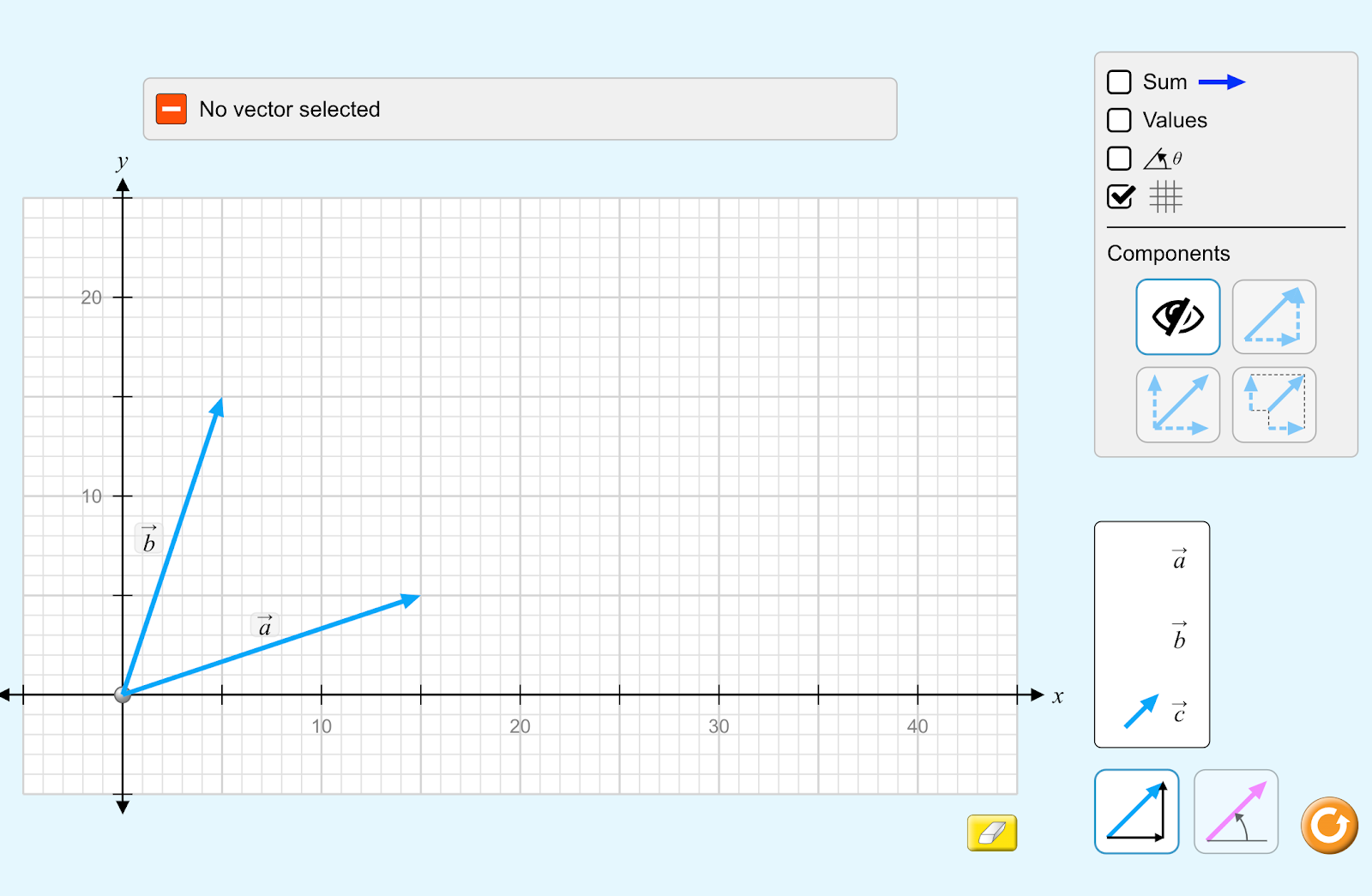
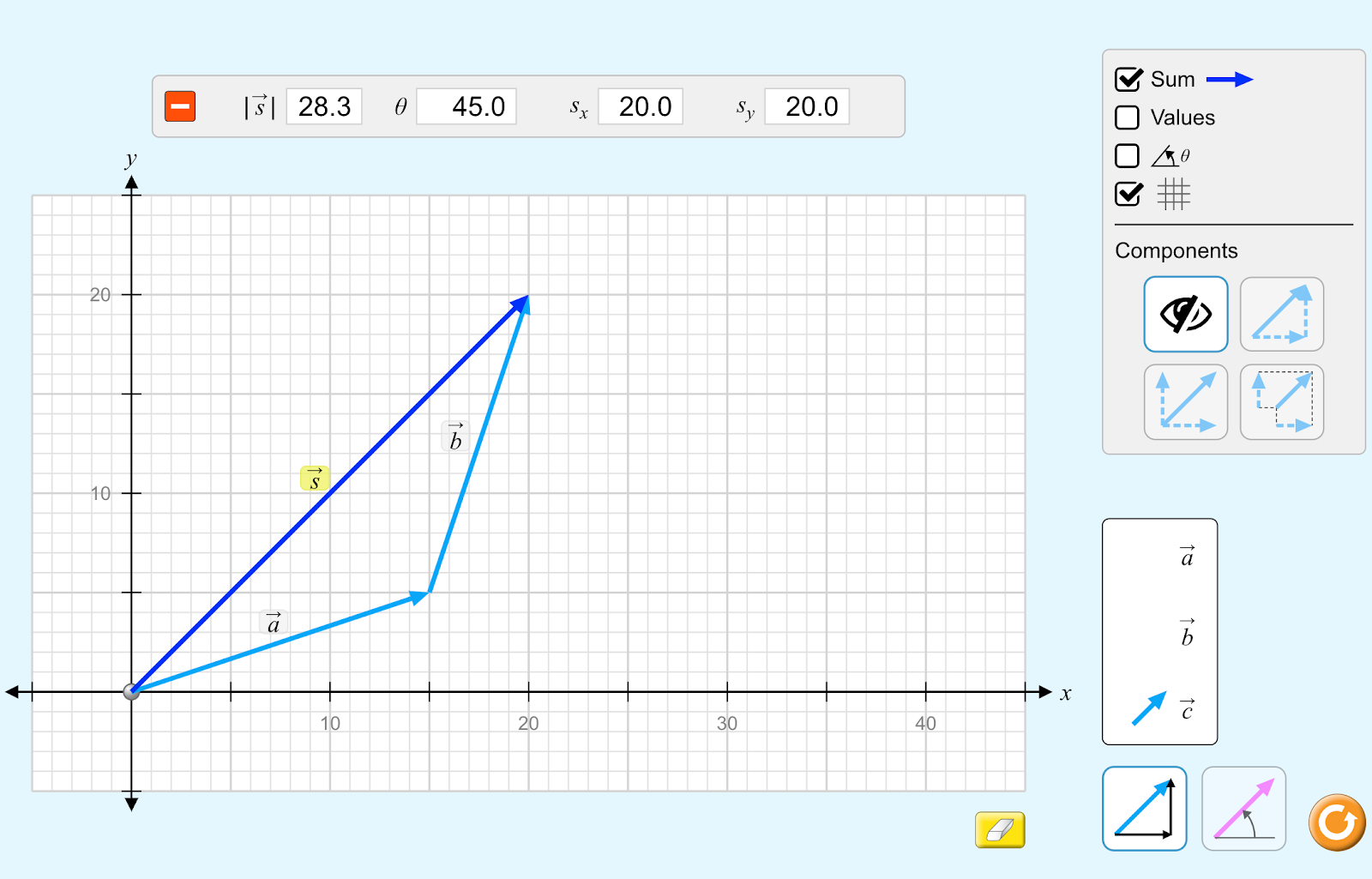
Play with the phet simulation with 2d vectors. Create two vectors 'a' and 'b'. click the sum button to show the resultant vector of a+b. spend some time playing in the lab setting. What there is no option to subtract vectors, what can you do to be able to subtract vectors?
On the phet simulation, If I asked you to create a vector that has a magnitude of 15.3 and formed an angle (\theta) of 31.6 to the x-axis, could you do it?
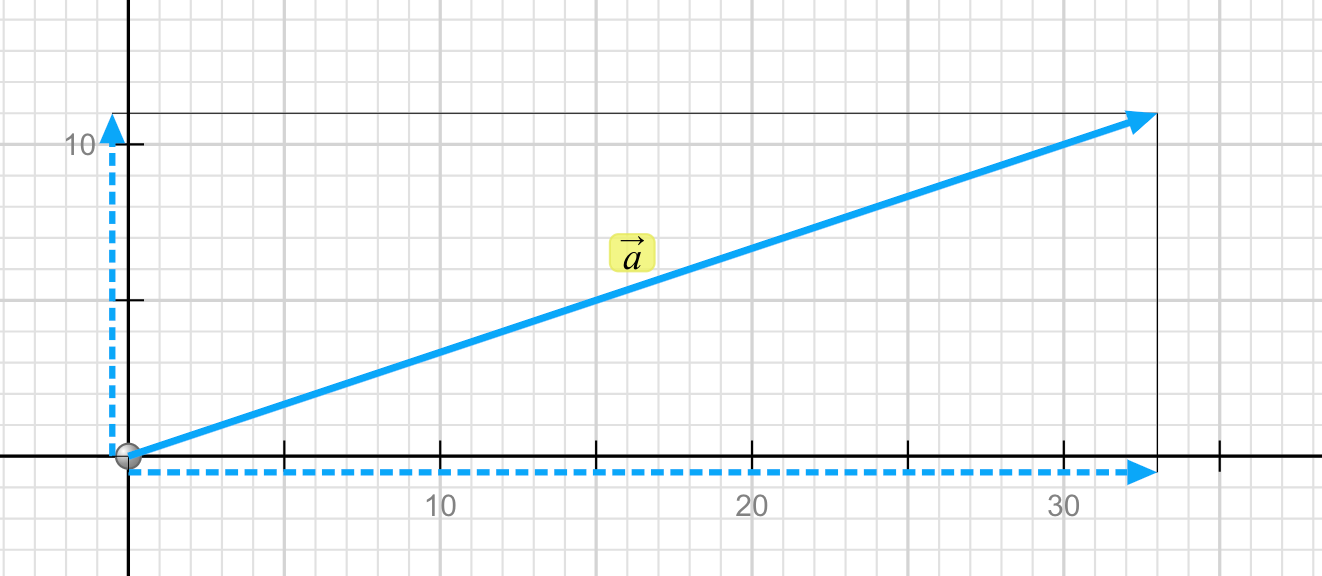
If you can add any two vectors to get a resultant vector, then you can describe any vector as the addition of two vectors, one going in the x direction and one going in the y direction. in the phet simulation, press the buttons under the word "components" in the top left. what do you see?
A unit vector is a vector with a magnitude of exactly 1 unit (whatever unit you are using) in a specific direction. If it is going in the positive x direction it is written as
sometimes we write vectors as being multiples of a unit vector, so the number shows the magnitude and the unit vector shows the direction.
Drag each written vector to the picture of the vector shown in the picture.

which is the component way of describing vector 'a'

We call this decomposing a vector. to decomposed a vector is to write as the sum of two _____________ vectors
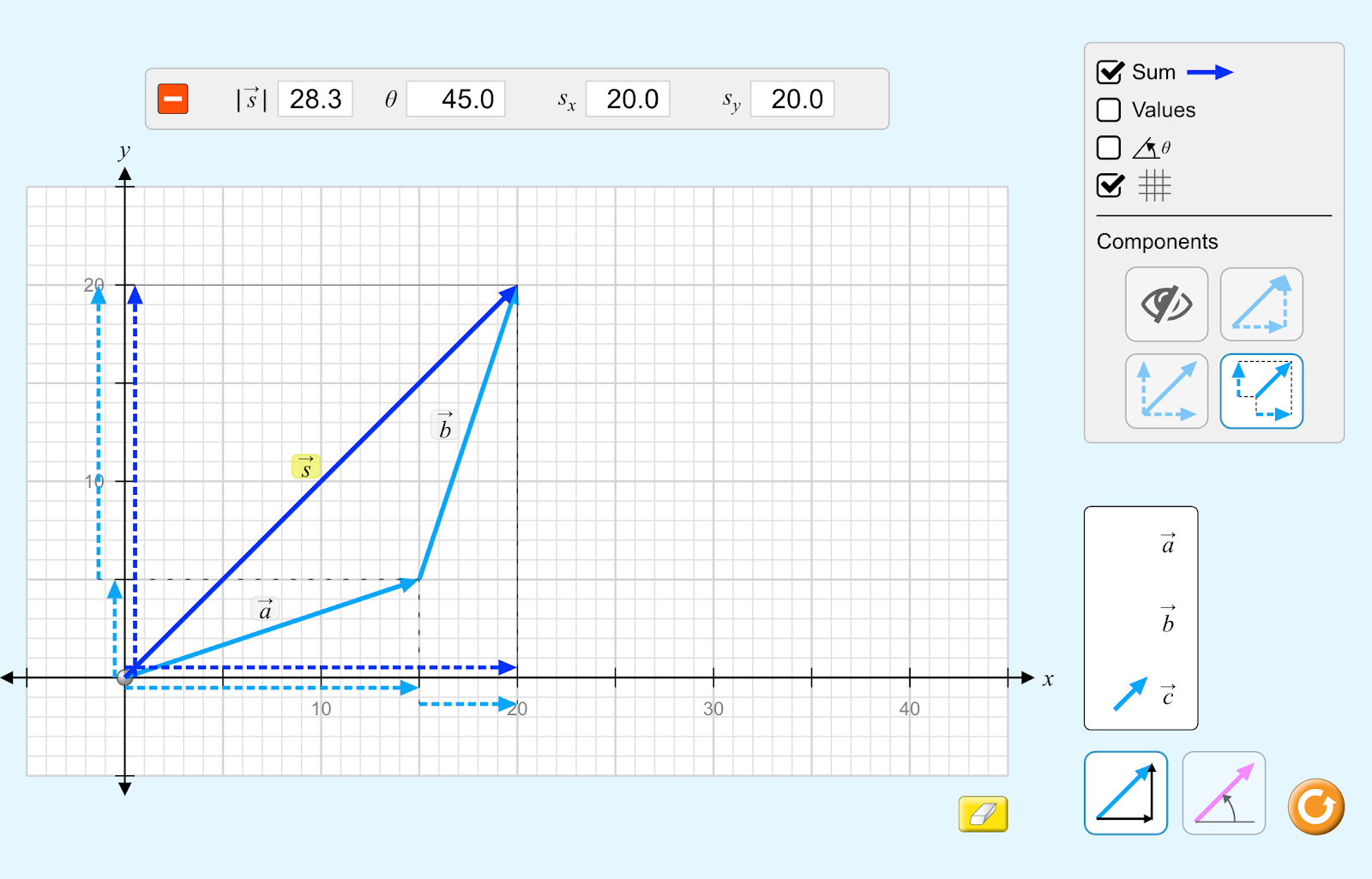
Play with the phet simulation with 2d vectors. create the situation show below. What is the horizontal component of a?

what is the horizontal component of b?
what is the horizontal component of the sum of a+b
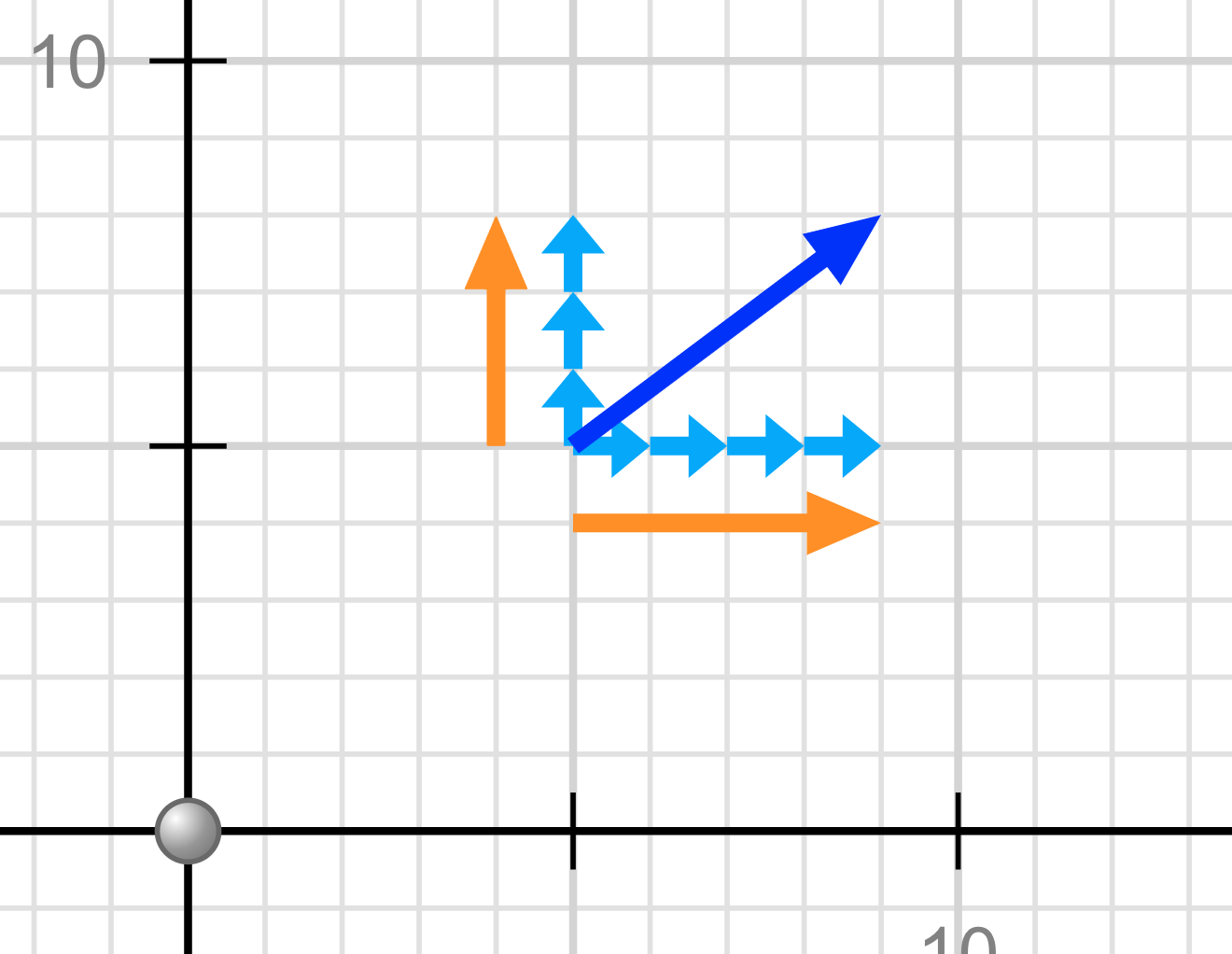
Play with the simulation. press the 'sum' button to show the resultant vector a+b. rearrange the vectors like so. this is called the "tip to tail" method of vector addition. (if you want to use the phet simulation to check you work on problem 11, that is a good idea. How many of them did you get right?

Turn on one of the "component views" like so. What is the relationship between the vertical components of a, b and s?

Adding vectors has a lot of applications in physics. It is useful for breaking 2 dimensional motion into two one-dimensional problems. we can also work with two separate factors to a situation. Consider a boat on a river. The boat is travelling at full power. on still water, this means 10 m/s. The water is fairly calm, and is traveling at 4 m/s. How fast is the boat moving with respect to the shore?
in regards to the last problem, match the vector addition question to the situation
| Stavka koja se može prevući | arrow_right_alt | Odgovarajuća stavka |
|---|---|---|
| arrow_right_alt | the boat is moving in the same direction as the river | |
| arrow_right_alt | the boat is moving in the opposite direction as the river | |
| arrow_right_alt | the boat is trying to cross the river |
A plane is flying 300mph. a gust of wind picks up going the opposite direction of the plane at 60 mph. What is the new speed of the plane?
how are you feeling about this?
reading position time graphs and explaining the movement they represent
making my own position-time graphs
what is a vector
how to add vectors graphically
how to describe a vector using a horizontal vector added to a vertical vector
what is a unit vector
what are vector components
how to add vectors in component form
how to read a velocity-time graph
how are some ways we might use vectors?
I've got this
i'm fuzzy
very confused