Describe the movement given in this graph.
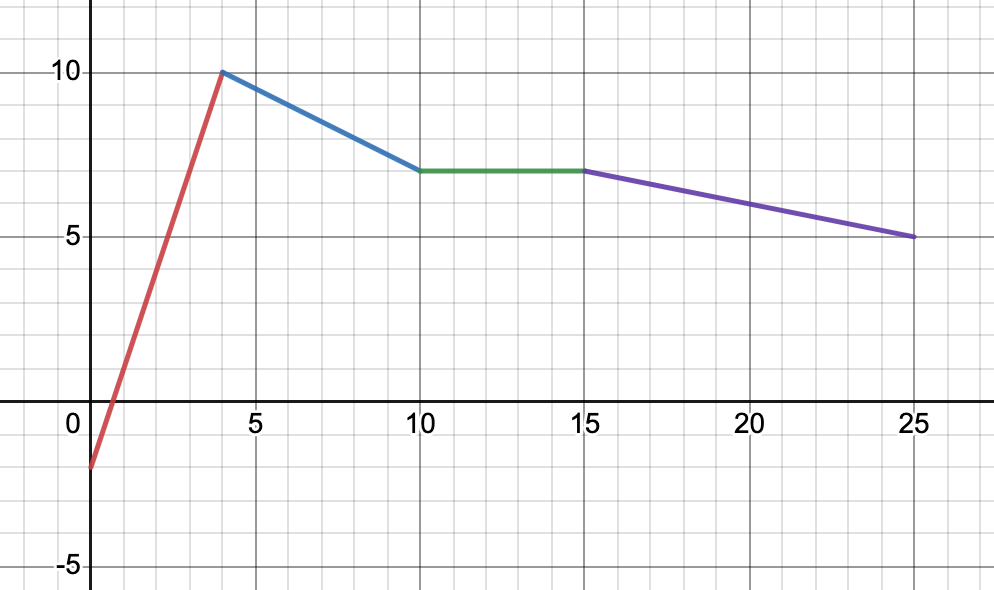
Describe the movement given in this graph.
We have already covered some of the basics of the difference between the words position, distance, displacement, speed and velocity. Read pages 18-31 in your book. This mostly covers some of the same material in a little more depth. Is there anything in here that you have questions about?
Match the problem type to the equation you would use.
| Draggable item | arrow_right_alt | Corresponding Item |
|---|---|---|
find the time given the velocity and displacement | arrow_right_alt | |
find the initial starting position given final position, velocity and time. | arrow_right_alt | |
find the distance an object fell from rest | arrow_right_alt | |
find the new velocity given a time and acceleration | arrow_right_alt |
given an average speed of 70 mph, and a 4 hour long drive, find the distance driven
explain why the average speed in the above problem is probably not the same as the average velocity.
while the average speed is not always going to be the same as the average velocity, the instantaneous speed will always be the same as the magnitude of the instantaneous velocity
Velocity and speed use the same units. which of the following are acceptable units for both speed and velocity?
I want you to compare the equation you chose for question 2 and units you chose for question 4. what do you notice?
grandma's house is 370 miles away. You know you will average 75 miles per hour on the drive. how long should it take you to go to grandma's house?
If something is at rest then its velocity is
Your book has the equation
but this is a specific version of the more general equation
given what you have already seen and read explain the differences - what is the difference between a and g, what is
given the equation
where x is the position of an object. if I asked what time something hit the ground (ie. the xx is 0) what steps mathematically would you take if you were given a,
Watch the following video on graphing 1 D motion. Do you have any questions?
Describe the movement given in this graph.
If this graph was being walked outside flipping physics' guy's house, would you ever be to the left of door? if so, when? if not, how do you know?
What does the y-intercept not being at 0 mean?
What are some easy mistakes you can see yourself making in interpreting these graphs?
We discussed frame of reference in class. What is the frame of reference for all of the flipping physicists walking diagrams? What doesn't move?
What do you mean the frame of reference bit made no sense? we talked about narcissists and only children and... oh. I see your point. Ok, this video is short, and explains things better.
A toy RC car is driving 2 m/s when it is picked up and put on a treadmill going 1 m/s. What happens? click all possibilities. (Assume ideal physics land, no air resistance or rolling resistance. the front of the treadmill is defined as the side of the machine you face when running.)
at 3 m/s | between 2-3 m/s | at 2 m/s | between 1-2 m/s | at 1 m/s | less than 1 m/s | |
|---|---|---|---|---|---|---|
the car runs off the back | ||||||
the car runs off the front | ||||||
the car runs off the side near the back | ||||||
the car runs off the side near the front |
Rosa's boat is paddling upstream at 125 cm/s relative to the water in a river which is flowing at 50 cm/s relative to the banks of the river. What is the resultant velocity of Rosa's boat (relative to the banks)?
you are in a car going 30 mph and a car passes you, from your frame of reference, the car is going 5 mph. how fast is the car going relative to the ground?
Another car wizzes past you going the opposite direction. looked like he was going 100 mph. How fast do you think he was going?