Preskoči na glavni sadržaj
Prijava
Sign up for FREE
arrow_back
Biblioteka

NJSLA - ESS Questions (released)

star
star
star
star
star
Posljednje ažuriranje 5 months ago
24 questions

There are over one million more solar power installations than fossil fuel plants in America. However, fossil fuels generate the most electricity, and solar power contributes the least.

Construction and use of electrical power plants produce carbon dioxide, which is a greenhouse gas (GHG). Building new power plants that maximize power production but minimize GHG emission is a current engineering challenge. One approach used in the United States is to construct power plants that use renewable energy.

Characteristics of electrical plants that use certain renewable or nonrenewable sources of energy are listed in Table 1.

Table 1. Energy Sources and Characteristics

Energy Sources

Renewable

Nonrenewable

Solar Power

Wind Power

Hydropower

Nuclear

Fossil Fuels

GHG Emissions Intensity
(grams of CO2 per kilowatt hour produced)

97

30

27

30

506

Cost
(cents per kilowatt hour produced)

6

6

2

9.5

≤7.5

Number of Facilities
(installations, turbines, or plants)

1.5 million

52,343

1,440

62

3,288

Electricity Generated in 2016

0.9%

5.6%

6.5%

20%

65%


1
Pitanje 1
1.

Which statement correctly answers the question of whether electrical plants that use wind power instead of fossil fuels would maximize power production and minimize GHG emissions?

DCI.ESS3.C.9-12.5
DCI.ESS3.C.9-12.6
…

There are over one million more solar power installations than fossil fuel plants in America. However, fossil fuels generate the most electricity, and solar power contributes the least.

Construction and use of electrical power plants produce carbon dioxide, which is a greenhouse gas (GHG). Building new power plants that maximize power production but minimize GHG emission is a current engineering challenge. One approach used in the United States is to construct power plants that use renewable energy.

Characteristics of electrical plants that use certain renewable or nonrenewable sources of energy are listed in Table 1.

Table 1. Energy Sources and Characteristics

Energy Sources

Renewable

Nonrenewable

Solar Power

Wind Power

Hydropower

Nuclear

Fossil Fuels

GHG Emissions Intensity
(grams of CO2 per kilowatt hour produced)

97

30

27

30

506

Cost
(cents per kilowatt hour produced)

6

6

2

9.5

≤7.5

Number of Facilities
(installations, turbines, or plants)

1.5 million

52,343

1,440

62

3,288

Electricity Generated in 2016

0.9%

5.6%

6.5%

20%

65%


1
Pitanje 2
2.

Energy facilities produce different amounts of electricity per facility depending on the type of energy source involved.

Drag the energy sources to arrange them in correct order from greatest (top) to the least (bottom) amount of electricity produced per facility.

  1. Wind power

  2. Fossil fuels

  3. Solar power

  4. Nuclear energy

  5. Hydropower

DCI.ESS3.C.9-12.5
DCI.ESS3.C.9-12.6
…

Changes in the concentration of carbon dioxide in the atmosphere impacts global sea level.

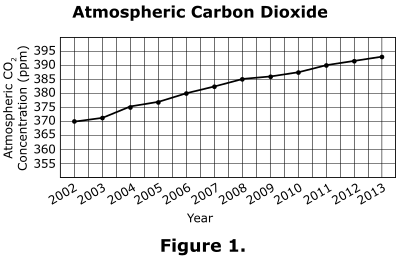
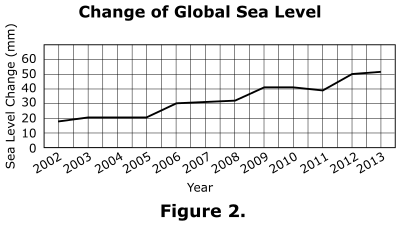
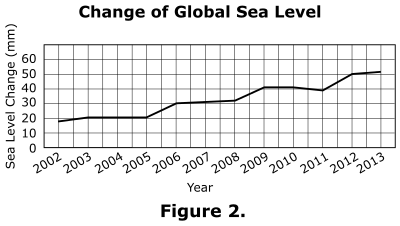
Rising carbon dioxide (CO2) levels are correlated with rising atmospheric temperatures. Researchers collected data, shown in Figures 1 and 2, on atmospheric carbon dioxide and global sea level.
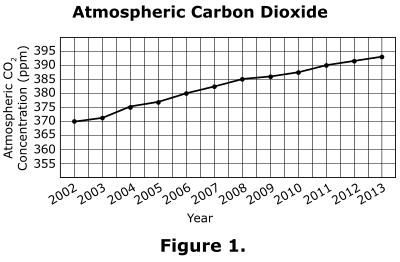
This line graph is titled Figure 1: Atmospheric Carbon Dioxide. The y-axis is labeled Atmospheric CO2 Concentration, open parenthesis, parts per million, close parenthesis, and ranges from 355 to 395 in increments of 5. The x-axis is labeled Year, and ranges from 2002 to 2013 in one-year increments. The line shows an overall increase over time; 2002 has a value of 370 parts per million, which increases to 392 parts per million in 2013.

This line graph is titled Figure 2: Change of Global Sea Level. The y-axis is labeled Sea Level Change, open parenthesis millimeters close parenthesis, and ranges from 0 to 60 in increments of 10. The x-axis is labeled Year, and ranges from 2002 to 2013 in one-year increments. The line shows an overall increase over time, from 18 millimeters in 2002 to 52 millimeters in 2013, although some years show little to no change.

1
Pitanje 3
3.

Which question is best addressed by analyzing the data?

DCI.ESS2.A.9-12.6
DCI.ESS2.A.9-12.7
…

Changes in the concentration of carbon dioxide in the atmosphere impacts global sea level.

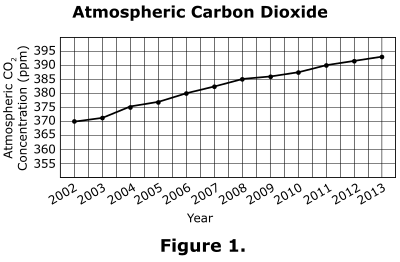
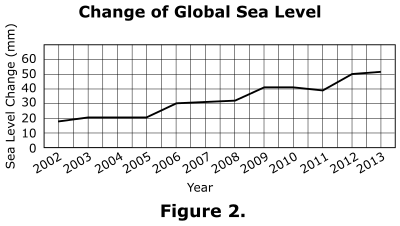
Rising carbon dioxide (CO2) levels are correlated with rising atmospheric temperatures. Researchers collected data, shown in Figures 1 and 2, on atmospheric carbon dioxide and global sea level.

This line graph is titled Figure 1: Atmospheric Carbon Dioxide. The y-axis is labeled Atmospheric CO2 Concentration, open parenthesis, parts per million, close parenthesis, and ranges from 355 to 395 in increments of 5. The x-axis is labeled Year, and ranges from 2002 to 2013 in one-year increments. The line shows an overall increase over time; 2002 has a value of 370 parts per million, which increases to 392 parts per million in 2013.

This line graph is titled Figure 2: Change of Global Sea Level. The y-axis is labeled Sea Level Change, open parenthesis millimeters close parenthesis, and ranges from 0 to 60 in increments of 10. The x-axis is labeled Year, and ranges from 2002 to 2013 in one-year increments. The line shows an overall increase over time, from 18 millimeters in 2002 to 52 millimeters in 2013, although some years show little to no change.

1
DCI.ESS2.A.9-12.6
DCI.ESS2.A.9-12.7
…

Changes in the concentration of carbon dioxide in the atmosphere impacts global sea level.

Rising carbon dioxide (CO2) levels are correlated with rising atmospheric temperatures. Researchers collected data, shown in Figures 1 and 2, on atmospheric carbon dioxide and global sea level.

This line graph is titled Figure 1: Atmospheric Carbon Dioxide. The y-axis is labeled Atmospheric CO2 Concentration, open parenthesis, parts per million, close parenthesis, and ranges from 355 to 395 in increments of 5. The x-axis is labeled Year, and ranges from 2002 to 2013 in one-year increments. The line shows an overall increase over time; 2002 has a value of 370 parts per million, which increases to 392 parts per million in 2013.

This line graph is titled Figure 2: Change of Global Sea Level. The y-axis is labeled Sea Level Change, open parenthesis millimeters close parenthesis, and ranges from 0 to 60 in increments of 10. The x-axis is labeled Year, and ranges from 2002 to 2013 in one-year increments. The line shows an overall increase over time, from 18 millimeters in 2002 to 52 millimeters in 2013, although some years show little to no change.

1
Pitanje 5
5.
Drugi mogući odgovor:
More sunlight reflected
Decreased ice sheet mass
Increased ice sheet mass
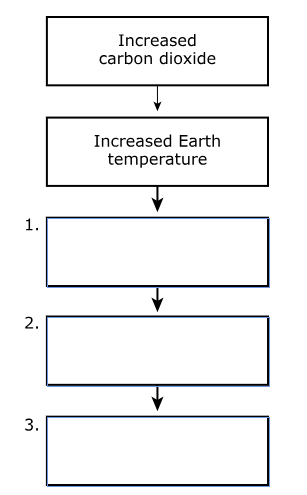
Increased Earth temperature
Less sunlight reflected
Decreased Earth temperature
DCI.ESS2.D.9-12.6
DCI.ESS2.D.9-12.7
…

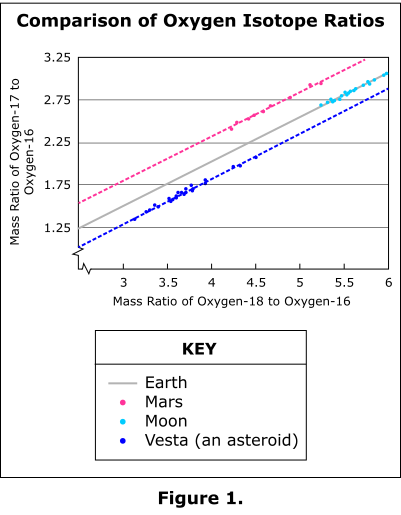
Information about Earth’s early history may be contained in materials from Mars, the Moon, and meteorites.

Various theories have been presented to explain the formation of the Moon during the early history of Earth:

Fission Theory: The Moon formed when a small, outer portion of the spinning Earth separated from the larger body and moved into space.

Capture Theory: The Moon formed elsewhere in the solar system, but in a similar manner to Earth. It then moved toward Earth and was captured by Earth’s gravity.

Condensation Theory: The Moon formed separately from Earth, but in a similar manner and in the same vicinity.  

Impact Theory: The Moon formed following a violent impact between Earth and a Mars-sized object. The impact caused the outer portion of molten Earth to be ejected. Gravity caused the debris to attract and eventually combine to form the Moon.

1
Pitanje 6
6.
DCI.ESS1.C.9-12.5
DCI.ESS1.C.9-12.6
…

Information about Earth’s early history may be contained in materials from Mars, the Moon, and meteorites.

Various theories have been presented to explain the formation of the Moon during the early history of Earth:

Fission Theory: The Moon formed when a small, outer portion of the spinning Earth separated from the larger body and moved into space.

Capture Theory: The Moon formed elsewhere in the solar system, but in a similar manner to Earth. It then moved toward Earth and was captured by Earth’s gravity.

Condensation Theory: The Moon formed separately from Earth, but in a similar manner and in the same vicinity.  

Impact Theory: The Moon formed following a violent impact between Earth and a Mars-sized object. The impact caused the outer portion of molten Earth to be ejected. Gravity caused the debris to attract and eventually combine to form the Moon.

1
Pitanje 7
7.
DCI.ESS1.C.9-12.5
DCI.ESS1.C.9-12.6
…

Information about Earth’s early history may be contained in materials from Mars, the Moon, and meteorites.

Various theories have been presented to explain the formation of the Moon during the early history of Earth:

Fission Theory: The Moon formed when a small, outer portion of the spinning Earth separated from the larger body and moved into space.

Capture Theory: The Moon formed elsewhere in the solar system, but in a similar manner to Earth. It then moved toward Earth and was captured by Earth’s gravity.

Condensation Theory: The Moon formed separately from Earth, but in a similar manner and in the same vicinity.  

Impact Theory: The Moon formed following a violent impact between Earth and a Mars-sized object. The impact caused the outer portion of molten Earth to be ejected. Gravity caused the debris to attract and eventually combine to form the Moon.

1
Pitanje 8
8.

Every planetary body in the solar system has a specific composition and density. Based on the data, indicate which statement would support each formation theory.

Select all of the correct answers.

Fission

Capture

Condensation

Impact

Earth and the Moon have similar compositions.

Earth and the Moon have different compositions.

DCI.ESS1.C.9-12.5
DCI.ESS1.C.9-12.6
…

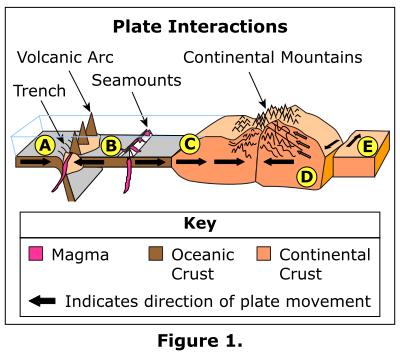
Tectonic plates interact in different ways, but most interactions result in some type of mountain formation.

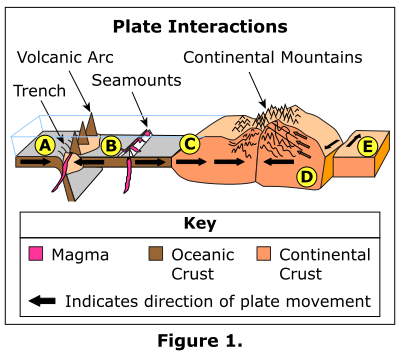
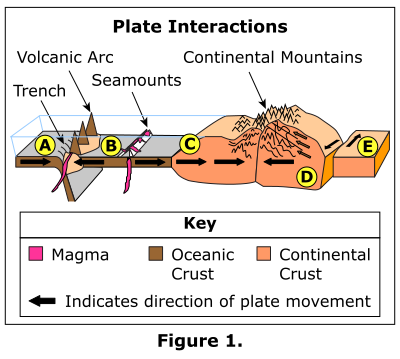
Figure 1 models conditions at plate boundaries that create various types of surface features. Each separate plate is marked with a letter, with arrows showing the plates’ directions of movement: moving toward or away from each other, or sliding past each other.

Figure 1 is titled Plate Interactions and shows different ways continental and oceanic plates interact.  There are five different plates, labeled A through E.  Plates A and B are oceanic crust, and plates C, D, and E are continental crust.  Plate A is moving toward Plate B.  At the point of interaction, plate A moves downward under plate B, creating a low area called a Trench and a series of three volcanoes called a Volcanic, Arc.  Magma can be seen traveling up toward the volcanoes from below Plate A.  Plate B is split, where half is travelling to the left, toward plate A, and half is travelling to the right, towards plate C.  At the middle point of plate B, where the plate is split, is a rise called Seamounts.  Magma can be seen flowing from under Plate B into the seamounts.  Plate C and plate D are travelling toward each other.  Where they meet, Continental Mountains are formed.  Plate E is sliding along the side of plate D with an arrow on the edge of D pointing toward the viewer and an arrow at the connecting edge of plate E pointing away.

Table 1 describes types of plate boundaries and the interactions between them.

Table 1. Plate Boundaries

Boundary Type

Tectonic Process

Resulting Surface Feature

Convergent with no subduction

Compression and uplift

Mountain

Convergent with subduction

Volcanism, compression, and uplift

Mountain and/or volcano

Divergent

Volcanism, rifting, and sea floor spreading

Seamount

Transform

Side-to-side motion

None


1
Pitanje 9
9.
DCI.ESS2.B.9-12.4
DCI.ESS2.B.9-12.5
…

Tectonic plates interact in different ways, but most interactions result in some type of mountain formation.

Figure 1 models conditions at plate boundaries that create various types of surface features. Each separate plate is marked with a letter, with arrows showing the plates’ directions of movement: moving toward or away from each other, or sliding past each other.

Figure 1 is titled Plate Interactions and shows different ways continental and oceanic plates interact.  There are five different plates, labeled A through E.  Plates A and B are oceanic crust, and plates C, D, and E are continental crust.  Plate A is moving toward Plate B.  At the point of interaction, plate A moves downward under plate B, creating a low area called a Trench and a series of three volcanoes called a Volcanic, Arc.  Magma can be seen traveling up toward the volcanoes from below Plate A.  Plate B is split, where half is travelling to the left, toward plate A, and half is travelling to the right, towards plate C.  At the middle point of plate B, where the plate is split, is a rise called Seamounts.  Magma can be seen flowing from under Plate B into the seamounts.  Plate C and plate D are travelling toward each other.  Where they meet, Continental Mountains are formed.  Plate E is sliding along the side of plate D with an arrow on the edge of D pointing toward the viewer and an arrow at the connecting edge of plate E pointing away.

Table 1 describes types of plate boundaries and the interactions between them.

Table 1. Plate Boundaries

Boundary Type

Tectonic Process

Resulting Surface Feature

Convergent with no subduction

Compression and uplift

Mountain

Convergent with subduction

Volcanism, compression, and uplift

Mountain and/or volcano

Divergent

Volcanism, rifting, and sea floor spreading

Seamount

Transform

Side-to-side motion

None


1
Pitanje 10
10.

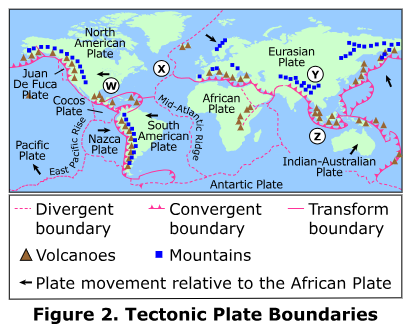
Figure 2 shows tectonic plate boundaries on Earth, with areas labeled W, X, Y, and Z. Identify the location in Figure 2 that best represents the boundary between plates C and D in Figure 1.

Select the correct location from the four options.

DCI.ESS2.B.9-12.4
DCI.ESS2.B.9-12.5
…

Tectonic plates interact in different ways, but most interactions result in some type of mountain formation.

Figure 1 models conditions at plate boundaries that create various types of surface features. Each separate plate is marked with a letter, with arrows showing the plates’ directions of movement: moving toward or away from each other, or sliding past each other.

Figure 1 is titled Plate Interactions and shows different ways continental and oceanic plates interact.  There are five different plates, labeled A through E.  Plates A and B are oceanic crust, and plates C, D, and E are continental crust.  Plate A is moving toward Plate B.  At the point of interaction, plate A moves downward under plate B, creating a low area called a Trench and a series of three volcanoes called a Volcanic, Arc.  Magma can be seen traveling up toward the volcanoes from below Plate A.  Plate B is split, where half is travelling to the left, toward plate A, and half is travelling to the right, towards plate C.  At the middle point of plate B, where the plate is split, is a rise called Seamounts.  Magma can be seen flowing from under Plate B into the seamounts.  Plate C and plate D are travelling toward each other.  Where they meet, Continental Mountains are formed.  Plate E is sliding along the side of plate D with an arrow on the edge of D pointing toward the viewer and an arrow at the connecting edge of plate E pointing away.

Table 1 describes types of plate boundaries and the interactions between them.

Table 1. Plate Boundaries

Boundary Type

Tectonic Process

Resulting Surface Feature

Convergent with no subduction

Compression and uplift

Mountain

Convergent with subduction

Volcanism, compression, and uplift

Mountain and/or volcano

Divergent

Volcanism, rifting, and sea floor spreading

Seamount

Transform

Side-to-side motion

None


1
Pitanje 11
11.
DCI.ESS2.B.9-12.4
DCI.ESS2.B.9-12.5
…

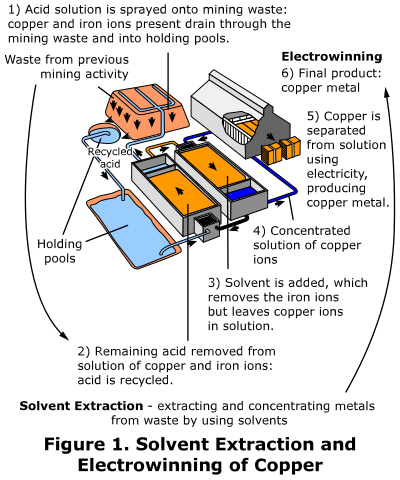
Traditional mining techniques used to extract materials such as copper are being abandoned in some cases in favor of other techniques that also produce these materials.

Removal of copper from Earth’s crust through mining has reduced this nonrenewable resource over time. Increased use of improved technologies, such as solvent extraction and electrowinning shown in Figure 1, has reduced the reliance on standard raw copper ore. These technologies are used in a process to extract copper from waste materials previously produced from traditional mining. The amount of waste available from previous mining makes the use of these technologies efficient for many years.

This diagram is labeled Figure 1: Solvent Extraction and Electrowinning of Copper. Below the diagram is a definition for Solvent Extraction: extracting and concentrating metals from waste by using solvents. The diagram shows the process in a system for extracting copper from mining waste. The top left of the diagram shows the starting point, where waste from previous mining activity enters the system. Caption 1 reads, Acid solution is sprayed onto mining waste: copper and iron ions present drain through the mining waste and into holding pools. To the left of the mining waste are two pools labeled Holding pools; one is next to the waste, a small pool labeled Recycled acid, which connects by a pipe to another larger holding pool farther down. The mining waste is connected to a chamber, described by Caption 2, which reads, Remaining acid removed from solution of copper and iron ions: acid is recycled. This chamber is also connected to the larger holding pool and to a second chamber to the right. The second chamber is described by Caption 3, which reads, Solvent is added, which removes the iron ions but leaves copper ions in solution. This chamber is connected by pipes to a factory building. The pipes are described by Caption 4, which reads, Concentrated solution of copper ions. The factory building is described by Caption 5, which reads, Copper is separated from solution using electricity, producing copper metal. Caption 6, above the factory building, reads, Electrowinning final product: copper metal.

1
DCI.ESS3.C.9-12.5
DCI.ESS3.C.9-12.6
…

Traditional mining techniques used to extract materials such as copper are being abandoned in some cases in favor of other techniques that also produce these materials.

Removal of copper from Earth’s crust through mining has reduced this nonrenewable resource over time. Increased use of improved technologies, such as solvent extraction and electrowinning shown in Figure 1, has reduced the reliance on standard raw copper ore. These technologies are used in a process to extract copper from waste materials previously produced from traditional mining. The amount of waste available from previous mining makes the use of these technologies efficient for many years.

This diagram is labeled Figure 1: Solvent Extraction and Electrowinning of Copper. Below the diagram is a definition for Solvent Extraction: extracting and concentrating metals from waste by using solvents. The diagram shows the process in a system for extracting copper from mining waste. The top left of the diagram shows the starting point, where waste from previous mining activity enters the system. Caption 1 reads, Acid solution is sprayed onto mining waste: copper and iron ions present drain through the mining waste and into holding pools. To the left of the mining waste are two pools labeled Holding pools; one is next to the waste, a small pool labeled Recycled acid, which connects by a pipe to another larger holding pool farther down. The mining waste is connected to a chamber, described by Caption 2, which reads, Remaining acid removed from solution of copper and iron ions: acid is recycled. This chamber is also connected to the larger holding pool and to a second chamber to the right. The second chamber is described by Caption 3, which reads, Solvent is added, which removes the iron ions but leaves copper ions in solution. This chamber is connected by pipes to a factory building. The pipes are described by Caption 4, which reads, Concentrated solution of copper ions. The factory building is described by Caption 5, which reads, Copper is separated from solution using electricity, producing copper metal. Caption 6, above the factory building, reads, Electrowinning final product: copper metal.

1
Pitanje 13
13.

DCI.ESS3.C.9-12.5
DCI.ESS3.C.9-12.6
…

Traditional mining techniques used to extract materials such as copper are being abandoned in some cases in favor of other techniques that also produce these materials.

Removal of copper from Earth’s crust through mining has reduced this nonrenewable resource over time. Increased use of improved technologies, such as solvent extraction and electrowinning shown in Figure 1, has reduced the reliance on standard raw copper ore. These technologies are used in a process to extract copper from waste materials previously produced from traditional mining. The amount of waste available from previous mining makes the use of these technologies efficient for many years.

This diagram is labeled Figure 1: Solvent Extraction and Electrowinning of Copper. Below the diagram is a definition for Solvent Extraction: extracting and concentrating metals from waste by using solvents. The diagram shows the process in a system for extracting copper from mining waste. The top left of the diagram shows the starting point, where waste from previous mining activity enters the system. Caption 1 reads, Acid solution is sprayed onto mining waste: copper and iron ions present drain through the mining waste and into holding pools. To the left of the mining waste are two pools labeled Holding pools; one is next to the waste, a small pool labeled Recycled acid, which connects by a pipe to another larger holding pool farther down. The mining waste is connected to a chamber, described by Caption 2, which reads, Remaining acid removed from solution of copper and iron ions: acid is recycled. This chamber is also connected to the larger holding pool and to a second chamber to the right. The second chamber is described by Caption 3, which reads, Solvent is added, which removes the iron ions but leaves copper ions in solution. This chamber is connected by pipes to a factory building. The pipes are described by Caption 4, which reads, Concentrated solution of copper ions. The factory building is described by Caption 5, which reads, Copper is separated from solution using electricity, producing copper metal. Caption 6, above the factory building, reads, Electrowinning final product: copper metal.

1
DCI.ESS3.A.9-12.4
DCI.ESS3.A.9-12.5
…

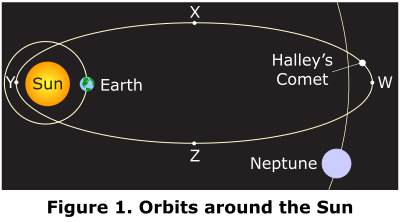
While most objects in the solar system travel around the Sun in nearly circular orbits, objects such as Halley’s Comet travel in orbits that are clearly elliptical. 

Figure 1 models the orbits of Earth, Neptune, and Halley’s Comet around the Sun (not to scale). The labeled points mark the path of Halley’s Comet.

This figure is a diagram titled Figure 1. Orbits around the Sun. At the far left side of the diagram is the sun. Earth is shown on its circular orbit around the Sun, to the right of the Sun but close to it. At the far right side of the diagram, a slightly curved line depicts a portion of Neptune’s orbit around the Sun. A large oval, much wider than it is tall, represents the orbit of Halley’s Comet around the Sun. The right side of the orbit of Halley’s Comet crosses the orbit of Neptune twice. The far right extremity of the comet’s orbit is labeled point W. Tracing the orbit from point W, up and around in a counterclockwise direction, Halley’s Comet itself is shown, just before the point where its path crosses the orbit of Neptune. Continuing along the orbit of the comet, the top-most point is labeled X. The orbit continues, crossing Earth’s orbit and continuing closely around the left side of the Sun, between the Sun and the orbit of Earth. The left most point is labeled Y, and is opposite and the point of Halley's Comet's orbit farthest away from point W. From point Y, the orbit continues around the Sun, crossing Earth’s orbit again. The lowest point on the orbit, opposite of point X, is labeled Z. From point Z the orbit continues to the right, crossing the orbit of Neptune again before reaching point W.

Table 1 compares data relevant to the orbits of Earth, Neptune, and Halley’s Comet.

Table 1. Orbit Data

Measure

Earth

Neptune

Halley’s Comet

Mass (kg)

5.97 × 1024

1.02 × 1026

2.2 × 10¹⁴

Average distance
from Sun center
(in AU)

1.00

30.07

17.83

Semi-major axis
length of orbit, R
(in AU)

1.00

30.11

17.83

Distance between
foci of orbit, f
(in AU)

0.0167

    0.285

17.2

1
Pitanje 15
15.

Eccentricity (e) is a measure that indicates the extent to which an orbit is elliptical. The value of e equals the distance between the foci of an orbit (f) divided by the length of the semi-major axis of the orbit (R).

Which is the orbital eccentricity of Halley’s Comet?

DCI.ESS1.B.9-12.6
DCI.ESS1.B.9-12.7
…

While most objects in the solar system travel around the Sun in nearly circular orbits, objects such as Halley’s Comet travel in orbits that are clearly elliptical. 

Figure 1 models the orbits of Earth, Neptune, and Halley’s Comet around the Sun (not to scale). The labeled points mark the path of Halley’s Comet.

This figure is a diagram titled Figure 1. Orbits around the Sun. At the far left side of the diagram is the sun. Earth is shown on its circular orbit around the Sun, to the right of the Sun but close to it. At the far right side of the diagram, a slightly curved line depicts a portion of Neptune’s orbit around the Sun. A large oval, much wider than it is tall, represents the orbit of Halley’s Comet around the Sun. The right side of the orbit of Halley’s Comet crosses the orbit of Neptune twice. The far right extremity of the comet’s orbit is labeled point W. Tracing the orbit from point W, up and around in a counterclockwise direction, Halley’s Comet itself is shown, just before the point where its path crosses the orbit of Neptune. Continuing along the orbit of the comet, the top-most point is labeled X. The orbit continues, crossing Earth’s orbit and continuing closely around the left side of the Sun, between the Sun and the orbit of Earth. The left most point is labeled Y, and is opposite and the point of Halley's Comet's orbit farthest away from point W. From point Y, the orbit continues around the Sun, crossing Earth’s orbit again. The lowest point on the orbit, opposite of point X, is labeled Z. From point Z the orbit continues to the right, crossing the orbit of Neptune again before reaching point W.

Table 1 compares data relevant to the orbits of Earth, Neptune, and Halley’s Comet.

Table 1. Orbit Data

Measure

Earth

Neptune

Halley’s Comet

Mass (kg)

5.97 × 1024

1.02 × 1026

2.2 × 10¹⁴

Average distance
from Sun center
(in AU)

1.00

30.07

17.83

Semi-major axis
length of orbit, R
(in AU)

1.00

30.11

17.83

Distance between
foci of orbit, f
(in AU)

0.0167

    0.285

17.2

1
Pitanje 16
16.

DCI.ESS1.B.9-12.6
DCI.ESS1.B.9-12.7
…

While most objects in the solar system travel around the Sun in nearly circular orbits, objects such as Halley’s Comet travel in orbits that are clearly elliptical. 

Figure 1 models the orbits of Earth, Neptune, and Halley’s Comet around the Sun (not to scale). The labeled points mark the path of Halley’s Comet.

This figure is a diagram titled Figure 1. Orbits around the Sun. At the far left side of the diagram is the sun. Earth is shown on its circular orbit around the Sun, to the right of the Sun but close to it. At the far right side of the diagram, a slightly curved line depicts a portion of Neptune’s orbit around the Sun. A large oval, much wider than it is tall, represents the orbit of Halley’s Comet around the Sun. The right side of the orbit of Halley’s Comet crosses the orbit of Neptune twice. The far right extremity of the comet’s orbit is labeled point W. Tracing the orbit from point W, up and around in a counterclockwise direction, Halley’s Comet itself is shown, just before the point where its path crosses the orbit of Neptune. Continuing along the orbit of the comet, the top-most point is labeled X. The orbit continues, crossing Earth’s orbit and continuing closely around the left side of the Sun, between the Sun and the orbit of Earth. The left most point is labeled Y, and is opposite and the point of Halley's Comet's orbit farthest away from point W. From point Y, the orbit continues around the Sun, crossing Earth’s orbit again. The lowest point on the orbit, opposite of point X, is labeled Z. From point Z the orbit continues to the right, crossing the orbit of Neptune again before reaching point W.

Table 1 compares data relevant to the orbits of Earth, Neptune, and Halley’s Comet.

Table 1. Orbit Data

Measure

Earth

Neptune

Halley’s Comet

Mass (kg)

5.97 × 1024

1.02 × 1026

2.2 × 10¹⁴

Average distance
from Sun center
(in AU)

1.00

30.07

17.83

Semi-major axis
length of orbit, R
(in AU)

1.00

30.11

17.83

Distance between
foci of orbit, f
(in AU)

0.0167

    0.285

17.2

1
Pitanje 17
17.

DCI.ESS1.B.9-12.6
DCI.ESS1.B.9-12.7
…

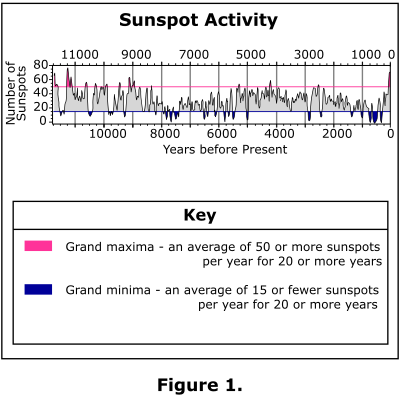
Sunspot activity rises and falls regularly in 11-year cycles, but the amount of variation from one cycle to the next appears to be random.

Earth’s climate is directly impacted by the Sun’s output, and the appearance of sunspots has been associated with greater solar output. Figure 1 represents an estimation of sunspot activity for the past 11,000 years based on observations and models.

Figure 1 is a line graph titled Figure 1: Sunspot Activity. The y-axis is labeled Number of Sunspots and ranges from 0 to 80. The x-axis is labeled Years before Present, and ranges from twelve thousand on the left to 0 on the right. Two types of features in the data are highlighted, grand maxima and grand minima. Grand maxima are defined as an average of 50 or more sunspots per year for 20 or more years. Grand minima are defined as an average of 15 or fewer sunspots per year for 20 or more years. Overall, sunspot activity is shown to fluctuate frequently, mostly between an average above 15 and below 50 sunspots per year, with lowest points of 2 and highest points close to 80 sunspots per year. There are few grand maxima periods and more than 20 grand minima periods over the whole graph. The graph shows a general trend of decrease between twelve thousand and 7500 years ago, showing gradually lower high points in the fluctuations and lower low points. It then gradually increases between 7500 and 4000 years ago, and decreases again between 4000 years ago and 500 years ago. The graph indicates a rapid rise over the last 500 years.

1
Pitanje 18
18.

Based on Figure 1, which statement best summarizes the pattern of sunspot activity over the past 2,000 years?

DCI.ESS2.A.9-12.6
DCI.ESS2.A.9-12.7
…

Sunspot activity rises and falls regularly in 11-year cycles, but the amount of variation from one cycle to the next appears to be random.

Earth’s climate is directly impacted by the Sun’s output, and the appearance of sunspots has been associated with greater solar output. Figure 1 represents an estimation of sunspot activity for the past 11,000 years based on observations and models.

Figure 1 is a line graph titled Figure 1: Sunspot Activity. The y-axis is labeled Number of Sunspots and ranges from 0 to 80. The x-axis is labeled Years before Present, and ranges from twelve thousand on the left to 0 on the right. Two types of features in the data are highlighted, grand maxima and grand minima. Grand maxima are defined as an average of 50 or more sunspots per year for 20 or more years. Grand minima are defined as an average of 15 or fewer sunspots per year for 20 or more years. Overall, sunspot activity is shown to fluctuate frequently, mostly between an average above 15 and below 50 sunspots per year, with lowest points of 2 and highest points close to 80 sunspots per year. There are few grand maxima periods and more than 20 grand minima periods over the whole graph. The graph shows a general trend of decrease between twelve thousand and 7500 years ago, showing gradually lower high points in the fluctuations and lower low points. It then gradually increases between 7500 and 4000 years ago, and decreases again between 4000 years ago and 500 years ago. The graph indicates a rapid rise over the last 500 years.

1
Pitanje 19
19.

DCI.ESS2.A.9-12.6
DCI.ESS2.A.9-12.7
…

Sunspot activity rises and falls regularly in 11-year cycles, but the amount of variation from one cycle to the next appears to be random.

Earth’s climate is directly impacted by the Sun’s output, and the appearance of sunspots has been associated with greater solar output. Figure 1 represents an estimation of sunspot activity for the past 11,000 years based on observations and models.

Figure 1 is a line graph titled Figure 1: Sunspot Activity. The y-axis is labeled Number of Sunspots and ranges from 0 to 80. The x-axis is labeled Years before Present, and ranges from twelve thousand on the left to 0 on the right. Two types of features in the data are highlighted, grand maxima and grand minima. Grand maxima are defined as an average of 50 or more sunspots per year for 20 or more years. Grand minima are defined as an average of 15 or fewer sunspots per year for 20 or more years. Overall, sunspot activity is shown to fluctuate frequently, mostly between an average above 15 and below 50 sunspots per year, with lowest points of 2 and highest points close to 80 sunspots per year. There are few grand maxima periods and more than 20 grand minima periods over the whole graph. The graph shows a general trend of decrease between twelve thousand and 7500 years ago, showing gradually lower high points in the fluctuations and lower low points. It then gradually increases between 7500 and 4000 years ago, and decreases again between 4000 years ago and 500 years ago. The graph indicates a rapid rise over the last 500 years.

1
Pitanje 20
20.
DCI.ESS2.A.9-12.6
DCI.ESS2.A.9-12.7
…

Even though plastics break down into smaller pieces, most plastics do not completely degrade in the ocean. The Great Pacific Garbage Patch (GPGP) is an area where plastic debris and other trash accumulates in the ocean.

This could have harmful consequences on marine life. The tiny plastic pieces are often mistaken for food. One potential solution focuses on preventing plastic waste from reaching the oceans, a problem known as “plastic waste leakage.” 

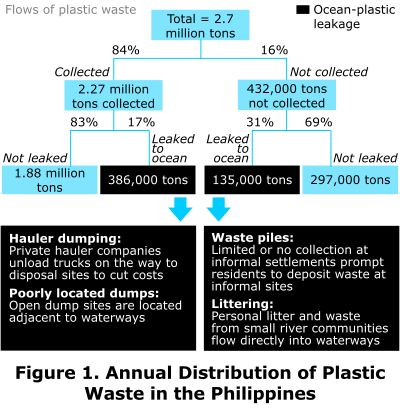
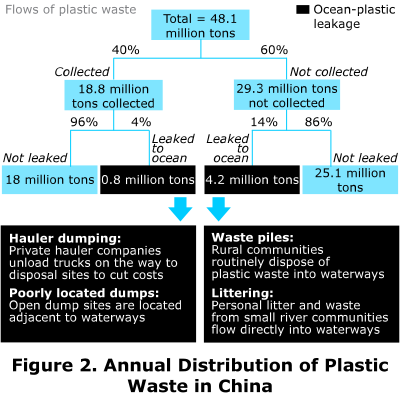
Information about annual usage, collection, and plastic waste leakage for the Philippines and China are shown in Figures 1 and 2.

Figure 1 is a flow chart titled 'Figure 1: Annual Distribution of Plastic Waste in Philippines.' At the top, a total of 2.7 million tons of plastic waste is given. Of that amount, 84% or 2.27 million tons are collected, and 16% or 432,000 tons are not collected. Of the collected waste, 83% or 1.88 million tons are not leaked to the ocean, while 17% or 386,000 tons are leaked to the ocean. Two causes of collected plastic being leaked to the ocean are shown. The first cause is hauler dumping, which is when private hauler companies unload trucks en route to disposal sites to cut costs. The second cause is poorly located dumps, which are open dump sites located adjacent to waterways. Of the 432,000 tons of plastic waste not collected, 69% or 297,000 tons are not leaked to the ocean, while 31% or 135,000 tons are leaked to the ocean. Two causes of non-collected plastic waste leaking to the ocean are shown: The first cause is waste piles due to limited or no collection at informal settlements prompting residents to deposit waste at informal sites.  The second cause is littering, where personal litter and waste from small river communities flow directly into waterways.

Figure 2 is a flow chart titled, Figure 2: Annual Distribution of Plastic Waste in China. At the top, a total of 48.1 million tons of plastic waste is given. Of that amount, 40% or 18.8 million tons are collected, and 60% or 29.3 million tons are not collected. Of the collected waste, 96% or 18 million tons are not leaked to the ocean, while 4% or 0.8 million tons are leaked to the ocean. Two causes of collected plastic being leaked to the ocean are shown. The first cause is hauler dumping, which is when private hauler companies unload trucks en route to disposal sites to cut costs. The second cause is poorly located dumps, which are open dump sites located adjacent to waterways. Of the 29.3 million tons of plastic waste not collected, 86% or 25.1 million tons are not leaked to the ocean, while 14% or 4.2 million tons are leaked to the ocean. Two causes of not-collected plastic waste leaking to the ocean are shown: The first cause is waste piles due to rural communities that routinely dispose of plastic waste into waterways, and the second cause is littering, with personal litter and waste from small river communities flowing directly into waterways.

1
Pitanje 21
21.

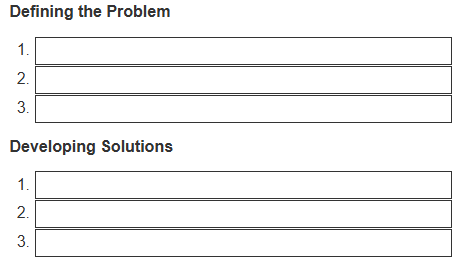
Engineers seek to define the problem of plastic trash debris in the GPGP and develop potential solutions to reduce plastic waste in the ocean. Move each question to place it in the appropriate engineering design step in which it should be addressed.

Drag and drop the answers in the correct boxes.

Drugi mogući odgovor:
How much plastic waste is leaked into the ocean each year?
What actions will prevent plastic waste leakage?
Is ocean cleanup more effective than preventing plastic waste leakage?
What technologies are available to remove plastic debris from the ocean?
What types of plastic are more likely to end up in the ocean?
How long does it take for plastic waste to degrade in the ocean?
DCI.ESS3.C.9-12.5
DCI.ESS3.C.9-12.6
…

Even though plastics break down into smaller pieces, most plastics do not completely degrade in the ocean. The Great Pacific Garbage Patch (GPGP) is an area where plastic debris and other trash accumulates in the ocean.

This could have harmful consequences on marine life. The tiny plastic pieces are often mistaken for food. One potential solution focuses on preventing plastic waste from reaching the oceans, a problem known as “plastic waste leakage.” 

Information about annual usage, collection, and plastic waste leakage for the Philippines and China are shown in Figures 1 and 2.

Figure 1 is a flow chart titled 'Figure 1: Annual Distribution of Plastic Waste in Philippines.' At the top, a total of 2.7 million tons of plastic waste is given. Of that amount, 84% or 2.27 million tons are collected, and 16% or 432,000 tons are not collected. Of the collected waste, 83% or 1.88 million tons are not leaked to the ocean, while 17% or 386,000 tons are leaked to the ocean. Two causes of collected plastic being leaked to the ocean are shown. The first cause is hauler dumping, which is when private hauler companies unload trucks en route to disposal sites to cut costs. The second cause is poorly located dumps, which are open dump sites located adjacent to waterways. Of the 432,000 tons of plastic waste not collected, 69% or 297,000 tons are not leaked to the ocean, while 31% or 135,000 tons are leaked to the ocean. Two causes of non-collected plastic waste leaking to the ocean are shown: The first cause is waste piles due to limited or no collection at informal settlements prompting residents to deposit waste at informal sites.  The second cause is littering, where personal litter and waste from small river communities flow directly into waterways.

Figure 2 is a flow chart titled, Figure 2: Annual Distribution of Plastic Waste in China. At the top, a total of 48.1 million tons of plastic waste is given. Of that amount, 40% or 18.8 million tons are collected, and 60% or 29.3 million tons are not collected. Of the collected waste, 96% or 18 million tons are not leaked to the ocean, while 4% or 0.8 million tons are leaked to the ocean. Two causes of collected plastic being leaked to the ocean are shown. The first cause is hauler dumping, which is when private hauler companies unload trucks en route to disposal sites to cut costs. The second cause is poorly located dumps, which are open dump sites located adjacent to waterways. Of the 29.3 million tons of plastic waste not collected, 86% or 25.1 million tons are not leaked to the ocean, while 14% or 4.2 million tons are leaked to the ocean. Two causes of not-collected plastic waste leaking to the ocean are shown: The first cause is waste piles due to rural communities that routinely dispose of plastic waste into waterways, and the second cause is littering, with personal litter and waste from small river communities flowing directly into waterways.

1
DCI.ESS3.C.9-12.5
DCI.ESS3.C.9-12.6
…

Even though plastics break down into smaller pieces, most plastics do not completely degrade in the ocean. The Great Pacific Garbage Patch (GPGP) is an area where plastic debris and other trash accumulates in the ocean.

This could have harmful consequences on marine life. The tiny plastic pieces are often mistaken for food. One potential solution focuses on preventing plastic waste from reaching the oceans, a problem known as “plastic waste leakage.” 

Information about annual usage, collection, and plastic waste leakage for the Philippines and China are shown in Figures 1 and 2.

Figure 1 is a flow chart titled 'Figure 1: Annual Distribution of Plastic Waste in Philippines.' At the top, a total of 2.7 million tons of plastic waste is given. Of that amount, 84% or 2.27 million tons are collected, and 16% or 432,000 tons are not collected. Of the collected waste, 83% or 1.88 million tons are not leaked to the ocean, while 17% or 386,000 tons are leaked to the ocean. Two causes of collected plastic being leaked to the ocean are shown. The first cause is hauler dumping, which is when private hauler companies unload trucks en route to disposal sites to cut costs. The second cause is poorly located dumps, which are open dump sites located adjacent to waterways. Of the 432,000 tons of plastic waste not collected, 69% or 297,000 tons are not leaked to the ocean, while 31% or 135,000 tons are leaked to the ocean. Two causes of non-collected plastic waste leaking to the ocean are shown: The first cause is waste piles due to limited or no collection at informal settlements prompting residents to deposit waste at informal sites.  The second cause is littering, where personal litter and waste from small river communities flow directly into waterways.

Figure 2 is a flow chart titled, Figure 2: Annual Distribution of Plastic Waste in China. At the top, a total of 48.1 million tons of plastic waste is given. Of that amount, 40% or 18.8 million tons are collected, and 60% or 29.3 million tons are not collected. Of the collected waste, 96% or 18 million tons are not leaked to the ocean, while 4% or 0.8 million tons are leaked to the ocean. Two causes of collected plastic being leaked to the ocean are shown. The first cause is hauler dumping, which is when private hauler companies unload trucks en route to disposal sites to cut costs. The second cause is poorly located dumps, which are open dump sites located adjacent to waterways. Of the 29.3 million tons of plastic waste not collected, 86% or 25.1 million tons are not leaked to the ocean, while 14% or 4.2 million tons are leaked to the ocean. Two causes of not-collected plastic waste leaking to the ocean are shown: The first cause is waste piles due to rural communities that routinely dispose of plastic waste into waterways, and the second cause is littering, with personal litter and waste from small river communities flowing directly into waterways.

1
DCI.ESS3.C.9-12.5
DCI.ESS3.C.9-12.6
…

Even though plastics break down into smaller pieces, most plastics do not completely degrade in the ocean. The Great Pacific Garbage Patch (GPGP) is an area where plastic debris and other trash accumulates in the ocean.

This could have harmful consequences on marine life. The tiny plastic pieces are often mistaken for food. One potential solution focuses on preventing plastic waste from reaching the oceans, a problem known as “plastic waste leakage.” 

Information about annual usage, collection, and plastic waste leakage for the Philippines and China are shown in Figures 1 and 2.

Figure 1 is a flow chart titled 'Figure 1: Annual Distribution of Plastic Waste in Philippines.' At the top, a total of 2.7 million tons of plastic waste is given. Of that amount, 84% or 2.27 million tons are collected, and 16% or 432,000 tons are not collected. Of the collected waste, 83% or 1.88 million tons are not leaked to the ocean, while 17% or 386,000 tons are leaked to the ocean. Two causes of collected plastic being leaked to the ocean are shown. The first cause is hauler dumping, which is when private hauler companies unload trucks en route to disposal sites to cut costs. The second cause is poorly located dumps, which are open dump sites located adjacent to waterways. Of the 432,000 tons of plastic waste not collected, 69% or 297,000 tons are not leaked to the ocean, while 31% or 135,000 tons are leaked to the ocean. Two causes of non-collected plastic waste leaking to the ocean are shown: The first cause is waste piles due to limited or no collection at informal settlements prompting residents to deposit waste at informal sites.  The second cause is littering, where personal litter and waste from small river communities flow directly into waterways.

Figure 2 is a flow chart titled, Figure 2: Annual Distribution of Plastic Waste in China. At the top, a total of 48.1 million tons of plastic waste is given. Of that amount, 40% or 18.8 million tons are collected, and 60% or 29.3 million tons are not collected. Of the collected waste, 96% or 18 million tons are not leaked to the ocean, while 4% or 0.8 million tons are leaked to the ocean. Two causes of collected plastic being leaked to the ocean are shown. The first cause is hauler dumping, which is when private hauler companies unload trucks en route to disposal sites to cut costs. The second cause is poorly located dumps, which are open dump sites located adjacent to waterways. Of the 29.3 million tons of plastic waste not collected, 86% or 25.1 million tons are not leaked to the ocean, while 14% or 4.2 million tons are leaked to the ocean. Two causes of not-collected plastic waste leaking to the ocean are shown: The first cause is waste piles due to rural communities that routinely dispose of plastic waste into waterways, and the second cause is littering, with personal litter and waste from small river communities flowing directly into waterways.

1
Pitanje 24
24.
DCI.ESS3.C.9-12.5
DCI.ESS3.C.9-12.6
…
Pitanje 4
4.

Which statements are best supported by the data?

Select two of the six statements.

The ice sheets reflect energy from sunlight back into space and allow the Earth to stay cooler. If the ice sheets melt, the amount of energy reflected will change, and thus the temperature of the Earth can change.

Based on the data, complete the model to show how a change in the ice sheets leads to changes in other Earth systems.

Drag and drop the answers in the correct boxes. Not all answers will be used.

Pitanje 12
12.

Based on Figure 1, which questions, if answered, would best help scientists determine the long-term economic and environmental impacts of using this process for extracting copper?

Select two of the six questions.

The solvent extraction-electrowinning technology has improved over time. Approximately 2.2 million tons of high-quality copper were produced using this technology in the year 2000. Table 1 shows the advancement of this technology, which includes how the solvent that extracts the copper has changed.

Table 1. Changes in Solvent Technology over Time

Property

1965

1970

1980

2000

Ability of solvent to remove copper ions from acid

Poor

Poor

Good

Excellent

Separation of copper ions from iron ions

Poor

Good

Good

Excellent

Speed of copper ion removal

Slow

Medium

Fast

Fast

Stability against decomposition

Excellent

Excellent

Good

Poor

Generation of impurities

Medium

Low

Medium

Low

Ability to chemically modify solvent to extract different metal ions

Poor

Fair

Good

Excellent


Which property of the solvent may be a limitation of the advancement of this technology in the future?

Pitanje 14
14.

Along with using new technology to extract copper, conserving copper through recycling also has long-lasting benefits.

Table 2. Economic Benefits of Recycling Copper


Extraction

Recycling

Energy Required
(gigajoules per metric ton)

100

10

Cost
(dollars per metric ton)

$16,200

$14,600

Air Pollution
(metric tons per year)

400,000

56,000


Indicate which claims about the potential benefits of recycling copper are supported by Table 2 and which are not supported by Table 2.

Select all of the correct answers.

Supported

Not Supported

Extracted copper produces more energy.

Recycled copper is worth 10% more than raw copper ore.

Recycling requires only 10% of the energy needed for extraction.

It is cheaper to recycle old copper than to mine and extract new copper.

Recycled copper produces the same amount of air pollution as raw copper ore.

The orbital period is the amount of time it takes a body to make one complete revolution around the Sun. The square of the orbital period (T) is proportional to the cube of the length of the semi-major axis of orbit (R).

Based on this expression and Table 1, which body has the shortest orbital period?

The gravitational force (F) between two objects is proportional to their masses and distance, as shown in the equation

where m1 is the mass of one object, m2 is the mass of a second object, and d is the distance between the two objects.

Based on Figure 1, at which labeled point in its orbit is the gravitational force between the Sun and Halley’s Comet the greatest?

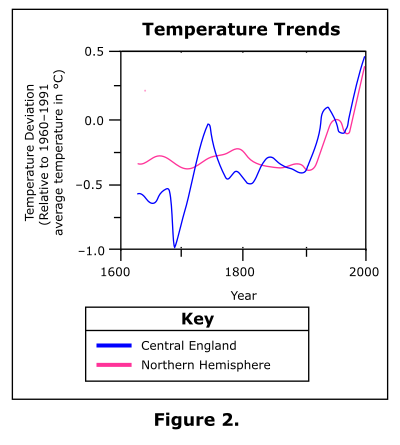
Figure 2 shows temperature trends for central England and the Northern Hemisphere from 1600–2000.

Figure 2 is a line graph titled ‘Figure 2: Temperature Trends.’ Two lines are graphed, one representing Central England, the other representing the Northern Hemisphere. The y-axis is labeled ‘Temperature Deviation (Relative to nineteen sixty through nineteen ninety one average temperature in degrees Celsius),’ and ranges from negative 1.0 to positive 0.5. The x-axis is labeled ‘Year,’ and ranges from 1600 to 2000. The values for Central England start around negative 0.6 in 1625, then decrease sharply to negative 1, its lowest point, just before 1700. The line for Central England then sharply increases to 0.0 around 1750, decreases to negative 0.4 by 1775, and fluctuates around that value until increasing sharply beginning in 1900. From 1900 to 2000, the value increases from negative 0.4 to positive 0.5, with a slight dip between 1940 and 1960. The values for the Northern Hemisphere are relatively constant from 1625 to 1900, ranging around negative 0.3. From 1900 to 2000, it closely matches the values for Central England, increasing sharply with a slight dip between 1950 and 1960.

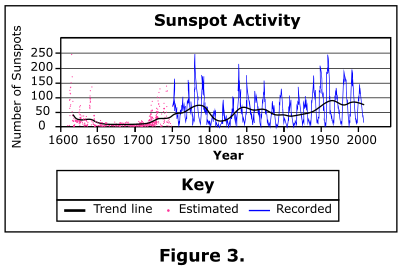
Figure 3 shows sunspot activity from 1600–2000.

Figure 3 is a graph titled ‘Figure 3: Sunspot Activity.’ The y-axis is labeled ‘Number of Sunspots’ and ranges from 0 to 250. The x-axis is labeled ‘Year,’ and ranges from 1600 to 2010. Data from 1600 to 1750 is shown as points, labeled ‘Estimated.’ Data from 1750 to 2010 is shown as a line graph, labeled ‘Recorded.’ A nonlinear trend line is also shown for the entire graph, from 1600 to 2010. From 1600 to 1750, the estimated points are mostly in the 0 to 50 range, with a few clusters of points reaching 150. From 1750 to 2000, the line for recorded data fluctuates high and low every few years, with most data between 0 and 150, and a few peaks as high as 250. The trend line is below 50 from 1600 to 1750 and increases to 75 between 1750 and 1800. From 1800 to 1850, it dips down to 25, then goes back up to above 50. The trend line hovers around 50 from 1850 to 1950, where it increases to and remains around 80.

Which statement correctly describes the relationship between the temperature trend in the Northern Hemisphere and sunspot activity between 1900 and 2000?

Pitanje 22
22.

Which potential solutions address the challenge of plastic waste in the ocean?

Select three of the six solutions. 

Pitanje 23
23.

Which potential solutions address the challenge of plastic waste in the ocean?

Select three of the six solutions.