SEL Check: 🌟 How are you feeling today? Please select the emoji that best represents your mood.
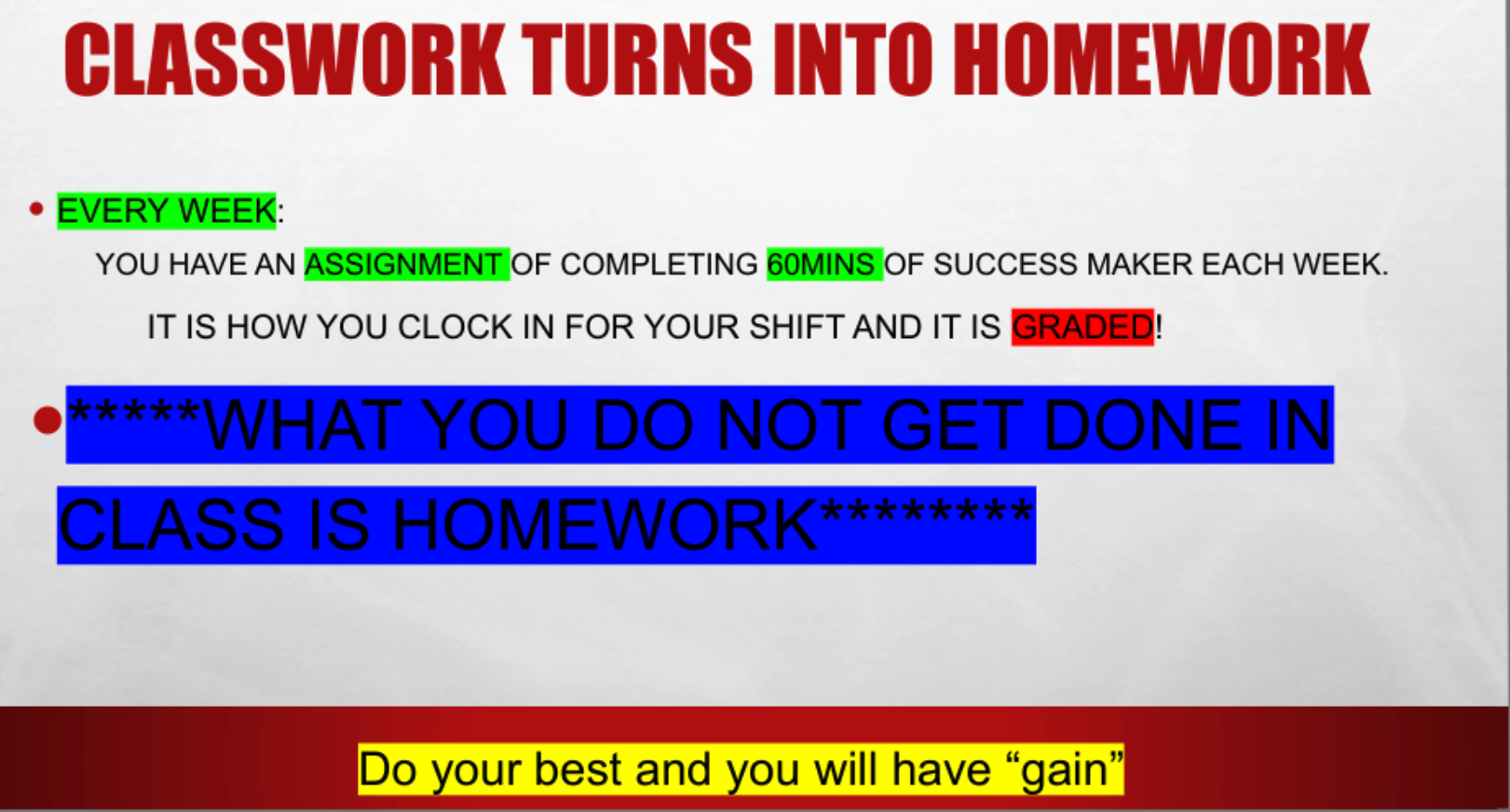
Take a screenshot of your completed 20 mins of Success Maker.
Screenshot must have:
Name
Complete mins.
Date:
April 13th
April 14th
SEL Check: 🌟 How are you feeling today? Please select the emoji that best represents your mood.
Take a screenshot of your completed 20 mins of Success Maker.
Screenshot must have:
Name
Complete mins.
Date
March 30th
March 31st
SEL Check: 🌟 How are you feeling today? Please select the emoji that best represents your mood.
Take a screenshot of your completed 40 mins of Success Maker.
Screenshot must have:
Name
Complete mins.
Date
March 25th
March 26th
SEL Check: 🌟 How are you feeling today? Please select the emoji that best represents your mood.
Take a screenshot of your completed 20 mins of Success Maker.
Screenshot must have:
Name
Complete mins.
Date
March 23rd
March 24th
SEL Check: 🌟 How are you feeling today? Please select the emoji that best represents your mood.
Take a screenshot of your completed 20 mins of Success Maker.
Screenshot must have:
Name
Complete mins.
Date
March 9th
March 10th
SEL Check: 🌟 How are you feeling today? Please select the emoji that best represents your mood.
Take a screenshot of your completed 40 mins of Success Maker.
Screenshot must have:
Name
Complete mins.
Date
March 4th
March 5th
SEL Check: 🌟 How are you feeling today? Please select the emoji that best represents your mood.
Take a screenshot of your completed 20 mins of Success Maker.
Screenshot must have:
Name
Complete mins.
Date
March 2nd
March 3rd
SEL Check: 🌟 How are you feeling today? Please select the emoji that best represents your mood.
Take a screenshot of your completed 40 mins of Success Maker.
Screenshot must have:
Name
Complete mins.
Date
Feb. 25th
Feb. 26th
https://content.vexrobotics.com/docs/v5-clawbot-legacy-build-instructions.pdf
Which Build kit do you have?
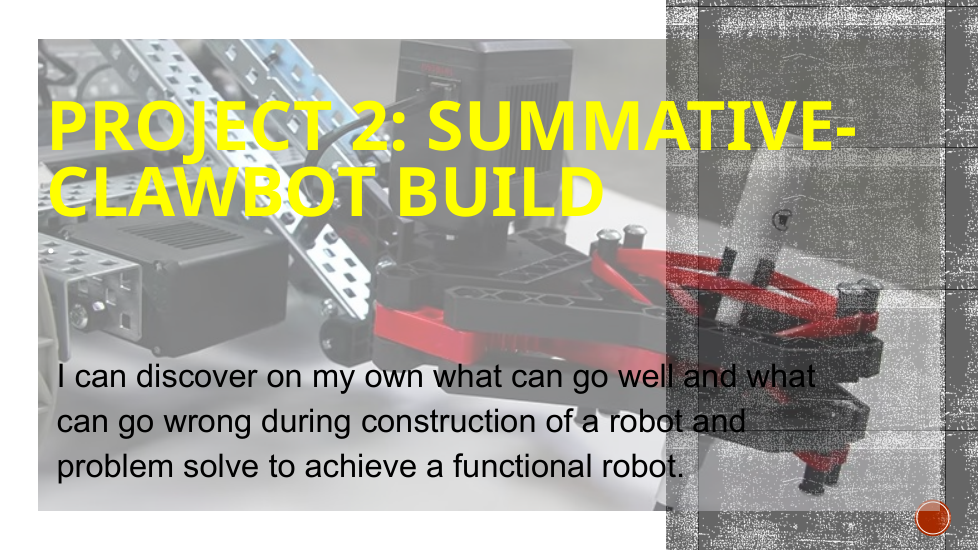
Take a picture of your completed 1-3 steps. This needs to be done by 3/27/26
Take a picture of your completed 4-6 steps. This needs to be done by 3/30/26
Take a picture of your completed 7-12 steps. This needs to be done by 4/2/26
DO NOT HOOK WIRES UP!!!!
Take a picture of your completed robot.
Each team member must upload a picture to get credit for the build.
Wait for teacher to call group up for robot inspection.
DO NOT HOOK WIRES UP!!!!
Robot arms perform jobs like welding, assembly, painting, and picking and placing items in manufacturing. They also handle tasks such as palletizing, packaging, and material handling. In other fields, they are used for precise medical procedures, research, and inspections.
Manufacturing and production
Welding and painting: Robot arms are used for tasks that require precision and consistency, such as welding car parts or painting surfaces in factories.
Assembly: They assemble components of a product, which can include anything from car parts to electronics.
Pick and place: Robots pick up individual objects, like electronic components or goods on a conveyor, and move them to a different location.
Packaging and palletizing: They pack products into boxes, place items onto pallets, and load/unload materials.
Material handling: This includes moving heavy or bulky machinery and materials around a facility.
Inspection: Robot arms can be equipped with vision systems to inspect products for quality control in real-time.
Machine tending: They can load and unload parts into machines, allowing them to operate more continuously.
Other applications
Medical: Robotic arms assist surgeons with precise, minimally invasive procedures.
Research: They are used in research and development settings for various tasks.
Disposal: In some cases, they are used for hazardous tasks like bomb disposal.
If this V5 Clawbot was 5 times larger, how would that modification change the capabilities of the robot?
What advantages would there be with a bigger robot? Explain with details.
All Free Response questions must be answered with at least one complete sentence.
Correct Grammar, Punctuation, and Spelling is graded.
f this V5 Clawbot was 5 times smaller, how would that modification change the capabilities of the robot?
What advantages would there be with a smaller robot? Explain with details.
All Free Response questions must be answered with at least one complete sentence.
Correct Grammar, Punctuation, and Spelling is graded.
If a robot arm sprays paint onto car bodies, what task is it doing?
A robot arm lifts heavy crates and moves them across the warehouse. Which application describes this?
In factories, robot arms with vision systems check products for defects. This activity is called ______.
Surgeons use robot arms because they offer what main benefit during operations?
Match each non-manufacturing field to the robot arm activity it relies on.
| Draggable item | arrow_right_alt | Corresponding Item |
|---|---|---|
Bomb squads | arrow_right_alt | Experimental manipulation |
Hospitals | arrow_right_alt | Explosive disposal |
Research labs | arrow_right_alt | Surgical assistance |
Connect each robot arm function to the factory workflow stage it optimizes.
| Draggable item | arrow_right_alt | Corresponding Item |
|---|---|---|
Inspection | arrow_right_alt | Continuous machining |
Material handling | arrow_right_alt | Quality check |
Machine tending | arrow_right_alt | Internal transport |
Link each benefit to the robot arm operation that delivers it.
| Draggable item | arrow_right_alt | Corresponding Item |
|---|---|---|
Reduced labor risk | arrow_right_alt | Automated welding |
Faster throughput | arrow_right_alt | Hazardous disposal |
Higher consistency | arrow_right_alt | Pick and place |
Match each manufacturing task to the specific product outcome a robot arm ensures.
| Draggable item | arrow_right_alt | Corresponding Item |
|---|---|---|
Welding car parts | arrow_right_alt | Accurate component positioning |
Pick and place | arrow_right_alt | Uniform surface finish |
Painting panels | arrow_right_alt | Strong consistent joints |
Using details from the passage, explain two reasons a factory chooses robot arms for welding or painting over humans.
Questions must be answered with at least one complete sentence.
Correct Grammar, Punctuation, and Spelling is graded.