Twa kɔ nsɛm atitiriw so
Log in
Sign up for FREE
arrow_back
Laabri

Week 2.5: Hard Work

star
star
star
star
star
Last updated about 2 hours ago
24 Nsɛmmisa
The Dishes on Our Tables
The Orange Tabby Cat
Dreams to Action

Click submit when finished with all questions and check your answers. You may not be able to make corrections at this time.

1
RL.5.4
1
Asemmisa {{asɛmmisaAhyɛnsode}}
2.

Read the paragraph from "The Dishes on Our Tables" below. Select a sentence that BEST show that a potter has amazingly delicate control when shaping clay.

RI.5.1
1
RI.5.2
1
RI.5.4
1
1
1
1
1
1
1
1
1
1
1
1
1

Dreams to Action

1

Billie sat on the couch, stuffing cheese potato chips in his mouth. He was watching his favorite basketball team play in the championship. They were up by two points with just seconds left on the clock. Billie reached for his soda and sucked down the last few drops as he watched his team attempt a three-point shot. Billie sucked in air and held his breath as he watched the basketball swoosh right through the hoop. Billie jumped up and down. He immediately thought about the tryouts for this school basketball team. Billie never felt good enough to be a basketball player, but right then and there, he decided to turn over a new leaf and pursue this goal.

2

Billie did not want to miss the boat on getting in shape. He decided to ditch the potato chips for a healthy diet, wake up before school to run and practice dribbling and shooting hoops daily. Billie felt confident over the new few weeks as he prepared for the school tryouts.

3

Billie wanted to take his new skill to the neighborhood court where other kids played. He figured he could see where he stood with other kids who loved playing as much as he did. After several games, Billie left the court feeling defeated. He felt that his dribbles needed to be faster, his shots needed to be more accurate, and his blocking could use some work. One of the older boys told Billie to put a kick in his step. Billie left the court with his tail between his legs and walked slowly home.

4

Billie hardly ate his dinner that evening and kept staring into space. "Penny for your thoughts," Mom inquired. "I don't think I am going to make the team," Billie said, sobbing to his mother. She reached over and hugged Billie. She told Billie that if being on the basketball team was something he wanted to do, he should keep trying; he should continuously pursue his dream, even if he didn't make the team this year.

5

The week of tryouts came and went. Billie was stoked to be made the backup player for the backup player. He may never get to play at game time, but this meant that he would be at practice every day after school. Billie vowed to himself that he would keep reaching for the stars, and hopefully, tie would bring him to be a full-time player.

1
1
1
1
1
1
1

The Dishes on Our Tables

by Eva March Tappan, Ph.D.

1

   If anyone should give you a lump of clay and ask you to make a bowl, how should you set about it? The first thing would be, of course, to put it on a table so you could work on it with both hands. You would make a depression at the top and push out the sides and smooth them as best you could. It would result in a rough, uneven sort of bowl. And before it was done, you would have made one discovery: namely, that if the table only turned around in front of you, you could see all sides of the bowl from the same position, and it would be easier to make it regular.

2

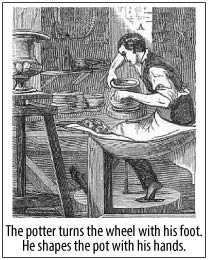
   This is just what the potter’s wheel does. It is really two horizontal wheels. The upper one is a disk a foot or two in diameter. This is connected with the lower one, which is much larger. The potter sits at his work and turns the wheel by means of a treadle.1

3

   This man is called the “thrower,” because he lifts the lump of clay above his head and throws it down heavily upon the center of the wheel. The things that happen to that lump of clay, when he touches it and the wheel revolves, seem like the work of magic. He presses his thumbs into it from above and draws the walls up between his thumbs and fingers. He clasps his hands around it, and it grows tall and slender. He lays his finger on the top of the little column of clay, and it flattens in a moment. He points his finger at it, barely touching it, and a little groove appears, running around the whole mass. He seems to be wasting considerable time in playing with it, but all the while he is making sure that the clay is perfectly uniform and that there are no bubbles of air in it. He holds a piece of leather against the outside surface and a wet sponge against the inside, to make them perfectly smooth, and in a moment he has made a bowl. He holds his bent finger against the top of the bowl, and it becomes a vase. With another touch of his magical finger, the top of the vase rolls over into a lip. If he makes a cup or a mug, he models a handle in clay and fastens it in place with slip.2 When it is done, he draws a wire deftly between the article and the table, and puts it on a board to dry.
4

   No two pieces of hand work are exactly the same, and skillful as the potter is, his pieces are not precisely alike.  

1treadle: a small, flat bar that you press with your foot to operate a machine
2slip: thin, wet clay that is used in pottery

"The Dishes on Our Tables"

by Eva March Tappan, PhD, from The Makers of Many Things. In the public domain.

What Is Clay?

1

   Clay is simply a type of dirt. Unlike soil, it does not contain any organic material. This means that plants have a very hard time growing in clay. Clay is made of rocks and sand that has been weathered.1
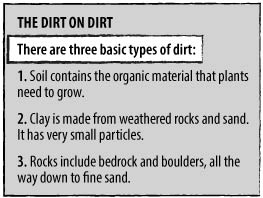
text box with a title "THE DIRT ON DIRT" that explains three basic types of dirt. The information is presented in a clear, numbered list format. The three points describe: What soil contains. Organic material that helps plants grow. What clay is. Made from weathered rocks and sand, with very tiny particles. What rocks are Including bedrock and boulders, ranging from big rocks down to fine sand.

2

   When clay is mixed with the right amount of water, it can be shaped into objects. When objects made of clay are heated to very high temperatures, the clay partially melts and forms a hard material called ceramic. Dishes, sinks, tile, and even statues are made from clay.

3

   The three most common types of clay used for ceramics are earthenware, stoneware, and porcelain. Each of these is fired in the kiln at a different temperature to reach its optimum hardness and durability.

Earthenware

4

   Earthenware clay is the most common type of clay and is probably among the first clays ever used to make pots. It is very sticky, easy to shape, and has a coarse texture. Finished products are thick and often look rustic. Earthenware products can be a variety of colors, from brown to orange to white, depending on the minerals in the clay.  Earthenware clay is fired at lower temperatures than other clays.
Stoneware

5

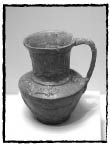
   Stoneware is a common type of clay used to make most everyday dishes. It is somewhat coarse in texture, but not as coarse as earthenware. Finished products are hard, durable, and not too thick. Stoneware products are gray or brown, depending on the minerals in the clay. Stoneware is fired at high temperatures.
Porcelain

6

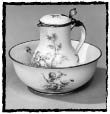
   Porcelain has a very fine texture. Because it is so fine, it can be shaped into very delicate objects. Fine china is usually made from porcelain. Porcelain products are white because this type of clay contains very few impurities. Porcelain is fired at very high temperatures, higher than stoneware.
1weathered: Weathered rock is rock that is broken down by physical and chemical processes.

Asemmisa {{asɛmmisaAhyɛnsode}}
1.

Read the sentence from paragraph 6 of "What is Clay?"

Porcelain has a very fine texture.

What word is the antonym of fine as it is used in this sentence?

He presses his thumbs into it from above and draws the walls up between his thumbs and fingers.

He clasps his hands around it, and it grows tall and slender.

He points his finger at it, barely touching it, and a little groove appears, running around the whole mass.

He seems to be wasting considerable time playing with it, but all the while he is making sure that they clay is perfectly uniform and that there are not bubbles of air in it.

Asemmisa {{asɛmmisaAhyɛnsode}}
3.

Which of the following answer choices BEST states the two key ideas from the text "What is Clay?"

Asemmisa {{asɛmmisaAhyɛnsode}}
4.

Read this sentence from paragraph 1 of "What is Clay?"

Unlike soil, it does not contain any organic material.

What does organic mean?

Asemmisa {{asɛmmisaAhyɛnsode}}
5.

Which detail supports the idea that pottery creation is skilled work?

Asemmisa {{asɛmmisaAhyɛnsode}}
6.

What happens to clay when it is heated?

Asemmisa {{asɛmmisaAhyɛnsode}}
7.

What type of clay is the easiest to shape?

Asemmisa {{asɛmmisaAhyɛnsode}}
8.

What distinguishes porcelain from other clays?

The Orange Tabby Cat

1

Ellie was in college when she adopted Tabby, a stray, orange tabby cat that lived by her apartment. She was not looking to adopt a pet, but the cat had won her heart with her sweet personality. When Ellie came home from school everyday, the cat was sleeping outside her door. She would sweetly purr and follow Ellie into her apartment. The cat was easy to care for, and she loved sitting on Ellie's lap while watching TV, studying, or sleeping. Ellie had Tabby for fourteen years before the cat suddenly got very sick. The sweet animal passed away one nights, and Ellie was devastated.

2

A few months later, Ellie visited her mom and noticed an orange tabby cat hanging around her mother's home. "I don't know what to do," stated her mother. "The cat has been hanging around the house, and the weather is supposed to get very cold tonight." Ellie missed Tabby terribly. Without a second thought, she took the stray to stay the night at her home. Ellie entered the door with the new pet, and her husband stared at her. He had a puzzled look on his face. "I know I did not discuss this with you," Ellie told her husband. "The cat does not have a home, and I miss Tabby so much," she told him. He knew how sad his wife had been and agreed she could keep the cat.

3

That night, Ellie had a blast playing with the cat. He had so much energy, which reminded her of her old cat when she was younger. After that night, Ellie names the cat Carl, and he became their new family member. Ellie told her husband that she would take full responsibility for the animal. She set up a vet appointment to get the cat checked out. The vet confirms that the cat was healthy and only a few years old. After having carl for about a week, he quickly showed that he was nothing like Tabby.

4

Carl would often wake up in the middle of the night by meowing loudly. He would sometimes pounce on Ellie's chest and meow in her fact. When Ellie would kick that cat out of the room, it clawed the furniture and ran through the halls. "What have I got myself into?" Ellie thought to herself. After weeks of being disturbed in the middle of the night, Ellie and her husband were exhausted. They decided to install a doggie door so the cat could go freely outside whenever he wanted. They had hoped that they cat would stop waking them up in the middle of the night.

5

The following day, Ellie teetered out of bed and went to the kitchen to make coffee. Carl was sitting in the middle of the kitchen. He meowed, and Ellie noticed something wiggling and twitching at the sides of his mouth. The cat stayed very still and was clenching down on something. "Ahh!" Ellie screamed. The cat dropped the object, and a lizard scurried across the floor. Ellie's husband came running when he heard his wife scream. She pointed to the reptile. He quickly scooped it up and threw both it and the cat outdoors.

6

Over the next few weeks, Ellie found many dead rodents, lizards, bugs, and snakes outside her front door. Ellie was at her wits' end and did not know what to do with her new pet. Ellie took her cat to the vet and explained what was going on. Much to Ellie's surprise, the vet started laughing after Ellie told her about all of the massacres at home. "Carl is showing how much he loves you," explained the vet. "A cat shows its owner affection by hunting. Carl is trying to show you his appreciation." After this explanation, Ellie started to pet Carl under his chin, and he began to purr. She left the vet that day knowing she would never replace her beloved Tabby, but her new pet would be a constant. Over time, Ellie developed a new love and fondness for her companion cat, Carl.

Asemmisa {{asɛmmisaAhyɛnsode}}
9.

How does Ellie change throughout the passage?

Asemmisa {{asɛmmisaAhyɛnsode}}
10.

What does the word teetered mean in the fifth paragraph?

Asemmisa {{asɛmmisaAhyɛnsode}}
11.

Which sentence shows that Ellie was beginning to form a new bond with her pet?

Asemmisa {{asɛmmisaAhyɛnsode}}
12.

What is the theme of "The Orange Tabby?"

Asemmisa {{asɛmmisaAhyɛnsode}}
13.

The main purpose of this selection is to:

Asemmisa {{asɛmmisaAhyɛnsode}}
14.

Because we only know Ellie's thoughts, Carl's nighttime antics seem

Asemmisa {{asɛmmisaAhyɛnsode}}
15.

Which line best shows the narrator's limited knowledge?

Asemmisa {{asɛmmisaAhyɛnsode}}
16.

If Carl narrated the story, readers would mainly

Asemmisa {{asɛmmisaAhyɛnsode}}
17.

Focusing on Ellie's feelings makes readers

Asemmisa {{asɛmmisaAhyɛnsode}}
18.

Which of the following best describe what an idiom is?

Asemmisa {{asɛmmisaAhyɛnsode}}
19.

Which phrase below helps the reader understand the idiom, "He decided to turn over a new leaf?"

Asemmisa {{asɛmmisaAhyɛnsode}}
20.

The author uses figurative language, for example, "One of the older boys told Billie to put a kick in his step" in the third paragraph. What does this idiom imply?

Asemmisa {{asɛmmisaAhyɛnsode}}
21.

Toward the end of the third paragraph, you can understand that Billie may not make the basketball team for his school. Which of the following choices does NOT help the reader draw this conclusion?

Asemmisa {{asɛmmisaAhyɛnsode}}
22.

What do you think Billie's mother meant by the following statement?

"Penny for your thoughts," Mom inquired.

Asemmisa {{asɛmmisaAhyɛnsode}}
23.

By the end of the passage, you know that Billie will most likely do which one of the following?

Asemmisa {{asɛmmisaAhyɛnsode}}
24.

What could the theme of the story be?