Wk 10 EOL 2.5
star
star
star
star
star
Last updated 4 months ago
10 Nsɛmmisa
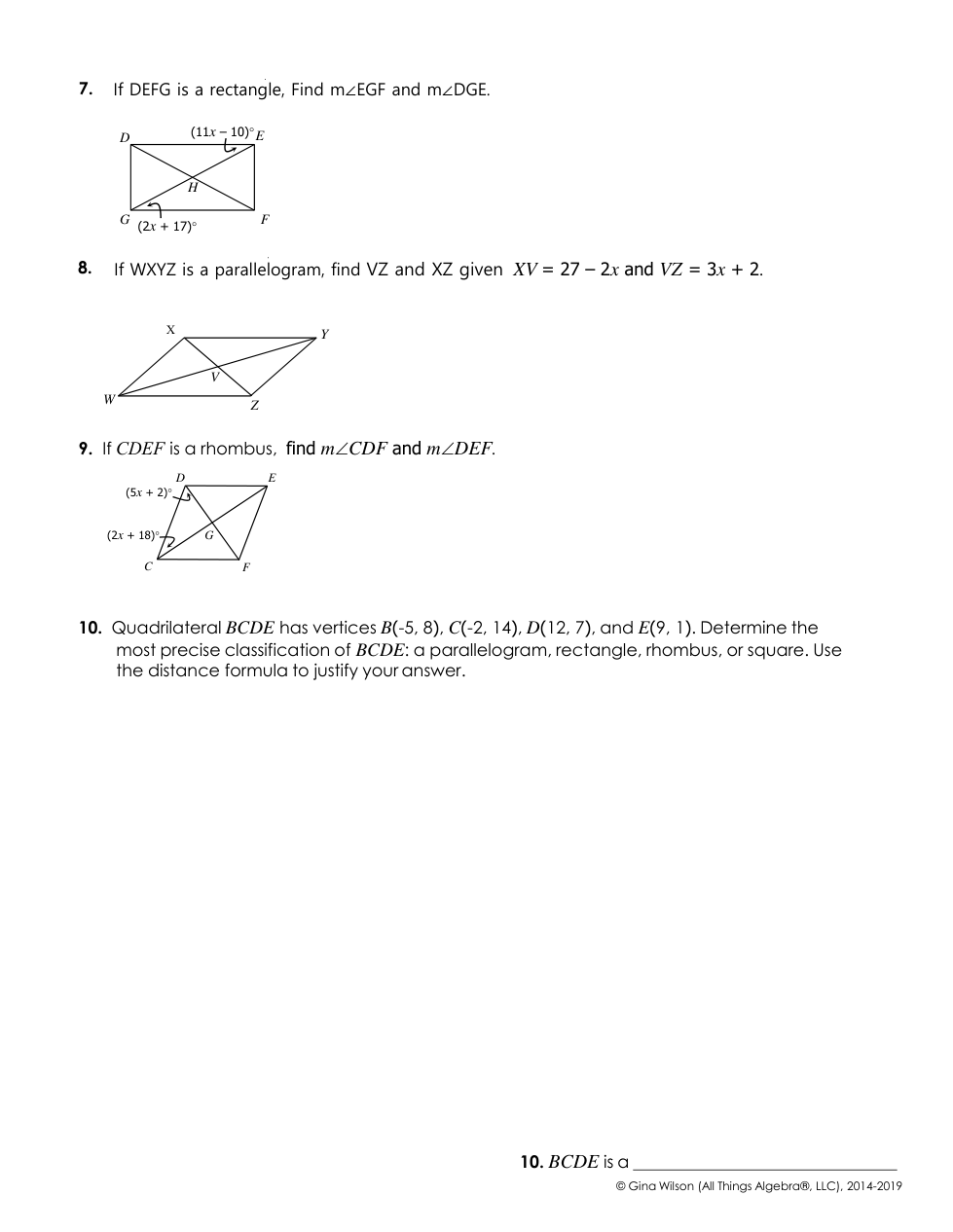
Quadrilateral BCDE has vertices B(-5, 8), C(-2, 14), D(12, 7), and E(9, 1). Determine the most precise classification of BCDE: a parallelogram, rectangle, rhombus, or square. Use the distance formula to justify your answer. **MUST SHOW ALL WORK for full credit**
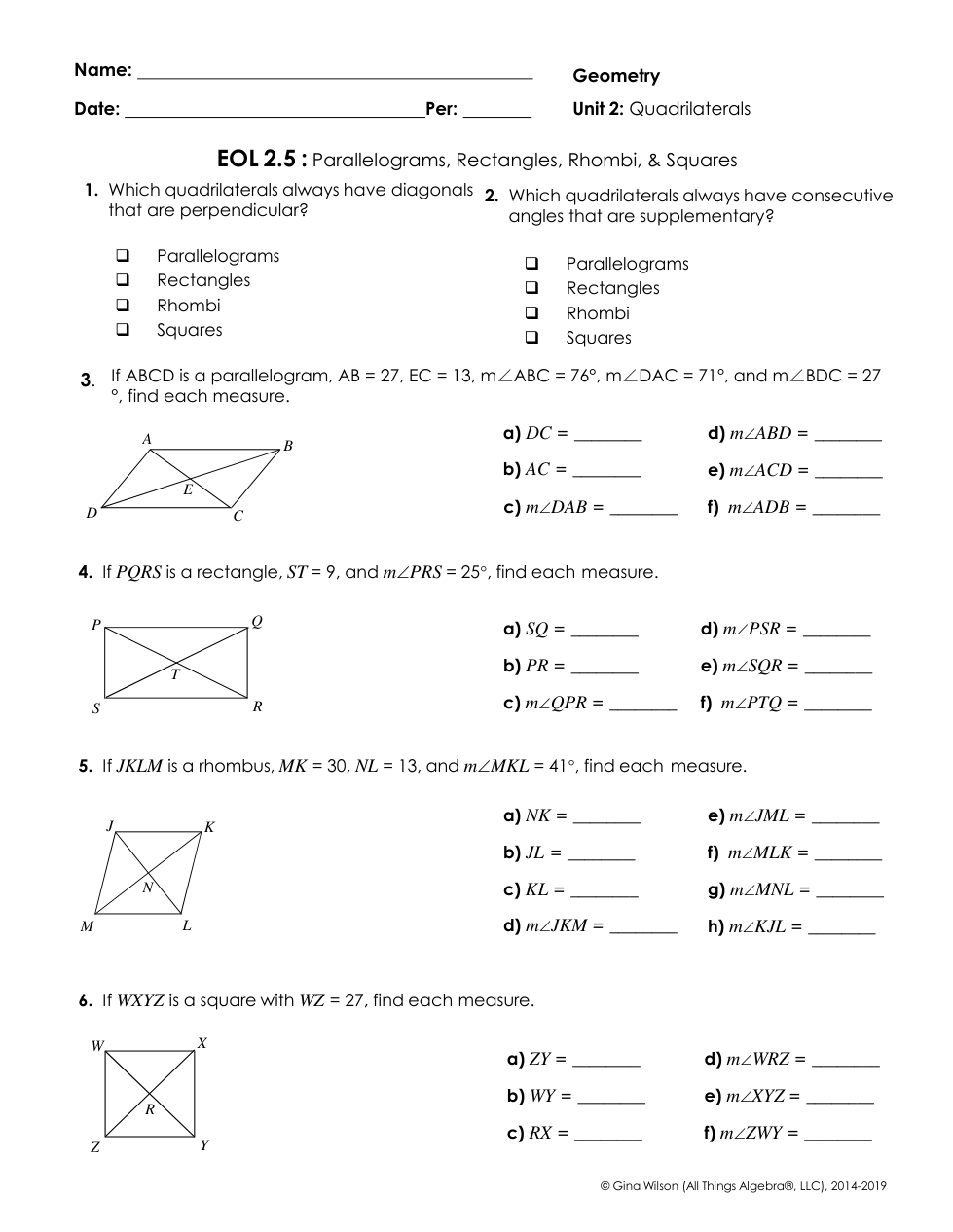
1. Which quadrilaterals always have diagonals that are perpendicular?*choose all that apply
2. Which quadrilaterals always have consecutive angles that are supplementary? *choose all that apply
If ABCD is a parallelogram, AB = 27, EC = 13, m∠ABC = 76°, m∠DAC = 71°, and m∠BDC = 27 °, find each measure.
a)DC=
b)AC=
c) m∠DAB=
d)m∠ABD=
e)m∠ACD=
f)m∠ADB=
If PQRS is a rectangle, ST = 9, and m∠PRS = 25°, find each measure.
a)SQ=
b)PR=
c)m∠QPR=
d)m∠PSR=
e)m∠SQR=
f)m∠PTQ=
If JKLM is a rhombus, MK = 30, NL = 13, and m∠MKL = 41, find each measure.
a)NK=
b)JL=
c)KL=
d)m∠JKM=
e)m∠JML=
f)m∠MLK=
g)m∠MNL=
h)m∠KJL=
If WXYZ is a square with WZ = 27, find each measure.
a)ZY=
b)WY=
c)RX=
d)m∠WRZ=
e)m∠XYZ=
f)m∠ZWY=
If DEFG is a rectangle, Find m∠EGF and m∠DGE.
If WXYZ is a parallelogram, find VZ and XZ given XV = 27 – 2x and VZ = 3x + 2.
If CDEF is a rhombus, find m∠CDF and m∠DEF.