This is a position vs time graph. is the man walking faster or slower in the green section compared to the red section?
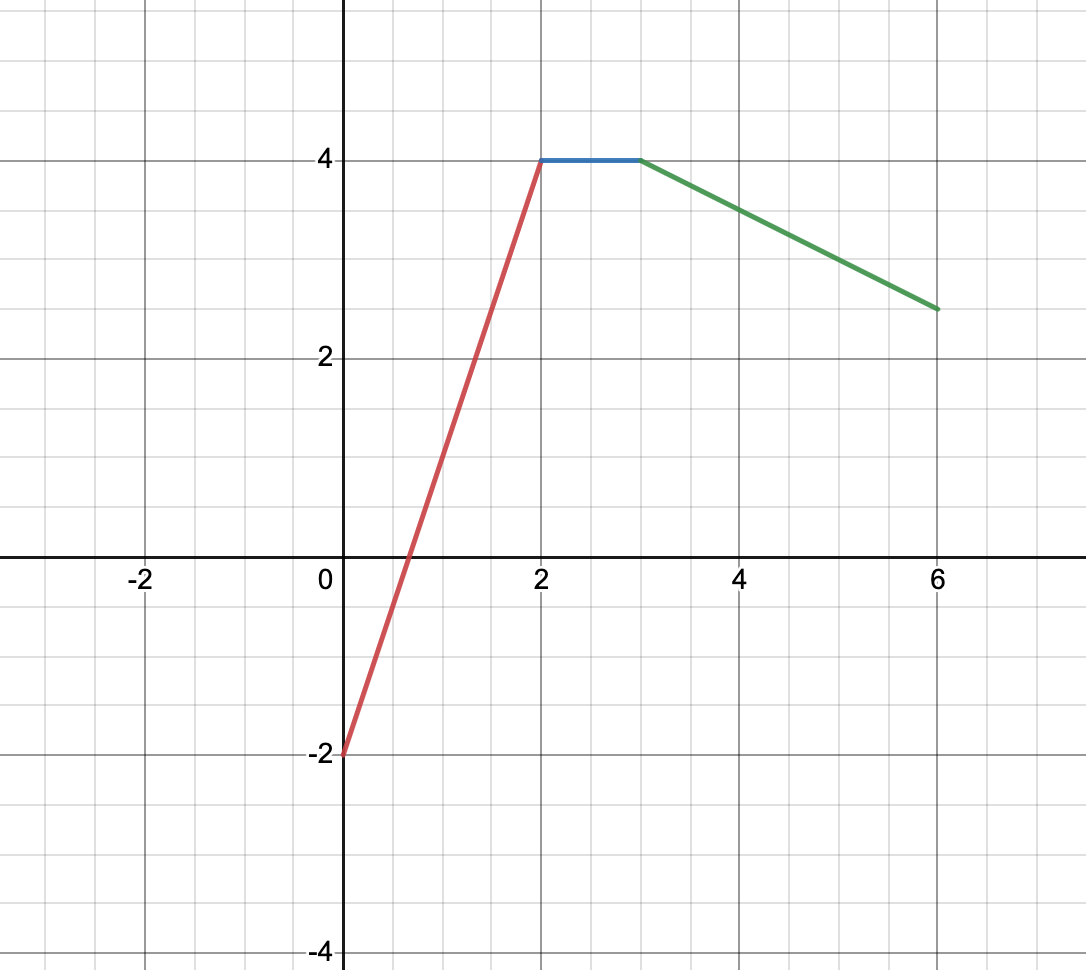
This is a position vs time graph. is the man walking faster or slower in the green section compared to the red section?
This is a position vs time graph. is the man walking faster or slower in the green section compared to the red section?
The velocity of the red section is , the velocity of the blue section is and the velocity of the red section is
what is the farthest distance the walker gets from his starting point?
Plug and chug time. You are on earth and you toss a ball up in the air with the initial velocity of 4 m/s. The ball starts 1 meter from the ground. How long does it take to hit the ground. given the following equation? use -10
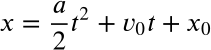
When solving a quadratic equation, especially one that you can factor, you will frequently get more than one answer. In this case you would have gotten a positive and a negative answer. explain why you only gave me one.
Watch the following video on Newton's first law. do you have any questions?
Which of these is the best definition of inertia?
Mass is simply a measurement of inertia. What is the definition of mass?
Which of the following is a good example of Newton's first law of motion?
Some people (such as me) will state newton's first law as a "unbalanced" external force rather than a "net" force. What does unbalanced mean here?
Read in your physics book the following 56-62, the sections on Newton's first law, mass, and newtons second law of motion. the first two sections should re-ieterate the last video. Focus on the section on the second law. do you have any questions?
What are the balanced forces for a car driving down the road at a constant velocity?
If an object has no acceleration, does that mean there are no forces on the object? explain why or why not?
What is the difference between weight and mass?
true/false - and object with mass can have no weight
Plug and chug - you are out in space - your engine gives a constant force of 1N. if the rocket has a mass of 100,000 kg, calculate the acceleration. a=
Notice that after 10 days that velocity is pretty tiny. If a space ship is in orbit around the earth and then leaves orbit with that same velocity, they would be going about 8,000 m/s. It takes about
A 400 kg bear is grasping a vertical tree slides down at a constant velocity. What is the friction force that acts on the bear?
A 747 jumbo jet of mass 30,000 kg experience in takeoff when the thrust for each of the four engines is 30,000 N. What acceleration does it have?
What is the net force on the following object? Show your work by adding the vectors
What definition would you give for friction?
What are some examples of friction at work?
match
| Draggable item | arrow_right_alt | Corresponding Item |
|---|---|---|
non-zero acceleration | arrow_right_alt | resistance to change |
inertia | arrow_right_alt | a push or a pull |
force | arrow_right_alt | measure of resistance to change |
mass | arrow_right_alt | when all the forces on an object add up to zero |
balanced forces | arrow_right_alt | effect of unbalanced forces |
What are some specific ways you can relate something we have done so far: Velocity, acceleration, vector addition, frames of reference, forces, inertia, etc to safety while driving. pick one and write a couple sentences about what you think a new driver should know about that topic when driving.
How do you feel about each of the following topics
What is inertia
What is the law of inertia
what is mass
the difference between mass and weight
the relationship between forces and acceleration
how there can be a force on an object when the acceleration is zero
how to use the equation F=ma to find the acceleration given a specific force
I've got this
i'm fuzzy
so confused