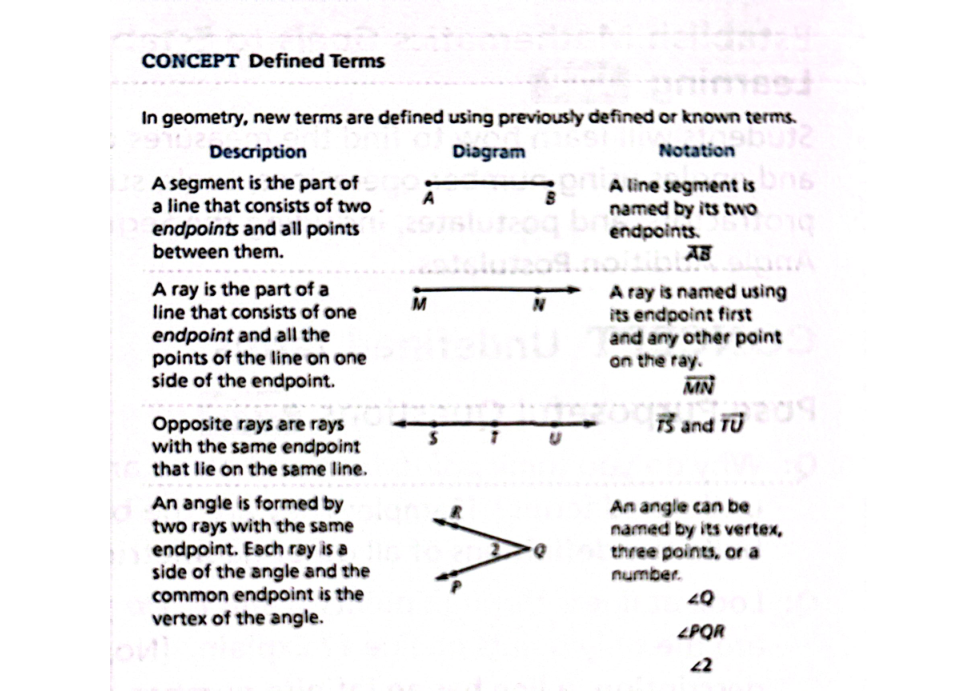
This assessment will help students understand the definitions and concepts related to angles and line segments, apply the Segment Addition and Angle Addition Postulates, and practice using protractors for precise angle measurement.
🔔 Bell Ringer: As you come in follow these instructions
Learning Intention: I am learning how to...
communicate precise definitions of angle and segment using the undefined terms: point, line, and plane
Use absolute value and the segment addition postulate
use the protractor postulate and angle addition postulate
Success Criteria: I am successful when I can...
Find the length of a segment or part of a segment using absolute value or the segment addition postulate
Find the measure of an angle using a protractor or the angle addition postulate
Look at line L through points A and B. Do you think A and B are the only points on Line L? Explain.
Which of the following are true about a line segment? (Select all that apply)
If ( AB = 8 ) and ( BC = 5 ), find ( AC ). Assume ( B ) is between ( A ) and ( C ).
Finding Segment Lengths
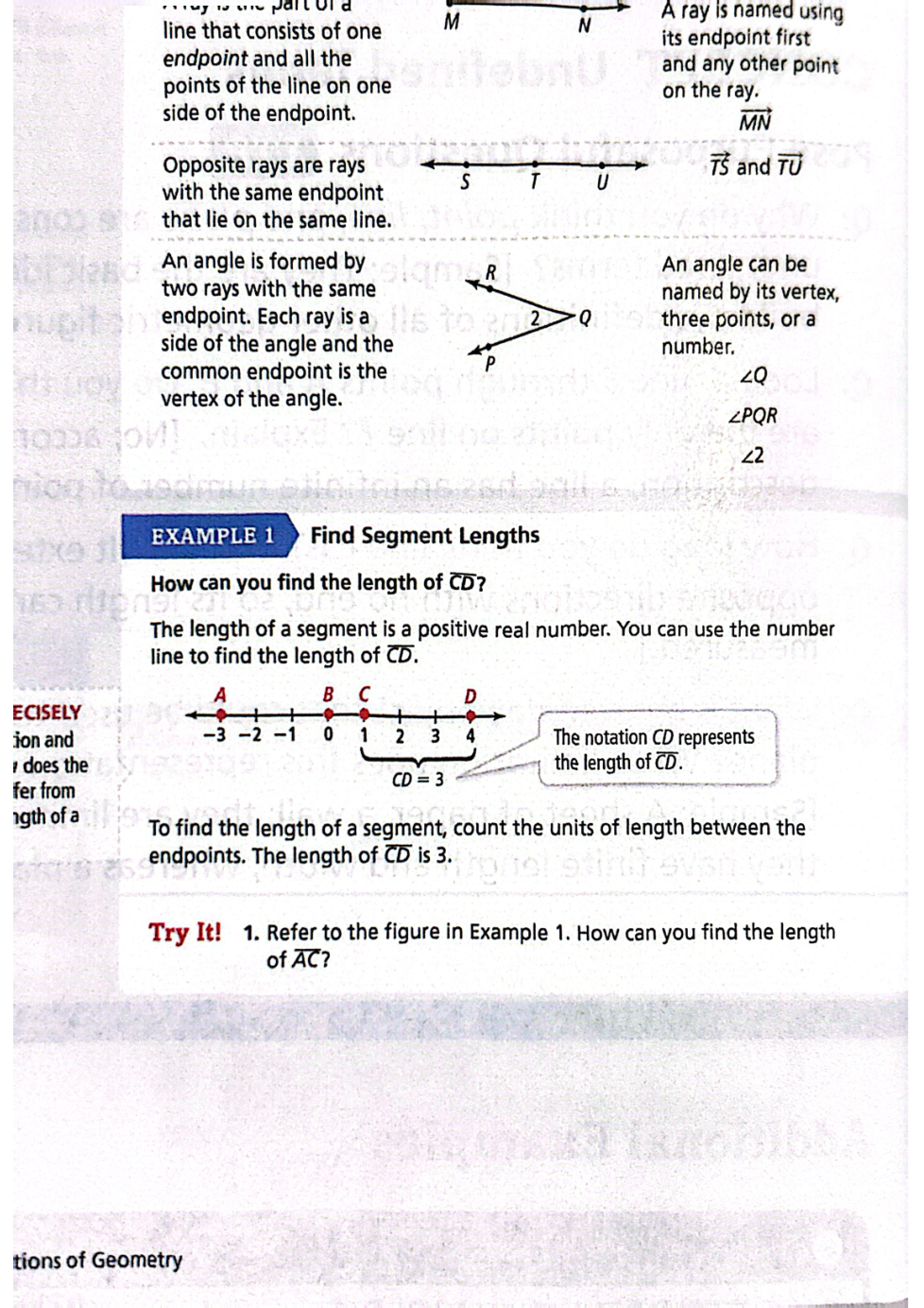
How can you find the length of segment CD?
Remember that the length of a segment is a positive number. You can use the number line to find the length, by counting the units between the endpoints.
Refer to the figure in Example 1. How can you find the length of segment AC?
The length of AC will be longer than the length of CD.
What are KM, LM, and KL? Use the ruler postulate to find the coordinates of K,L and M. Then, find the distance between K and M, L and M, and K and L.