Gravitational Forces
star
star
star
star
star
Last updated 5 months ago
39 Nsɛmmisa
What type of force is a sports car's engine acting on the ground?
Gravity is similar to a magnetic force in a couple of ways. Like magnetism, gravitational force is a pull interaction between objects through space with or without contact. Also similar to magnetism, the force that objects “feel” from a gravitational pull is greater when those objects are closer to one another. However, that is about where the similarities end.
What type of interaction is gravity?
Gravity is a pretty tricky thing. We still are not fully sure how gravity even works or what it is. But, here is what we think we know about gravity.
Gravitational force, as stated earlier, is stronger the closer objects are to one another.
The more mass an object has, the more gravitational force the object will exhibit, or in other words, the more mass an object has the stronger its gravitational pull.
All matter, even a speck of dust or a molecule of air, has a gravitational force.
All matter exhibits a pull force on all other matter.
One last thing about gravity is that gravity travels from its source in a wave. (We’ll come back to this later in the chapter.)
Mass and Weight, What’s the Difference?
Before we dive into the basics of gravity, we need to understand two very similar terms: mass and weight. Mass and weight are often used to mean the same thing, but they are different. Mass is the measure of how many atoms an object contains. Weight is the measurement of those atoms under the force of gravity. So weight is basically the measurement of mass under gravitational forces.
What is mass a measure of?
Here on Earth, that gravitational force is caused by the mass of the Earth itself. The gravitational force of Earth is written as an acceleration (an increase in speed with time). Earth’s gravitational force is 9.8 m/s^2 (9.8 meters per second per second). So what does that mean?
Mathematical constants are special numbers that are often ratios that have been shown to be mathematically true. A common constant that many junior high students are familiar with is pi (π). The gravitational constant (G) is 6.67408 × 10⁻¹¹ m3 kg-1 s-2. It was discovered by Sir Isaac Newton and used by Albert Einstein in his Theory of General Relativity
Let’s imagine a thought experiment and create a mental model to help us understand this. We’re going to pretend to drop a watermelon from a certain height. First let’s establish that we will ignore air resistance (the force air molecules exert on a moving object in the atmosphere) so that the only force we have to imagine will be the gravitational force (Earth’s acceleration).
Earth’s acceleration, 9.8 m/s^2, means that when we drop our watermelon it will fall toward Earth increasing in speed roughly 9.8 meters per second every second that it falls. So if the melon is falling for 3 seconds, how fast will it be traveling when it hits the ground? How fast will it be traveling if it falls for 5 seconds? To see how to calculate this, see the Fun With Math section. My guess is that the watermelon will be traveling so fast when it hits the ground that it isn’t going to survive either fall.
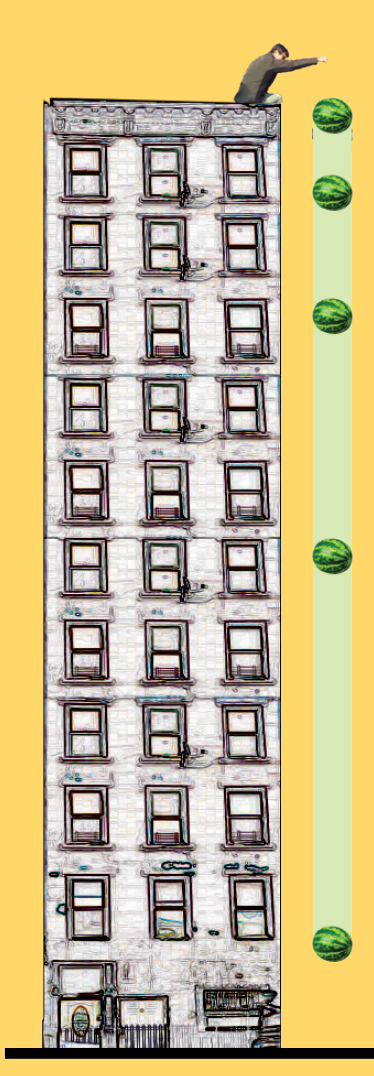
To figure out how to do this problem we will use dimensional analysis (this sounds super fancy, but really it is not that bad so stick with me here). First take the acceleration units (m/s2) and transfer them into speed units (m/s). We can do this by multiplying our acceleration by our time (s). This will cancel out one of the second units in the denominator of the acceleration.
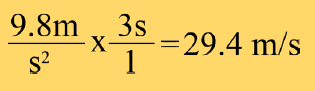
The speed of 29.4 m/s is pretty fast! That is 106 km/hr (68.5 mph). At that speed, the melon isn’t going to make it. Now its your turn. How fast will the melon be traveling if it falls for 5 seconds?
________________________________________________________________________________
Answer: 49 m/s or 176 km/h (109 mph). Fun fact: the terminal velocity of a watermelon is about 185 km/h (115
mph).
The fall of the watermelon is a product of Earth’s mass and the attraction of all matter to all other matter. Now, take a minute to think about mass and what we have just covered. Think about the definitions of mass and weight while you ponder the following questions. Would you weigh the same on Earth as you would the moon? What about on Jupiter or Pluto? Why or why not? What if we dropped the watermelon on the moon? Would it fall at the same rate as it did in our mental model? Would it fall faster, slower, or the same rate? Create an argument or claim for your stance. What evidence can you come up with to support your claim?
If you haven’t noticed just yet, you would not weigh the same on Earth as you would on other solar system bodies. Thinking back to our watermelon experiment, if we dropped the watermelon from the same height on different planets, it would fall at different rates depending on the planet you were on, but would your mass change? Your mass, the atoms in your body, should remain the same (unless you lost your lunch being transported from planetary body to planetary body, of course).
What stays constant regardless of where you are in space?
Let’s move this mass thought experiment up a notch. Instead of focusing on Earth and objects falling onto the surface or standing on the surface, let’s examine a larger system and their gravitational interactions. Let’s talk about orbits!
Remember that: (1) gravity exhibits a pull (attractive) force that interacts through space, (2) all matter has gravity, and (3) all objects exert a force on all other objects. In an orbit, the sun and planets all tug or pull on each other as they move around. The Earth is tugged along by the Sun, but that isn’t quite the right way to say it. Because both the Earth and the Sun have mass, they both exert a gravitational force on each other.
What causes the Sun to wobble as it spins in space?
The gravitational force between objects can be written as a mathematical equation.
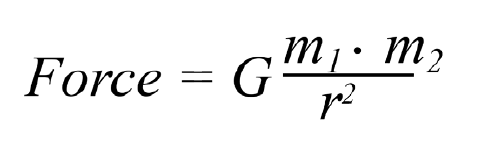 What this equation means is that gravitational force (Force) for either object near any other object is equal to the gravitational constant (G) multiplied by the mass of object one (m1) multiplied by the mass of object two (m2) all divided by the square of the distance (r) between those masses.
What happens to gravitational force when mass increases?
A real world example of mass and gravity is our Earth and moon system. The moon is pretty small when compared to the Earth. Its diameter (the distance through the center of the moon) is about the distance from Utah to New York. As small as the moon is, the gravitational force between the moon and the Earth is much larger than the gravitational force shared between the sun and the Earth. Why would this be? What causes this? It is the distance. The moon is much closer to the Earth than the Sun is, so the gravitational forces between the Earth and moon system are much larger.

What is one reason the moon has a strong gravitational pull on Earth?
Arguing from evidence
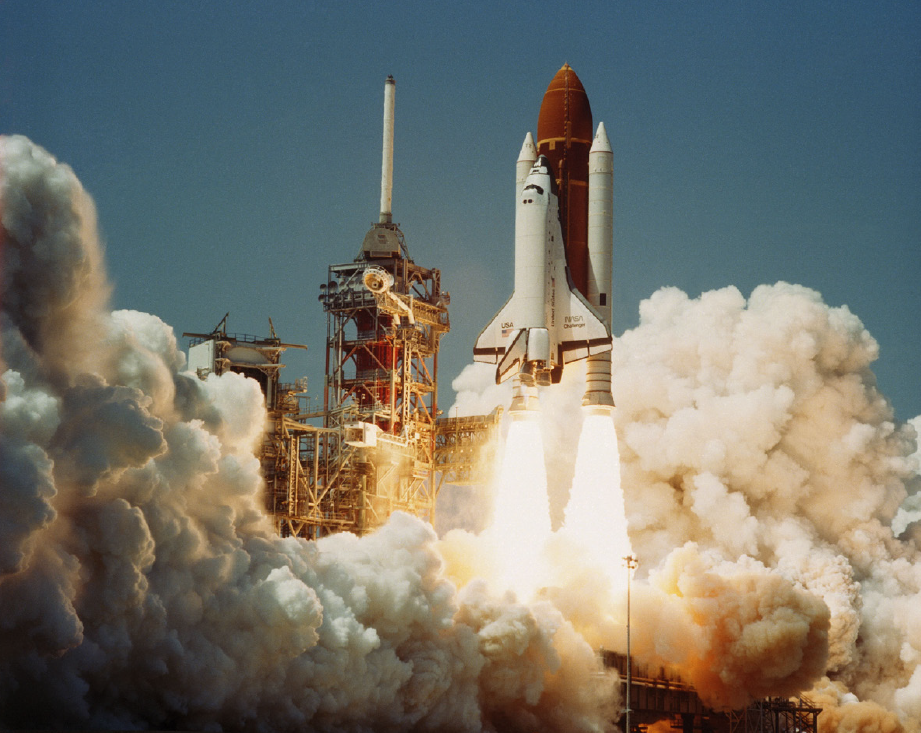
According to NASA, it takes 1,607,185 pounds of fuel to launch a space shuttle from Earth. Create a claim for the following situation and use evidence to back up that claim. Let’s imagine that the space shuttle is headed for Mars. Will it take the same amount of fuel for the shuttle to leave the surface of Mars as it did leaving the surface of Earth?
In the introduction to this section, a few understandings of gravity were listed. One of those understandings was that gravity, like light, moves in waves. The fact that both of these phenomenon travel in waves, means that it takes time for them to travel. Light takes about eight minutes to travel from the surface of the sun to the surface of Earth.
Let’s do another thought experiment. There is nothing known in the Universe that could cause the sun to blip out of existence, but let’s imagine for one moment that the sun just disappeared. Since light takes time to travel, we would still have light for roughly eight minutes. Then all of the sudden, everything would go dark. Itwould be night over the entire world all at once.
However, the light from the sun would still be traveling through the solar system even though the sun was gone. At this moment if you turned to look at Jupiter, the sun’s light would still be reflecting back at you. Light traveling through the solar system would light up Jupiter for about 34 more minutes. But since light takes time to travel, it would take another 34 minutes before Jupiter would appear to go dark because it would take that long for the light that traveled past Earth to Jupiter to bounce all the way back to your eye. Whoa, right?
Light wouldn’t be the only change on Earth, though. Since the sun keeps the Earth in its orbit due to our gravitational interactions, the Earth would fly out of its orbit on a straight path at tens of thousands of kilometers per hour in a trajectory sending us out of the solar system. But again since gravity moves in waves like light, this wouldn’t happen for about eight minutes after the mass of the sun would have disappeared. One by one objects in the solar system would stop orbiting the vacant sun and fly off in whatever direction starting with Mercury, followed by Venus, Earth, and so on.
How do we know gravity travels in waves? In 1915 Albert Einstein published his Theory of General Relativity which most people know as the Theory of Gravity (often mistaken as the Law of Gravity). In this theory he made several predictions about gravity based on mathematical proofs. One of those predictions was that gravity didn’t just exist, but instead traveled as light does, in a wave. Nearly 100 years later in 2016 a team of scientists was able to gather this evidence that Einstein predicted. Gravity waves were detected emitting from two colliding black holes that sent a mass of detectable waves throughout the Universe.
The acceleration of gravity is a testable experiment. Locate a tennis ball (or any type of ball will do), a stopwatch, a tape measure, and something to record data with. You’ll need somewhere you can drop the ball from like a deck or a ladder. With a partner practice starting and stopping a stopwatch at the release and impact of the ball at a specific height. Once you think you have it consistent, it’s time to take down some data. Remember when experimenting it is important to control outside variables. What kind of variables might alter the results of your experiment? What units should you measure your experiment in? What procedures should you and your partner agree upon to make sure each test is valid? How many times should you test the drop experiment? Would averaging your results be helpful? How will you be able to tell if your data is weak evidence, strong evidence, or disconfirming evidence?
When you have recorded all of your data, use the mathematical formula below to calculate your acceleration. Check your results with the accepted value of acceleration for Earth at 9.8 m/s2.
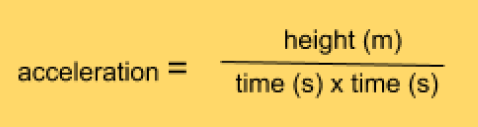
To calculate acceleration divide the height your ball fell from by your time in seconds squared (time in seconds multiplied by your time in seconds).
Introduction to Gravity
Forces are categorized as either pushing or pulling forces. We’ve already explored a few pushing forces. Think about two vehicles – one is a small sports car and the other is a dump truck. With the same force applied, the sports car will move faster than the heavy dump truck. The push force is the engine giving energy to the wheels to push against the ground.
 Another pushing force can be shown when you push a couch across the living room. You push on the couch, and you feel a push back from the couch on you as you both move.
 Pulling forces, like those in magnetic fields, can pull objects toward one another.

What happens when you push a couch?
Which vehicle would move faster with the same force, the dump truck or the sports car?
What are pulling forces in magnets called?
How does gravitational pull change with distance?
What forces are similar to gravity?
Which statement about gravity is true?
What happens to gravitational force as objects get closer together?
What affects the strength of an object's gravitational pull?
Does all matter have a gravitational force?
What does gravitational force do between two objects?
How does gravity travel from its source?
What does weight measure?
If gravity increases, what happens to weight?
Remember that mass and weight are similar, but different. The mass of an object is determined by how much “stuff” is in that object and the weight is determined by the gravitational pull on that “stuff”. Let’s take a trip around the solar system. Every solar system body has a different mass. The moon has less mass than the Earth, while Jupiter has much more mass than the Earth does. Calculate how much you weigh on each solar system body using your weight here on Earth and the multiplication factor in the data table on the following page. Complete the table and compare your results. If you don’t know how much you weigh you can use the average weight of a seventh grade student, 42 kg (92 lbs).

What happens to your mass when you travel to another planet?
If you dropped a watermelon on Mars, it would fall slower than on Earth because?
What describes the weight of an object?
Why do different planets have different weights for the same object?
Planetary Orbits
Let’s move this mass thought experiment up a notch. Instead of focusing on Earth and objects falling onto the surface or standing on the surface, let’s examine a larger system and their gravitational interactions. Let’s talk about orbits!

What is gravity primarily responsible for between objects?
Which of the following has gravity?
How do the Earth and Sun interact gravitationally?
What force do planets experience while orbiting the Sun?
What role does mass play in gravitational attraction?

Everyone knows that the Earth orbits the Sun, but what everyone doesn’t understand is that they are sort of just orbiting each other. Now the Sun has a much larger mass than Earth does. While the Sun tugs on the Earth and flies us around the solar system in an elliptical orbit, the small mass of the Earth pulls on the Sun just a little bit causing it to wobble. All the planets do this actually. So as the Sun spins at the center of our solar system, instead of staying steady, it sort of wobbles around like a top spinning on a table. The larger the mass of the planet, the more it causes the sun to wobble.
What role does the mass of a planet play in the solar system?
How does the Earth's mass affect the Sun?
Which statement about gravity is true?
The figure below illustrates this idea. Each sphere represents a planetary body with a given mass. The gravitational force between the two is determined by the mass of each planet and the distance between them.


When an object has more mass, it has a stronger gravitational force. Distance makes a big difference too! The closer the planets are to one another, the stronger the force between them. The farther apart they are, the weaker the force. The force on an object here on Earth is measurable in a unit called Newtons (N). The more mass an object has the more gravitational pull that object has between it and the Earth. We notice this when it is harder to pick up an object like a bowling ball than it is a softball. More mass means the attraction of gravitational force is stronger so it takes more work to pick up the heavier object.
How does distance affect gravitational force between objects?
What unit measures gravitational force on Earth?
Why is a bowling ball harder to lift than a softball?
What can increase gravitational pull between two planets?
What primarily affects the strength of gravity according to distance?
Why is the gravitational force between the Earth and moon greater?
What role does mass play in gravitational force?
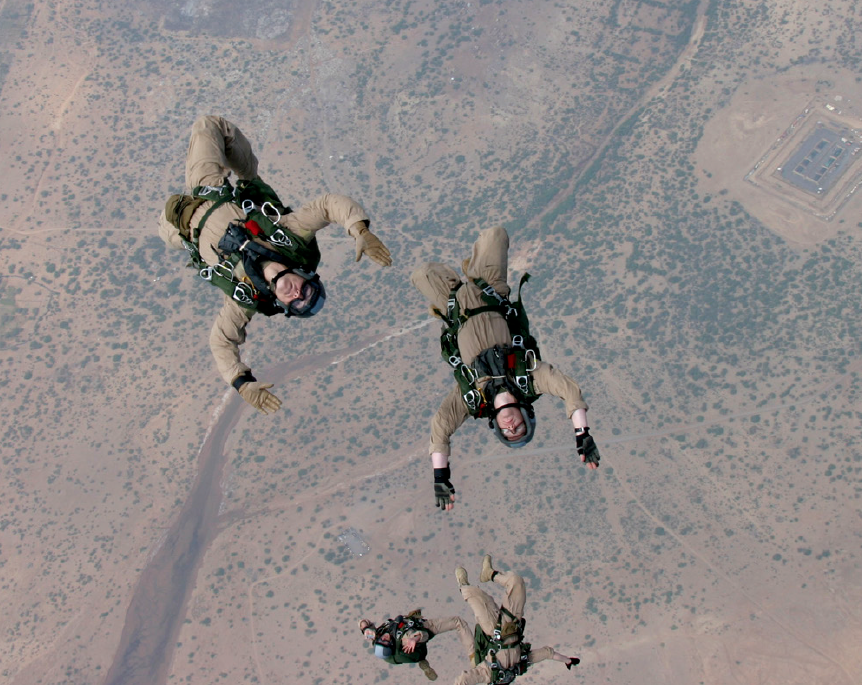 Force Reconnaissance Marines in a training exercise over Djibouti, Africa accelerating towards Earth due to their mutual gravitational forces.