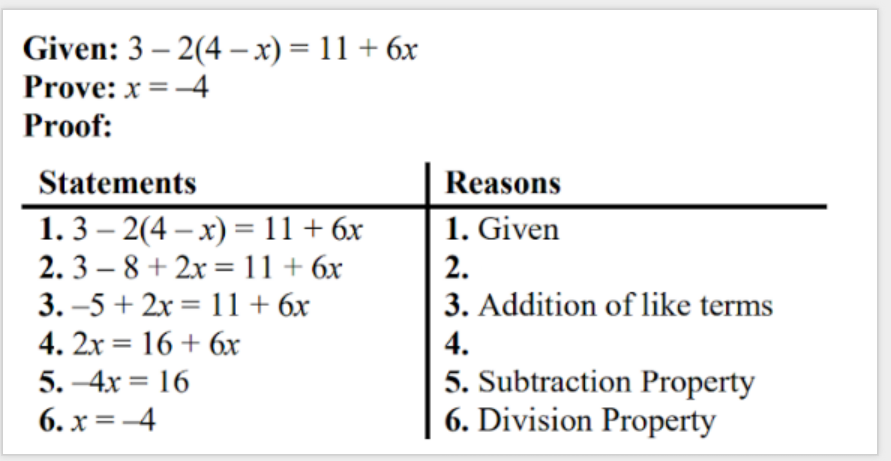
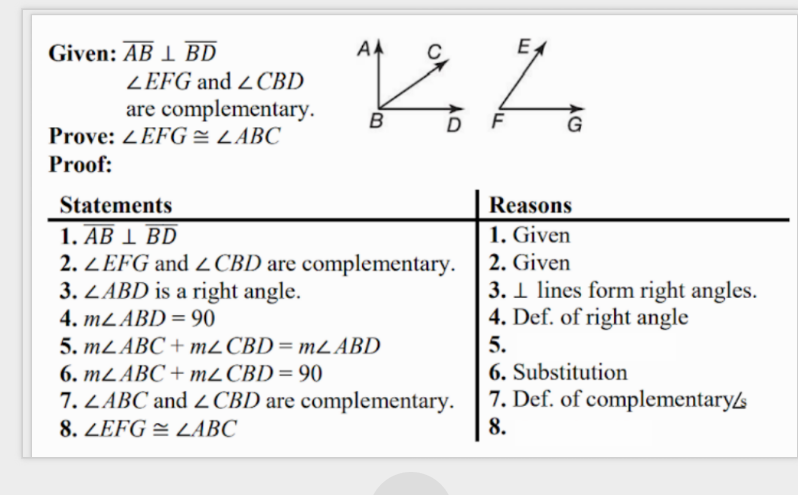
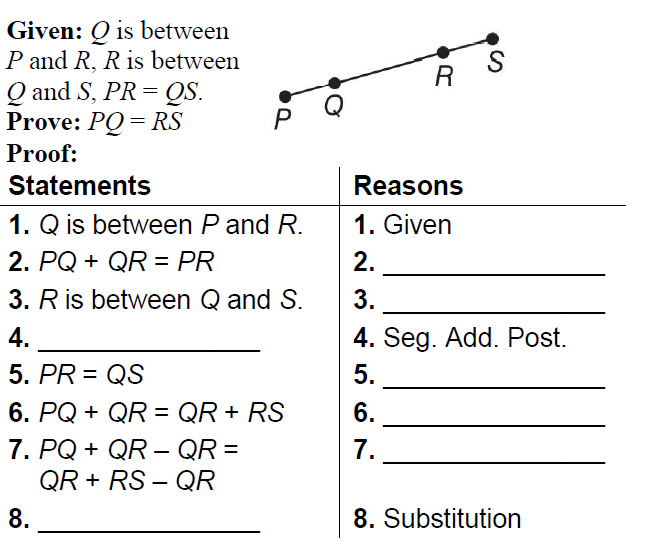
Match each statement with the property of equality, property of congruence, definition, postulate, or theorem that can be used to justify it.
Match each statement with the property of equality, property of congruence, definition, postulate, or theorem that can be used to justify it.
| Draggable item | arrow_right_alt | Corresponding Item |
|---|---|---|
| arrow_right_alt | Definition of a right angle | |
| arrow_right_alt | Congruent complements theorem | |
| arrow_right_alt | Verticle angles theorem | |
| arrow_right_alt | symmetric property of equality | |
| arrow_right_alt | substitution property of equality | |
| arrow_right_alt | definition of a midpoint | |
| arrow_right_alt | definition of congruence | |
| arrow_right_alt | addition property |