Twa kɔ nsɛm atitiriw so
Log in
Sign up for FREE
arrow_back
Laabri

ELA 09.25.25 - Blast The Unbreakable Journey

star
star
star
star
star
Last updated about 1 month ago
4 Nsɛmmisa
DO NOW
1
Asemmisa {{asɛmmisaAhyɛnsode}}
1.

Match the person in the story with how they are described in the story The Other Side of the Sky

Draggable itemarrow_right_altCorresponding Item

Farah's Mother

arrow_right_alt

"certainly a good man, so patient with us and so compassionate."

The border guards

arrow_right_alt

"Her asthma was pretty bad at this point, poor thing. No doubt, her anxiety made it worse,"

Ghulam Ali

arrow_right_alt

"She’s missing a leg, and yet she’s going faster than you."

Farah Ahmedi

arrow_right_alt

"...had clubs, and they had carbines, too, which they turned around and used as weapons."

Doom Scroll

(Time Permitting)

3


The Other Side of the Sky  

[From: Escape from Afghanistan]

by Farah Ahmedi

1

The gate to Pakistan was closed, and I could see that the Pakistani border guards were letting no one through. People were pushing and shoving and jostling up against that gate, and the guards were driving them back. As we got closer, the crowd thickened, and I could hear the roar and clamor at the gate. The Afghans were yelling something, and the Pakistanis were yelling back. My mother was clutching her side and gasping for breath, trying to keep up. I felt desperate to get through, because the sun was setting, and if we got stuck here, what were we going to do? Where would we stay? There was nothing here, no town, no hotel, no buildings, just the desert.

2

Yet we had no real chance of getting through. Big strong men were running up to the gate in vain. The guards had clubs, and they had carbines, too, which they turned around and used as weapons. Again and again, the crowd surged toward the gate and the guards drove them back with their sticks and clubs, swinging and beating until the crowd receded. And after that, for the next few minutes, on our side of the border, people milled about and muttered and stoked their own impatience and worked up their rage, until gradually the crowd gathered strength and surged against that gate again, only to be swept back.

3

We never even got close to the front. We got caught up in the thinning rear end of crowd, and even so, we were part of each wave, pulled forward, driven back. It was hard for me to keep my footing, and my mother was clutching my arm now, just hanging on, just trying to stay close to me, because the worst thing would have been if we had gotten separated. Finally, I saw that it was no use. We were only risking injury. We drifted back, out of the crowd. In the thickening dusk we could hear the dull roar of people still trying to get past the border guards, but we receded into the desert, farther and farther back from the border gate.

4

Night was falling, and we were stranded out there in the open.

…

5

On that second day, however, I learned that it was all a question of money. Someone told me about this, and then I watched closely and saw that it was true. Throughout the day, while some of the guards confronted the crowds, a few others lounged over to the side. People approached them quietly. Money changed hands, and the guards then let those people quietly through a small door to the side.

6

Hundreds could have flowed through the main gate had it been opened, but only one or two could get through the side door at a time. The fact that the guards were taking bribes did us no good whatsoever. We did not have the money to pay them. What little we had we would need to get from Peshawar to Quetta. And so the second day passed.

7

At the end of that day we found ourselves camping near a friendly family. We struck up a conversation with them. The woman told us that her husband, Ghulam Ali, had gone to look for another way across the border. He was checking out a goat path that supposedly went over the mountains several miles northeast of the border station. If one could get to Pakistan safely by that route, he would come back for his family. “You can go with us,” the woman said.

8

Later that night her husband showed up. “It works,” he said. “Smugglers use that path, and they bribe the guards to leave it unguarded. Of course, we don’t want to run into any smugglers, either, but if we go late at night, we should be fine.”

9

His wife then told him our story, and Ghulam Ali took pity on us. “Yes, of course you can come with us,” he said. “But you have had two hard days. You will need some rest before you attempt this mountain crossing. Spend tonight here and sleep well, knowing that you will have nothing to do tomorrow except lounge around, rest, and catch your breath. Tomorrow, do not throw yourself against those border guards again. Let your only work be the gathering of your strength. Then tomorrow night we will all go over the mountain together, with God’s grace. I will show you the way. If God wills it, we will follow that smugglers’ path to safety. You and your mother are in my care now.”

10

So we spent the whole next day there. It was terribly warm and we had no water, but we walked a little way and found a mosque that refugees like us had built over the years, so that people waiting to get across the border would have a place to say their prayers. We got some water to drink at the mosque, and we said namaz there too. Somehow we obtained a little bit of bread as well. I can’t remember how that turned up, but there it was, and we ate it. We sustained our strength. After sunset we lay down just as if were going to spend another night. In fact, I did fall asleep for a while. Long after dark—or early the next morning, to be exact, before the sun came up—that man shook us awake. “It’s time,” he said.

11

We got up and performed our ablutions quickly in the darkness, with just sand because that’s allowed when you have no access to water. We said our prayers. Then Ghulam Ali began to march into the darkness with his family, and we trudged along silently behind them. After several miles the path began to climb, and my mother began to wheeze. Her asthma was pretty bad at this point, poor thing. No doubt, her anxiety made it worse, but in such circumstances how could she rid herself of anxiety? It was no use knowing that her difficulty was rooted in anxiety, just as it was no use knowing that we could have moved more quickly if we had possessed wings. Life is what it is. The path over that mountain was not actually very long, only a couple of miles. Steep as it was, we could have gotten over in little more than an hour if not for my mother. Because of her, we had to pause every few minutes, so our journey took many hours.

12

I myself hardly felt the exertion. I was walking quite well that day, quite athletically. I had that good prosthetic leg from Germany. The foot was a little worn by then, but not enough to slow me down. Thinking back, I’m puzzled, actually. How did I scale that mountain so easily? How did I climb down the other side? These days I find it hard to clamber up two or three flights of stairs, even. I don’t know what made me so supple and strong that day, but I felt no hardship, no anxiety or fear, just concentration and intensity. Perhaps my mother’s problems distracted me from my own. That might account for it. Perhaps desperation gave me energy and made me forget the rigor of the climb. Well, whatever the reason, I scrambled up like a goat. The family we were following had a girl only a bit younger than me, and she was moving slowly. Her family used my example to chide her. They kept saying, “Look at that girl. She’s missing a leg, and yet she’s going faster than you. Why can’t you keep up? Hurry now!”

13

That Ghulam Ali was certainly a good man, so patient with us and so compassionate. He had never seen us before, and yet when he met us, he said, “I will help you.” That’s the thing about life. You never know when and where you will encounter a spot of human decency. I have felt alone in this world at times; I have known long periods of being no one. But then, without warning, a person like Ghulam Ali just turns up and says, “I see you. I am on your side.” Strangers have been kind to me when it mattered most. That sustains a person’s hope and faith.


Ahmedi, Farah, and Tamim Ansary. The Other Side of the Sky. Gallery Books-Simon & Schuster, 2006.

CER Response Rubric

Claim (3pts)

  • The Claim answers the question.(1pt)

  • The Claim uses important words from the question (including the subject). (1pt)

  • The Claim is a complete sentence (with a capital letter at the beginning and a period at the end). (1pt)

Evidence (3pts)

  • There is a Lead-in that introduces the quote (usually by saying, The author writes,) (1pt)

  • The Evidence is a word-for-word quote from the text (with "quotation marks" around it) (1pt)

  • There is an Author's Citation which contains the last name of the author (in (Parenthesis)) (1pt)

Reasoning (3pts)

  • Reasoning explains how or why the evidence supports the claim.

The Unbreakable Journey

  1. Standing up for your own rights and the rights of others can begin with just one person.

  2. Farah Ahmedi is an Afghan humanitarian, writer, and speaker whose life shows how courage and hope can survive even in the hardest times.

  3. Farah was born in Kabul, Afghanistan, during one of the most violent and unstable periods in her country’s history. Her childhood was shaped by war, by the threat of bombs and armies, and by daily fear. When she was in second grade, she took a shortcut on the way to school—an ordinary choice to save time—and stepped on a landmine. The explosion badly injured her leg. She lost her left leg below the knee, and her right leg was severely damaged.

  4. Farah was transported to Germany for medical treatment. There she spent over eighteen months recovering—learning to use a prosthetic leg and adjusting to long hospital stays.After she returned to Kabul, her life felt fragile in new ways: a stray rocket killed her father and two sisters while she and her mother were out shopping. Her two brothers left Afghanistan to avoid being forced into military service.

  5. Because of the continuing danger, Farah and her mother fled to neighboring Pakistan. For several years they lived in refugee camps, facing harsh conditions, scarce resources, and uncertainty every day. Later, an aid organization called World Relief helped them move to the United States. They settled in Chicago, Illinois.

  6. Moving to America brought new challenges. Farah did not speak English and had missed many years of formal education. Adjusting to new culture, different school expectations, and learning a new language—all while coping with her injury—was difficult. But she was determined. She worked hard to learn, to keep up academically, and to rebuild her confidence.

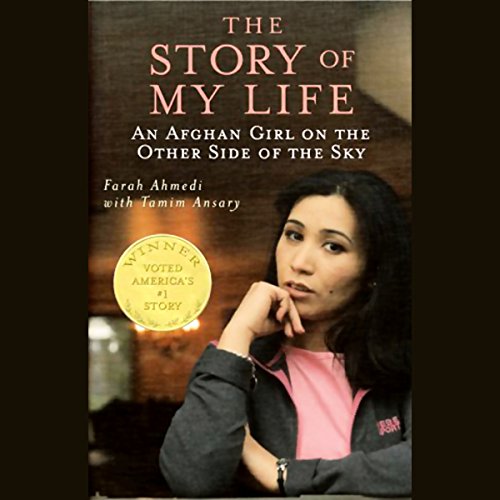
  7. At around age seventeen, Farah won a contest called “Story of My Life”, run by Good Morning America. It gave her a chance to share her story publicly. She used that opportunity to write her memoir, The Other Side of the Sky: A Memoir, co-written with Tamim Ansary. In this book, she recounts her life in Kabul, the loss of family, the escape from war, and what it felt like to build a new life in America. The memoir was published in 2005.

  8. Even after arriving in America, Farah faced emotional challenges. She sometimes felt others saw her with pity because of her injury, or made assumptions about what she could or couldn’t do. She struggled with memories of her past—memories of loss, of fear, of family—and with adjusting to a life very different from the one she had known.

  9. But Farah also found moments of joy and connection. She built new friendships, experienced things she had never known—ordinary things like carnivals, colorful fairs, the smells and sounds of new foods, and being in school among classmates. Each of those was powerful because for a time, she thought she might never get to live that way.

  10. Now, as a grown woman, Farah Ahmedi is a college graduate, and a mother. She travels as a public speaker, telling her story of survival, loss, courage, hope, and peace. She believes that even when life brings deep pain, people can heal and find strength. Her story shows that even one person who refuses to give up can inspire many.

Directions:

For each question below, you must do the following:

  1. Write a CLAIM that answers the question.

  2. Write EVIDENCE that supports your claim.

  3. Write a REASONING sentences that explains why the evidence supports the claim

Tip: Use the Claim, Evidence, and Reasoning Rubrics at the top of the page to get 8/8 points smiley emoji

8
Asemmisa {{asɛmmisaAhyɛnsode}}
2.

CER Response Question

  • What caused Farah to lose her left leg?

In the same answer box:

  1. Write a claim to answer each question

  2. Write evidence that supports the claim

  3. Write reasoning the explains why your evidence supports your claim

Use the Rubrics at the top of the page when crafting your response.

8
Asemmisa {{asɛmmisaAhyɛnsode}}
3.

CER Response Question

  • What character trait or traits does Farah demonstrate throughout her journey?

In the same answer box:

  1. Write a claim to answer each question

  2. Write evidence that supports the claim

  3. Write reasoning the explains why your evidence supports your claim

Use the Rubrics at the top of the page when crafting your response.

Asemmisa {{asɛmmisaAhyɛnsode}}
4.

By the Numbers

Claim Question:

  • Take a guess. How do you think the number 45,300 relates to the article?

    Answer this question with only a claim.