Where Do the Nutrients Come From?
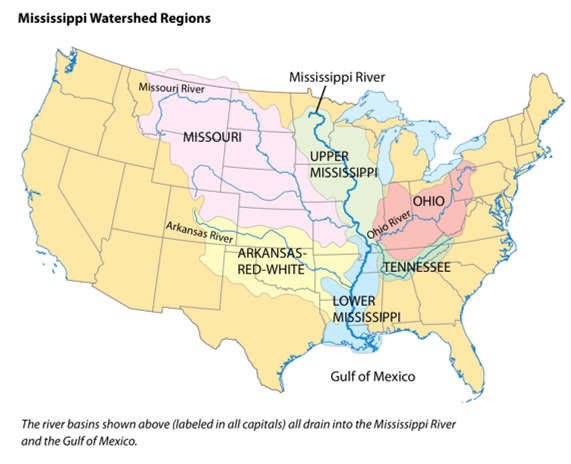
The Mississippi River has a huge river basin, which is an area of land where water drains downhill on the surface or through the ground into a river or series of rivers. The Mississippi drains water from 41% of the land in the United States. The waterways in the basin are all connected. This means that fertilizer put on fields in Minnesota can travel all the way to the Mississippi Delta. This also means that there is no single source of pollution causing the Gulf of Mexico dead zone. As water runs downhill toward the ocean, it picks up nutrients from the soil along the way. The nutrients in the Mississippi Delta can come from 31 different states!
Given the vast size of the basin, it is not surprising that the dead zone at the mouth of the Mississippi can also be vast. It has been as large as 22,730 km2 (8,776 miles2). This dead zone is seasonal, growing in size during the warmer months of the year when bacteria can grow rapidly. The recent average size is about 14,150 km2 (5,500 miles2), about the size of the state of Connecticut. The size of the dead zone has grown over the years. This correlates with an increase in the amount of nitrogen in streams that drain into the Mississippi Basin. This amount has nearly tripled since the late 1950s.
Since agriculture covers nearly one-half of the continental United States, it is not surprising that much of the nitrogen in the Gulf of Mexico comes from farmland. However, there are other sources, such as the burning of fossil fuels, storm water, runoff, wastewater, and some home products. This graph (on pg. 29) shows the sources of two kinds of nutrient pollution: nitrogen and phosphorus.
Dead zones have occurred naturally in certain environments throughout time. Any condition that results in lower oxygen levels can result in a dead zone. For example, the dead zone in the lower part of the Black Sea in northern Europe is due to a natural lack of mixing of water rich in oxygen with water poor in oxygen. This area of the Black Sea is a permanent dead zone.
However, over the past several decades, the number of dead zones throughout the world has increased in size and number. Currently there are over 500 dead zones in the world. The recent increase is a direct result of human activities. Rising populations coupled with advances in science and technology have resulted in a large increase in the release of nitrogen and phosphorus into the environment. These nutrients have entered our air, soil, and water mainly through agricultural and industrial activities. Human activities add almost twice as much nitrogen and three times as much phosphorus as natural emissions.