DELETE Lesson 10 - Baseball Assessment V2

Last updated 3 months ago
13 questions
Note from the author:
At each level of organized baseball, there are rules in place about what type of bat and ball can be used. These rules help ensure the gameplay remains competitive, fair, and fun.

The type of bat and the type of ball are the two major factors that game organizers can control.

But there are a lot of other factors that people claim also have a big impact on gameplay that cannot be controlled, such as weather conditions, the location of the stadium, and the strength of the players.
At each level of organized baseball, there are rules in place about what type of bat and ball can be used. These rules help ensure the gameplay remains competitive, fair, and fun.

The type of bat and the type of ball are the two major factors that game organizers can control.

But there are a lot of other factors that people claim also have a big impact on gameplay that cannot be controlled, such as weather conditions, the location of the stadium, and the strength of the players.
Required
1

Answer the prompts below to figure out how these factors could impact the game of baseball.
Weather Conditions and Pitch Speed
Below is a graph showing how wind speed affects pitch speed. The line on the graph shows the relationship between wind speed and pitch speed.
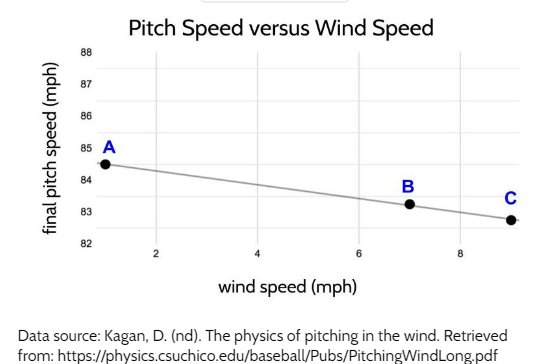
Points A, B, and C represent three balls thrown at the same initial speed, but under different wind conditions.

What is the contact force on the ball after the ball is thrown?
Required
1

In Question 1, Points A, B, and C represent three balls thrown at the same initial speed, but under different wind conditions.

For each ball thrown (A,B,C), show the contact forces on the ball after the ball has left the pitcher’s hand. Draw arrows to show the amount of the strength of forces on the ball.

Required
1

In Question 1, Points A, B, and C represent three balls thrown at the same initial speed, but under different wind conditions.

If all three balls (A, B, and C) had equal amounts of KE when they left the pitcher's hand, would they all have the same amount of KE when they reach home plate?

Required
1

Explain your answer choice from question 3.

Use the words kinetic energy, transfer.

Required
3
How would you design an investigation using materials we have used in class to collect evidence for all 3 pitches to support or refute your claim for question 3?

Think about items we have used in our class and list the items you will use in your investigation.
The items and objects I will use in my investigation:
Pitcher: _______
Ball: _______
Wind: _______

We would collect measurements and data with _______

My plan for setting up and carrying out my investigation:
Controlled Variable- _______
Independent Variable-_______
Dependent Variable- _______
Required
1

Representing and Explaining the Relationships between Bat Speed and Bat Mass

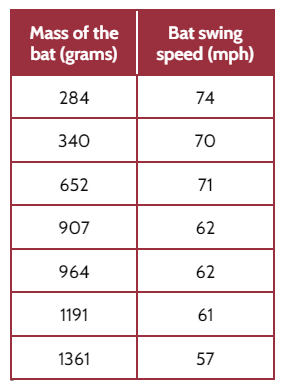
The data table below shows how fast a major league power hitter can swing a bat with different amounts of mass. The mass of the bat was the independent variable in this investigation, and the speed of the bat swing was the dependent variable.
Plot the data from the table on your graph.

Required
1

After graphing your data, draw a line of best fit for it.

Required
1

Use your line of best fit to predict how fast a player could swing a bat with a mass of 779 grams. Record your prediction here

Required
1

A batter swings a bat with the same amount of force. Why would the speed of the bat swing decrease as the mass of the bat increases?

Explain the cause and effect using the words forces, energy transfer, and kinetic energy.

Required
1

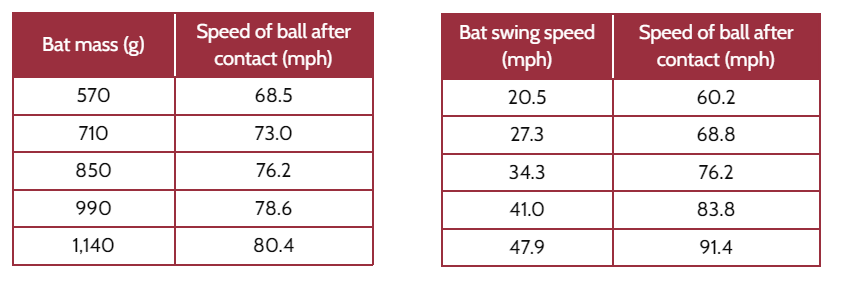
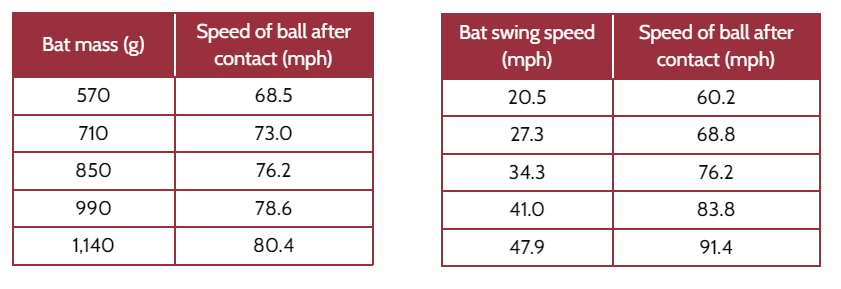
What has a bigger effect on the kinetic energy of the bat and the ball?

Required
1

In question 10 you answered the following question:
"What has a bigger effect on the kinetic energy of the bat and the ball?"

Use the data above to explain your answer to question 10.

Required
1

Some baseball stadiums (such as Coors Field in Denver, Colorado, which is the home stadium for the Colorado Rockies) are located at a much higher altitude than most stadiums. Coors Field is 5,200 feet (almost a mile) above sea level. At this higher altitude, there are fewer air particles in a given space than at lower altitudes.


How would you expect the data to be different if there are fewer air particles?

Required
1


Use the data to explain your answer to Question 12.