Lesson 6: Explaining the Effect of Different Lid Designs V2
star
star
star
star
star
Last updated 3 months ago
8 questions
Note from the author:
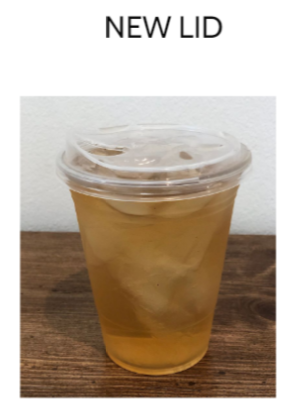
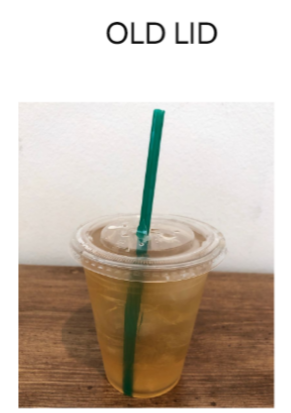
A beverage company wants to stop using plastic straws, so the company designs a new lid. The new lid has a much bigger hole than the old lid.
Alex, a scientist at the company, is wondering how this might affect what happens with the liquid inside the cup.
A beverage company wants to stop using plastic straws, so the company designs a new lid. The new lid has a much bigger hole than the old lid.
Alex, a scientist at the company, is wondering how this might affect what happens with the liquid inside the cup.
Required
2 points
2
Question 1
1.
1) First, Alex does an experiment in which she fills 2 cups with cold liquid at the same temperature: 1 cup with the old lid and 1 cup with the new lid. She finds that the liquid in one cup warmed up more than the liquid in the other cup after 10 minutes.
Which cup do you think warmed up more? Why?
(The cup that will warm up is____________________. This is because______________)
Required
1 point
1
Question 2
2.
Now, Alex wants to do a second experiment to see how the amount of liquid changes in the same 2 cups (1 with the old lid, 1 with the new lid) over time.
She decides to leave them out for a month. She designs the following procedure:
1)Fill each plastic cup with liquid and put the lid on the cup.
2) Draw a line where the liquid level is on each cup.
3) At the end of 30 days, weigh the 2 cups to see if there is a difference in mass between them.
If Alex wants to use the mass of the liquid as her dependent variable, what steps did Alex miss at the beginning of her procedure?
(If Alex wants the mass to be her dependent variable she should ____________________)
Required
1 point
1
Question 3
3.
Now, Alex wants to do a second experiment to see how the amount of liquid changes in the same 2 cups (1 with the old lid, 1 with the new lid) over time.
She decides to leave them out for a month. She designs the following procedure:
1)Fill each plastic cup with liquid and put the lid on the cup.
2) Draw a line where the liquid level is on each cup.
3) At the end of 30 days, weigh the 2 cups to see if there is a difference in mass between them.
If Alex wants to use the liquid level as her dependent variable, what steps did Alex miss to get the data she would need to use the liquid level as her dependent variable?
(If Alex wants the liquid level to be her dependent variable she should ____________________)
Required
1 point
1
Question 4
4.
Now, Alex wants to do a second experiment to see how the amount of liquid changes in the same 2 cups (1 with the old lid, 1 with the new lid) over time.
She decides to leave them out for a month. She designs the following procedure:
1)Fill each plastic cup with liquid and put the lid on the cup.
2) Draw a line where the liquid level is on each cup.
3) At the end of 30 days, weigh the 2 cups to see if there is a difference in mass between them.
To compare the 2 cups, what should Alex keep constant in her investigation
(To compare the 2 cups Alex should keep the following things the same:____________________)
Required
1 point
1
Question 5
5.
At the end of 30 days Alex finds that one cup lost more liquid than the other. Add particle diagrams for the zoomed-in views at lid locations A and B to help explain how that could happen.
Required
1 point
1
Question 6
6.
Explain what is happening to the liquid in both cups and how it is being affected.
(The liquid in the cup with a new lid ___________________.
The liquid in the cup with an old lid ___________________.
The liquid in both cups___________________)
Required
1 point
1
Question 7
7.
Alex repeats the Question 1 experiment 4 times. Each time, she records how much the liquid in the cup that warmed up the most changed temperature after 10 minutes. Here are her results:
Based on these data, what is the average temperature change for the liquid in the cup? ________℃