Přejít k hlavnímu obsahu
Přihlásit se
Sign up for FREE
arrow_back
Knihovna

ELA 10.02.25 Blast The Race For Gold (CERC Paragraph)

star
star
star
star
star
Poslední aktualizace about 1 month ago
5 Dotazy
DO NOW
1
Otázka 1
1.

DO NOW

Question

  • If something like the Klondike gold rush were to happen today, how do you think social media might change things?

Blast: The Race For Gold

(Time Permitting/Extra Credit)

This part below is only to be completed if we have extra time before the end of class.

3
Otázka 5
5.

By the Numbers

Claim Question:

  • Take a guess, how do you think the number 29 million relates to "The Race for Gold" article above?

    Answer this question with only a claim.

CER Response Rubric

Claim (3 pt)

  • The Claim answers the question.(1pt)

  • The Claim uses important words from the question (including the subject). (1pt)

  • The Claim is a complete sentence (with a capital letter at the beginning and a period at the end). (1pt)

Evidence#1 (3pt)

  • There is a Lead-in that introduces the quote (usually by saying, The author writes,) (1pt)

  • The Evidence is a word-for-word quote from the text (with "quotation marks" around it) (1pt)

  • There is an Author's Citation which contains the last name of the author (in (Parenthesis)) (1pt)

Reasoning#1 (3pt)

  • Reasoning explains how or why the evidence supports the claim. (3pts)

CERC Paragraph Rubric

Claim (3 pt)

  • The Claim answers the question.(1pt)

  • The Claim uses important words from the question (including the subject). (1pt)

  • The Claim is a complete sentence (with a capital letter at the beginning and a period at the end). (1pt)

Evidence#1 (3pt)

  • There is a Lead-in that introduces the quote (usually by saying, The author writes,) (1pt)

  • The Evidence is a word-for-word quote from the text (with "quotation marks" around it) (1pt)

  • There is an Author's Citation which contains the last name of the author (in (Parenthesis)) (1pt)

Reasoning#1 (3pt)

  • Reasoning explains how or why evidence #1 supports the claim. (3pts)

Evidence#2 (3pt)

  • There is a Lead-in that introduces the quote (usually by saying, The author writes,) (1pt)

  • The Evidence is a word-for-word quote from the text (with "quotation marks" around it) (1pt)

  • There is an Author's Citation which contains the last name of the author (in (Parenthesis)) (1pt)

Reasoning#2 (3pt)

  • Reasoning explains how or why evidence #2 supports the claim. (3pts)

Conclusion/Summary (3pts)

  • A Conclusion is a summary of the paragraph or a sentence that restates the Claim in new words.

Blast: The Race For Gold

By Alan Smithee

Gold! Gold! Gold! When news broke in 1896 that gold had been found in the Yukon Territory, people flocked to the region. Over the course of four years, 100,000 people set off for the Yukon. Only 4,000 of them found gold. What risks did people take when they followed the Klondike Gold Rush?

Men were willing to spend money to make money. In order to survive in the Yukon Territory, men needed at least a year’s worth of supplies. Typical supplies included 800 pounds of flour, 30 pounds of nails and 50 pounds of dried fruit, among other things, and cost the equivalent of $40,000 in today’s money. Men borrowed money, mortgaged their homes, and spent their life savings to pay for a chance at striking it rich.

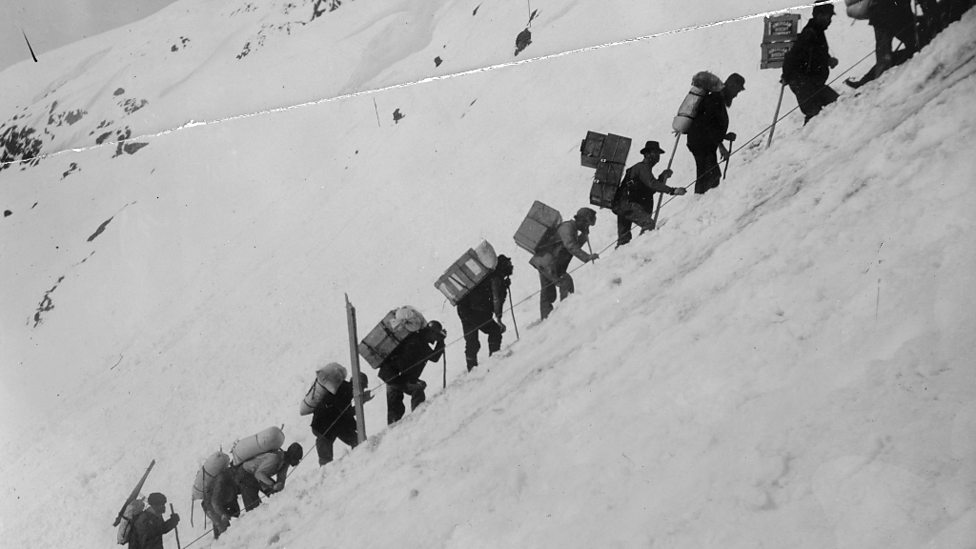
After making the financial commitment, men had to figure out how to navigate the Klondike, a mountainous area east of Alaska. Some took their chances on the Yukon River, where several died in the rapids. Others traveled a route that became known as Dead Horse Gulch, since 3,000 horses lay dead at the bottom. Most climbed Chilkoot Pass, a 30-mile climb straight up and down that was too steep for animals, so men had to carry their own supplies. When an avalanche hit Chilkoot Pass in April of 1898, 80 men died.

Prospectors who survived the journey into the Klondike faced extreme conditions. Freezing temperatures often reached 60 below zero. Prospectors built fires to thaw the ground so they could dig mines or pan for gold in the chilly rivers.

Despite the risks, many people were willing to undertake this mission to pursue the Klondike’s riches.

0
Otázka 2
2.

CER Response Question

  • Why was it so difficult to travel in the Yukon Territory?

In the same answer box:

  1. Write a claim to answer the question

  2. Write evidence that supports the claim

  3. Write reasoning the explains why your evidence supports your claim

Use the CER Response Rubrics above when crafting your response.

18
Otázka 3
3.

Direction:

Copy and Paste your answer from Question #2 into the box below, then add/write the following sentences to that answer.

  • evidence#2

  • reasoning#2

  • and a conclusion/summary

CERC Paragraph Question

Why was it so difficult to travel in the Yukon Territory?

In the same answer box:

  1. Write a claim to answer each question

  2. Write evidence#1 that supports the claim

  3. Write reasoning#1 the explains why your evidence#1 supports your claim

  4. Write evidence#2 that supports the claim

  5. Write reasoning#2 the explains why your evidence#2 supports your claim

  6. Write a conclusion/summary that summarizes or restates your claim

Use the CERC Paragraph Rubrics above when crafting your responses.

(Time Permitting)

9
Otázka 4
4.

CER Response Question

  • What was the financial risk involved in joining the Klondike Gold Rush?

In the same answer box:

  1. Write a claim to answer the question

  2. Write evidence that supports the claim

  3. Write reasoning the explains why your evidence supports your claim

Use the CER Response Rubrics above when crafting your response.