ELA Summative 3 - Peter Rabbit, Penguins Swim Together
star
star
star
star
star
Last updated 6 months ago
25 Nsɛmmisa
1 Once upon a time there were four little Rabbits, and their names were—Flopsy, Mopsy, Cotton-Tail, and Peter. They lived with their Mother in a sandbank, underneath the root of a very big fir tree.
2 "Now, my dears," said old Mrs. Rabbit, one morning, "you may go into the fields or down the lane, but don't go into Mr. McGregor's garden because you will find trouble there.”
3 "Now run along, and don't get into mischief. I am going out."
4 Then old Mrs. Rabbit took a basket and her umbrella and went through the woods to the baker's. She bought a loaf of brown bread and five currant buns.
5 Flopsy, Mopsy, and Cotton-Tail, who were good little bunnies, went down the lane to gather blackberries. But Peter, who was very naughty, ran straight away to Mr. McGregor's garden and squeezed under the gate!
6 First, he ate some lettuce, some French beans, and some radishes. Then, feeling rather sick, he went to look for some parsley. When he went around the end of a cucumber frame, whom should he meet but Mr. McGregor! Mr. McGregor was on his hands and knees planting out young cabbages, but he jumped up and ran after Peter, waving a rake and calling out, "Stop, thief!"
7 Peter was most dreadfully frightened; he rushed all over the garden, for he had forgotten the way back to the gate. He lost one of his shoes among the cabbages, and the other shoe amongst the potatoes. After losing them, he ran on four legs and went faster. He might have gotten away altogether if he had not unfortunately run into a gooseberry net, and got caught by the large buttons on his jacket. It was a blue jacket with brass buttons, quite new.
8 Peter gave himself up for lost, and shed big tears. His sobs were overheard by some friendly sparrows, who flew to him in great excitement, and begged him to exert himself. Mr. McGregor came up with a lid, which he intended to pop upon the top of Peter, but Peter decided to move just in time, leaving his jacket behind him. Then, he rushed into the tool shed, and jumped into a can. It would have been a beautiful thing to hide in, if it had not had so much water in it.
9 Mr. McGregor was quite sure that Peter was somewhere in the tool shed, perhaps hidden underneath a flowerpot. He began to turn them over carefully, looking under each. Presently Peter sneezed—"Kerty-schou!" Mr. McGregor was after him in no time and tried to put his foot upon Peter, who jumped out of a window, upsetting three plants. The window was too small for Mr. McGregor, and he was tired of running after Peter. He went back to his work.
10 An old mouse was running in and out, carrying peas and beans to her family in the woods. Peter asked her the way to the gate, but she had such a large pea in her mouth that she could not answer. She only shook her head at him. Peter began to cry.
11 Then he tried to find his way straight across the garden, but he became more and more puzzled. Presently, he came to a pond where Mr. McGregor filled his water cans. A white cat was staring at some goldfish; she sat very, very still, but now and then the tip of her tail twitched as if it were alive. Peter thought it best to go away without speaking to her; he had heard about cats from his cousin, little Benjamin Bunny.
12 He went back toward the tool shed, but suddenly, quite close to him, he heard the noise of a hoe—scr-r-ritch, scratch, scratch, scratch. Peter scuttered underneath the bushes. But, presently, as nothing happened, he came out, and climbed upon a wheelbarrow, and peeped over. The first thing he saw was Mr. McGregor hoeing onions. His back was turned toward Peter, and beyond him was the gate!
13 Peter got down very quietly off the wheelbarrow and started running as fast as he could go, along a straight walk behind some black-currant bushes. Mr. McGregor caught sight of him at the corner, but Peter did not care. He slipped underneath the gate and was safe at last in the woods outside the garden. Mr. McGregor hung up the little jacket and the shoes for a scarecrow to frighten the blackbirds.
14 Peter never stopped running or looked behind him till he got home to the big fir tree. He was so tired that he flopped down upon the nice soft sand on the floor of the rabbit hole and shut his eyes. His mother was busy cooking; she wondered what he had done with his clothes. It was the second little jacket and pair of shoes that Peter had lost!
15 Peter was not very well during the evening; he had found the trouble about which his mother had cautioned. His mother put him to bed and made some chamomile tea; and she gave a dose of it to Peter!
16 "One table-spoonful to be taken at bed-time."
17 But Flopsy, Mopsy, and Cotton-Tail had bread and milk and blackberries for supper.
Part A
Which statement expresses one of the themes of the text? RL 4.2
Part B
Which detail from the story provides the best evidence for the answer to Part A? RL 4.1
Select the underlined phrase from paragraph 8 that helps the reader understand that the meaning of the word exert is to “make an effort/to try.”
Peter (A) gave himself up for lost, and (B) shed big tears. His sobs (C) were overheard by some friendly sparrows, who flew to him in great excitement, and begged him to exert himself. Mr. McGregor came up with a lid, which he intended to pop upon the top of Peter, but Peter (D) decided to move just in time, leaving his jacket behind him. Then, he rushed into the tool shed, and jumped into a can. It would have been a beautiful thing to hide in, if it had not had so much water in it.
What can the reader infer Peter is thinking at the end of the text? RL 4.1
Part A What action caused Mr. McGregor to chase Peter? RL 4.1
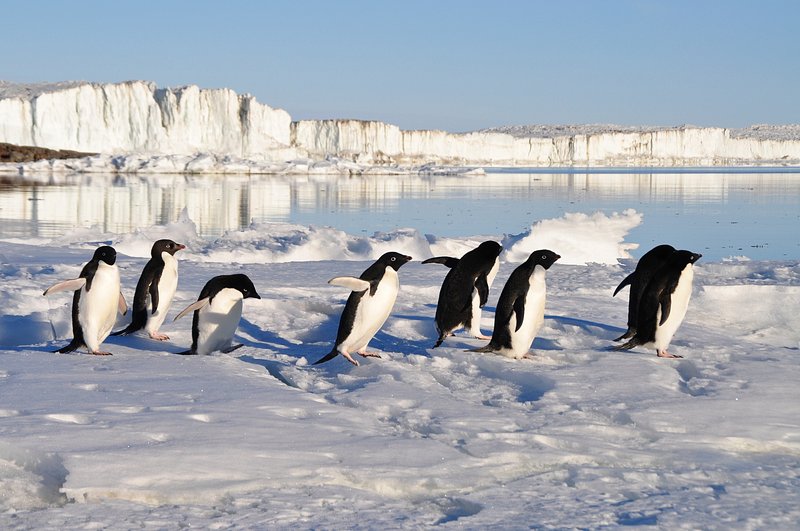
1 Penguins spend some of their time on land or on huge slabs of ice. But when they need to eat, they must return to the water. Most kinds of penguins, like Adelie (AD-uh-lee) penguins, return to the water in groups. That’s because an enemy, such as a leopard seal, may be hiding below the water’s surface. A group has more eyes to look out for an oncoming predator. And a nearby predator may have a hard time choosing which penguin to chase. A lone penguin is a much easier target.
2 Penguins have other enemies in the water to worry about besides leopard seals. Sea lions, sharks, and killer whales all prey on penguins.
3 On land, adult penguins are usually safe. But chicks that are weak, sickly, or left alone are always at risk of being attacked. Large birds of prey, gulls, and giant petrels eat chicks if given the chance.
4 On top of their skin, penguins have thick coats of feathers. Penguin feathers are good at trapping heat. They are the main reason some penguins can live in such cold places. The feathers are also waterproof. They keep penguins dry underneath, even while the birds are swimming.
5 If penguins don’t keep their feathers in very good shape, they don’t stay waterproof. So penguins spend several hours a day preening, or caring for, their feathers. Penguins use their beaks, flippers, and feet to preen. For extra protection in the water, penguins spread oil on their feathers. The oil comes from a special gland near their tail feathers.
6 Penguins that live in cold regions have an extra layer of fat, called blubber. The extra layer of fat acts like a blanket to help keep the birds warm when the temperature drops. Penguins also use fat to store energy. That comes in handy when they go long periods without food.
7 Penguins shed their feathers because they become worn and damaged. When penguins shed their old feathers and grow new ones, it is called molting. Penguins molt once a year. Penguins always molt on land or on ice. Until they grow new waterproof coats, they can’t go back into the water. And the water is where they need to go to find food.
8 Sometimes penguins might have to go for more than a month without food while they molt. To prepare, penguins eat as much as they can during the weeks leading up to the molt. Eating so much helps them add fat to their bodies. The penguins live off the fat while they grow new feathers.
Excerpt from Penguins and Other Flightless Birds by Patricia Brennan. Copyright 2002 by Animals of the World Book Series published by World Book, Inc.
Which quotation supports the author’s point that penguins must keep their feathers in good condition to keep them waterproof?
What text structure does the author use in paragraph 6?
Part A
What does the phrase "at risk of" mean as it is used in paragraph 3?
Part B
Which statement from the passage supports the answer to Part A?
What keeps a penguin's feathers waterproof?
Why do penguins swim together?
Read these details from the passage about penguins. RI 4.1
"Penguins spend some of their time on land or on huge slabs of ice."
"On top of their skin, penguins have thick coats of feathers."
"Penguin feathers are good at trapping heat."
"The extra layer of fat acts like a blanket to help keep the birds warm when the temperature drops."
What do these details tell the reader about most penguins?
How do penguins protect themselves from predators? RI 4.1
What does the word target mean as it is used in paragraph 1? RI 4.4
What is the main idea of this passage? RI 4.2
According to the passage, why is blubber important? RI 4.3
What effect does molting have on penguins? RI 4.3
Which of the following correctly describes “Penguins and Other Flightless Birds”? RI.4.6
How does the image help the reader understand the passage? RI 4.7
Which two details belong in a summary of the section, Why do Penguins Swim Together? RI 4.2