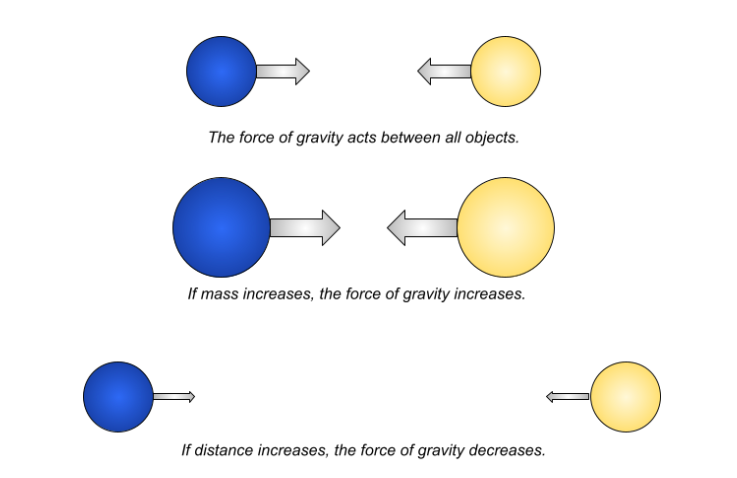
Gravity has traditionally been defined as a force of attraction between things that
have mass. According to this concept of gravity, anything that has mass, no
matter how small, exerts gravity on other matter. Gravity can act between objects
that are not even touching. In fact, gravity can act over very long distances, but
the farther apart the objects are, the weaker the force of gravity between them is. The two things that affect gravity are mass and distance. 
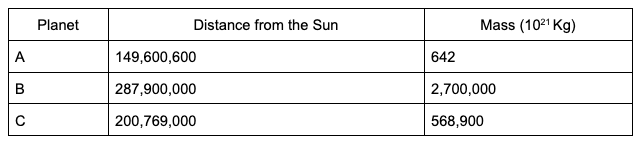
Which planet has the most gravitational force?

What are the two things that affect gravity? (choose 2)
Barycenter:
In astronomy, the barycenter is the center of mass of two or more bodies that orbit one another and is the point about which the bodies orbit. The barycenter will be closer to the object with more mass.
The entire Solar System, including the Sun, has a barycenter, or a common center of mass of all of the Solar System's objects, around which they orbit. The barycenter of the Solar System is not the center of the Sun. That's because planets and other bodies of the Solar System enforce a gravitational tug on the sun, causing it to wobble around a little bit. The more mass a planet has, the more that planet changes the barycenter. The barycenter of the Solar System lies a little outside of the Sun's surface.
Which planet would have the most affect on the barycenter?
If I drop a coin, it gets pulled to the ground. Why doesn't it get pulled to me?
Objects with more mass have more gravitational pull. An object that has more mass will be pulled with more gravitational pull. The Earth would not pull you and the Statue of Liberty towards it with the same force, instead it would have to pull the Statue of Liberty down with more force since it has more mass. A rocket taking off from the moon would be pulled with less force than a rocket taking off from Earth so more fuel would be needed to take off from Earth. Also, objects that fall on other planets will fall faster on planets that have more mass because those planets have more gravitational pull.