Change the information panel to "brightness."

Describe the changes the Sun's luminosity (brightness) will go through between stages.
Stage 1 to Stage 2:
Stage 2 to Stage 3:
If you need help with this lab, please watch the class recording (updated 10/15/25)
If you need help with this lab, please watch the class recording (updated 10/15/25)
Click the play button below the Hertzsprung-Russell diagram to show the Sun’s evolution.
You may want to adjust the speed in the lower right corner.
Name the three stages of the Sun’s life shown on the Hertzsprung–Russell diagram.
Stage 1:
Stage 2:
Stage 3:
Describe the changes the Sun's radius (size) will go through between stages.
Stage 1 to Stage 2:
Stage 2 to Stage 3:
At which stage will the Sun have the largest radius?
Change the information panel to "brightness."
Describe the changes the Sun's luminosity (brightness) will go through between stages.
Stage 1 to Stage 2:
Stage 2 to Stage 3:
Change the information panel to "Stages in your stars life."
What stage will the Sun spend most of its life?
Change the information panel to "Mass."
Describe the changes the Sun's mass will go through between stages.
Stage 1 to Stage 2:
Stage 2 to Stage 3:
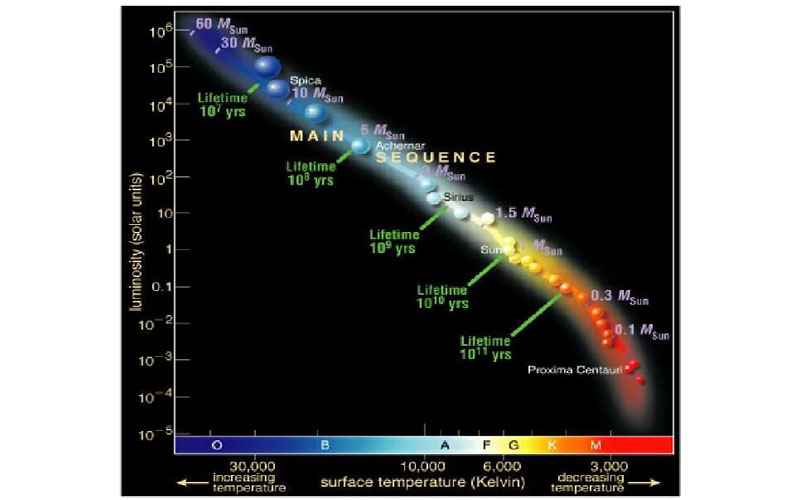
 Use the dropdown in the lower left to change the star's mass to other low numbers like 0.2, 0.65, and 2. Observe the starting location of low mass stars on the Main Sequence.
Where are low mass stars like the Sun found on the Main Sequence?
Switch to a high mass star by changing the star's mass to 30.
Click the play button below the Hertzsprung-Russell diagram to show the high mass star’s evolution.
You may want to adjust the speed in the lower right corner.
Name the three stages of the high mass star’s life shown on the Hertzsprung–Russell diagram.
Stage 1:
Stage 2:
Stage 3:
Describe the changes the high mass star's radius (size) will go through between stages.
Stage 1 to Stage 2:
Stage 2 to Stage 3:
At which stage will the high mass star have the largest radius?
Change the information panel to "temperature."
Describe the changes the high mass star's temperature will go through between stages.
Stage 1 to Stage 2:
Stage 2 to Stage 3:
At which stage in its lifecycle will the high mass star be at its hottest?
Change the information panel to "brightness."
Describe the changes the high mass star's luminosity (brightness) will go through between stages.
Stage 1 to Stage 2:
Stage 2 to Stage 3:
At which stage in its lifecycle will the high mass star be at its brightest?
Change the information panel to "Stages in your stars life."
What stage will the high mass star spend most of its life?
Change the information panel to "Mass."
Describe the changes the high mass star's mass will go through between stages.
Stage 1 to Stage 2:
Stage 2 to Stage 3:
Use the dropdown in the lower left to change the star's mass to other high numbers like 10, 20, and 40. Observe the starting location of high mass stars on the Main Sequence.
Where are high mass stars found on the Main Sequence?
Consider this model of star life cycles:
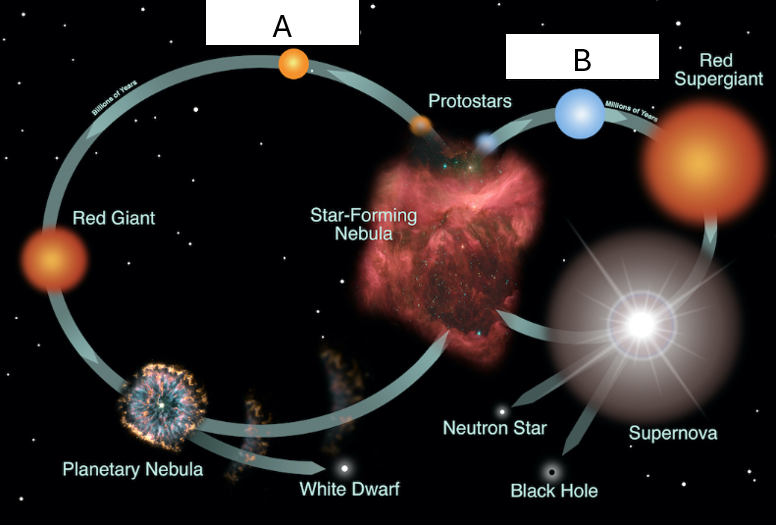
Which side (A or B) depicts the life cycle of a high mass star?
Which side (A or B) depicts the life cycle of a low mass star?
Compare and contrast low mass and high mass stars.
Low Mass Star | High Mass Star | Both Low & High Mass Stars | |
|---|---|---|---|
Begins as a hot blue star | |||
Has a shorter life span | |||
Ends as a white dwarf | |||
Ends as a supernova | |||
Begins on the main sequence | |||
Begins as a "Sun" like star | |||
Spends time as a red giant/supergiant before its death | |||
Brighter throughout its life time | |||
Larger overall throughout its life |


