Log in
Sign up for FREE
arrow_back
Library

Pre-Test Unit 2 - How Can I Smell Things From a Distance? [86330] (10/13/25)

star
star
star
star
star
Last updated 7 months ago
23 questions
1
MS-PS1-1
1
MS-PS1-1
1
MS-PS1-1
1
MS-PS1-1
1
MS-PS1-1
1
MS-PS1-4
1
MS-PS1-2
1
MS-PS1-6
1
MS-PS1-2
2
MS-PS1-2
1
MS-PS1-2
2
2
1
MS-PS1-6
1
MS-PS1-4
1
MS-PS1-4
1
MS-PS1-6
1
MS-PS1-4
1
MS-PS1-4
1
MS-PS1-4
Question 1
1.

Question 2
2.

Question 3
3.

Question 4
4.

Question 5
5.

Question 6
6.

Question 7
7.

Question 8
8.

Question 9
9.

Question 10
10.

Oxygen, hydrogen, and water are substances. Which of these substances are elements?
[Select two.] Options:
A. Oxygen
B. Hydrogen
C. Water
D. None of These

Question 11
11.

Question 12
12.

A middle school science class is studying metallic elements. The teacher provided each
student with a strip of metal. Pairs of students need to find out whether both students' strips are made of the same elements.

How would the students determine whether their strips are the same?

Write a claim naming at least two properties that could be used to determine whether the strips are the same. [Use a complete sentence(s).]

Question 13
13.

A middle school science class is studying metallic elements. The teacher provided each
student with a strip of metal. Pairs of students need to find out whether both students' strips are made of the same elements

How would the students determine whether their strips are the same?
Use the sentence frames below to provide evidence that supports your claim.
Describe the properties that could be used to determine whether the strips
are the same.

Evidence: ____________ (1st property) is ____________ (describe 1st property).
____________ (2nd property) is ____________ (describe 2nd property).

2
Question 14
14.

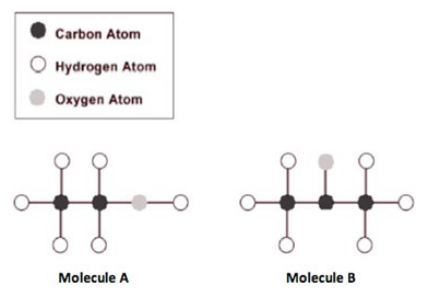
Two jars contain substances that smell similar. Molecule A is in one jar and Molecule B is in
the other jar.

Question: How can the diagrams help you decide whether or not the two jars contain the same substance?

Task: Write a claim stating at least one way that you could use the diagrams to determine whether or not the two jars contain the same substance. [Use a complete sentence.]

2
Question 15
15.

Two jars contain substances that smell similar. Molecule A is in one jar and Molecule B is in
the other jar.

Question: How can the diagrams help you decide whether or not the two jars contain the same
substance?

Task: Use the sentence frame below to provide evidence for your claim, describing what the diagrams show that help you to determine whether or not the two jars contain the
same substance.

Evidence: The diagrams show ____________ which helps to determine whether or not the two jars contain the same substance.

2
Question 16
16.

Two jars contain substances that smell similar. Molecule A is in one jar and Molecule B is in
the other jar.

Question: How can the diagrams help you decide whether or not the two jars contain the same
substance?

Task: Use the sentence frame below to provide reasoning for how the evidence supports your claim. Explain how you could use the diagrams to determine whether or not the two jars contain the same substance.

Reasoning: The diagrams show ____________ which helps to determine whether or
not the two jars contain the same substance by/because ____________.

Question 17
17.

Question 18
18.

Question 19
19.

Question 20
20.

Question 21
21.

Question 22
22.

Question 23
23.

An element is.....
A. the smallest particle of an element that is still that element.
B. a characteristic of a substance or element that is always true.
C. made up of the same type of atom all the way through.
D. something that is made up of either one type of atom or one type of molecule all the way through.
E. a particle made up of more than one atom.
An atom is.....
A. the smallest particle of an element that is still that element.
B. a characteristic of a substance or element that is always true.
C. made up of the same type of atom all the way through.
D. something that is made up of either one type of atom or one type of molecule all the way through.
E. a particle made up of more than one atom.
A molecule is.....
A. the smallest particle of an element that is still that element.
B. a characteristic of a substance or element that is always true.
C. made up of the same type of atom all the way through.
D. something that is made up of either one type of atom or one type of molecule all the way through.
E. a particle made up of more than one atom.
A substance is.....
A. the smallest particle of an element that is still that element.
B. a characteristic of a substance or element that is always true.
C. made up of the same type of atom all the way through.
D. something that is made up of one type of molecule all the way through.
E. a particle made up of more than one atom.
A property is.....
A. the smallest particle of an element that is still that element.
B. a characteristic of a substance or element that is always true.
C. made up of the same type of atom all the way through.
D. something that is made up of either one type of atom or one type of molecule all the way through.
E. a particle made up of more than one atom.
If you could use a powerful microscope to see the particles in a gas, what would you see between the particles?
More particles
Air
Empty space
Liquid
Which of the following is true about odors?
All odors are made up of particles
Odors move in all directions
Odors can be detected
All of the above
What happens to the molecules in a substance that changes from a liquid to a solid?
The molecules shrink
The molecules slow down
The molecules expand
The molecules speed up
A ball made of an unknown substance is a solid at room temperature. A block made of a different substance is also a solid at room temperature. Their melting points would be
the same because they are both solids at room temperature.
the same because they are made of the same types of atoms.
different because they have different shapes.
different because they are made up of different molecules.
Which is not a characteristic of all matter?
A. All matter has color.
B. All matter takes up space.
C. All matter is made of atoms.
D. All matter has mass.
In the following models, each small dot represents a wax molecule. Which model best represents what happens when solid wax melts?
A water molecule in the gas phase is _________________ a water molecule in the solid phase.
Smaller than
Lighter than
Heavier than
Larger than
The same as
When ammonia at 24°C is cooled to 0°C, the ammonia molecules ________________________.
become less organized
move faster
move slower
break apart
stop moving
A pot of water on a hot stove begins to boil rapidly, and a cold glass lid is placed on the pot. Water droplets immediately begin forming on the inside of the lid. What happened?
The lid started to sweat
Steam cooled and water molecules moved closer together
Water from the outside leaked into the pot
Hydrogen and oxygen combined to form water
Steam combined with the air to wet the inside of the lid
Flask A contains an unknown gas. A student lets some of the gas escape by opening and closing the flask. Which of the following models best represents the gas that remains in the flask?
When a thermometer is heated, the red liquid inside the thermometer moves upward. This is because ___________.
the red liquid is thin
the molecules of the liquid move faster and move further apart
hot liquid is lighter
the glass of the thermometer gets hot
When you heat a sample of gas, what happens to the particles that make up the gas?
The particles move faster
The particles will break apart
The particles will get smaller
The particles will become denser