1
Asemmisa {{asɛmmisaAhyɛnsode}}
4.
1
Asemmisa {{asɛmmisaAhyɛnsode}}
5.
1
Asemmisa {{asɛmmisaAhyɛnsode}}
6.
This question is about oxygen. Oxygen can be stored in tanks as a liquid or as a gas.
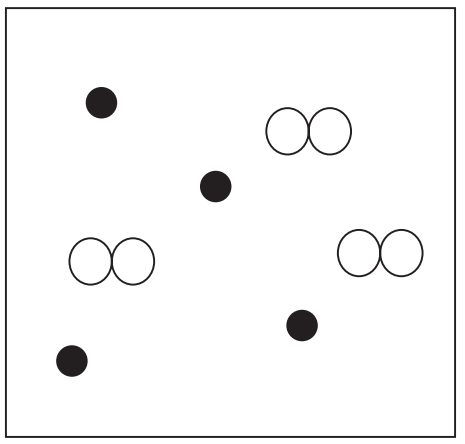
Complete the diagram to show the arrangement of six more particles in a gas.
Give a reason why a tank can store much more oxygen as a liquid.
Identify a hazard when storing oxygen as a gas.
State how the box represents a mixture
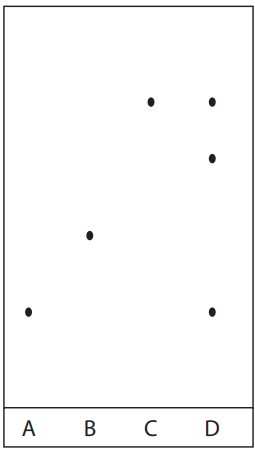
Food colourings are mixtures of food dyes. A student uses paper chromatography to separate the food dyes contained in food colouring D. The student places spots of three food dyes A, B and C and food colouring D on chromatography paper. The diagram shows the appearance of the paper after the experiment.
Describe the composition of food colouring D.
A compound has the formula Ca(HCO3)2
Determine the number of different elements
Determine the number of atoms in the formula
The equation represents the complete combustion of an alkene.
CnH2n + oxygen → carbon dioxide + nH2O
Complete combustion of 0.0100mol of the alkene produces 2.16g of water.
Determine the molecular formula of this alkene. [for H2O, Mr = 18]
The teacher burns 30.0g of heptane. This is the equation for the complete combustion of heptane.
C7H16 + 11O2 → 7CO2 + 8H2O
Calculate the minimum mass of oxygen needed for the complete combustion of 30.0g of heptane. [for C7H16 , Mr = 100; for O2 , Mr = 32]
Give a physical test to show that the water that collects in the U-tube is pure.
Compound X contains these percentages by mass.
• carbon 60%
• hydrogen 13.3%
• oxygen 26.7%
Compound X has an Mr of 60 Determine the molecular formula of compound X.
Complete the chemical equation for the decomposition of calcium nitrate. (just write coefficients through comma, e.g. 1,1,1,1)
................Ca(NO3)2 → ................CaO + ................NO2 + ................O2
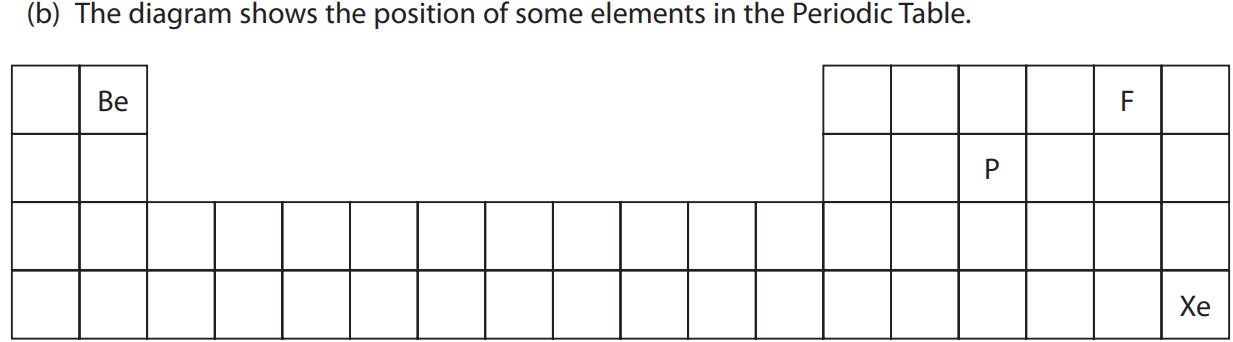
How are elements arranged in the Periodic Table?
Explain which of the four elements in the diagram is least reactive.
Pb(NO3)2(aq) + 2KBr(aq) → PbBr2(s) + 2KNO3(aq)
A solution containing 0.150mol of lead(II) nitrate is reacted with an excess of potassium bromide solution. A mass of 49.6g of pure, dry lead(II) bromide is produced.
Show, by calculation, that the percentage yield of lead(II) bromide is 90.1%.
[for PbBr2, Mr = 367]
This is the equation for the reaction between sodium and water.
2Na(s) + 2H2O(l) → 2NaOH(aq) + H2(g)
A mass of 0.750g of sodium is reacted with an excess of water. Calculate the volume of hydrogen gas produced, in cm3 , at room temperature.
[molar volume of hydrogen at rtp = 24000cm3 ] [for Na, Ar = 23]
Give your answer to three significant figures.
Which statement is correct about the position of phosphorus, P, in the Periodic Table?