If you need help with this lab, please watch the recording (updated 10/29/25)
If you need help with this lab, please watch the recording (updated 10/29/25)
Galaxies are vast systems of stars, gas, dust, and dark matter held together by gravity.
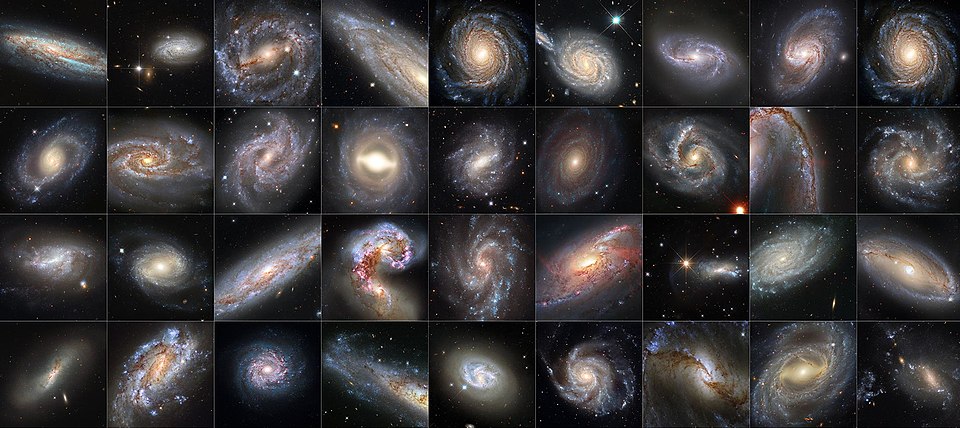
The image above shows a variety of galaxies as seen from the Hubble Space Telescope.
Brainstorm: How could you organize these galaxies into groups based on their features?
Galaxies can also be classified by their shape.
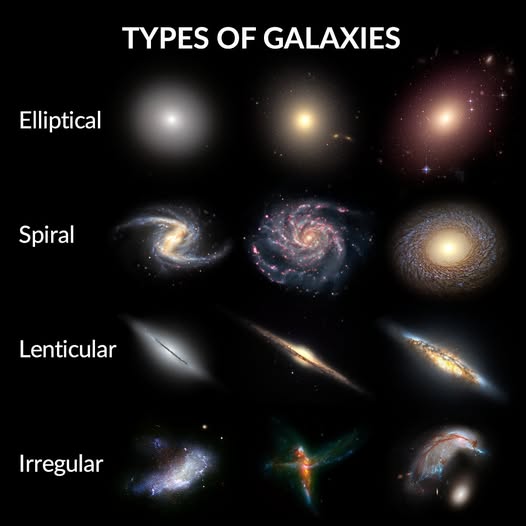
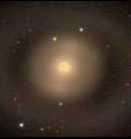
Elliptical galaxies appear smooth and featureless, with their shapes ranging to circular to very elongated.
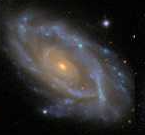
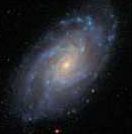
Spiral galaxies have distinctive arms that curve outwards from a central bulge. Spirals are defined by the tightness of their arms and whether a "central bar" is present in the center.
Lenticular galaxies feature a central bulge and flattened disk, but lack spiral arms.
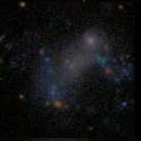
Irregular galaxies lack a defined shape and may have once been another type of galaxy distorted by the gravitational pull of other galaxies.
Match the galaxy shape to its description.
| Draggable item | arrow_right_alt | Corresponding Item |
|---|---|---|
Lenticular | arrow_right_alt | Smooth, featureless, round to elongated |
Elliptical | arrow_right_alt | Central bulge with distinctive arms, may have a central bar |
Irregular | arrow_right_alt | Flattened disk and central bulge without arms |
Spiral | arrow_right_alt | No defined shape |
Identify each galaxy by its shape.
Elliptical | Spiral | Irregular | |
|---|---|---|---|
| |||
| |||
| |||
| |||
| |||
|
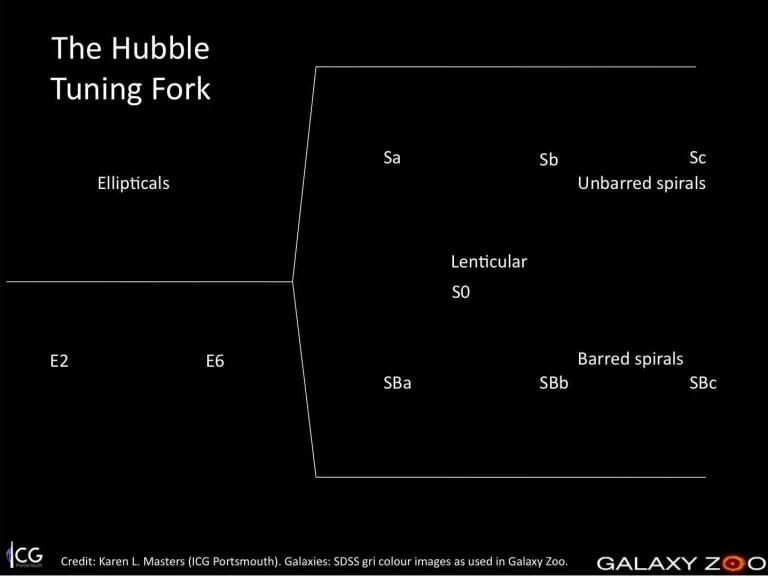
In 1927, Edwin Hubble created a classification scheme for galaxies based primarily on their shape that is still used today. It is sometimes called Hubble's "tuning fork" because its shape resembles a sideways tuning fork.
Elliptical galaxies are classified as E0 (perfectly round) to E7 (extremely oval shaped).
Lenticular galaxies are classified as S0, or galaxies in between the elliptical or spiral classiciation.
Spiral galaxies are divided into 2 categories: unbarred and barred
Unbarred spirals are classified as Sa (tightly wound arms with bright central bulge) to Sc (loosely wound arms with fainter central bulge)
Barred spirals are classified as SBa (tightly wound arms with a distinct central bar) to SBc (loosely wound arms with a fainter central bar)
Irregular galaxies are not part of the Hubble sequence.
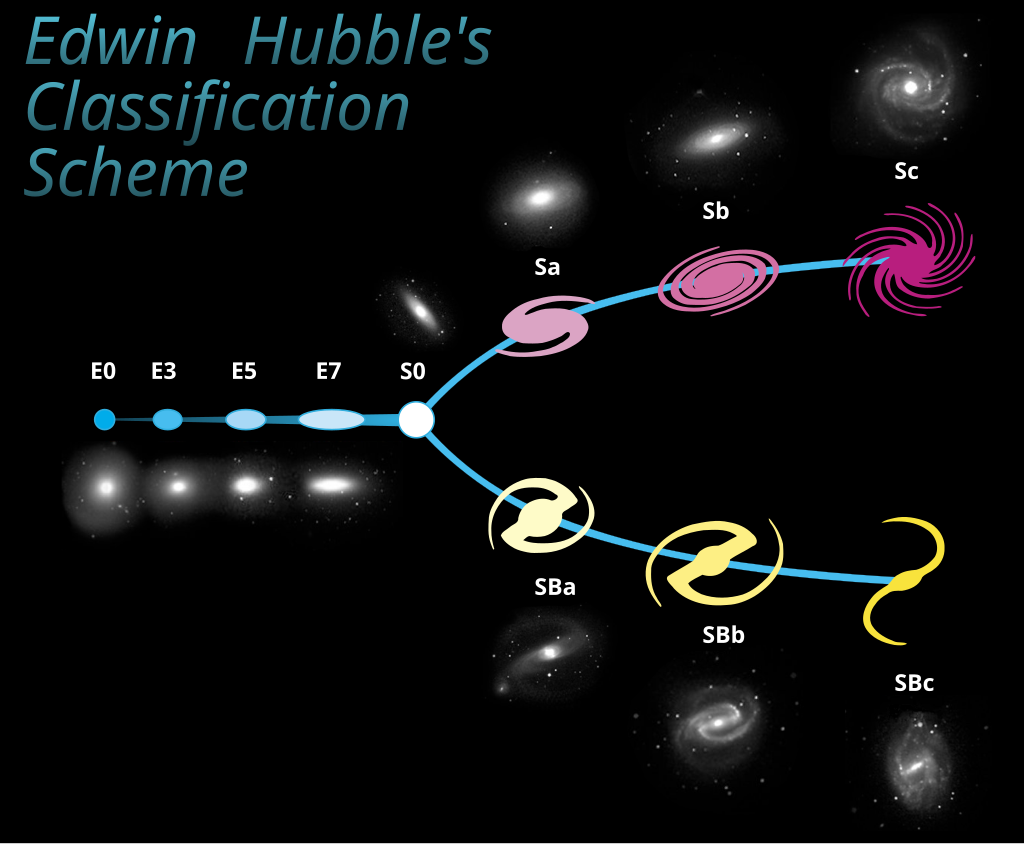
Which type of galaxy is not included in Hubble's classification scheme?
Place the galaxies according to their classification on the Hubble "Tuning Fork"

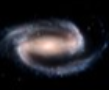
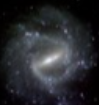
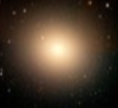
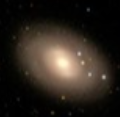
Galaxies can be classified by the color of their stars.
Think about what you know about star lifecycles.
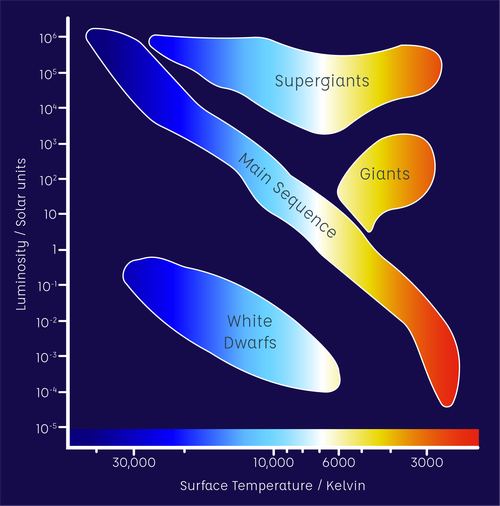
Remember that most stars can be found in the Main Sequence for the majority of their lives.
Young blue and white stars are the hottest and brightest. There are young yellow, orange, and red stars, but they aren't as hot or bright.
Once stars are older and run out of hydrogen to fuse to helium, they become red giants or supergiants. These stars are cooler, but still very bright.
White dwarfs are also older stars that are very hot, but they are very dim and hard to see.
Which color galaxy would have the hottest stars?
Which color galaxy would have the coolest stars?
Which color galaxy would have the youngest stars?
Which color galaxy would have the older stars?
Look at each galaxy and determine its temperature and age based on its color.
Hot & Young | Dim & Older | |
|---|---|---|
| ||
| ||
| ||
| ||
| ||
|
Which shape galaxies tend to be young and hot and which shape galaxies tend to be older and cooler? Drag the shape to the correct description.
Spiral
Elliptical
Irregular
Young & Hot
Older & Cooler