Preskoči na glavni sadržaj
Prijava
Sign up for FREE
arrow_back
Biblioteka

2025 (Aug.): NY Regents - ELA

star
star
star
star
star
Posljednje ažuriranje 4 months ago
26

Part 1

Directions (1–24): Closely read each of the three passages below. After each passage, there are several multiple-choice questions. Select the best suggested answer to each question and record your answer on the separate answer sheet provided for you. You may use the margins to take notes as you read.

Reading Comprehension Passage A

The Clasp

In the following excerpt from a science fiction story, the narrator describes living with a species that shares his people’s home on the great butte.1

Our tribe didn’t have a word for the huge, winged race of reptiles who shared the cliff faces with us. They were just “The Clasp.” Same as us. One tribe. One name. One shared livelihood as old as the great butte.

When I was a young boy, before I knew better, I asked my grandmother if we were pretending to be like the big, scaly tribesmen or if they were pretending to be like us. After all, we didn’t look anything alike. When I finally made her understand my question, I hated the way she looked at me, like she’d tasted something bitter.

“There’s no ‘they’ or ‘us,’” she said. “We eat the same plants and insects, don’t we? We drink the same water, don’t we? All The Clasp warms our blood on the southern face and shelters from storms in the red caverns, eh?”...

“The Clasp” was fine for most, but not for me. I needed a new word for the things. I needed to name them so that I could hate them properly. Our language was on the side of unity, but language can change. So, I called them “the swoops” and I wove the new name into a tapestry of curses under my breath.

For a long time, I had trouble articulating2 why I hated the swoops. I may have feared them as a child. Their size. Their black eyes and hooked claws. But, in the end, it was their freedom I hated. The swoops were the only living things I had ever known to leave the butte. They’d glide away to trace vast, winding circles around the great finger of rock. Sometimes, they’d even veer off toward the horizon, to the dark green line of misty shapes that hemmed in the plains below. They’d come back carrying strange smells, their snouts wet with the pulp of fruits I’d never taste.

I’d watch them do these things as I clung to the stone, clambering from perch to perch, peeping out of caves and fissures while wearing the butte smooth with my footfalls. In turn, the butte wore me smooth, my fingers and toes, my patience and my temper. Every time I looked at a swoop, whether I was on the highest cliffs or in the lowest caverns, I felt my world shrink a bit more. ...

The common wisdom was that only the fastest, strongest members of the tribe could go to ground with any hope of returning. Of course that meant the damn swoops, but nobody ever seemed to list “wings instead of hands” as the key prerequisite. That would admit too much difference. ...

So, on a wet spring morning just before false dawn, I gathered up what supplies I could fit into my small shoulder bag and began climbing down. I loved that time of morning, before the sun heated the rock and the swoops, before their croaking chatter filled the caverns and

1butte — an isolated, flat-top, steep hill
2articulating — expressing
drove out the gentle sound of sleepers’ steady breathing. That was the hardest time of day to leave my people, but that was part of the reason it needed to be then.

I had no idea what climbing down would involve. No one had ever done it or even suggested that it would be possible. But I knew, one way or another, I’d reach the plains that day. I’d add a new, hazy shape to the children’s guessing games.

It took less than an hour to reach the lowest spot I knew on the butte, a little outlet where rain runoff trickled from our small reservoir in the lower caverns. I splashed along the tiny stream toward the growing daylight, the water making the red dust shine like blood on the hard, brown skin of my feet. When I emerged and felt the breeze on my face and chest, the realization that the lowest spot I knew wasn’t actually low at all felt like an old, familiar insult. It was like the butte itself was chastising3 me for my childishness, my odd ways. Tutting at me in my grandmother’s voice. …

“The hell with you,” I said, and swung down to a fingertip hold in a narrow crack beneath the outlet. It was the closest I had ever been to the ground. It was the bravest thing I had ever done.

At first, the climb was easy, if strange. The edges of the cracks were sharper than I was used to, not smoothed and rounded by thousands of fingers and swoops’ claws. But the holds were sound and regular, and before midday I was seeing sights beneath me that I had never seen before. The branching limbs of a lone tree standing in the plain. The shifting movement of grasses in the wind. I had to remind myself to keep moving or else I might have stared until I lost the light and my grip. A swoop glided past and cocked its head to look at me. I scowled up at it and started off with renewed purpose. …

There came a point, not a hundred feet above a mound of shattered stone that sloped down to the plain, that even my clever fingers couldn’t find a hold anywhere. The butte had become a blank, red wall. Featureless and merciless. I was sick with weariness and terror and defeat. I couldn’t climb back up if I wanted to, and the only path I could see was a lateral4 jump to a crooked shadow on the rock. I couldn’t tell if the shadow was a finger hold or just discolored stone. Necessity decided it was a hold and I tensed my trembling limbs to jump. …

Time slowed as I fell. Twisting through the air, my eyes fell upon a stand of brushy shrubs where the broken rock met the soil of the plains. They were alien5 and beautiful and I wanted to fill all my vision with them. I spun as I fell, looking from ground to sky and back again. But, with each fleeting glimpse of the approaching plain I felt the wonder of it filling me up, beating back the fear and loss. All the while the sky and the butte felt more and more distant, even as the daylight was swallowed up by a swift darkness.

The impact of the diving swoop clutching me with tail and talons brought time back to bear with bone-cracking speed and ferocity. The unexpected blow reawakened the life and terror in me, and my scream joined the croaking wail of grasping swoop. The huge, slate-blue creature beat its wings madly and the whip-crack of them stole away my remaining breath. But, strong as they are, swoops were not made to carry burdens. …

I awoke to the steady rise and fall of breath. The swoop lay on its side, clutching me to its chest with folded wings. When I stirred, the swoop gently withdrew, letting me slide down into a tuft of amber grass. It stood stiffly, raising itself onto its hind legs and the clawed fore-joints of its wings. It moved as if pained, but its eyes were bright and it stood tall and steady. …

3chastising — scolding

4lateral — sideways

5alien — exotic

1
RL.11-12.2
1
RL.11-12.3
1
RL.11-12.3
1
RL.11-12.4
1
RL.11-12.6
1
RL.11-12.4
1
RL.11-12.3
1
L.11-12.5.a
1
RL.11-12.5

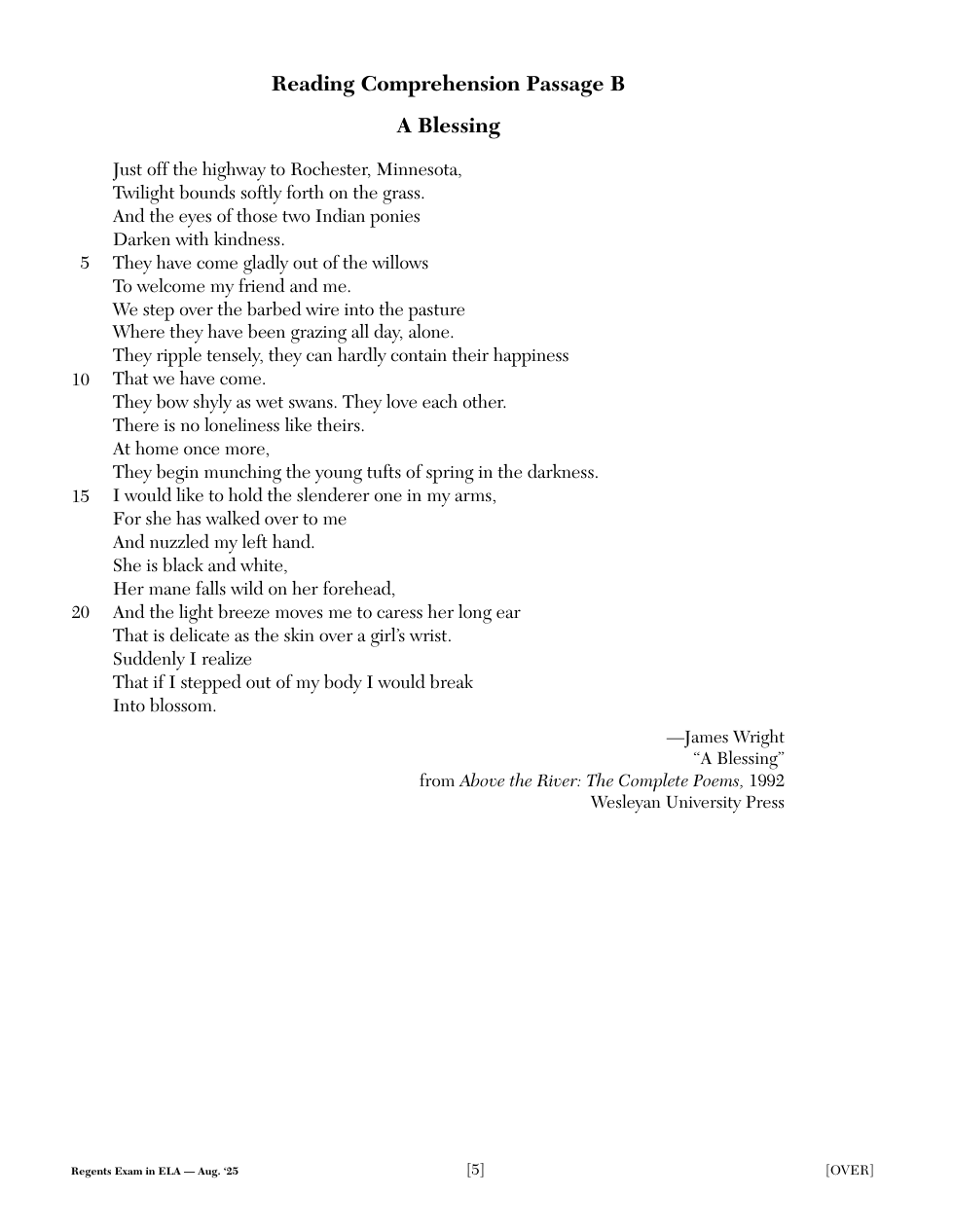
A Blessing

Just off the highway to Rochester, Minnesota,
Twilight bounds softly forth on the grass.
And the eyes of those two Indian ponies
Darken with kindness.
They have come gladly out of the willows
To welcome my friend and me.
We step over the barbed wire into the pasture
Where they have been grazing all day, alone.
They ripple tensely, they can hardly contain their happiness
That we have come.
They bow shyly as wet swans. They love each other.
There is no loneliness like theirs.
At home once more,
They begin munching the young tufts of spring in the darkness.
I would like to hold the slenderer one in my arms,
For she has walked over to me
And nuzzled my left hand.
She is black and white,
Her mane falls wild on her forehead,
And the light breeze moves me to caress her long ear
That is delicate as the skin over a girl's wrist.
Suddenly I realize
That if I stepped out of my body I would break
Into blossom.

—James Wright
“A Blessing”
from Above the River: The Complete Poems, 1992
Wesleyan University Press

1
L.11-12.5.a
1
RL.11-12.4
1
L.11-12.5.a
1
RL.11-12.5
1
RL.11-12.5

Reading Comprehension Passage C

Sweet, Sour, and Resentful

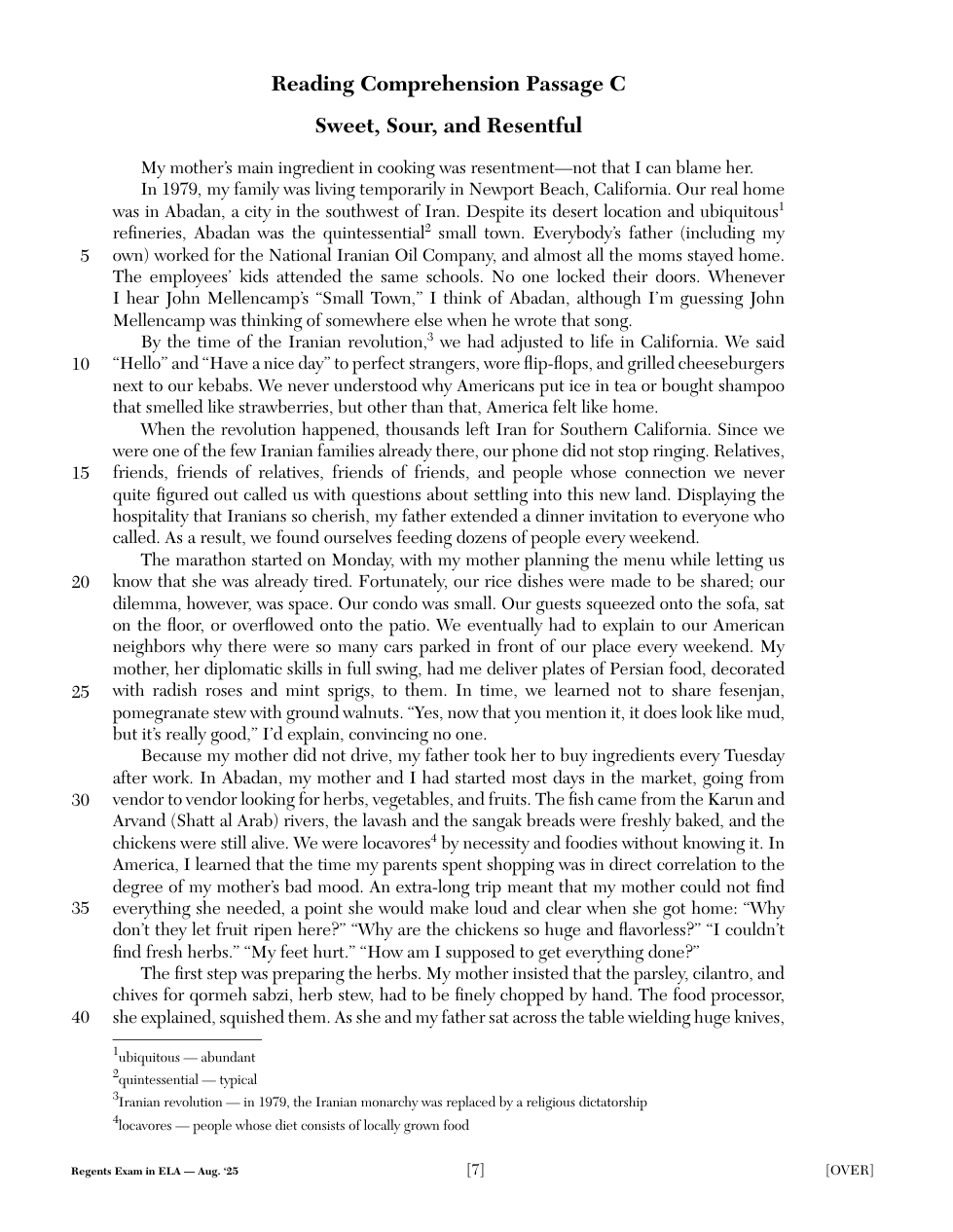
My mother’s main ingredient in cooking was resentment— not that I can blame her.

In 1979, my family was living temporarily in Newport Beach, California. Our real home was in Abadan, a city in the southwest of Iran. Despite its desert location and ubiquitous1 refineries, Abadan was the quintessential2 small town. Everybody’s father (including my own) worked for the National Iranian Oil Company, and almost all the moms stayed home. The employees’ kids attended the same schools. No one locked their doors. Whenever I hear John Mellencamp’s “Small Town,” I think of Abadan, although I’m guessing John Mellencamp was thinking of somewhere else when he wrote that song.

By the time of the Iranian revolution3, we had adjusted to life in California. We said “Hello” and “Have a nice day” to perfect strangers, wore flip-flops, and grilled cheeseburgers next to our kebabs. We never understood why Americans put ice in tea or bought shampoo that smelled like strawberries, but other than that, America felt like home.

When the revolution happened, thousands left Iran for Southern California. Since we were one of the few Iranian families already there, our phone did not stop ringing. Relatives, friends, friends of relatives, friends of friends, and people whose connection we never quite figured out called us with questions about settling into this new land. Displaying the hospitality that Iranians so cherish, my father extended a dinner invitation to everyone who called. As a result, we found ourselves feeding dozens of people every weekend.

The marathon started on Monday, with my mother planning the menu while letting us know that she was already tired. Fortunately, our rice dishes were made to be shared; our dilemma, however, was space. Our condo was small. Our guests squeezed onto the sofa, sat on the floor, or overflowed onto the patio. We eventually had to explain to our American neighbors why there were so many cars parked in front of our place every weekend. My mother, her diplomatic skills in full swing, had me deliver plates of Persian food, decorated with radish roses and mint sprigs, to them. In time, we learned not to share fesenjan, pomegranate stew with ground walnuts. “Yes, now that you mention it, it does look like mud, but it’s really good,” I’d explain, convincing no one.

Because my mother did not drive, my father took her to buy ingredients every Tuesday after work. In Abadan, my mother and I had started most days in the market, going from vendor to vendor looking for herbs, vegetables, and fruits. The fish came from the Karun and Arvand (Shatt al Arab) rivers, the lavash and the sangak breads were freshly baked, and the chickens were still alive. We were locavores4

by necessity and foodies without knowing it. In America, I learned that the time my parents spent shopping was in direct correlation to the degree of my mother’s bad mood. An extra-long trip meant that my mother could not find everything she needed, a point she would make loud and clear when she got home: “Why don’t they let fruit ripen here?” “Why are the chickens so huge and flavorless?” “I couldn’t find fresh herbs.” “My feet hurt.” “How am I supposed to get everything done?”

The first step was preparing the herbs. My mother insisted that the parsley, cilantro, and chives for ghormeh sabzi, herb stew, had to be finely chopped by hand. The food processor, she explained, squished them. As she and my father sat across the table wielding huge knives,

1ubiquitous — abundant

2quintessential — typical

3Iranian revolution — in 1979, the Iranian monarchy was replaced by a religious dictatorship

4locavores — people whose diet consists of locally grown food

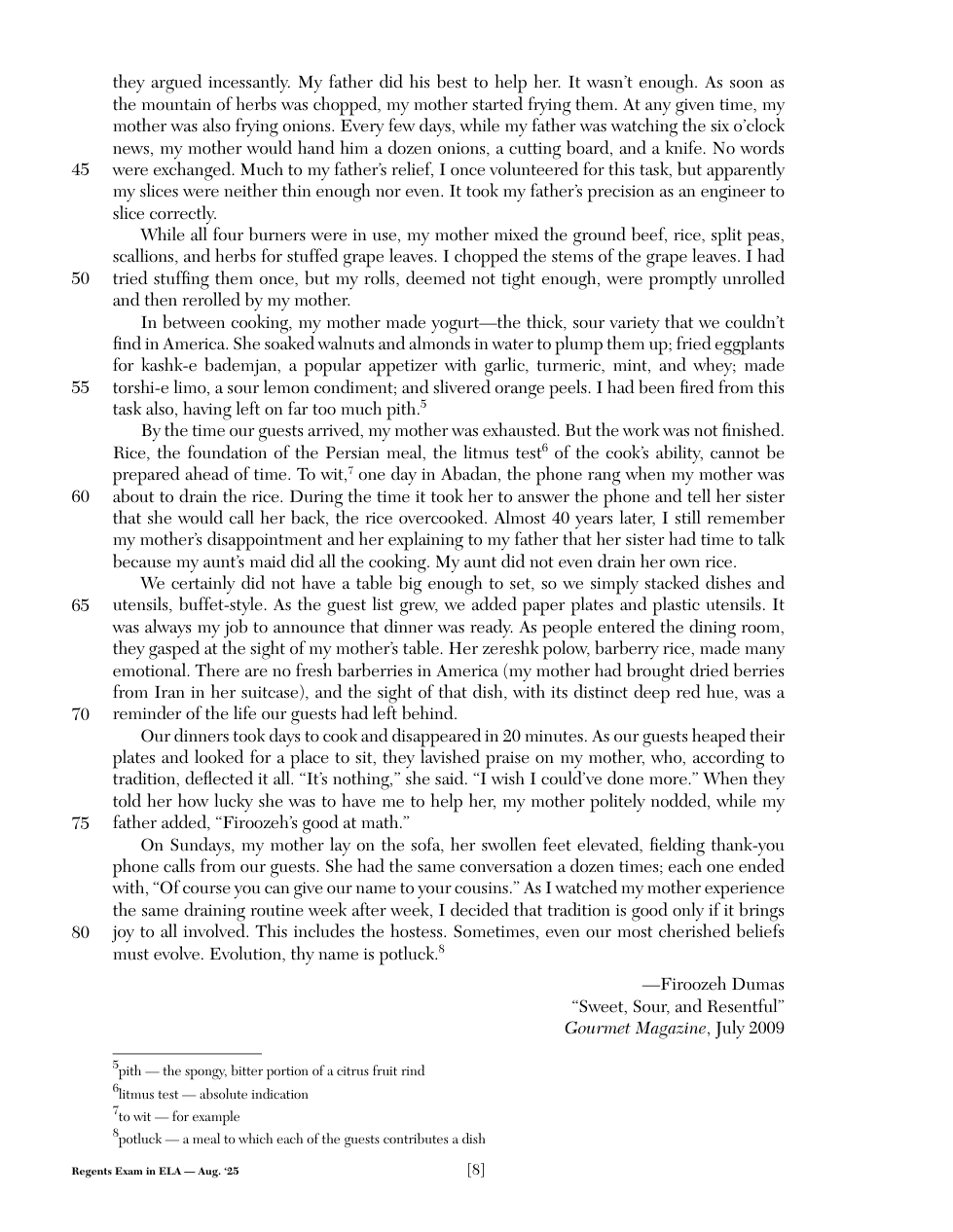
they argued incessantly. My father did his best to help her. It wasn’t enough. As soon as the mountain of herbs was chopped, my mother started frying them. At any given time, my mother was also frying onions. Every few days, while my father was watching the six o’clock news, my mother would hand him a dozen onions, a cutting board, and a knife. No words were exchanged. Much to my father’s relief, I once volunteered for this task, but apparently my slices were neither thin enough nor even. It took my father’s precision as an engineer to slice correctly.

While all four burners were in use, my mother mixed the ground beef, rice, split peas, scallions, and herbs for stuffed grape leaves. I chopped the stems of the grape leaves. I had tried stuffing them once, but my rolls, deemed not tight enough, were promptly unrolled and then rerolled by my mother.

In between cooking, my mother made yogurt—the thick, sour variety that we couldn’t find in America. She soaked walnuts and almonds in water to plump them up; fried eggplants for kashk-e bademjan, a popular appetizer with garlic, turmeric, mint, and whey; made torshi-e limo, a sour lemon condiment; and slivered orange peels. I had been fired from this task also, having left on far too much pith.5

By the time our guests arrived, my mother was exhausted. But the work was not finished. Rice, the foundation of the Persian meal, the litmus test6 of the cook’s ability, cannot be prepared ahead of time. To wit,7 one day in Abadan, the phone rang when my mother was about to drain the rice. During the time it took her to answer the phone and tell her sister that she would call her back, the rice overcooked. Almost 40 years later, I still remember my mother’s disappointment and her explaining to my father that her sister had time to talk because my aunt’s maid did all the cooking. My aunt did not even drain her own rice.

We certainly did not have a table big enough to set, so we simply stacked dishes and utensils, buffet-style. As the guest list grew, we added paper plates and plastic utensils. It was always my job to announce that dinner was ready. As people entered the dining room, they gasped at the sight of my mother’s table. Her zereshk polow, barberry rice, made many emotional. There are no fresh barberries in America (my mother had brought dried berries from Iran in her suitcase), and the sight of that dish, with its distinct deep red hue, was a reminder of the life our guests had left behind.

Our dinners took days to cook and disappeared in 20 minutes. As our guests heaped their plates and looked for a place to sit, they lavished praise on my mother, who, according to tradition, deflected it all. “It’s nothing,” she said. “I wish I could’ve done more.” When they told her how lucky she was to have me to help her, my mother politely nodded, while my father added, “Firoozeh’s good at math.”

On Sundays, my mother lay on the sofa, her swollen feet elevated, fielding thank-you phone calls from our guests. She had the same conversation a dozen times; each one ended with, “Of course you can give our name to your cousins.” As I watched my mother experience the same draining routine week after week, I decided that tradition is good only if it brings joy to all involved. This includes the hostess. Sometimes, even our most cherished beliefs must evolve. Evolution, thy name is potluck.8

—Firoozeh Dumas
“Sweet, Sour, and Resentful”
Gourmet Magazine, July 2009

5pith — the spongy, bitter portion of a citrus fruit rind
6litmus test — absolute indication
7to wit — for example
8potluck — a meal to which each of the guests contributes a dish

1
RI.11-12.2
1
L.11-12.4.a
1
RI.11-12.3
1
RI.11-12.2
1
RI.11-12.4
1
RI.11-12.4
1
RI.11-12.3
1
RI.11-12.3
1
RI.11-12.5
1
RI.11-12.6

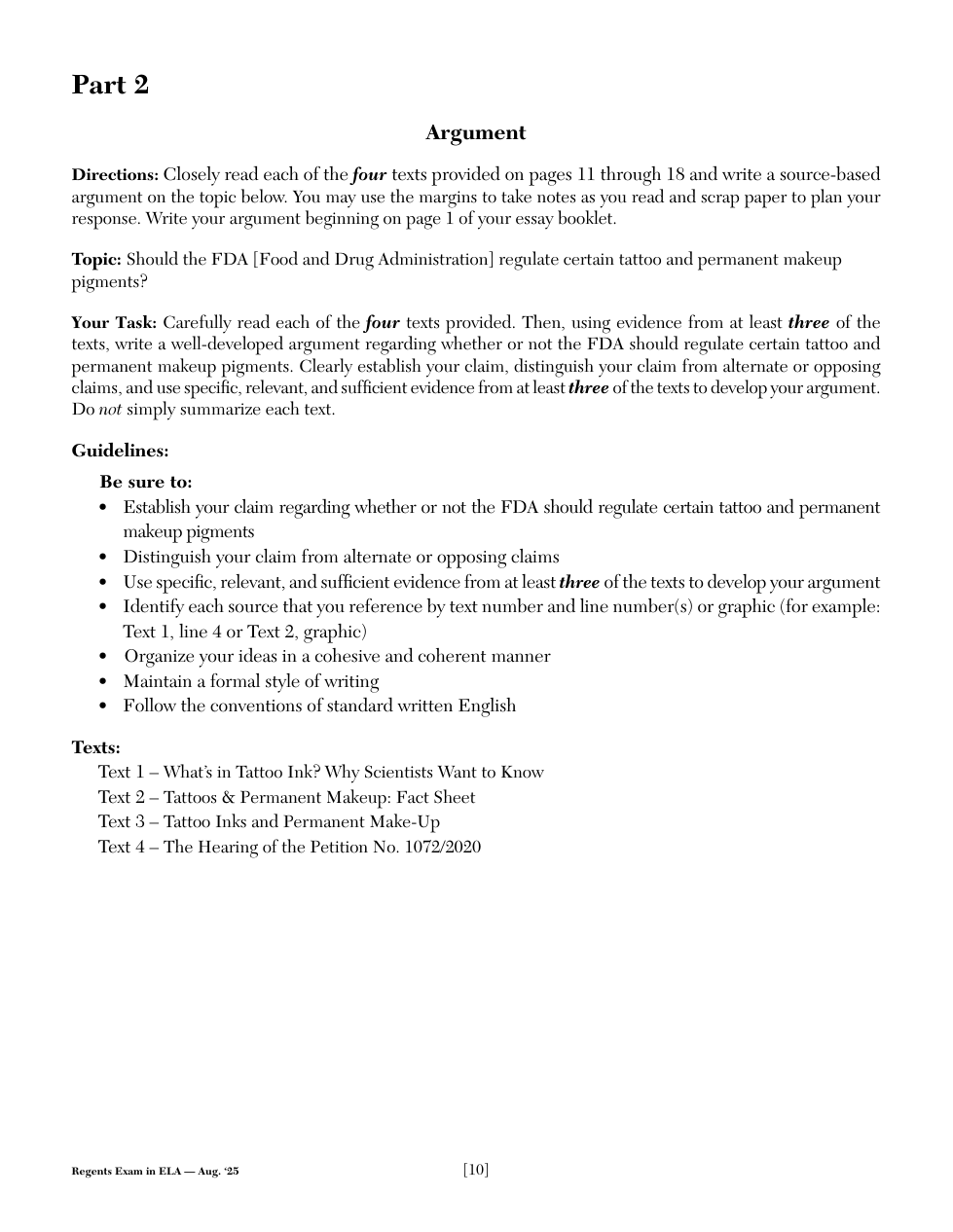
Part 2

Argument

Directions: Closely read each of the four texts provided on pages 11 through 18 and write a source-based argument on the topic below. You may use the margins to take notes as you read and scrap paper to plan your response. Write your argument beginning on page 1 of your essay booklet.

Topic: Should the FDA [Food and Drug Administration] regulate certain tattoo and permanent makeup pigments?

Your Task: Carefully read each of the four texts provided. Then, using evidence from at least three of the texts, write a well-developed argument regarding whether or not the FDA should regulate certain tattoo and permanent makeup pigments. Clearly establish your claim, distinguish your claim from alternate or opposing claims, and use specific, relevant, and sufficient evidence from at least three of the texts to develop your argument. Do not simply summarize each text.

Guidelines:

Be sure to:

  • Establish your claim regarding whether or not the FDA should regulate certain tattoo and permanent makeup pigments

  • Distinguish your claim from alternate or opposing claims

  • Use specific, relevant, and sufficient evidence from at least three of the texts to develop your argument

  • Identify each source that you reference by text number and line number(s) or graphic (for example: Text 1, line 4 or Text 2, graphic)

  • Organize your ideas in a cohesive and coherent manner

  • Maintain a formal style of writing

  • Follow the conventions of standard written English

Texts:

Text 1 – What’s in Tattoo Ink? Why Scientists Want to Know

Text 2 – Tattoos & Permanent Makeup: Fact Sheet Text 3 – Tattoo Inks and Permanent Make-Up

Text 4 – The Hearing of the Petition No. 1072/2020

24
Pitanje 25
25.

Write your Argument here.

L.11-12.1.a
L.11-12.2.a
…

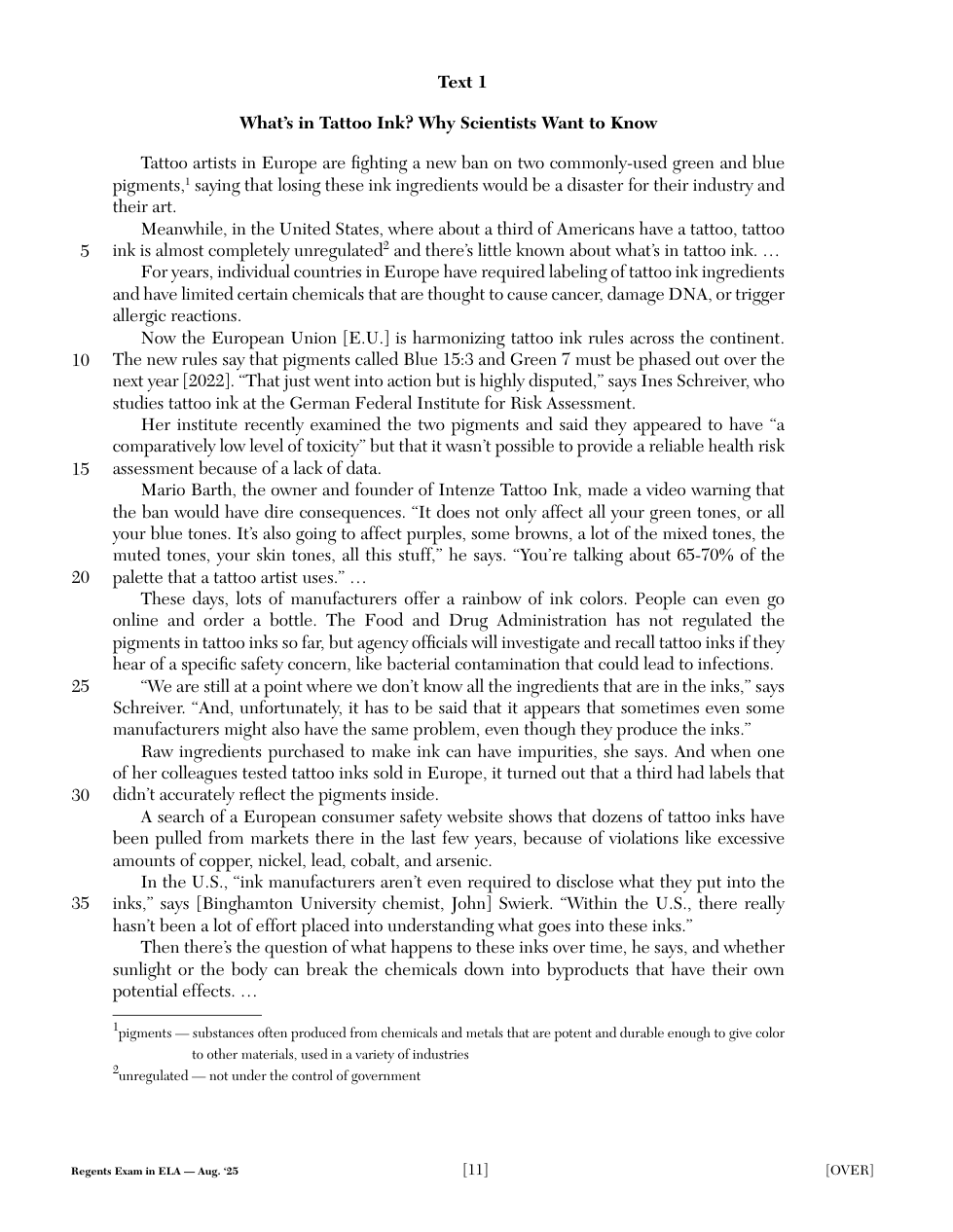
Text 1

What’s in Tattoo Ink? Why Scientists Want to Know

Tattoo artists in Europe are fighting a new ban on two commonly-used green and blue pigments,1 saying that losing these ink ingredients would be a disaster for their industry and their art.

Meanwhile, in the United States, where about a third of Americans have a tattoo, tattoo ink is almost completely unregulated2 and there’s little known about what’s in tattoo ink. …

For years, individual countries in Europe have required labeling of tattoo ink ingredients and have limited certain chemicals that are thought to cause cancer, damage DNA, or trigger allergic reactions.

Now the European Union [E.U.] is harmonizing tattoo ink rules across the continent. The new rules say that pigments called Blue $15:3$ and Green $7$ must be phased out over the next year [2022]. “That just went into action but is highly disputed,” says Ines Schreiver, who studies tattoo ink at the German Federal Institute for Risk Assessment.

Her institute recently examined the two pigments and said they appeared to have “a comparatively low level of toxicity” but that it wasn’t possible to provide a reliable health risk assessment because of a lack of data.

Mario Barth, the owner and founder of Intenze Tattoo Ink, made a video warning that the ban would have dire consequences. “It does not only affect all your green tones, or all your blue tones. It’s also going to affect purples, some browns, a lot of the mixed tones, the muted tones, your skin tones, all this stuff,” he says. “You’re talking about 65-70% of the palette that a tattoo artist uses.” …

These days, lots of manufacturers offer a rainbow of ink colors. People can even go online and order a bottle. The Food and Drug Administration has not regulated the pigments in tattoo inks so far, but agency officials will investigate and recall tattoo inks if they hear of a specific safety concern, like bacterial contamination that could lead to infections.

“We are still at a point where we don’t know all the ingredients that are in the inks,” says Schreiver. “And, unfortunately, it has to be said that it appears that sometimes even some manufacturers might also have the same problem, even though they produce the inks.”

Raw ingredients purchased to make ink can have impurities, she says. And when one of her colleagues tested tattoo inks sold in Europe, it turned out that a third had labels that didn’t accurately reflect the pigments inside.

A search of a European consumer safety website shows that dozens of tattoo inks have been pulled from markets there in the last few years, because of violations like excessive amounts of copper, nickel, lead, cobalt, and arsenic.

In the U.S., “ink manufacturers aren’t even required to disclose what they put into the inks,” says [Binghamton University chemist, John] Swierk. “Within the U.S., there really hasn’t been a lot of effort placed into understanding what goes into these inks.”

Then there’s the question of what happens to these inks over time, he says, and whether sunlight or the body can break the chemicals down into byproducts that have their own potential effects. …

1pigments — substances often produced from chemicals and metals that are potent and durable enough to give color to other materials, used in a variety of industries

2unregulated — not under the control of government

Surgeons who do biopsies have long noted that tattooed people can have lymph nodes3 that are stained with color. A few years ago, Schreiver and her colleagues analyzed tattooed human skin and lymph nodes from corpses. They found evidence that smaller pigment particles can indeed migrate from the skin towards the lymph nodes.

What’s more, during the tattooing process it’s not uncommon for drops of blood to appear, showing that blood vessels can be damaged and give the ink access to the bloodstream.

“It's very, very likely that tattoo pigments will also end up in other organs, but in a very minor amount compared to the skin and lymph nodes,” says Schreiver.

So, if some tattoo ink components can move through the body, researchers want to know:

Are there any long-term health risks? ...

Any effort to find out would have to factor in all the different inks used, the differing amount of skin area covered, and the different amounts of time that people had their tattoos.

“I would love some way to get data to really look and see if there is an association between malignancy4 and tattoos,” says [dermatologist and Northwestern University cancer researcher, Walter] Liszewski, “but there’s just multiple layers of data that we don’t have, and complexities that make it very, very difficult.” ...

—Nell Greenfieldboyce
excerpted and adapted from “What’s in Tattoo Ink?
Why Scientists Want to Know”
www.npr.org, February 13, 2021


3lymph nodes — small filtering structures within the lymphatic system that contain immune cells and attack germs that are carried in through lymph fluid

4malignancy — cancerous cells

Text 2

Tattoos & Permanent Makeup: Fact Sheet

Safety and Regulatory Background

FDA considers the inks used in intradermal1 tattoos, including permanent makeup, to be cosmetics. When we identify a safety problem associated with a cosmetic, including a tattoo ink, we investigate and take action, as appropriate, to prevent consumer illness or injury. The pigments used in the inks are color additives, which are subject to premarket approval under the Federal Food, Drug, and Cosmetic Act. However, because of other competing public health priorities and a previous lack of evidence of safety problems specifically associated with these pigments, FDA traditionally has not exercised regulatory authority for color additives on the pigments used in tattoo inks. The actual practice of tattooing is regulated by local jurisdictions.

During 2003 and 2004, FDA became aware of more than 150 reports of adverse2 reactions in consumers to certain permanent makeup ink shades, and it is possible that the actual number of women affected was greater. The inks associated with this outbreak were voluntarily recalled by the company that marketed them in 2004. In the spring of 2012, we received reports of infections from contaminated inks, resulting in their recall and market withdrawal. In the fall of 2017, a firm voluntarily recalled several colors and sizes of tattoo inks, due to microbial contamination identified by an FDA survey. In addition, concerns raised by the scientific community regarding the pigments used in tattoo inks have prompted FDA to investigate their safe use. FDA continues to evaluate the extent and severity of adverse events associated with tattooing and is conducting research on tattoo inks. As new information is assessed, we will consider whether additional actions are necessary to protect public health.

In addition to the reported adverse reactions, areas of concern include tattoo removal, infections that result from tattooing, and the increasing variety of pigments and diluents3 being used in tattooing. More than fifty different pigments and shades are in use, and the list continues to grow. Although a number of color additives are approved for use in cosmetics, none is approved for injection into the skin. Using an unapproved color additive in a tattoo ink makes the ink adulterated.4 Many pigments used in tattoo inks are not approved for skin contact at all. Some are industrial grade colors that are suitable for printers’ ink or automobile paint.

Nevertheless, many individuals choose to undergo tattooing in its various forms. For some, it is an aesthetic5 choice or an initiation rite. Some choose permanent makeup as a time saver or because they have physical difficulty applying regular, temporary makeup. For others, tattooing is an adjunct6 to reconstructive surgery, particularly of the face or breast, to complete the process.

  1. intradermal — within the layers of the skin

  2. adverse — negative

  3. diluents — thinning agents that are added to assist in the pumping of dense materials

  4. adulterated — contaminated

  5. aesthetic — artistic

  6. adjunct — addition

simulate natural pigmentation. People who have lost their eyebrows due to alopecia (a form of hair loss) may choose to have “eyebrows” tattooed on, while people with vitiligo (a lack of pigmentation in areas of the skin) may try tattooing to help camouflage the condition.

Whatever their reason, consumers should be aware of the risks involved in order to make an informed decision.

—U.S. Food and Drug Administration
excerpted from “Tattoos & Permanent Makeup: Fact Sheet”
www.fda.gov, March 15, 2022

Text 3

Tattoo Inks and Permanent Make-Up

…To protect European citizens, thousands of hazardous chemicals found in tattoo inks and permanent make-up are restricted in the EU under the REACH [Registration, Evaluation, Authorisation and Restriction of Chemicals] Regulation from January 2022.

The restriction covers, for example: chemicals that cause cancer or genetic mutations and chemicals that are toxic to reproduction as well as skin sensitisers and irritants. The aim is not to ban tattooing but to make the colours used in tattoos and permanent make-up safer.

Chronic allergic reactions and other inflammatory skin reactions from tattoo and permanent make-up inks are expected to decrease thanks to the restriction. More serious effects such as cancer, harm to our DNA or the reproductive system potentially originating from chemicals used in the inks could also decrease. …

What Are the Concerns?

Tattoo inks and permanent make-up are a mix of several chemicals. They may contain hazardous substances that cause skin allergies and other more serious health impacts, such as genetic mutations and cancer.

Ink pigments can also migrate from the skin to different organs, such as the lymph nodes and liver. Sometimes tattoos are removed using a laser that breaks down pigments and other substances into smaller particles. If these include harmful chemicals, the removal process will free them to circulate in the body.

As chemicals used in tattoo inks and permanent make-up may stay in the body for life, there is also the possibility for long-term exposure to the potentially harmful ingredients.

What Has the EU Done to Protect Its Citizens?

In 2015, the European Commission asked ECHA [European CHemicals Agency] to assess the health risks of chemicals in tattoo inks and permanent make-up and to examine the need for an EU-wide restriction on their use. ECHA did this assessment together with Norwegian, Italian and Danish authorities. German authorities also contributed to the work.

The investigation covered chemicals known to be used in tattoo inks and permanent make-up that may be hazardous to our health. Special attention was given to chemicals that are carcinogenic,1 mutagenic and toxic to reproduction (CMRs); sensitisers, irritants and corrosive to the skin; substances that are corrosive or damaging to the eye; metals; and other substances in the Council of Europe’s resolution on requirements and criteria for the safety of tattoos and permanent make-up.

The authorities examined the health risks of these chemicals and investigated the availability of safer alternatives. They also looked at the socio-economic impact of restricting their use, considering its effects on manufacturing and on service sector jobs. …

Committee Opinions

The consolidated opinion of RAC [Risk Assessment Committee] and SEAC [Socio-Economic Analysis Committee] was sent to the European Commission in June 2019. RAC looked at the risks of chemicals to people's health by assessing available scientific evidence on the hazards and risks of the substances included in the proposal. SEAC evaluated the benefits of the proposal to people's health and the associated costs and other socio-economic impacts.

1carcinogenic — cancer causing

Both committees agreed that — with a few modifications — the restriction proposal would be the most appropriate means to control the risks of hazardous chemicals in tattoo inks and permanent make-up at EU-level.

RAC also evaluated whether certain pigments or colourants should not be restricted as proposed. It concluded that the risks of cancer and other negative health effects could not be ruled out. RAC noted that information received during the consultation indicated that safer and technically adequate alternatives were currently unavailable for only two colourants — Pigment Blue 15:3 and Pigment Green 7. SEAC considered the socio-economic impacts of restricting these two pigments and recommended that industry is given additional time to identify and switch to suitable safer alternatives.

Overall, SEAC concluded that the restriction would not have significant negative economic impacts on supply chains nor would it lead to significant price increases to consumers. The committee also agreed that the restriction would minimise risks of regrettable substitution.

Both committees agreed that the suggested 12-month transition period would give the necessary time for the concerned actors to adjust their operations. …

The new rules apply in the EU/EEA [European Economic Area] as of 4 January 2022, and for Pigment Blue 15:3 and Pigment Green 7 — where the Commission and EU Member States agreed on a 24-month transition — as of 4 January 2023. …

— European Chemicals Agency
excerpted and adapted from “Tattoo Inks and Permanent Make-Up”
https://echa.europa.eu, 2021

Text 4

The Hearing of the Petition No. 1072/2020

The following excerpt is from a March 23, 2021, European Union Petitions Committee hearing where tattoo artists, Erich Mähnert and Michael Dirks, spoke about regulating the two pigments, Blue 15:3 and Green 7. The transcript was originally published in German and has been translated into English.

…Statement from Erich Mähnert:

In principle, we welcome uniform rules to increase consumer safety. But in this case, exactly the opposite occurs. If the two pigments Blue 15 and Green 7 were banned for the manufacture of tattoo inks in Europe in 2023, the following serious problems would arise:

1. Consumer demand on the market cannot be regulated. Consumer safety drops drastically.

Consumers will still not do without their high quality color tattoos, which they are currently getting and will continue to see in public and in the media. If the consumer no longer receives this from reputable tattoo artists in Europe, he will either switch to other EU countries or to unoffi cial and dubious providers. These unoffi cial and dubious providers in particular have never and will not adhere to any regulations. They continue to purchase their tattoo inks without any control and without the possibility of tracing them on online platforms such as Amazon, Ebay & Co. Thus, the REACH [Registration, Evaluation, Authorisation, and Restriction of Chemicals] regulation promotes undeclared work and poses a risk for consumers.

2. The economy suffers damage and all EU member states will suffer tax deficits.

The member states will not only lose the current security mechanisms, but will also receive a substantial tax defi cit. With all market-leading manufacturers who are not based in the EU, up to 65% of all color tones will be lost. These shades are not only existential1 for tattooing in the traditional sense. In the area of permanent make-up and especially in the area of nipple reconstructions after breast removal, these shades are of the utmost importance. The economic damage caused by emigration to third countries in the EU affects not only the tattoo industry, but also part of the cosmetics industry (permanent make-up) and medical tattoos such as nipple reconstruction. This ban massively restricts the competitiveness of the European tattoo industry compared to other EU countries. This contradicts a European community idea.

3. The transition period of 2 years is far too short due to the lack of alternative pigments.

The 2-year transition period granted by ECHA to fi nd alternative pigments is far too short for the tattoo industry. It is already known that there are no equivalent alternatives in the conventional pigment industry. In addition, it is already known that the pigment industry has no economic interest in producing the desired alternatives for the tattoo industry. And since the manufacturers of tattoo inks can only use the raw materials that the pigment industry provides, the 2-year transition period is far too short.

1existential - established

Statements from Dipl. Ing. (FH)2 Michael Dirks:

  1. The ban is based on pure suspicion by ECHA and does not contain sufficient scientific data.

The German Federal Institute for Risk Assessment published a statement on September 8, 2020 that currently available data only indicate a comparatively low toxicity. The German Federal Institute for Risk Assessment therefore sees no need for action to ban the pigments. This statement from the advisory institution for consumer protection of the German federal government clearly shows that the ban was determined on the basis of insufficient data and, moreover, without the involvement of the industry concerned. …

  1. ECHA contradicts itself when comparing the tattoo industry with the cosmetics industry.

ECHA contradicts itself in the statement that substances that are prohibited on the skin must also be prohibited under the skin. Conversely, however, substances are allowed in the cosmetics industry, although they are not suitable for tattooing. For example, ECHA bans pigment Blue 15 for tattoos because it has not been approved for use in hair dyes, but at the same time it is permitted for all areas of application in cosmetics, in particular for cosmetics that come into contact with the mucous membrane of the eye. You should know that the approval for this area of application is actually an approval criterion for use in tattoo inks. It also follows that manufacturers of tattoo inks will in [the] future be allowed, according to the cosmetics ordinance, to use ingredients that emit toxic substances, when these are deposited in the skin. Examples are ultramarine blue, which gives off hydrogen sulfide, and iron hexacyanoferrate, which gives off hydrocyanic acid. Both are poisonous, but would be allowed in tattoo inks, as these substances are permitted in the cosmetics ordinance. Therefore, as an engineer in chemistry, I am of the opinion that the ban should be viewed as excessive and counterproductive. …

—Erich Mähnert and Dipl. Ing. (FH) Michael Dirks
excerpted and adapted from “The Hearing of the Petition No. 1072/2020”
https://savethepigments.com, March 23, 2021

2Dipl. Ing. (FH) — the German equivalent of a graduate degree in engineering

3ordinance — rules

Part 3

Text-Analysis Response

Your Task: Closely read the text provided on pages 20 and 21 (The Good Earth) and write a well-developed, text-based response of two to three paragraphs. In your response, identify a central idea in the text and analyze how the author’s use of one writing strategy (literary element or literary technique or rhetorical device) develops this central idea. Use strong and thorough evidence from the text to support your analysis. Do not simply summarize the text. You may use the margins to take notes as you read and scrap paper to plan your response. Write your response in the space provided.

Guidelines:

Be sure to:

  • Identify a central idea in the text

  • Analyze how the author’s use of one writing strategy (literary element or literary technique or rhetorical device) develops this central idea. Examples include: characterization, conflict, denotation/connotation, metaphor, simile, irony, language use, point-of-view, setting, structure, symbolism, theme, tone, etc.

  • Use strong and thorough evidence from the text to support your analysis

  • Organize your ideas in a cohesive and coherent manner

  • Maintain a formal style of writing

  • Follow the conventions of standard written English

16
Pitanje 26
26.

Write your Text-Analysis Response here.

L.11-12.1.a
L.11-12.2.a
…

Text

The Good Earth

In the following excerpt set in early 20th century China, farmer Wang Lung and his family prepare to celebrate the New Year.

The New Year approached and in every house in the village there were preparations. Wang Lung went into the town to the candlemaker's shop and he bought squares of red paper on which were brushed in gilt1 ink the letter for happiness and some with the letter for riches, and these squares he pasted upon his farm utensils to bring him luck in the new year. Upon his plow and upon the ox's yoke and upon the two buckets in which he carried his fertilizer and his water, upon each of these he pasted a square. And then upon the doors of his house he pasted long strips of red paper brushed with mottoes of good luck, and over his doorway he pasted a fringe of red paper cunningly cut into a flower pattern and very finely cut. And he bought red paper to make new dresses for the gods, and this the old man did cleverly enough for his old shaking hands, and Wang Lung took them and put them upon the two small gods in the temple to the earth and he burned a little incense before them for the sake of the New Year. And for his house he bought also two red candles to burn on the eve of the year upon the table under the picture of a god, which was pasted on the wall of the middle room above where the table stood.

And Wang Lung went again into the town and he bought pork fat and white sugar and the woman rendered the fat smooth and white and she took rice flour, which they had ground from their own rice between their millstones to which they could yoke the ox when they needed to do so, and she took the fat and the sugar and she mixed and kneaded rich New Year's cakes, called moon cakes, such as were eaten in the House of Hwang2.

When the cakes were laid out upon the table in strips, ready for heating, Wang Lung felt his heart fit to burst with pride. There was no other woman in the village able to do what his had done, to make cakes such as only the rich ate at the feast. In some of the cakes she had put strips of little red haws3 and spots of dried green plums, making flowers and patterns.

“It is a pity to eat these,” said Wang Lung.

The old man was hovering about the table, pleased as a child might be pleased with the bright colors. He said,

“Call my brother, your uncle, and his children—let them see!”

But prosperity had made Wang Lung cautious. One could not ask hungry people only to see cakes.

“It is ill luck to look at the cakes before the New Year,” he replied hastily. And the woman, her hands all dusty with the fine rice flour and sticky with the fat, said,

“Those are not for us to eat, beyond one or two of the plain ones for guests to taste. We are not rich enough to eat white sugar and lard. I am preparing them for the Old Mistress at the great house. I shall take the child on the second day of the New Year and carry the cakes for a gift.”

Then the cakes were more important than ever, and Wang Lung was pleased that to the great hall where he had stood with so much timidity and in such poverty his wife should now go as visitor, carrying his son, dressed in red, and cakes made as these were, with the best flour and sugar and lard.

1gilt — having the appearance of gold

2Hwang — a wealthy and powerful family

3haws — fruit from the hawthorn bush

All else at the New Year sank into insignificance beside this visit. His new coat of black cotton cloth which O-lan had made, when he had put it on, only made him say to himself, “I shall wear it when I take them to the gate of the great house.”

He even bore carelessly the first day of the New Year when his uncle and his neighbors came crowding into the house to wish his father and himself well, all boisterous with food and drink. He had himself seen to it that the colored cakes were put away into the basket lest he might have to offer them to common men, although he found it very hard when the plain white ones were praised for their flavor of fat and sugar not to cry out, “You should see the colored ones!”

But he did not, for more than anything he wished to enter the great house with pride.

Then on the second day of the New Year, when it is the day for women to visit each other, the men having eaten and drunk well the day before, they rose at dawn and the woman dressed the child in his red coat and in the tiger-faced shoes she had made, and she put on his head, freshly shaven by Wang Lung himself on the last day of the old year, the crownless red hat with the small gilt Buddha sewed on front, and she set him upon the bed. Then Wang Lung dressed himself quickly while his wife combed out afresh her long black hair and knotted it with the brass pin washed with silver which he had bought for her, and she put on her new coat of black that was made from the same piece as his own new robe, twenty- four feet of good cloth for the two, and two feet of cloth thrown in for good measure, as the custom is at cloth shops. Then he carrying the child and she the cakes in the basket, they set out on the path across the fields, now barren with winter.

Then Wang Lung had his reward at the great gate of the House of Hwang, for when the gateman came to the woman’s call he opened his eyes at all he saw and he twirled the three long hairs on his mole and cried out,

“Ah, Wang the farmer, three this time instead of one!” And then seeing the new clothes they all wore and the child who was a son, he said further, “One has no need to wish you more fortune this year than you have had in the last.”

Wang Lung answered negligently as one speaks to a man who is scarcely an equal, “Good harvests—good harvests—” and he stepped with assurance inside the gate. …

—Pearl S. Buck
excerpted from The Good Earth, 1931
The John Day Company

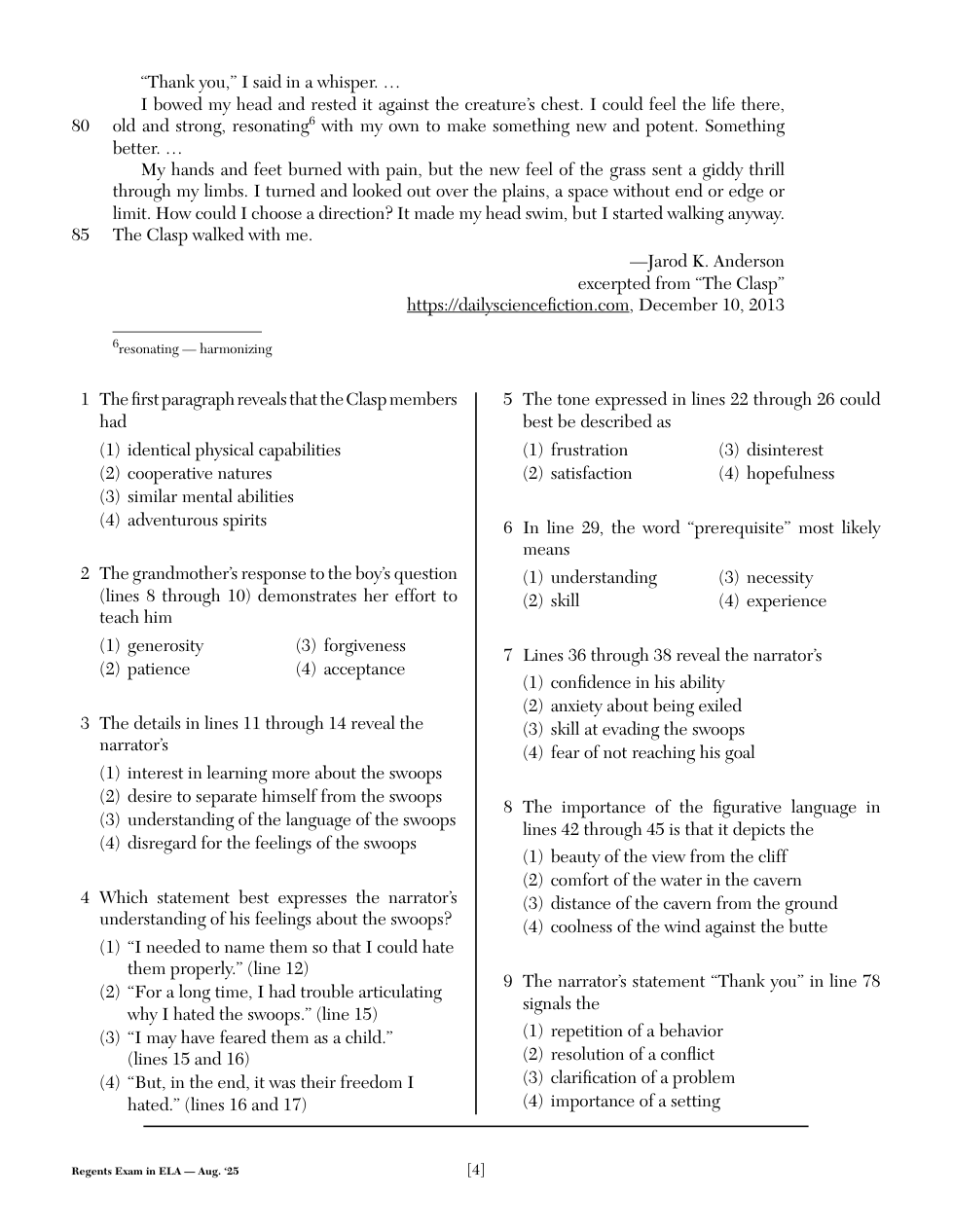
“Thank you,” I said in a whisper. …
I bowed my head and rested it against the creature’s chest. I could feel the life there, old and strong, resonating6 with my own to make something new and potent. Something better. …


My hands and feet burned with pain, but the new feel of the grass sent a giddy thrill through my limbs. I turned and looked out over the plains, a space without end or edge or limit. How could I choose a direction? It made my head swim, but I started walking anyway. The Clasp walked with me.

—Jarod K. Anderson
excerpted from “The Clasp”
https://dailysciencefiction.com, December 10, 2013

6 resonating — harmonizing

Pitanje 1
1.

The first paragraph reveals that the Clasp members had

Pitanje 2
2.

The grandmother’s response to the boy’s question (lines 8 through 10) demonstrates her effort to teach him

Pitanje 3
3.

The details in lines 11 through 14 reveal the narrator’s

Pitanje 4
4.

Which statement best expresses the narrator’s understanding of his feelings about the swoops?

Pitanje 5
5.

The tone expressed in lines 22 through 26 could best be described as

Pitanje 6
6.

In line 29, the word “prerequisite” most likely means

Pitanje 7
7.

Lines 36 through 38 reveal the narrator’s

Pitanje 8
8.

The importance of the figurative language in lines 42 through 45 is that it depicts the

Pitanje 9
9.

The narrator’s statement “Thank you” in line 78 signals the

Pitanje 10
10.

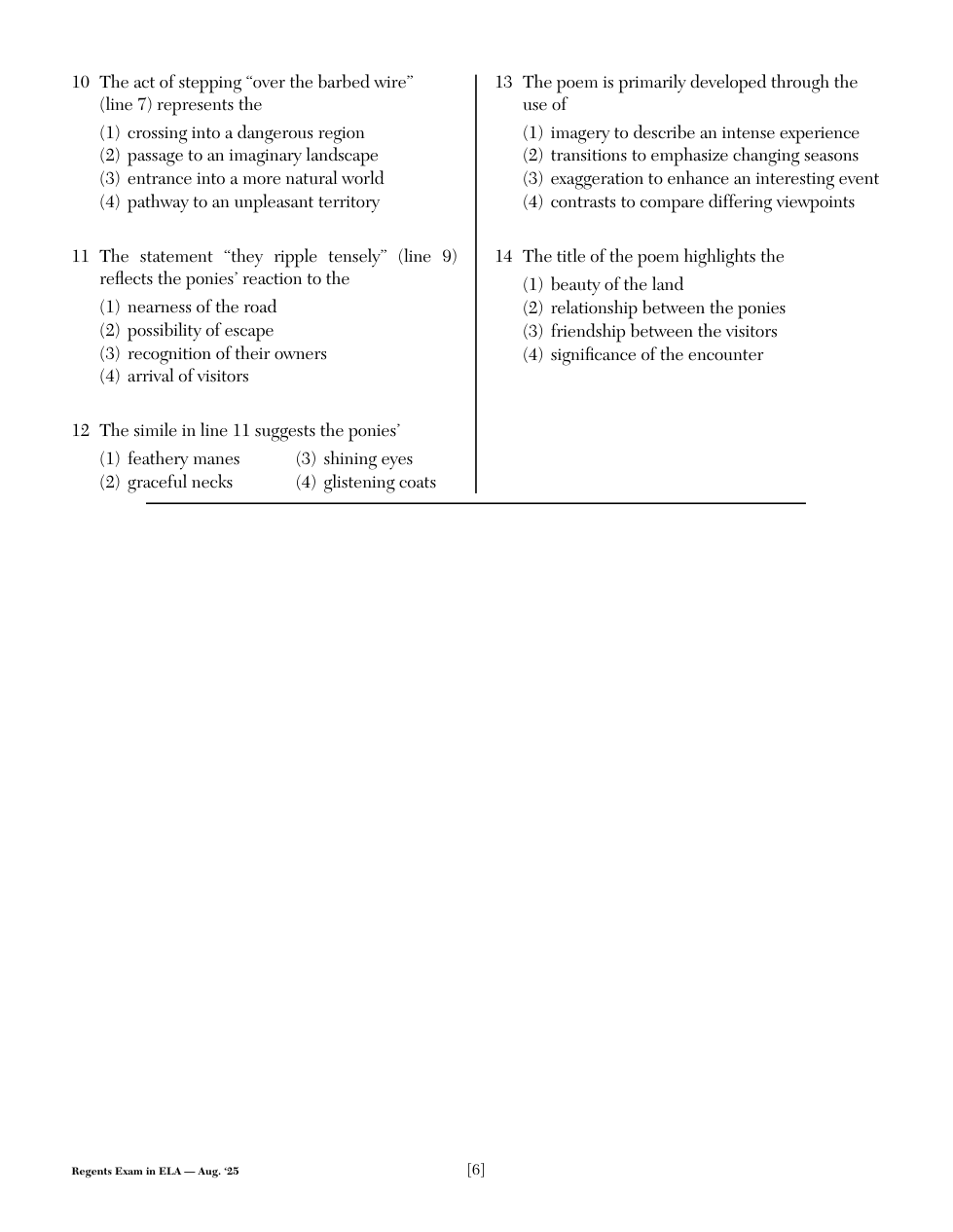
The act of stepping “over the barbed wire” (line 7) represents the

Pitanje 11
11.

The statement “they ripple tensely” (line 9) reflects the ponies’ reaction to the

Pitanje 12
12.

The simile in line 11 suggests the ponies’

Pitanje 13
13.

The poem is primarily developed through the use of

Pitanje 14
14.

The title of the poem highlights the

Pitanje 15
15.

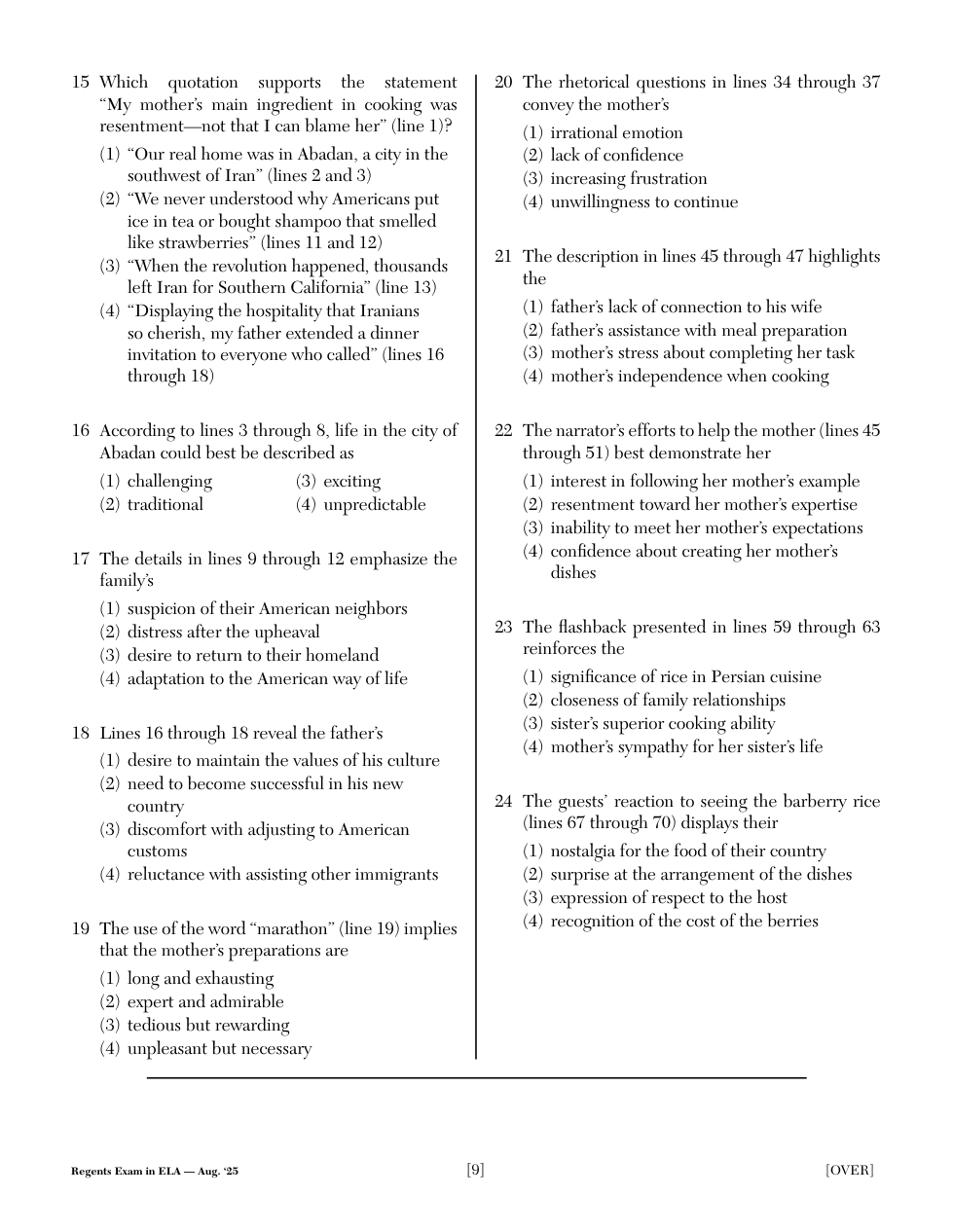
Which quotation supports the statement “My mother’s main ingredient in cooking was resentment—not that I can blame her” (line 1)?

Pitanje 16
16.

According to lines 3 through 8, life in the city of Abadan could best be described as

Pitanje 17
17.

The details in lines 9 through 12 emphasize the family’s

Pitanje 18
18.

Lines 16 through 18 reveal the father’s

Pitanje 19
19.

The use of the word “marathon” (line 19) implies that the mother’s preparations are

Pitanje 20
20.

The rhetorical questions in lines 34 through 37 convey the mother’s

Pitanje 21
21.

The description in lines 45 through 47 highlights the

Pitanje 22
22.

The narrator’s efforts to help the mother (lines 45 through 51) best demonstrate her

Pitanje 23
23.

The flashback presented in lines 59 through 63 reinforces the

Pitanje 24
24.

The guests’ reaction to seeing the barberry rice (lines 67 through 70) displays their