Ɛhia
3.7
RL.4.2
Ɛhia
3.7
RL.4.3
Ɛhia
3.7
RL.4.4
Ɛhia
3.7
RL.4.4
Ɛhia
3.7
RL.4.3
Ɛhia
3.7
RL.4.1
Ɛhia
3.8
RL.4.1
Ɛhia
3.7
RL.4.4
Ɛhia
3.7
RL.4.7
Douglas Hyde was only 15 years old when his friend and mentor Seamus Hart died.
It was the most devastating loss Hyde ever had suffered—a loss he remembered throughout his life. He expressed his sorrow in a simple, direct and moving passage written partly in phonetic Irish, partly in conventional Irish script in his diary for December 29:
Seamas died yesterday. A man so decent and generous, alas, so true and honest, alas, so friendly, alas, never will I see again. He was sick about a week and today he is gone. Poor Seamas, I learned Irish from you. A man so good with the Irish, never will there be another like you. I can see no one at all from now on whom I would love as well as you.
Although years passed before Douglas Hyde again wrote of Seamas Hart, their relationship did not end at Hart’s grave but continued in Hyde’s consciousness throughout his long life…. Hart had introduced Douglas to Irish history, folklore, myth, and legend; had shared with him his own store of poems and stories; had passed on to him, as if he were a son, the seanchncoil—fragments of ancient wisdom and folk belief—that he had received from his elders…. Hart had schooled him in histories not found in books but written across the face of the land.
How does the information in the additional passage add to the information in the passage from Leprechauns and Irish Folklore?
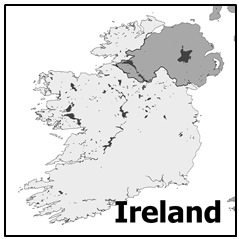
1 Ireland is an island near the coast of Great Britain. Because it rains a lot, Ireland is a very green country. It is so green that people call it the Emerald Isle. Emeralds are deep green stones that sparkle in the light. People often see rainbows shining over the green hills and valleys of the Emerald Isle.
2 There was a time in Ireland when many people believed in fairies. They claimed that on summer nights fairies danced in their gardens. When they saw clouds of dust blowing down the road, they said, “The fairies are riding their horses today.” Even the rustling of leaves sounded like little fairy feet running through the woods.
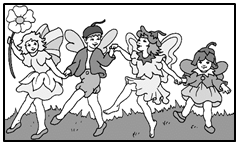
3 Stories about fairies are an important part of Irish folklore. Folklore is the customs and stories of a people that are passed down through the years. Among the stories are tales of magical creatures that the Irish call the wee folk. The wee folk include tricky leprechauns and beautiful fairies that live in shining kingdoms under the hills.
The Irish Oral Tradition
4 Many Irish fairy stories were first told by the Celts (KELTZ). The Celts came from mainland Europe and settled in Ireland over two thousand years ago. Even though the Celts were mighty warriors, they loved to tell stories, recite poems, sing and dance. They spoke an ancient language called Irish, or Gaelic (GAY-lik).
5 Because the early Celts did not have books and did not write, they told stories to each other. Telling stories instead of reading them is called the oral tradition. For thousands of years, the oral tradition has played a large part in Irish culture. The Irish are famous the world over for their storytelling.
6 About sixteen hundred years ago…monks and priests also wrote down many old Celtic myths and stories. Their writings would later help people to research ancient Irish folklore.
Stories in Danger
7 Most people in Ireland spoke Irish until about 150 years ago. The English ruled Ireland for many years. They wanted Ireland to become more English and wanted to do away with old Irish customs. In 1871, the English made strict laws against the use of the Irish language. Children were punished if they spoke it in school. All signs and legal papers had to be English.
8 English began to replace Irish as the most common language. It looked as if the language of the Celts would not survive. Because the old stories were in Irish, they, too, were in danger of fading away.
Douglas Hyde
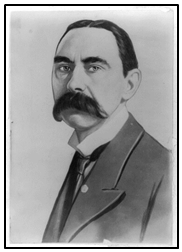
9 Douglas Hyde was born in Ireland in 1860. When Douglas was a boy, he lived in the country. He often visited the cottage of an old gamekeeper named Seamus (SHAY-mus) Hart. Douglas loved to hear Seamus tell stories. Seamus told him about the adventures of mighty warriors, gods, and goddesses. He also told old Celtic tales about the wee folk, who had strange and magical powers.
10 Because of Seamus, Douglas wanted to learn all he could about his country’s rich past. When he grew up, Douglas became a famous teacher of Irish folklore. But he knew that the old stories and the Irish language were in danger of slipping away forever. To keep them alive, Douglas wrote popular books about Irish folklore. He also urged people to speak Irish and to remember Irish music and dancing. In 1938, when Douglas was an old man, he became the first president of Ireland.
gamekeeper—a person in charge of birds used for sport on private land |
|---|
Which choice provides a summary of the passage?
Part A: Why did people in Ireland stop speaking Irish in the 1800s?
Part B: Which quotation from the passage supports the answer to Part A?
What do the authors mean by the phrase “in danger of fading away” in paragraph 8?
According to the passage, which two creatures were part of Irish folklore?
Which quotation supports the point that Irish folklore could have been lost?
How does the image help the reader understand the passage?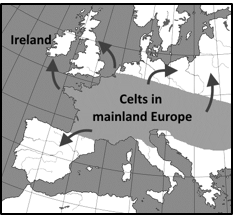
How does the information in the passage from Douglas Hyde: A Maker of Modern Ireland compare to the information in the passage from Leprechauns and Irish Folklore?
What is the theme of the poem?
Which choice describes the setting of the poem?
What does the poet mean by the simile in line 8?
What is the meaning of the word ease in line 13?
Part A: How does the mouse change in the poem?
Part B: Which line from the poem best supports the answer to Part A?
What did the mouse eat by the door?
Which phrase from lines 14-16 helps the reader understand the meaning of the word fragments?
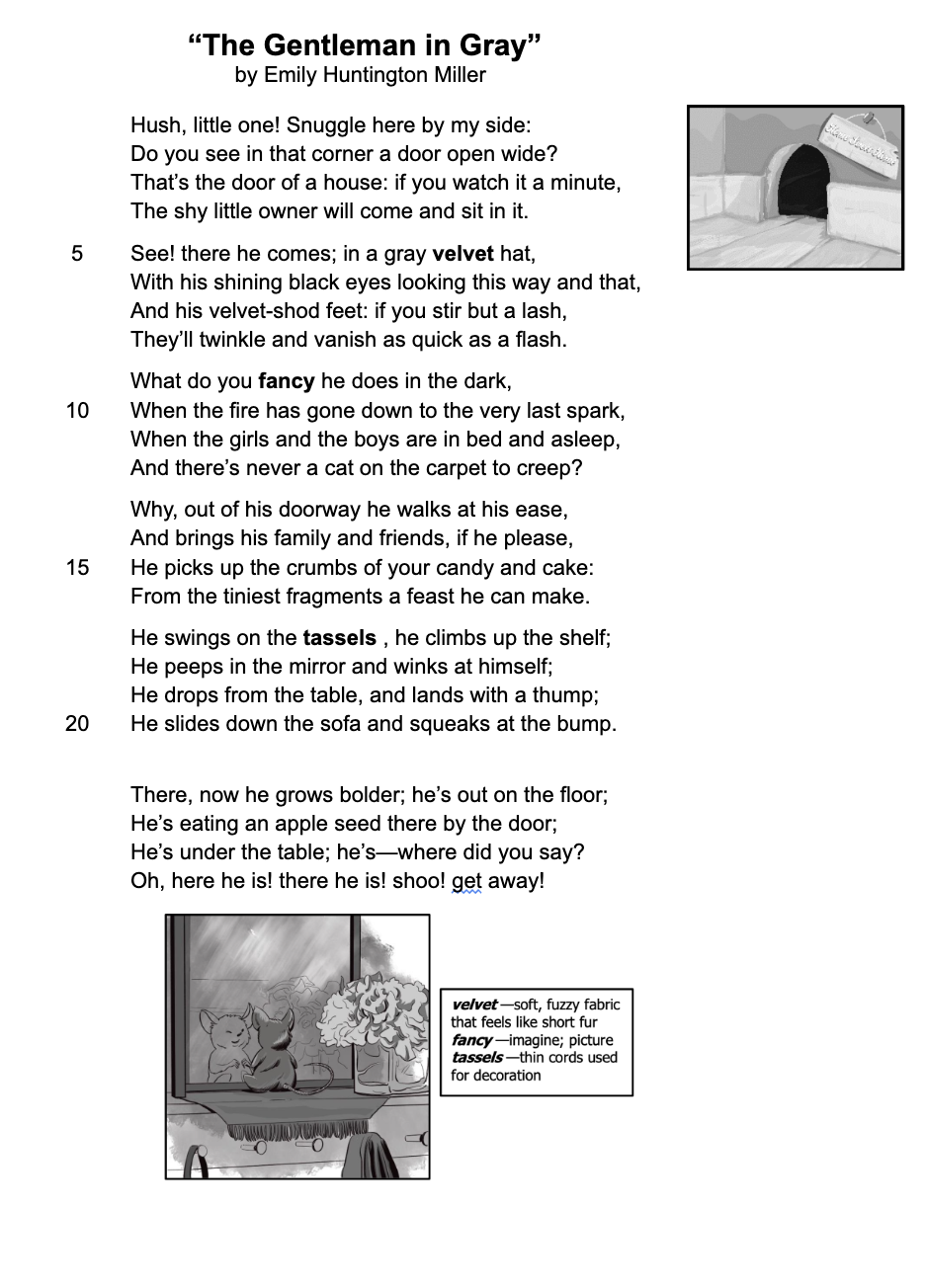
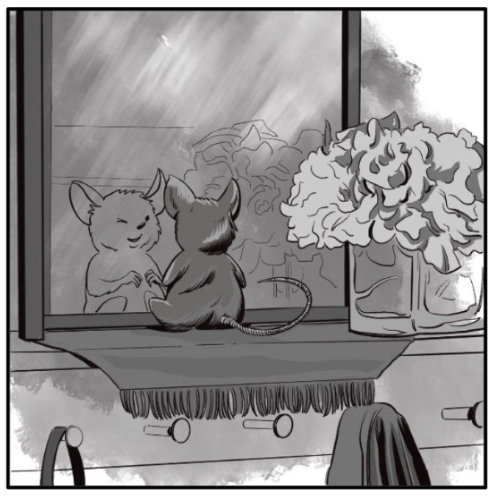
Which set of lines from the poem describes what is shown in the illustration?
1 In a hole in the Great Green House lived a royal mouse family known as the Top-Right-Cabinet branch of the House of Cheddar, or the TRCHOC. (When any mice tried to pronounce the abbreviation, they were kindly asked to “repeat that, and don’t cough this time!”)
2 Colby was the youngest of the TRCHOC family. He was very smart and liked to build things out of the odds and ends that found their way into the Top-Right Cabinet. His favorite was a little round bell he’d fashioned out of an apple seed and a piece of scrap metal. He carried it everywhere he went. He loved tugging the bell on its thin thread and hearing it ring as it bumped along beside him.
3 Then, one day, the cat came.
4 The humans who owned the Great Green House cared nothing about mice royalty of the TRCHOC. A mouse was just a mouse as long as it made unwanted raids on the fruit bowl. Because the mice had become clever at avoiding traps, the owners brought home a ginger-tabby tomcat with moonlike eyes that seemed to swallow up its face.
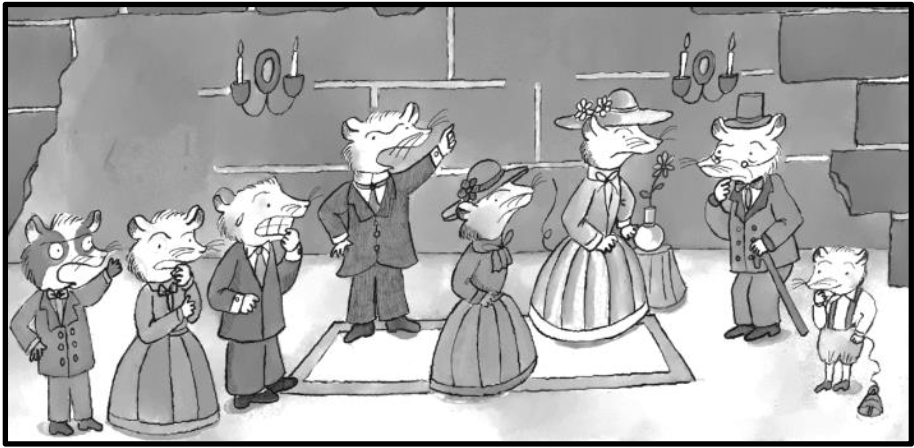
5 The mouse families from all over the Great Green House were thrown into an uproar. They called a meeting at Nook-Inside-Fireplace to figure out how to solve the Calamity.
6 “This is an outrage!” yelled the delegate from Spare Bedroom.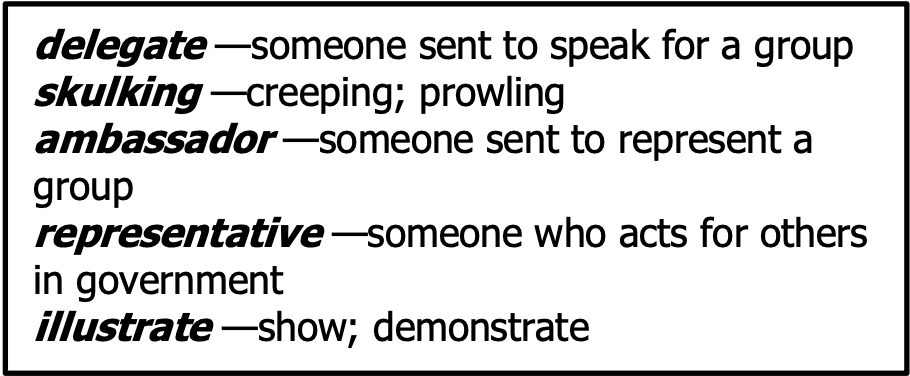
7 “To be policed by that skulking creature is below the dignity of mice!” cried the ambassador from the far town of Above-Attic-Beam.
8 “Something must be done!” said the representative of Behind-Water-Pipe.
9 As at every such meeting, all heads turned toward the figure the mice looked up to most: Lord Stilton, who spoke for the TRCHOC.
10 Before Lord Stilton could say anything, there was an anxious squeak, and Colby stood up. Between his paws was his homemade metal bell, which reflected a dozen eager faces. “I have an idea!” he exclaimed.
11 “Yes?” Lord Stilton said.
12 Colby twitched his tail nervously at the sudden attention. “My plan,” he said, “is to put my bell on the neck of the cat. That way, we’ll always know when it is coming.” He shook the bell to illustrate.
13 “How can we accomplish this dangerous feat?” asked the spokesman from the realm of Niche-Above-Furnace. He spoke too loudly, as he was accustomed to raising his voice above the racket in his home.
14 At that moment, there was a terrible scratching noise. The nimble cat was trying to dig its way into Nook-Inside-Fireplace! With high-pitched squeals and the frantic scamper of scurrying feet, the mice fled.
15 Colby was paralyzed by fright. In less than two seconds, he was all alone in the nook, the bell still clutched between his paws. He could see one huge lantern eye of the cat outside, and he heard it give a hiss of triumph as it squeezed its rotund head through the hole.
16 But in its zeal to get Colby, the cat had unthinkingly left its paws on the other side of the hole. Colby, his senses heightened by fear, noticed the cat’s mistake and it filled him with a rush of courage. Pulling his scattered wits back together, he launched himself at the great ginger tabby.
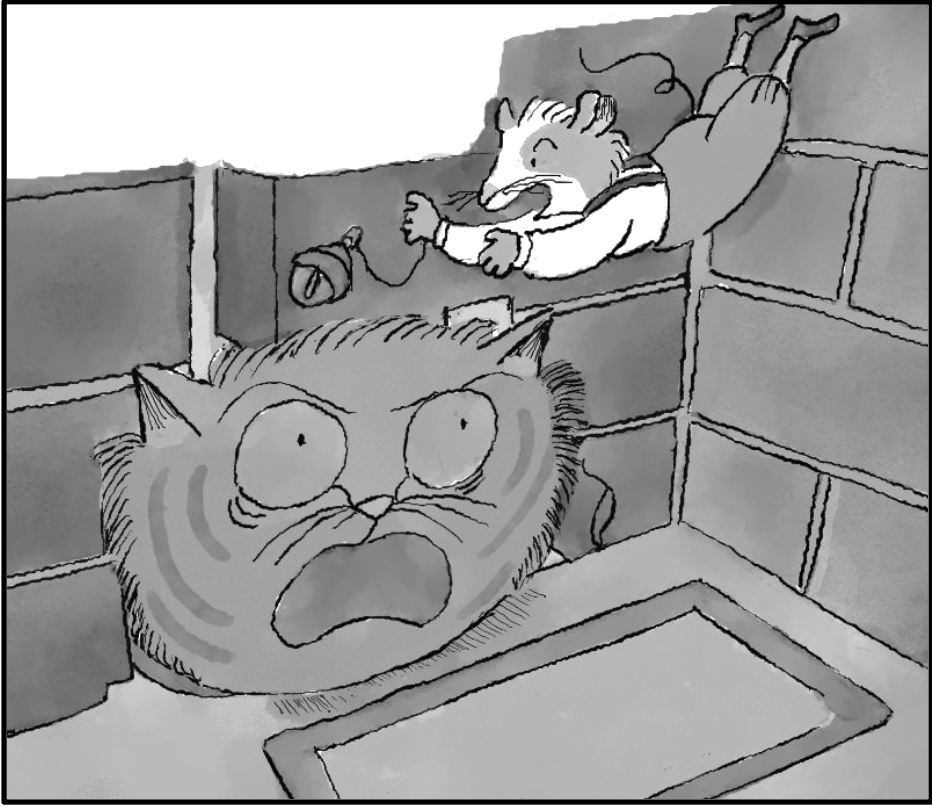 17 The feline was taken aback. Mice weren’t supposed to come flying at cats like this! Awkwardly, the cat tried to escape, but Colby was faster. Leaping on top of the cat’s head, far back enough to evade the feline’s lethal jaws, Colby threw the bell’s thread around the cat’s collar and tied the ends together as tightly as he could.
18 Then he jumped and ran for his life back to Top-Right-Cabinet. He could hear the click - click of claws on the floor behind him as the cat readied to spring, and for a moment Colby knew he was done for.
19 The cat gave a yowl of annoyance at the disturbance under its chin and stopped to scratch at it, just long enough for Colby to make safety.
20 Colby collapsed in the middle of his cheering family of mice, who hoisted their triumphant hero on their shoulders. Now every mouse, TRCHOC or otherwise, would be safe from the cat.
Part A: What is the theme of the passage?
Part B: Which quotation from the passage best supports the answer to Part A?
Which phrase from paragraph 2 helps the reader understand the meaning of the word fashioned?
How did the cat react to the bell on its collar?
Which two quotations support the inference that Colby was creative?
What does the author mean by the phrase “pulling his scattered wits back together” in paragraph 16?
Which statement correctly compares the points of view from which the poem and the passage are told?
How do the structural elements used in the poem and the passage differ?
How are the mouse in the poem and Colby in the passage different?