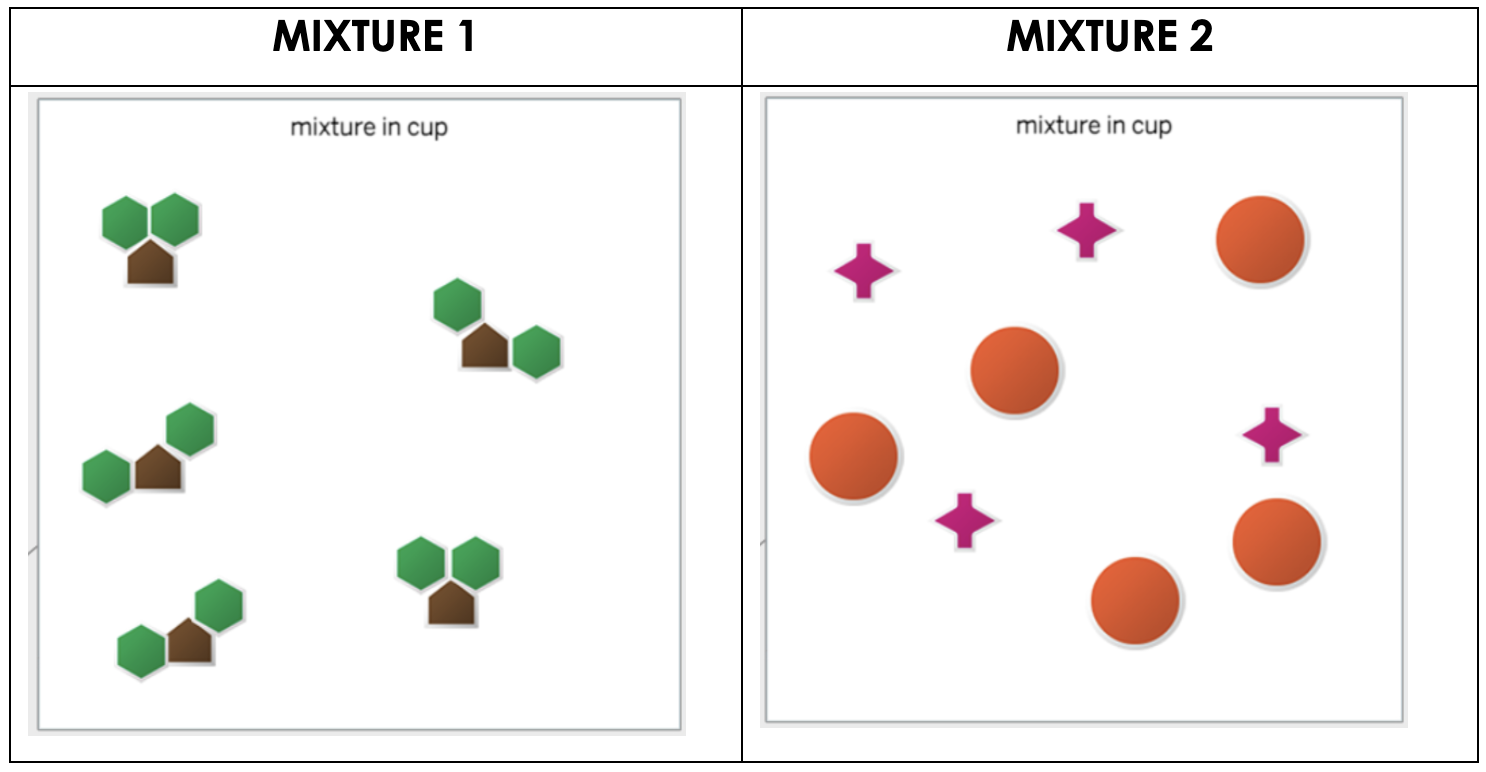
Which mixture shows something dissolving?
How do you know the mixture is dissolving?
How do you know the mixture is NOT dissolving?
Reading about Sugar (pgs 8-9)
Click on the link to read the book: https://learning.amplify.com/books/9781943228171/#page=10

Where does it come from?
What is it used for?
What are two properties of sugar?
What is one new thing you learned about sugar?
Reading about Citric Acid (pgs 16-17)
Click on the link to read the book: https://learning.amplify.com/books/9781943228171/#page=18

Where does it come from?
What is it used for?
What are two properties of sugar?
What is one new thing you learned about sugar?

How mixed are these two substances?

How mixed are these two substances?

How mixed are these two substances?
Based on what you've learned about mixing and dissolving, if a solid dissolves into a liquid, what does it mean about the properties of their molecules?
Describe what it would look like on the nanoscale.
If a solid dissolves in a liquid, the molecules are ________
Question: Why does sugar dissolve in water, but pepper does not?
Explanation B
Sugar dissolves in water because it is soluble in water. Molecules that are attracted to one another spread apart and mix evenly in a mixture. This is what happened with the sugar and water. When I put sugar in water and stirred, the sugar seemed to disappear. However, because the water tasted sweet, I knew that the sugar was still there.
Pepper, on the other hand, is not soluble in water. Even after stirring a long time, I could still see clumps of pepper in the water. This must have happened because pepper molecules and water molecules have low attraction to one another. Sugar and pepper do not interact in the same way when you mix them with water because of the different properties of their molecules.
Does Explanation B answer the question? Yes or No?
Does Explanation B describe things that are not easy to observe? Yes or No?
Question: Why does sugar dissolve in water, but pepper does not?
Explanation A
Sugar is soluble in water. When I put sugar in water and stirred, the sugar seemed to disappear. However, because the water tasted sweet, I knew that the sugar was still there. Pepper, on the other hand, is not soluble in water. Even after stirring for a long time, I could still see clumps of pepper in the water.
Does Explanation A answer the question? Yes or No?
Does Explanation A describe things that are not easy to observe? Yes or No?
Question: Why does sugar dissolve in water, but pepper does not?
Explanation B
Sugar dissolves in water because it is soluble in water. Molecules that are attracted to one another spread apart and mix evenly in a mixture. This is what happened with the sugar and water. When I put sugar in water and stirred, the sugar seemed to disappear. However, because the water tasted sweet, I knew that the sugar was still there.
Pepper, on the other hand, is not soluble in water. Even after stirring a long time, I could still see clumps of pepper in the water. This must have happened because pepper molecules and water molecules have low attraction to one another. Sugar and pepper do not interact in the same way when you mix them with water because of the different properties of their molecules.
Which explanation of dissolving do you think is more accurate? Why?
Which mixture shows something NOT dissolving?
The ideas in Explanation B are correct based on the scientific ideas we have learned? Yes or No?
The ideas in Explanation A are correct based on the scientific ideas we have learned? Yes or No?