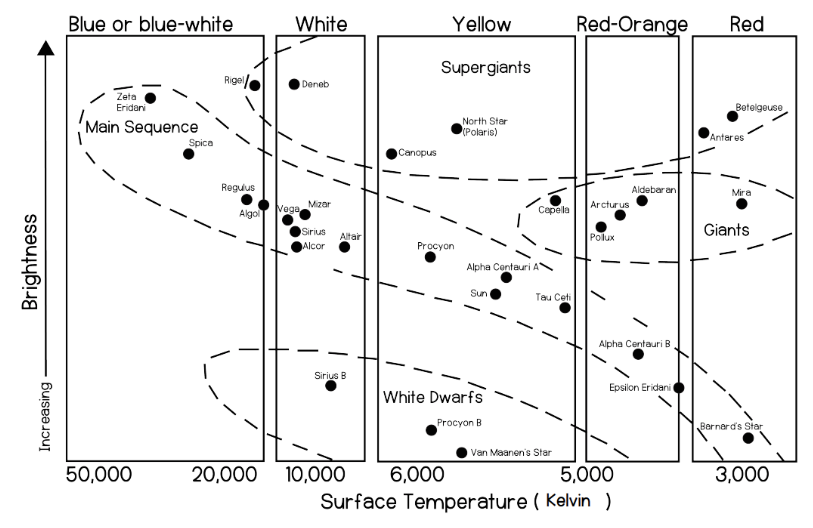
Why is Sirius B a white star and Spica a blue star?
Why is Sirius B a white star and Spica a blue star?
Student | Nebula | Supernova |
|---|---|---|
One | a collection of dust and gas that forms stars or results from dying stars | a sphere of matter with a temperature and density great enough to cause a nuclear reaction at its core |
Two | a sphere of matter with a temperature and density great enough to cause a nuclear reaction at its core | a collection of dust and gas that forms stars or results from dying stars |
Three | a collection of stars and their solar systems all held together by gravity | all of space and everything that exists |
Four | a collection of dust and gas that forms stars or results from dying stars | the collapse of a massive star's core resulting in an explosion |
Students are studying the components of the universe. They have been carefully studying the life cycle of supergiants and were asked to describe the difference between a nebula and a supernova. Students made a table with their comparison descriptions. Which student(s) had correct descriptions?
A star begins as part of a large cloud of gas and dust called what?
The beginning stage of a star's life cycle is known as what?
A dying high-mass star can suddenly explode, becoming a what?
What determines how long a star will live?
Check all answers that apply to a main sequence star:
Why is Sirius B a white star and Spica a blue star?
The Hertzsprung-Russell diagram below shows the spectral class of stars.
Based on the above diagram, which type of stars belong to spectral class K and have the lowest luminosity?
Three different stars have been labeled on the HR diagram displayed. When analyzing Stars X, Y, and Z, which star would be hot and dim?