Kimi spends the afternoon relaxing by the pool. She reads some of her book. Then she __________ for a while.
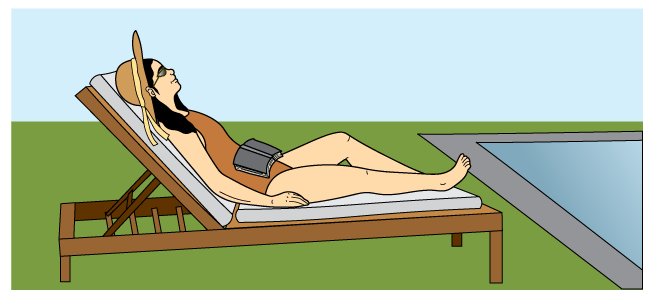
Kimi spends the afternoon relaxing by the pool. She reads some of her book. Then she __________ for a while.
Kimi spends the afternoon relaxing by the pool. She reads some of her book. Then she __________ for a while.
President Abraham Lincoln signed the Morrill Act into law July 2, 1862. This act granted at least 30,000 acres of public land to each state. The recipient could then sell the land and use the proceeds to fund public colleges and universities that focused on agriculture and mechanical studies. In total, the Morrill Act helped fun 69 colleges. This opened up educational opportunities to more people. And by supporting mechanical studies in those colleges, the act also helped establish the country's ____________ in the field of engineering.
The Indian Removal Act of 1830 ultimately led to the forced relocation of several American Indian groups, including the Cherokees. Thousands of Cherokees were made to leave their homes and walk nearly 1,000 miles to Indian Territory. The journey was very difficult. The routes used for this migration have become known as the Trail of Tears because of the journey's ___________effects on the Cherokees.
Henry David Thoreau was a writer, philosopher, and abolitionist who lived in Massachusetts. In 1843 he decided to protest the institution of slavery by refusing to pay a state poll tax. After several years of refusing to pay his taxes, Thoreau was arrested by Constable Samuel Staples and take to jail. One of Thoreau's relatives paid the tax bill that night, and Staples attempted to release Thoreau from jail the following day. Thoreau, however, refused to leave, citing the fact that he was not the one who had actually paid the back taxes.
Many were confused by Thoreau's desire to stay in jail. Thoreau gave a lecture, later printed as the essay "Civil Disobedience," to explain his rationale. Thoreau believed that if every opponent of slavery took action similar to his own, the government would have no choice but to abolish slavery. Thoreau's "Civil Disobedience" became an influential document over time, inspiring the actions of individuals such as Mohandas Gandhi and Dr. Martin Luther King, Jr.
In this text, what does the word citing meaning?
In the real number system, all numbers can be plotted on a number line. Two sets of numbers exist within the system: rational numbers and irrational numbers. Rational numbers are basically numbers that can be written as fractions. For instance, values such as 3 and -2 are rational numbers because they can be written as fractions, specifically 3/1 and -2/1. Correspondingly, decimals that end or repeat, such as 0.25 and 0.33, are rational because they too can be written as fractions. In this case, the fractions are 1/4 and 1/3.
Irrational numbers are defined as those numbers that cannot be written as fractions. When expressed in decimal form, irrational numbers are decimals that never repeat and never end. This is because the decimal of an irrational number is an approximation instead of a true value. Instead of using decimals, mathematicians often use symbols to express irrational numbers. One well-known symbol is π, which represents an irrational constant. Many square roots, such as √17, are also expressed as symbols.
What is the main purpose of this text?
The soil covering much of Arches National Park in Utah is called biological crust. This is a type of living ground cover, formed primarily by bacteria. It also includes lichens, mosses, and algae. Although the soil may appear to be simply a lumpy crust on the ground, it is nevertheless a critical building block for plant life in the desert. Because this soil crust is so fragile, visitors to the park are required to stay on marked trails to avoid damaging it.
Some of the bacteria in the soil crust are cyanobacteria, one of the oldest known organisms on the Earth. As these bacteria move through wet soil and rock, they bind particles together, making a sort of woven mat or web. This web helps prevent wind and water erosion; in addition, it traps water and nutrients within the soil. Thus the cyanobacteria play an important role in the park's desert ecosystem. Without the foundation of this soil crust, other plants would struggle to grow and survive.
Where would this text most likely be found?
One of the central debates of the Constitutional Convention was about how to determine representation in the legislature. Edmund Randolph proposed the Virginia Plan, which appealed to large states. Under the Virginia Plan, Congress would consist of a bicameral legislature. Representation in both houses would be determined by each state's population or by its overall wealth. William Paterson then countered with the New Jersey Plan, a plan that appealed to small states. Under the New Jersey Plan, each state would receive equal representation in the legislature.
Seeking to strike a balance between those two plans, Roger Sherman and Oliver Ellsworth put forth the Connecticut Compromise. The Connecticut Compromise included features that appealed to both large and small states. Like the Virginia Plan, the Connecticut Compromise included a bicameral legislature. The lower house, the House of Representatives, would have proportional representation based on each state's population. The upper house, the Senate, would have equal representation for each state. The delegates approved the Connecticut Compromise, also known as the Great Compromise, on July 16, 1787.
The Great Compromise is called "great" mainly because it was ---
Read the text. Choose the answer that best completes the text.
He wanted to show us a ________ trick, but he couldn't find his deck of cards.
Read the text. There is an error that is underlined.
When cooking on a stove top, you have to be careful not to burn itself.
In the box, write the word that corrects the error.
Read the text. There is an error that is underlined.
During fall, all the leafs fell from the trees to the ground.
In the box, write the word that corrects the error.
Read the text. There is one error. Click on the error.
She was
In the box, write the word that corrects the error in Question 11.
Read the text. The text has one or more errors.
I saw a packs of wolfs not very far from here.
In the space provided, rewrite the complete text to make the text correct.
Read the text. The text has one or more errors.
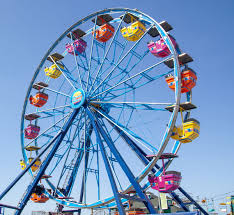
The Ferris wheel we waited for patiently.
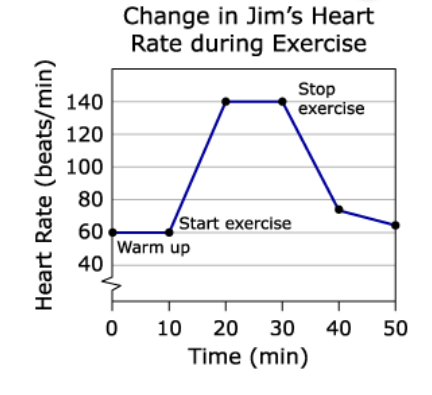
Describe what is happening in the line graph.
Why do you think that Jim's heart rate stayed the same for 10 minutes?
What other conclusions have you come to after looking at the graph?
Write about a time when you looked at or made a line graph like this one. What was it for?
Look at the pictures. Use the pictures to write a story. Your story should have a beginning, a middle, and an end. Write about each picture in order. Include as many details as you can.
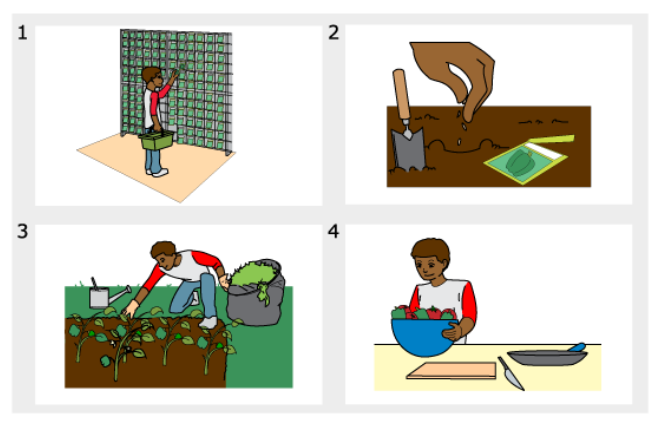
Tell who the person is, where the person went, what the person did, and why.
Explain what the person saw, what the person thought, and how the person felt.
Think about classes you are taking this year in school and classes you have taken in the past.
What was your favorite class, and why did you enjoy that class?
What is a class that you struggle in and why? What is a class that you do well in and why?
Wo is or was your favorite teacher, coach, or other staff member? Explain why you like or liked this person?
Read the selection and choose the best answer to each question.
Bowerbirds.
Many people enjoy decorating their home. They want their home to look nice. They carefully choose chairs to sit on and pictures to hang on the walls. Do you know there is a type of bird that also decorates? That bird is the bowerbird.
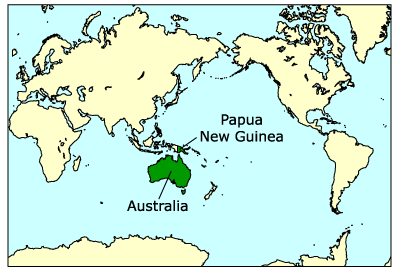
Bowerbirds live in Australia and in Papua New Guinea. There are about 20 different kinds of bowerbirds. Male bowerbirds build special structures called bowers. These fancy bowers are not nests for eggs. Instead, a male bowerbird builds a bower in a special place to attract a female. Bowers take a lot of time to build. Some bowers take months to build.
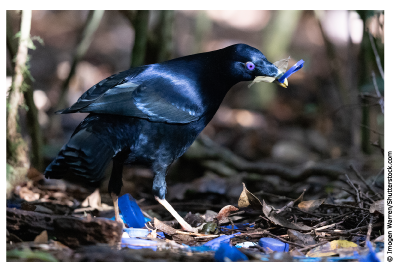
Male bowerbirds embellish their bowers with objects they find. The birds may add leaves, shells, or bits of colorful plastic. Berries and feathers can also be used as decorations. Some bowerbirds even paint the bower walls. They make paint by mixing plant juices or charcoal with saliva from their mouth. At the front of each bower, the bird clears a space on the ground. It moves away objects that it does not want. Then there is more room for decorations.
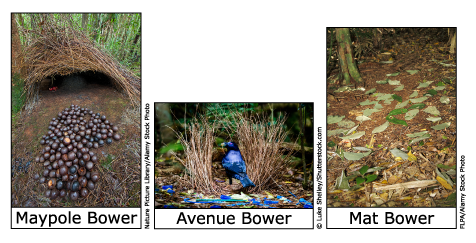
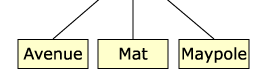
Different types of bowerbirds build different types of bowers. A maypole bower is built around the bottom of a small tree. The bowerbird makes the bower out of many sticks. Maypole bowers can be very tall.
An avenue bower is also made of sticks. Avenue boers have two walls of sticks with a space in between. Some bowerbirds decorate their avenue bower with blue objects.
Another type of bower is the mat bower. A mat bower is a thick layer of plant pieces on the ground. One kind of bowerbird decorates its mat bower with special leaves.
When the bower is ready, a female bowerbird will come to look at it. The male bowerbird dances for the female while she surveys the bower. The male will tilt his head, puff out his chest, or show off his decorations. It the female bowerbird likes the bower, she will choose to stay with the male. Later she will elave and build a nest for eggs in a bush or a tree.
What does the word surveys mean in paragraph 7?
What does a male bowerbird probably do first when building a bower?
What is paragraph 3 mostly about?
Look at the diagram. Move the answer that best completes the diagram into the empty box.
What do bowerbirds mainly use to make avenue bowers?
Why do male bowerbirds build a bower?
Read the selection and choose the best answer to each question.
A Woman Runs the Marathon
Roberta "Bobbi" Gibb was 21 years old when she watched her first marathon race, the Boston Marathon. The year was 1964. She later recalled how she fell in love with the event and how much she wanted to be a part of it. She wasted no time. On the very next day, she started training, and for many, many months after that she pushed herself to do increasingly longer runs.
In February 1966, Gibb requested an application from the Boston Athletic Association (B.A.A.) to run in the Boston Marathon later that spring. She wasn't prepared for their response--that women weren't phsyiologically capable of running a marathon and that the B.A.A. couldn't take on the liability. Many people at the time believed that a woman might die if she ran a marathon, and the B.A.A. didn't want to be held responsible for a runner's death. Gibb recognized the opportunity in the situation. She thought that if she could show how mistaken the B.A.A.'s belief about women was, this would shake up other myths about what women could and couldn't do.
Bobbi Gibb ran the Boston Marathon on April 19, 1966, but not in the way all the other participants did. Before the race, she put on a black one-piece bathing suit and over that a hodded sweatshirt and shorts she had borrowed from her brother. (Running apparel for non-elite women athletes didn't exist at the time." Then she hid behind some bushes located just past the starting point of the race. When the crowd of all male runners passed by, she joined them as surreptitiously as possible.
"It's a Free Road"
Gibb had worried that the runners around her would be enraged by her presence. They might try to shove her off the road or even get someone to call a police officer to arrest her. Instead, the men around her assured Gibb that they wouldn't allow anyone to stop her. "It's a free road," one said. At that point, she took off her sweatshirt and ran undisguised.
Spectators lined both sides of the road into Boston, cheering on the marathoners. And then they saw it: a woman was running the marathon! As she passed, a man screamed, "Way to go!" Some women cried. Others cheered. The route passed by Wellesley College, an all-women's undergraduate school. Word of Gibb's run had preceded her by that point. As she approached the college, she could hear the female students' screams in the distance, and they grew even wilder as she ran by.
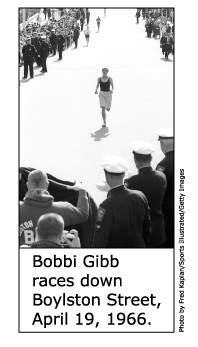
By the time Gibb hit mile 20, her feet were covered in painful blisters. She had bought new sneakers for the race, not knowing it was unwise to run such a distance in shoes that hadn't been broken in. Toward the end of the race, she was practically tiptoeing. When she turned onton Boylston Street, the last lef of the race, the crowd roared and roared. The governor of Massachusetts shook her hand. Gibb had finished in 3 hours and 21 minutes, in the top third of all the participants.
Post-Race Revolution
The year after Gibb's historic run, another woman named Kathy Switzer submitted an application as "K.V. Switzer," was given a participant number, and completed the race. In 1972 the Boston Marathon became the first of the world's great marathon races to officially welcome female runners.
As for Bobbi Gibb, she went o nto graduate from law school, and then she practiced law for about 20 years. She also studied neuroscience and worked to find cures for diseases related to nerve disorders. In 2016, 50 years to the day after her first marathon, she was given the honor of being designated Grand Marshal of the Boston Marathon. Reflecting on her groundbreaking race, Gibb spoke of her desire to be an example of the type of person who pursues what he or she loves and excels at. She also expressed her belief that everyone comes to this world to give something. What Bobbi Gibb gave the world was a challenge to let go of certain myths about, and prejudices toward, women.
When did Gibb take off the piece of clothing that helped disguise her?
Which sentence from the selection best relates to the main idea?
What are paragraphs 7 and 8 mainly about?
Which words in paragraph 2 help the reader know what liability means?
What is the most likely reason that some women cried when they saw Gibb running the marathon?
Read the selectio and choose the best answer to each question.
Everything Old Is New Again
No matter which way she turned, Janelle Baker bumped into another box. The apartment seemed even smaller now that they were sorting and packing their belongings for the move to her grandma's house.
"I can't believe all this stuff fit into this tiny apartment," she grumbled.
Her brother William shrugged. "But it did."
Mrs. Baker patted her daughter's arm. "Amazing, isn't it? Think how great it will be when everything is rganized and stored in our new home," she said.
Janelle looked at her mother, worried. "Is Granma sad?" she asked. "She lived in that house her whole life. It feels almost like...well, like we're taking it from her."
"No. She realized it was time to move," Mrs. Baker replied. "She was having a hard time taking care of her house. Going up and down the stairs had become arduous for her too. She's much happier now, living in a smaller place. And she's really excited that the house is staying in the family."
"Grandma's old home becomes our new one," added William.
"Life is like a circle," Janelle said in a singsong voice. Her mother nodded.
William and Janelle finished sealing the boxes. Then they carried them down to the minivan that would cart them all to their new house.
As they drove into town, the family discussed the plans for their home. Janelle was glad that her mother's old bedroom was going to be hers. William was excited about the backyard. Now he would have a place to improve his pitching skills. He hoped to help his baseball team win state championship this year.
"I know you're both eager to move in," said Mrs. Baker. "But I want to stop by the storage unit first to pick up a few things."
Janelle twisted around in her seat to look at the back of the minivan. "There isn't a lot of space back there," she said. "I don't think we'll have room for much more stuff."
"On, I don't plan on taking a lot from the storage unit," said Mrs. Baker. "The things in there are mostly keepsakes from my younger days."
Mrs. Baker parked the minivan in front of their unit. Then she unlocked and opened the overhead door. Inside, the musty smell of old cardeboard and dust filled the air.
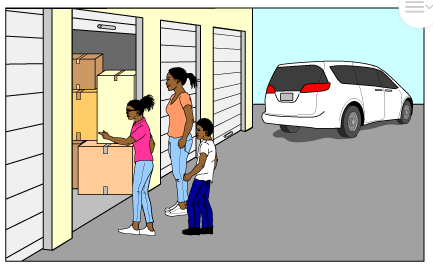
"Whew. You can tell that we haven't been here in a while," Mrs. Baker said, fanning the air. "I just want to grab some photos."
While Mrs. Baker looked for the photos, Janelle and William started opening boxes and rummaging through them.
"What is in this one?" asked William, opening a box labed "High School."
"Old clothes from years ago," Mrs. Baker replied. "There's nothing worth saving."
William coughed as he pulled an oversized baseball jersey from the box. "Mom!" he exclaimed, wide-eyed. "You've got vintage Cubs jerseys in here!" He kept digging through the clothes. "And look at all these other cool baseball T-shirts!"
"Your grandfather took us to a lot of games over the years," said Mrs. Baker. "I had forgotten I still had all those souvenirs."
Janelle pulled out a brightly colored skirt. "Look at this cute thing!" she exclaimed. "And this denim jacket with the patches on it!"
Mrs. Baker looked puzzled. "Janelle, I don't understand why you're excited," she said. "Those clothes of mine are so old-fashioned."
"Not anymore!" replied Janelle, holding the skirt at her waist. "This is the latest look. Just check out the fashion magazines. You'll see."
Mrs. Baker shook her head as she placed several framed photos in the van. "O.K., you two. Take a few hand-me-downs for now," she said.
Janelle and William cheered as they piled into the van with their treasures. Mrs. Baker closed the door to the storage unit.
"I certainly didn't expect you to want any clothes from my high school years," she said as they drove off. "I thought they were nothing but old junk."
"No way," said Janelle. "Just like Grandma's house, they're new to us. And they'll be new to whoever gets them next."
"All part of the circle, I guess," said Mrs. Baker.
Which word means almost the same as vintage in paragraph 19?
Why is Janelle interested in her mother's clothing?
What will most likely happen the next time the Baker family visits the storage unit?
In paragraph 24, what does hand-me-downs mean?
The items that the family finds in the storage unit suggest that Mrs. Baker----
Which words in paragraph 6 best help the reader understand what arduous means?
Why is Mrs. Baker surprised by her children's interest in the clothes?
Read the selection and choose the best answer to each question.
The Mysterious Life of Eels
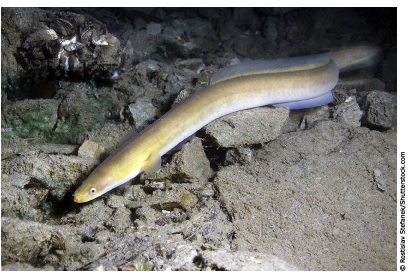
Eels are mysterious creatures. Scientists know that American and European eels hatch in a particular area of the Atlantic Ocean. Researchers have also found adult eels living in freshwater lakes and rivers. So how do the eels get from the ocean to these bodies of water thousands of miles away? One of the more perplexing characteristics of these eels is their remarkable ability to navigate this long journey. They don't even need a road map, satellite, or tour guide!
Understanding the eels' life cycle can help explain the incredible nature of this feat. Most American and European eels hatch deep in the Sargasso Sea, a warm spot in the Atlantic Ocean located off the southeastern coast of the United States. The newly hatched baby eels then begin to migrate to faraway places. It takes the developing eels one to three years to make their ocean voyage. Eventually they arrive on the coasts of North American and Europe. Then they begin to swim into rivers and other bodies of freshwater.
The eels grow into yellow or greenish adults intheir new freshwater habitat. After 10 to 25 years, they turn silver and are fully mature. Now the eels are ready for another distance challenge. They swim back to the ocean and then all the way back to the Sargasso Sea, where they were born! There the eels lay their first and only batch of eggs. After a lifetime that includes two ocean journeys totaling as much as 6,000 miles, the eels die.
Scientists have never seen eels traveling through the ocean, and they once knew almost nothing about this part of the eels' journey. To learn more about their movements, scientists tried to tag eels with tacking devices. But the tags kept falling off, or the eels were eaten by predators. Then in 2015, scientists reported that one female eel and her tracking tag had made it back to the Sargasso Sea. From studying the information recorded on the tag, scientists learned that eels travel deep below the ocean's surface. Their deep dives are probably why no one ever sees them swimming in the ocean.
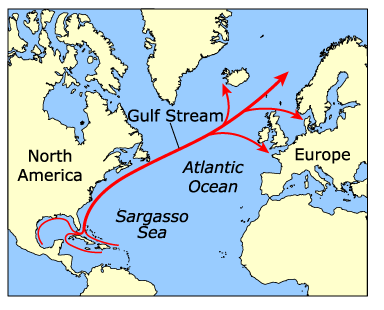
Scientists still wanted to know how the young eels could travel from the ocean to coastal waters. A real breakthrough came from studies suggesting that eels use the Earth's magnetic field to guide their journey. Eels seem to use magnetic clues to find the Gulf Stream, a warm current in the Arlantic Ocean. The Gulf Stream helps pull the recently hatched eels to North America and Europe. The eels' use of a "magnetic map" to locate the Gulf Stream increases their chances of safely navigating thousands of miles of open ocean.
There is still much to learn about the elusive eels and their mysterious habits. However, discovering that eels may sense magnetic fields and chart their direction toward a favorable current is extremely helpful to scientists. These puzzling creatures are now better understood than ever before.
What do scientists believe causes eels to be guided to the Gulf Stream?
In the life cycle of an eel, what happens after the eel becomes fully mature?
Which word in paragraph 6 best helps the reader understand the meaning of elusive?
What is paragraph 4 mainly about?
a silver eel that is found on the coast of North America is probably headed to ---
The author wrote this selection mainly to give information about ----
Which sentence from the selection best shows one of the difficulties in studying eels?
Read the selection and choose the best answer to each question.
Help from Friends
It is a warm summer day. Sophie and Kayla are walking to the park to go seimming at the pool. "Let's stop at Yolanda's house," says Sophie. "Maybe she can go to the pool with us."
When the girls arrive at Yolanda's house, they see her in the front yar. She is wearing heavy work gloves on her hands. Her face is read. She is sweating. Yolanda smiles and waves. She says, "Hi! What are you goind here?"
"Kayla and I are going to the swimming pool," Sophie tells Yolanda.
"Come with us," says Kayla.
"Oh, I love to swim. But I can't go now," says Yolanda. "I have a job to do.." Yolanda points to a pile of bricks on the driveway. "I have to carry all these bricks to the backyard." She explains that her mom is going to use the bricks to build a wall around the garden. "I can't go anywhere until this job is done."
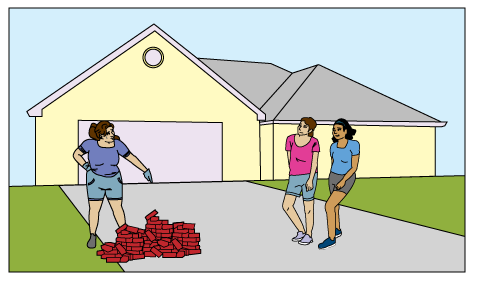
Sophie frowns at the bricks. "That is a lot of bricks. It's going to take you a long time."
Kayla says, "I have an idea. If Sophie and I pitch in, we can finish quickly."
Yolanda says, "Wow! You want to help me?"
"Sure," Sophie and Kayla say at the same time.
"Thanks!" Yolanda tells them.
Yolanda gives her friends gloves to protext their hands. Then each girl picks up two bricks. They carry them to the backyard and put them near the garden. They do this again and again. Soon all the bricks are in the backyard.
"We are already done. We finished the job in a snap," says Yolanda. "I'm going to get my swimsuit. Then let's go!"
"
Which event happens first in the story?
In paragraph 7, what do the words pitch in mean?
Why do Sophie and Kayla go to Yolanda's house?
How does Yolanda probably feel in paragraph 8?
In paragraph 12, what does in a snap mean?