Twa kɔ nsɛm atitiriw so
Log in
Sign up for FREE
arrow_back
Laabri

Week 2.7: Land

star
star
star
star
star
Last updated about 2 hours ago
26 Nsɛmmisa
To the Prairie
The Great Science Fair Mix-Up
Grandpa’s Garden Lessons
Why Cities Need More Green Spaces

Click submit when finished with all questions and check your answers. You may not be able to make corrections at this time.

To the Prairie

1

Ma says she wants to talk with me after I get back from working in Mr. Mallory's Store. I sense the wind of change blowing, and I am worried about what it will bring. Things have been real hard for me and Ma since Papa died. I quit school to work at Mallory's, but we barely scrape by.

2

I hurry home. Even though I am worried, I am also curious. Rumor has it that Mr. Mallory wants to court Ma. His wife has been dead for two years, and he has his hands full with four little girls. Apparently, he thinks Ma will make a fine mother to those little girls. And she will, too. But there is one problem. Mr. Mallory does not want to acquire an almost-grown son. He tolerates me fine at the store, but at his home is a different story. I heard about a boy my age who got sent out to the prairies to live with strangers because there was no room for him in the new family.
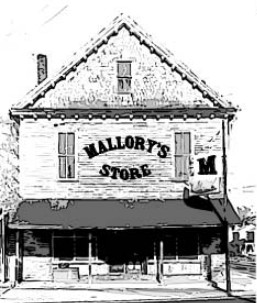
simple sketch of a storefront building with a sign Mallory's Store

3

When I get home, Ma looks troubled. I am getting an uneasy feeling about this. She looks like she is having trouble breaking bad news.

4

She asks, "How would you feel about moving to the wide open prairie, the land of unlimited opportunities?" She must be reading my mind!

5

"The prairie?" I respond with a gulp. I try hard to look brave.

6

But I can't hide my feelings from Ma. She looks stricken and says, "Oh, I knew you would not like this idea. But, I just cannot figure out another way to make a better life."

7

When I see her disappointed eyes, I say, "All will be well, Ma. Just tell me."

8

She pulls some papers from her pockets. "Well, I have been reading up on the Homestead Act. Today, I mustered up the courage to go to the Land Office to ask about it. And they gave me the official papers, just like that."
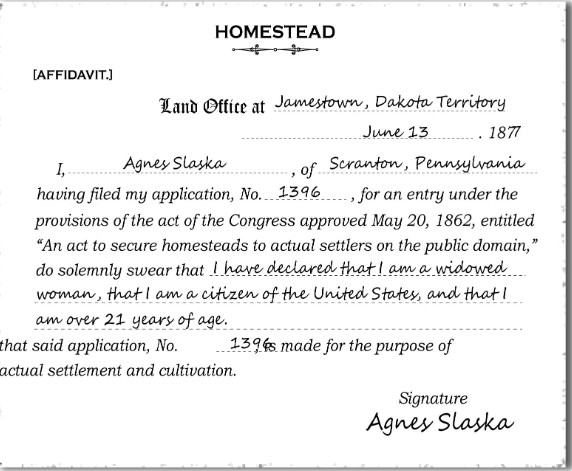
Homestead Affidavit document showing: Land Office at Jamestown, Dakota Territory, June 13, 1871. Agnes Slaska of Scranton, Pennsylvania, having filed application No. 1396 for entry under the provisions of the act of Congress approved May 20, 1862, entitled "An act to secure homesteads to actual settlers on the public domain," do solemnly swear that I have declared that I am a widowed woman, that I am a citizen of the United States, and that I am over 21 years of age. That said application, No. 1396 made for the purpose of actual settlement and cultivation. Signature: Agnes Slaska

9

It dawned on me that I was not being sent alone to the prairie, but all I could say was, "But, but, but..."

10

Ma laughed. "I thought so too. But they said that any woman who is single or widowed can get her own 160 acres of land. All you have to do is live on it for five years, and it is yours. And our land," she said, pointing to a map, "it is just a few miles outside of Jamestown in the Dakota Territory."

11

"So we are going together?" I asked with happiness spreading through me like butter on warm bread.

12

"Of course. Did you think I could leave you behind working for that awful Mr. Mallory?" she asked with a twinkle.
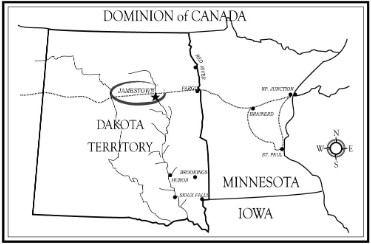
Map showing Dakota Territory with Jamestown marked, bordered by Minnesota, Iowa, and Dominion of Canada

1
RL.5.6
1
RL.5.6
1
1
1
1
1
RL.5.6
1
RL.5.6
1
RL.5.6
1
RL.5.6
1
RL.5.6
1
RL.5.6
1
RL.5.6
1
L.5.5.a
1
L.5.5.b
1
L.5.5.a
1
L.5.5.a
1
L.5.5.b
1
L.5.5.a
1
1
1
1
1
1
1
Asemmisa {{asɛmmisaAhyɛnsode}}
1.

How would this story be different if it were told from Mr. Mallory's point of view?

Asemmisa {{asɛmmisaAhyɛnsode}}
2.

Why does the boy think his life will be different if his mother marries Mr. Mallory?

Asemmisa {{asɛmmisaAhyɛnsode}}
3.

How does the narrator feel about moving to the prairie?

Asemmisa {{asɛmmisaAhyɛnsode}}
4.

What is the narrator's reaction to the idea of moving?

Asemmisa {{asɛmmisaAhyɛnsode}}
5.

What influence does Ma's decision have on the narrator?

Asemmisa {{asɛmmisaAhyɛnsode}}
6.

What does the narrator notice about Ma's feelings?

The Great Science Fair Mix-Up

My name is Liam Rivera, and I’ll be the first to admit I’m not exactly what you’d call a “science guy.” I’m more of an “accidentally-blow-things-up-in-the-kitchen” kind of person. But when our teacher, Ms. Patel, announced the annual Lincoln Elementary Science Fair, I decided this year would be different. I was going to win—no matter what.

It all started three weeks before the fair. My best friend, Sophie, and I brainstormed project ideas. She’s one of those people who actually reads the directions before starting something, which I’ve always found unnecessary—until later, that is.

“How about a model volcano?” I suggested, already picturing red lava bubbling over.

Sophie raised an eyebrow. “Everyone does volcanoes, Liam. What about something new—like testing which materials make the best water filters?”

That sounded fine, but not exciting. “No one remembers water filters, Sophie. People remember explosions!”

She sighed. “You just want to make a mess again.”

I grinned. “Exactly.”

Finally, we compromised. We’d test different chemical reactions using safe ingredients. Sophie made sure to underline the word safe in her notebook. I tried to pay attention as she explained the plan, but honestly, I was already imagining the judges’ faces when our project fizzed, foamed, and maybe—just maybe—sparked a little.


The day before the fair, our experiment sat neatly on Sophie’s kitchen counter. We had labeled bottles, measuring spoons, and even safety goggles. Everything was ready. That’s when I had my “brilliant” idea.

“What if we add just a little more baking soda to the final mixture?” I asked. “It’ll make the reaction bigger—like, way bigger!”

Sophie crossed her arms. “We’re supposed to follow the measurements exactly.”

“But think about it,” I insisted. “The judges will be impressed!”

She hesitated. “Fine. But only a tiny bit more.”

When she turned to grab a towel, I may have poured in more than just a tiny bit. I figured the extra fizz would make our display unforgettable.

I was right about that part.


The next morning, the gym buzzed with excitement. Students carried colorful boards and experiments that ranged from “Which Soap Works Best?” to “Solar Power in Action.” Sophie and I set up our project in the center of the room. I couldn’t stop smiling at our gleaming jars and bright labels.

When the judges finally reached our table, I stood tall, trying to sound professional. “Our experiment demonstrates how different ratios of baking soda and vinegar affect the reaction speed and foam level.”

Sophie nodded proudly. “We tested each combination and recorded the results.”

“Would you mind showing us a sample reaction?” one judge asked.

I glanced at Sophie. “Sure!” I said before she could answer. I grabbed the final mixture—yes, the one I had “improved.”

As soon as I poured the vinegar, the reaction started—only much faster than expected. Foam shot up like a rocket, spilling over the sides and covering the table. Then it spread onto the floor. The judges stepped back, their shoes splattered with white foam.

“Liam!” Sophie yelled. “What did you do?”

I froze. “Just… added a little more baking soda?”

Her eyes widened. “You mean a lot more!”

The judges tried not to laugh, though one of them hid a smile behind his clipboard. The principal hurried over with a mop.

Ms. Patel gave me that look teachers use when they’re deciding if they should be disappointed or impressed. “Well,” she said slowly, “that was certainly a memorable demonstration.”

I wanted to melt into the floor. Sophie cleaned the mess while I apologized to everyone within ten feet.


When the awards were announced, we didn’t win first place—or second, or third. But Ms. Patel did give us a “Most Enthusiastic Scientists” ribbon. Sophie said it was just a polite way of saying “Biggest Mess-Makers,” but I’ll take what I can get.

After the fair, I told Sophie I was sorry for not listening. She smiled. “At least it worked, just a little too well.”

I laughed. “Next time, you’re in charge of measurements.”

She nodded. “And you’re in charge of cleaning up.”

I guess the science fair taught me two things: one, follow the directions, and two, a narrator might make himself sound like the hero—but sometimes, the story shows otherwise.

Asemmisa {{asɛmmisaAhyɛnsode}}
7.

What kind of narrator is Liam?

Asemmisa {{asɛmmisaAhyɛnsode}}
8.

How does Liam’s point of view influence how the events are described?

Asemmisa {{asɛmmisaAhyɛnsode}}
9.

Which sentence best shows Liam’s attitude toward the science fair at the beginning?

Asemmisa {{asɛmmisaAhyɛnsode}}
10.

How does the story show that Liam’s point of view changes by the end?

Asemmisa {{asɛmmisaAhyɛnsode}}
11.

How might the story be different if Sophie were the narrator?

Asemmisa {{asɛmmisaAhyɛnsode}}
12.

Which detail helps the reader understand that Liam exaggerates his confidence?

Asemmisa {{asɛmmisaAhyɛnsode}}
13.

What lesson about storytelling can be learned from this passage?

Grandpa’s Garden Lessons

I never thought a backyard garden could teach me anything about life. To me, it was just dirt, bugs, and way too much sweating under the hot summer sun. But to Grandpa Joe, our little vegetable patch was more than that—it was his classroom, and every plant was part of his lesson plan.

The first Saturday of summer break, Grandpa handed me a small shovel and pointed toward the empty garden beds. “Time to get your hands dirty, Max,” he said.

“Do I have to?” I groaned. “It’s blazing hot out here!”

Grandpa chuckled. “Well, the early bird catches the worm. And the early gardener gets the best tomatoes.”

I knew he was serious because Grandpa had a saying for everything. He loved old proverbs and idioms, and half the time I wasn’t even sure what he meant.

Still, I started digging beside him, the soil warm beneath my hands. “So what does that mean—‘the early bird catches the worm’?” I asked.

“It means people who start early often get the best results,” Grandpa explained. “Plants, opportunities—same thing. You’ve got to be ready to grab them when they come.”

I nodded, pretending to understand. Honestly, I was more interested in getting back inside to my video games.


The next few weeks, we worked side by side. Grandpa showed me how to plant seeds, water them “just enough, not too much,” and pull out weeds before they took over.

Every day, he’d toss out another one of his sayings.

“Patience is a plant that doesn’t grow overnight,” he told me one morning as we checked on our slow-sprouting carrots.

“That’s not even a real saying!” I laughed.

He smiled. “Maybe not, but it’s true. Good things take time.”

By mid-June, tiny green shoots poked through the soil. Grandpa grinned like a kid who’d found buried treasure. “See that, Max? Where there’s a will, there’s a way.”

I frowned. “We didn’t use willpower. We used water.”

Grandpa laughed so hard he nearly dropped his watering can. “You’ll get it someday.”


One afternoon, a fierce summer storm rolled in. The wind bent the tomato plants, and the rain turned the soil to mud. I watched from the porch as Grandpa rushed outside, covering the garden with plastic sheets.

“Come on, Max!” he shouted. “Don’t just stand there—lend a hand!”

We worked in the downpour, slipping and sliding until we were both soaked. When the rain finally stopped, our shoes were caked with mud. I was sure the garden was ruined.

But a few days later, the sun returned, and to my surprise, most of the plants were still standing.

Grandpa knelt beside the tomatoes, brushing away bits of dirt. “You see, Max? You can’t make a rainbow without a little rain.”

I looked up at the bright arch stretching across the sky and smiled. That one actually made sense.


By late July, the garden was thriving. Plump tomatoes, shiny peppers, and green beans dangled from the vines like decorations. Grandpa and I picked vegetables every evening while the sky turned orange and purple.

One night, as we worked, I said, “You know, Grandpa, I think I’m finally starting to understand your weird sayings.”

He smiled. “Oh yeah? Which one?”

“Well,” I said, “I guess you were right about patience. I didn’t think anything would grow, but now look at all this.”

Grandpa nodded. “Exactly. The fruit doesn’t fall far from the tree.”

I blinked. “Wait, what fruit? These are vegetables.”

He laughed. “It means you’re more like me than you think.”

I grinned, a little embarrassed but also proud. Maybe I was like Grandpa after all.

When summer ended and school began, Grandpa’s health started to fade. He couldn’t get outside as much, so I took over the garden work. I watered, weeded, and gathered vegetables, remembering everything he had taught me.

One afternoon, I brought him a basket full of bright red tomatoes. He smiled weakly but his eyes sparkled.

“Looks like you’ve learned my best lesson,” he said softly.

“What’s that?” I asked.

He placed a wrinkled hand on mine. “You reap what you sow, Max. In gardening, in life—it’s all the same.”

That fall, when the air turned cool and the plants began to fade, I saved some seeds for next year. I knew I’d be planting again in the spring—this time, not because Grandpa told me to, but because I wanted to.

And every time I knelt in that garden, I heard his voice reminding me: Patience, hard work, and care—they’ll always bear fruit.

Asemmisa {{asɛmmisaAhyɛnsode}}
14.

What does Grandpa mean when he says, “Patience is a plant that doesn’t grow overnight”?

Asemmisa {{asɛmmisaAhyɛnsode}}
15.

The phrase “you can’t make a rainbow without a little rain” is an example of:

Asemmisa {{asɛmmisaAhyɛnsode}}
16.

What lesson does “you can’t make a rainbow without a little rain” teach?

Asemmisa {{asɛmmisaAhyɛnsode}}
17.

Which sentence from the story contains figurative language that compares two things directly?

Asemmisa {{asɛmmisaAhyɛnsode}}
18.

What does the proverb “You reap what you sow” mean in the story?

Asemmisa {{asɛmmisaAhyɛnsode}}
19.

Which best describes what Max learns from his time in the garden?

Why Cities Need More Green Spaces

Imagine walking through a city filled with tall buildings, busy traffic, and concrete sidewalks—but then you turn a corner and suddenly see a bright green park filled with trees, flowers, and families playing. That feeling of relief and calm is no accident. Green spaces—such as parks, gardens, and community lawns—are essential parts of healthy cities.

Many people believe that cities should focus mainly on buildings, roads, and businesses. However, there are strong reasons why green spaces deserve just as much attention. In fact, scientists, doctors, and city planners all agree that green areas help people, communities, and the planet in several important ways.


Point 1: Green Spaces Improve Physical Health

One main reason cities need green spaces is that they help people stay active and healthy.
Researchers have found that people who live near parks are more likely to exercise regularly. When children have a playground nearby, they run, jump, and play instead of sitting inside all day. Adults who have access to walking trails or open lawns are more likely to go for a jog or walk their dogs.

For example, a study from the American Heart Association showed that people living within a ten-minute walk of a park were 25% more likely to meet daily exercise goals. That’s clear evidence that parks don’t just look nice—they directly improve people’s physical health.


Point 2: Green Spaces Support Mental Well-Being

Another reason green spaces are important is that they reduce stress and make people feel happier. Being surrounded by nature gives people a break from the noise and pressure of city life. Studies show that even just looking at trees can lower heart rates and calm the mind.

In one experiment, students who spent time studying outside in a school garden reported feeling more focused and less anxious than those who studied indoors. Doctors in some cities have even started writing “park prescriptions,” encouraging patients to spend time outdoors as part of their treatment for anxiety or depression.

This evidence supports the idea that green spaces are not a luxury—they’re a necessity for mental health.


Point 3: Green Spaces Help the Environment

Cities are often sources of air pollution and heat. Green spaces can help fix those problems. Trees act as natural air filters, absorbing carbon dioxide and releasing clean oxygen. They also provide shade, which keeps neighborhoods cooler.

Scientists call large cities “urban heat islands” because concrete and asphalt trap heat from the sun. Parks, trees, and gardens can lower city temperatures by several degrees. For example, one study by the Environmental Protection Agency found that areas with lots of trees were up to 9°F cooler than areas without them.

Green areas also help manage rainwater. When heavy rain falls, plants and soil absorb water that might otherwise cause flooding. So, by adding parks, cities can protect both the air and the land.


Point 4: Green Spaces Bring Communities Together

Green spaces also strengthen communities. When people gather in public parks, they meet their neighbors, celebrate together, and build friendships. This helps reduce feelings of isolation and creates a stronger sense of belonging.

For instance, community gardens allow people to grow vegetables together. Neighbors who might never talk in their apartment buildings often become friends while planting and harvesting crops. A city survey in Chicago found that neighborhoods with more parks and gardens had lower crime rates and stronger social connections.

This evidence shows that green spaces do more than decorate a city—they help build community spirit.


Point 5: Green Spaces Boost Local Economies

Finally, parks and green areas can help a city’s economy. When neighborhoods have beautiful parks, property values often rise. Local businesses near green areas also attract more customers. Tourists are more likely to visit cities known for their beautiful outdoor spaces—like New York’s Central Park or San Francisco’s Golden Gate Park.

A study by the Trust for Public Land estimated that every dollar a city invests in parks can return up to four dollars in economic benefits, through higher property taxes, tourism, and reduced health-care costs. That’s powerful evidence that investing in green spaces pays off in more ways than one.


Conclusion: A Greener Future for Everyone

The evidence is clear: green spaces improve health, protect the environment, build communities, and even strengthen city economies. Cities that ignore their parks and gardens risk losing more than beauty—they lose the heart of their communities.

So next time you walk through a park or sit under a shady tree, remember this: those green spaces are not just pretty—they’re powerful. The more we support them, the stronger and healthier our cities will become.

Asemmisa {{asɛmmisaAhyɛnsode}}
20.

What is the author’s main point in this passage?

Asemmisa {{asɛmmisaAhyɛnsode}}
21.

Which reason supports the idea that green spaces improve physical health?

Asemmisa {{asɛmmisaAhyɛnsode}}
22.

What evidence does the author use to support the idea that green spaces improve physical health?

Asemmisa {{asɛmmisaAhyɛnsode}}
23.

What point does the evidence about community gardens support?

Asemmisa {{asɛmmisaAhyɛnsode}}
24.

What evidence does the author give to support the idea that green spaces boost local economies?

Asemmisa {{asɛmmisaAhyɛnsode}}
25.

Why does the author include several studies and statistics throughout the passage?

Asemmisa {{asɛmmisaAhyɛnsode}}
26.

What is the author’s overall purpose in writing this text?