Base your answers to questions 1 through 5 on the information below and on your knowledge of chemistry. A Profitable Blueberry Field Optimal blueberry growth occurs within a soil pH of 4.5 to 5.0. A blueberry farmer had the soil from a field tested. The results indicated that the soil had a 8 hydronium ion concentration of 1.0×10− M. Figure 1 shows indicators that could be used to test soil pH. One way farmers can optimize the soil for blueberry growth is by adding elemental sulfur. Equation 1 shows the process when bacteria in the soil oxidizes the sulfur.
Equation 1: 2S(s) + 3O (g) + 6H O( 2 ) → 4H O+ (aq) + 2SO 2− 2 3 4 (aq)
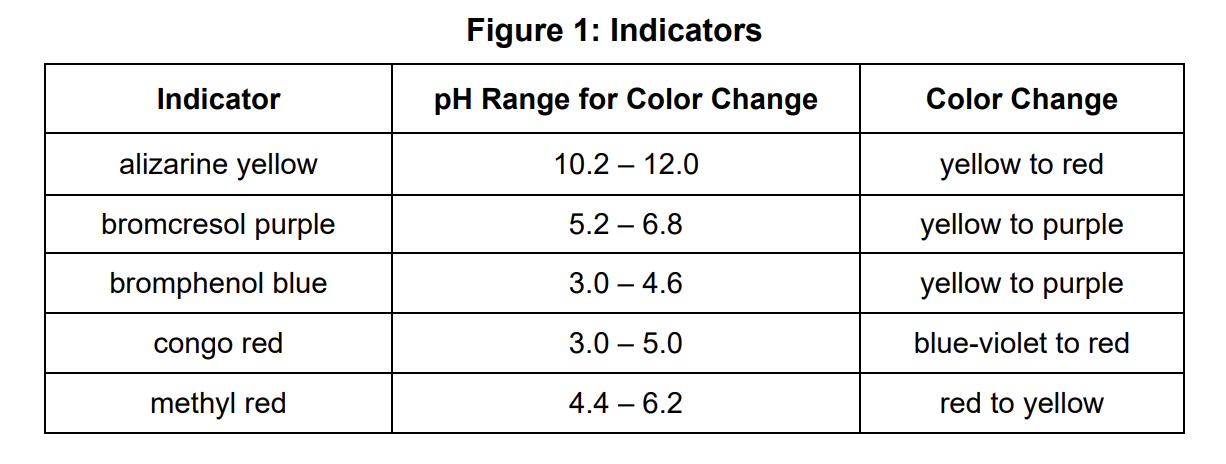

Which two indicators, when used independently, would provide results that, together, are suitable for evaluating soil pH to ensure optimal blueberry growth?
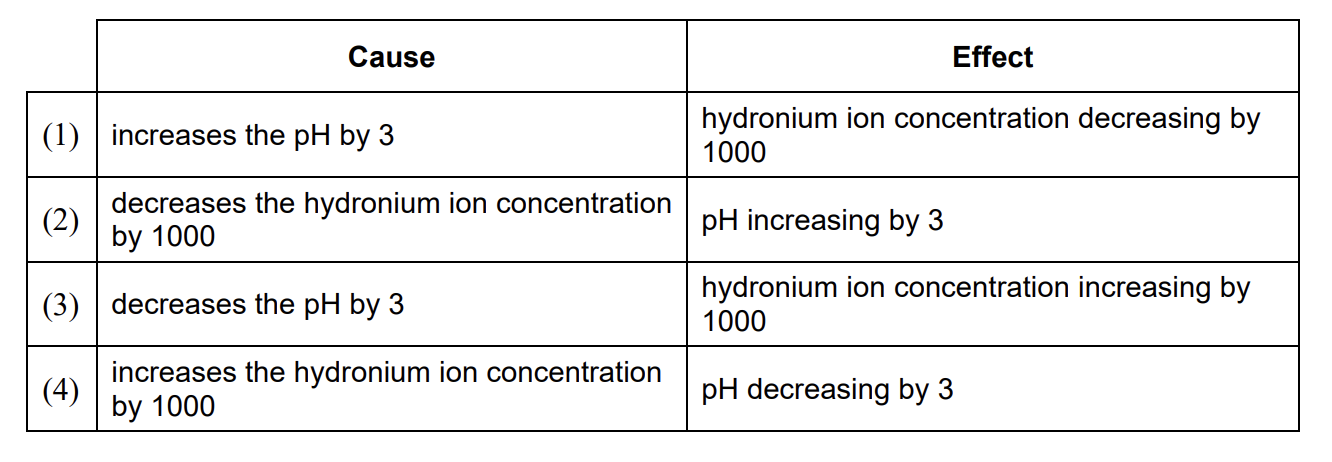
Which row in the table completes the claim describing a possible cause and effect of adding elemental sulfur to the soil? Adding elemental sulfur to the soil ___cause__, resulting in the ___effect___.
The use of elemental sulfur can result in over-acidifying the soil. Using ammonium fertilizers such as ammonium sulfate ((NH ) SO ) as an 4 2 4 alternative reduces this risk. The equations below demonstrate two ways in which ammonium ions contribute to soil acidification.

Identify the acid and the base when both water and ammonium fertilizer are added to soil. Compare the pattern of behaviors to explain why each substance is classified as an acid or a base. [1]
Acid: ____________________ Base: ____________________
Comparison of Behaviors: ___________________________________________
Cite numerical evidence from Equation 3 to demonstrate the claim that atoms, and therefore mass, are conserved. [1]
Evidence: ___________________________________________________________________________
How many grams of nitrogen are added to the soil when 100. grams of the substance that acidifies soil with reduced risk is applied?