Chapter 7 - Ancient China Assessment Performance Task

Last updated about 1 month ago
1 question
You've checked your knowledge.

It's time to demonstrate your reading and writing ability.

Take a trip along the silk road and at the end write a fictional journal about your trip.
The Heavenly Horses are coming
Across the pastureless wilds
A thousand legs at a stretch
Following the eastern road.

– Poem by Han Emperor Wu-Ti, circa 140 BCE.
He wrote as he waited for the arrival of new horses on the Silk Road.
When you sit down to a bowl of spaghetti at home or a Math problem in school, you probably aren’t thinking about history. Yet it is a fact that noodles from China and a number system from Persia and India first made their way into the European world along ancient trade routes called the Silk Road.

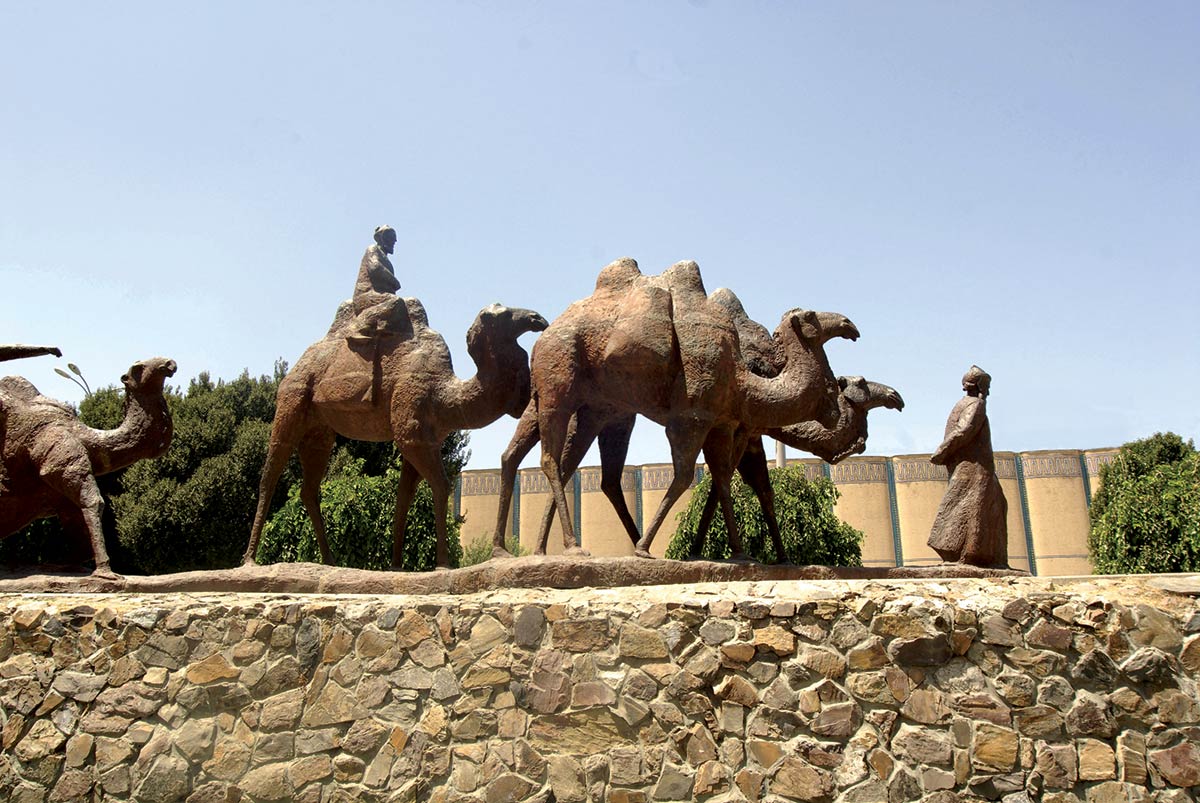
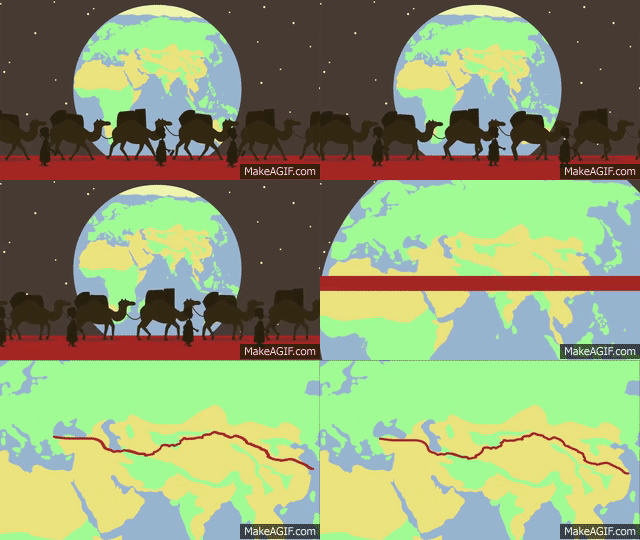
The Silk Road was actually a series of roads and routes that together made up a huge trade network. It stretched from China to Rome with many side branches leading to the north and the south. The Silk Road began more than 3,000 years ago and got its name from the luxurious, brightly colored cloth that was China’s biggest export. The Silk Road owes an important part of its success to the domestication of the camel – an animal that could carry heavy loads over long distances and required little water while doing so. Camels were the fuel-efficient minivans of the ancient world.

As is true with international trade today, politics made business on the Silk Road difficult and often dangerous. Caravans had to travel through many kingdoms and city-states that fought each other. When conflict broke out, trade was interrupted. Between about 200 BCE and 250 CE, the growth of four stable empires helped ease this problem and keep the Silk Road humming. The empires were the Han, the Kushan, the Parthian, and the Roman.

From 202 BCE to 220 CE, the Han dynasty ruled over China. The Han were especially eager to trade silk for magnificent horses from Ferghana in Central Asia. To protect this trade, the Han cracked down on bandits who preyed on Silk Road travelers.

Starting in 50 CE, another Asian empire took shape and began profiting from the Silk Road. This was the Kushan Empire, which stretched from western China into northern India. The Kushans established themselves as a kind of toll booth that collected taxes on goods moving back and forth between China and points west.

Beyond the Kushans was the powerful empire of Parthia, which covered much of modern-day Iran and Iraq. The Parthians became skilled merchants, buying up goods flowing into their country and reselling them at a higher price to traders who carried them further along the Silk Road.

Meanwhile, the Roman Empire had come to dominate the West, eventually controlling much of the land that rimmed the Mediterranean Sea. As the empire got richer, Romans demanded more and more luxury goods, especially that wonderful Chinese fabric, silk.

In time these four empires collapsed, but for hundreds of years, the Silk Road continued on without them. Then, around 1400 CE, exploration and new sea routes brought an end to much of the overland trade.
In its heyday, tens of thousands of traders traveled the Silk Road.

Now it’s your turn. Using the voice of the person chosen below, record what you learn about trade and the spread of ideas on the Silk Road. The documents that follow will provide material for the journal entries you will write. Be creative, but be factual, too.

It is just past dawn on a brisk, early spring day in Chang’an, China. After days of preparation, your caravan is fully assembled and ready to head west. Rolled bolts of silk are strapped tightly to camel backs. The dust builds as these humped beasts struggle to their feet. Dogs bark. Children race. Your caravan leader, speaking Chinese with a thick Sogdian accent, barks out, “We go!” You touch the journal tucked into your tunic. You are off.
Silk Road Travelers
Most Silk Road travelers were men as was the custom then for this type of journey. Yet, many women did travel on the Silk Road; others played important roles in trading centers, especially as producers of goods.

Caravan Leader
Many caravan leaders were Sogdians, who came from the region of Marakanda in the Kushan Empire of northern Asia. Caravan leaders were essentially trail bosses. They determined how long the caravan should travel each day and where it should stop to rest. In addition, they were aware of possible dangers, like bandits lurking along the northern edge of the Taklimakan Desert.
Caravan Guide
Caravan guides made sure that the caravan was heading in the right direction. Since compasses were not used during the Silk Road period, guides had to rely on the stars for their bearings. Indeed, many caravan guides were trained at nautical schools in India, where they learned how to read the stars. Also, guides might know the best paths to take through difficult terrain, such as the rugged Pamir Mountains in Central Asia.
Han Official
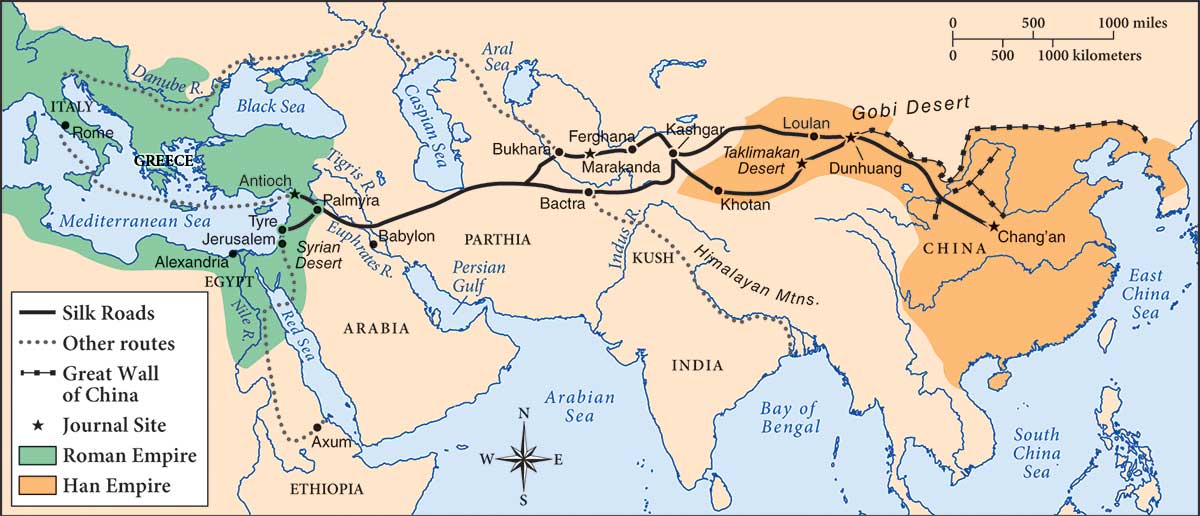
Han emperors liked to keep tabs on the western lands. To do this, they sent officials along the Silk Road to gather information. Some of these officials made it as far as the Parthian Empire (see map on page 407). However, the Parthians did not want an alliance to form between China and Rome, so they stopped Han officials at the border. For Han officials to reach the Roman Empire, they had to travel incognito, or in secret.
Merchant
Merchants interested in trading their goods at cities along the Silk Road often traveled with caravans. Some of them wrote itineraries that listed cities and oases on the Silk Road and mentioned the pros and cons of these places. In this way, the itineraries acted as travel guides. Successful merchants often became very wealthy and were respected in their home cities.
Soldier
Bandits were a constant threat along the Silk Road. During the Han period, some parts of the Silk Road were protected by military outposts. However, bandits sometimes attacked caravans in areas that were far away from these outposts. Also, the region west of the Pamirs was not controlled by the Han and so did not have military protection. To protect caravans from bandits, soldiers often traveled with the caravans.
Source 1: Map and Description — “The World’s First Superhighway”
The Silk Road was the world’s first superhighway. Not literally a single road, it consisted of a network of trade routes connecting China with Central Asia and lands beyond, all the way to Rome. Goods were usually transported by large caravans made up of guides, soldiers, religious pilgrims, merchants and hundreds of freight-bearing camels. The Silk Road flourished for more than 3,000 years and had a major influence on the cultures of Asia, Europe, and Africa.
1

Writing Situation

Your teacher is creating a classroom exhibit called “Journeys on the Silk Road.” Students will contribute first-person journal narratives written from the perspective of people who traveled the Silk Road in ancient times. You have read about the map and routes of the Silk Road, the oasis town of Dunhuang, and the dangers of the Taklimakan Desert. Now you will imagine that you are a traveler along the Silk Road.
You may choose to write as one of the following:
  • Caravan Leader — a trail boss who directs the group and guards against bandits.
  • Caravan Guide — a navigator skilled in reading the stars and knowing safe routes.
  • Han Official — a secret messenger traveling west to gather information.
  • Merchant — a trader hoping to reach new markets.
  • Soldier — a guard protecting a caravan through dangerous lands.
Your journal entry should describe a specific event or day on your journey, using what you learned from the sources to make your narrative historically accurate and vivid.

Directions for Writing

Write at least three paragraphs for your journal narrative, each reflecting a different day on the journey.
Establish the setting, point of view, and time period clearly.
Include sensory details that show what you might see, hear, or feel along the Silk Road.
Use details and ideas from the sources to make your story realistic and informative.
Develop your characters and events with clear, logical sequence.
Show how the journey challenges or changes the traveler.
Provide an ending that gives a sense of reflection or completion.
You may look back at the sources as you write.