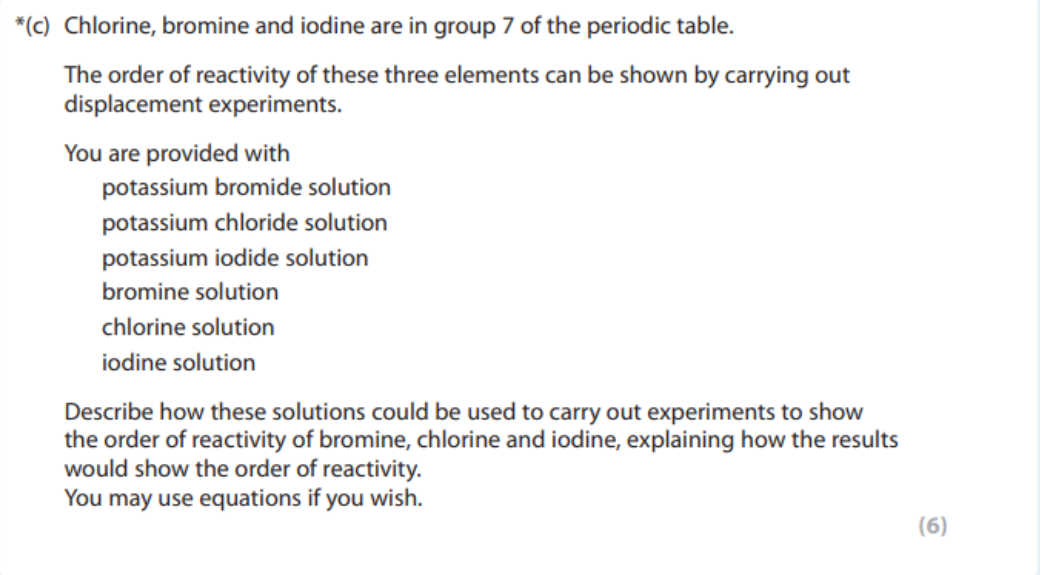
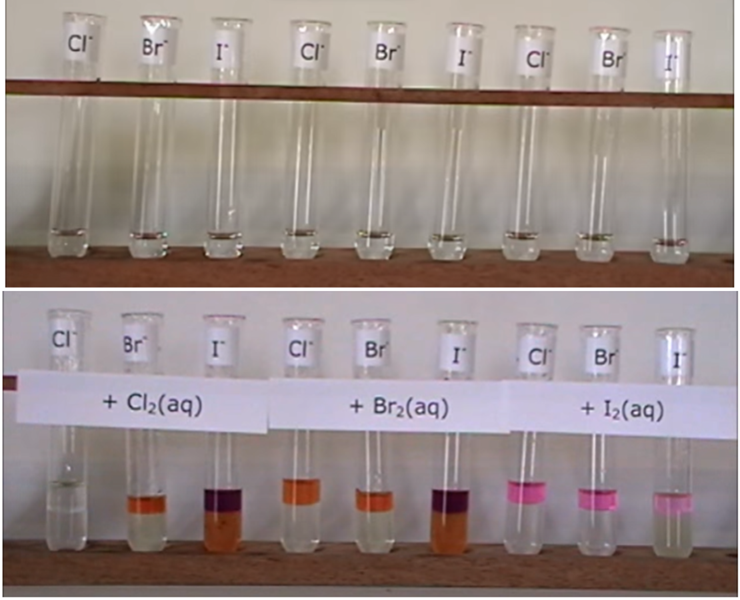
Order of reactivity: _____________ > ____________ > ___________
Experiment
add (aqueous) chlorine to a solution of potassium bromide
the solution turns ___________ as bromine is produced
Conclusion/Explanation and equation:
(so) chlorine ______________ bromine
Full equation
Cl₂ + 2KBr → Br₂ + 2KCl
__________ equation
/ Cl₂ + 2Br⁻ → Br₂ + 2Cl⁻
Experiment
add (aqueous) bromine to a solution of potassium
iodide
the solution turns __________ as iodine is produced
Conclusion/Explanation and equation:
(so) bromine is _________ reactive than
Br₂ + 2KI → I₂ + 2KBr
or ionic equation
Br₂ + 2I⁻ → I₂ + 2Br⁻
Experiment
add (aqueous) chlorine to a solution of potassium iodide
the solution turns brown
iodine is produced
Conclusion
(so) chlorine is more reactive than iodine
Cl₂ + 2KI → I₂ + 2KCl
Cl₂ + 2I⁻ → I₂ + 2Cl⁻
What is group I in the periodic table called?
alkali metals
halogens
noble gases
Transition metals
What is group 0 in the periodic table called?
alkali metals
halogens
noble gases
Transition metals
Alkali metals are
relatively soft compared to transition metals
relatively hard compared to transition metals
Alkali metals have
relatively high melting points
relatively low melting points
Which of the following is true of the reactions between alkali metals and water?
Fizzing is observed due to hydrogen gas being formed
Fizzing is observed due to oxygen gas being formed
Fizzing is observed due to carbon dioxide gas being formed
Option 1
Option 2
From Li to K the outermost electron is lost
More easily
Less easily
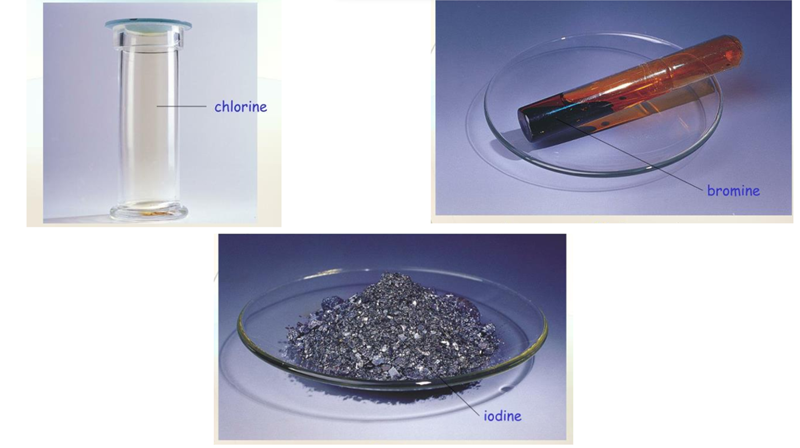
At room temperature Br₂
is a gas
is a liquid
is a solid
At room temperature I₂
is a gas
is a liquid
is a solid
Chlorine gas is
Pale yellow
Green
Red - brown
Dark grey
Bromine is
Pale yellow
Green
Red - brown
Dark grey
Iodine is
Pale yellow
Green
Red - brown
Dark grey
Astatine is likely to be
Pale yellow
Green
Red - brown
Dark grey
As group VII is descended the melting point of the halogens
increases
decreases
What is used to test for chlorine gas
Damp red litmus paper
Damp blue litmus paper
What is the positive result for the chlorine test?
Damp red litmus paper turns blue then white
Damp blue litmus paper turns red then white.
Give the product of the following reaction
Iron + chlorine →
Iron chlorine
Iron chloride
Iron chlorate
Give the product of the following reaction
magnesium + bromine →
Magnesium bromide
Magnesium bromine
Magnesium bromate
When the hydrogen halides dissolve in water they form
Acidic solutions
Alkali solutions
Neutral solutions
Option 1
Option 2
Tick all the boxes where a reaction would take place
Sodium chloride
Sodium bromide
Sodium iodide
Chlorine water
Bromine water
Iodine water
Option 1
Option 2
As group 7 is descended _______________________
The atomic radius decreases
The atomic radius increases
As group 7 is descended the tendency to gain an electron
increases
decreases
As group 7 is descended the halogens become
More reactive
Less reactive
From Fluorine to iodine the halogens become
More reactive
Less reactive
Which two of the following are properties of the alkali metals?
they form coloured compounds
they form hydroxides that are soluble in water
they have lower melting points than most usual metals
they react with water, releasing hydrogen
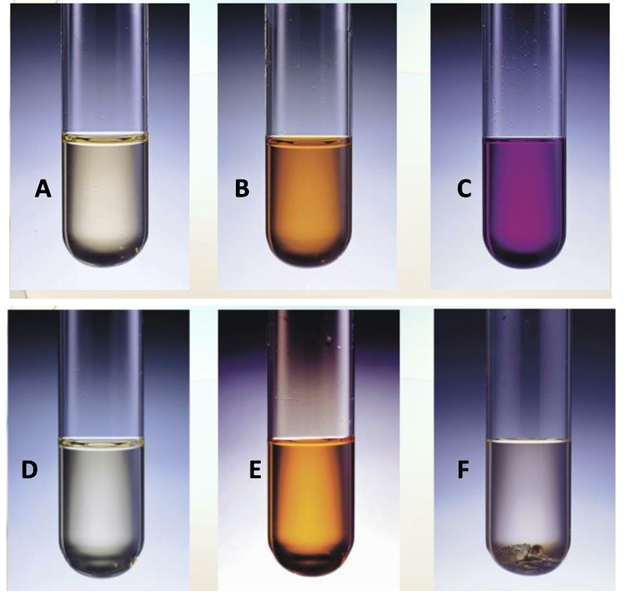
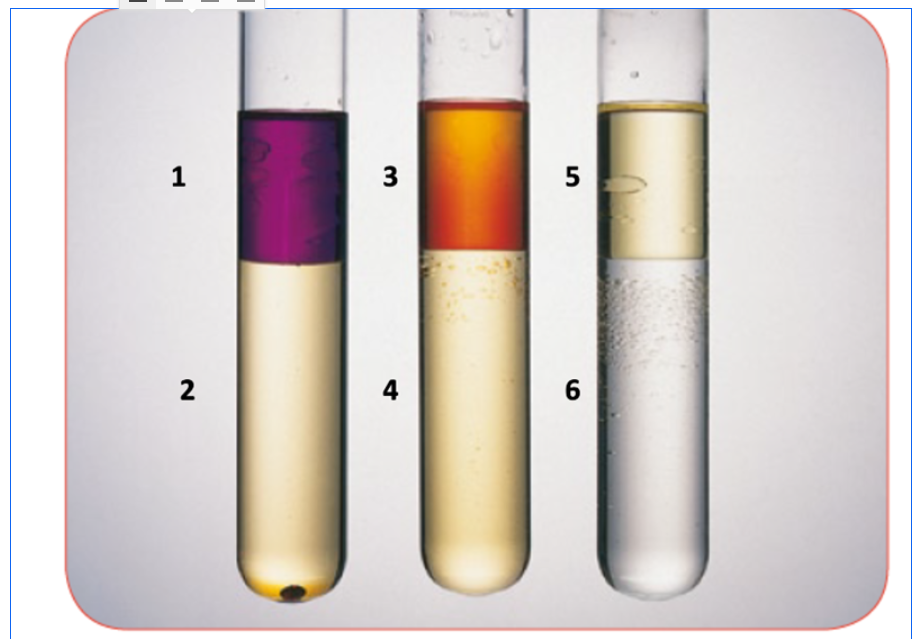
Which letter shows iodine in cyclohexane?
A
B
C
D
E
F
Use the results of the displacement reactions to place the halogens in order of reactivity from most reactive to least reactive.
Note 1. the halide ions would have to be added as a salt such as KCl, KBr and KI rather than the individual ions
Note 2. The potassium halide solutions are all colourless.
Note 3. The final colour of the sample depends upon the halogen present only.