Week 14 ELA Quiz - The Arrival of Europeans
star
star
star
star
star
Last updated 17 days ago
10 Nsɛmmisa
1) In August 1492, Christopher Columbus, an Italian sea captain, sailed from Spain. He led three ships - the Nina, the Pinta, and the Santa Maria. Columbus was looking for a new route from Europe to the Indies, a group of islands in Asia. Columbus thought he could reach the Indies by sailing west across the Atlantic Ocean. Instead, he reached one of the Bahama Islands. He called the people there “Indians” because he thought he was in the Indies. Later many Europeans said that Columbus had discovered a “New World.” To the Native Americans already living here, this world was not “new” at all. Their people had been there thousands of years before Columbus.
2) After Columbus’s journey, other Europeans explored the coasts of North and South America. To explore is to travel to unfamiliar places in order to find out and learn about them.
3) In 1539 a Spanish explorer named Hernando de Soto (er NAHN doh day SOH toh) sailed from Cuba to the west coast of present-day Florida to search for gold. With him were more than 800 people, about 200 horses, and a herd of hogs to use for food.
4) The explorers traveled north and west, through swamps, across rivers, and into deep forests. Find their route on the map below. The journey was not easy. Many people and horses died.
5) After more than a year and a half, the explorers reached what is now Mississippi. In May 1541 DeSoto’s men became the first Europeans to see the Mississippi River. One of the men described it as being of “great depth, …strong current [and] always muddy.”
6) Desoto’s journey lasted two more years, but he found no gold. Only half the men survived to reach the Gulf of Mexico. DeSoto himself died of a fever along the way.
7) Native Americans also suffered because of DeSoto’s journey. When the Spanish arrived in North America, they brought diseases such as measles and smallpox that were common in Europe. Native Americans had no natural protection against these diseases and no medications to cure them. Thousands died. Whole villages disappeared.
8) In the 1600s the French built many settlements near the Great Lakes. Many French settlers traded cloth, cooking pots, and metal axes with Native Americans for animal furs. Other French settlers came to spread the religion of Christianity among Native Americans.
9) Rene Robert Cavelier, Sieur de La Salle (re NAY roh BAIR cah vuhl YAY sihr duh lah SAHL) was a French explorer. In 1677 he asked the French king, Louis XIV for permission to travel down the Mississippi River. He wished to explore the land south of the Great Lakes. After traveling down the Illinois River by canoe, La Salle reached the Mississippi River in February 1682. With him were 23 Frenchmen and 31 Native Americans, including ten women and three small children. Along the way, the explorer met many Native American groups. When the explorers ran out of food, they hunted deer, buffalo, and turkeys. Sometimes Native Americans living along the river gave them food such as corn and dried fruit.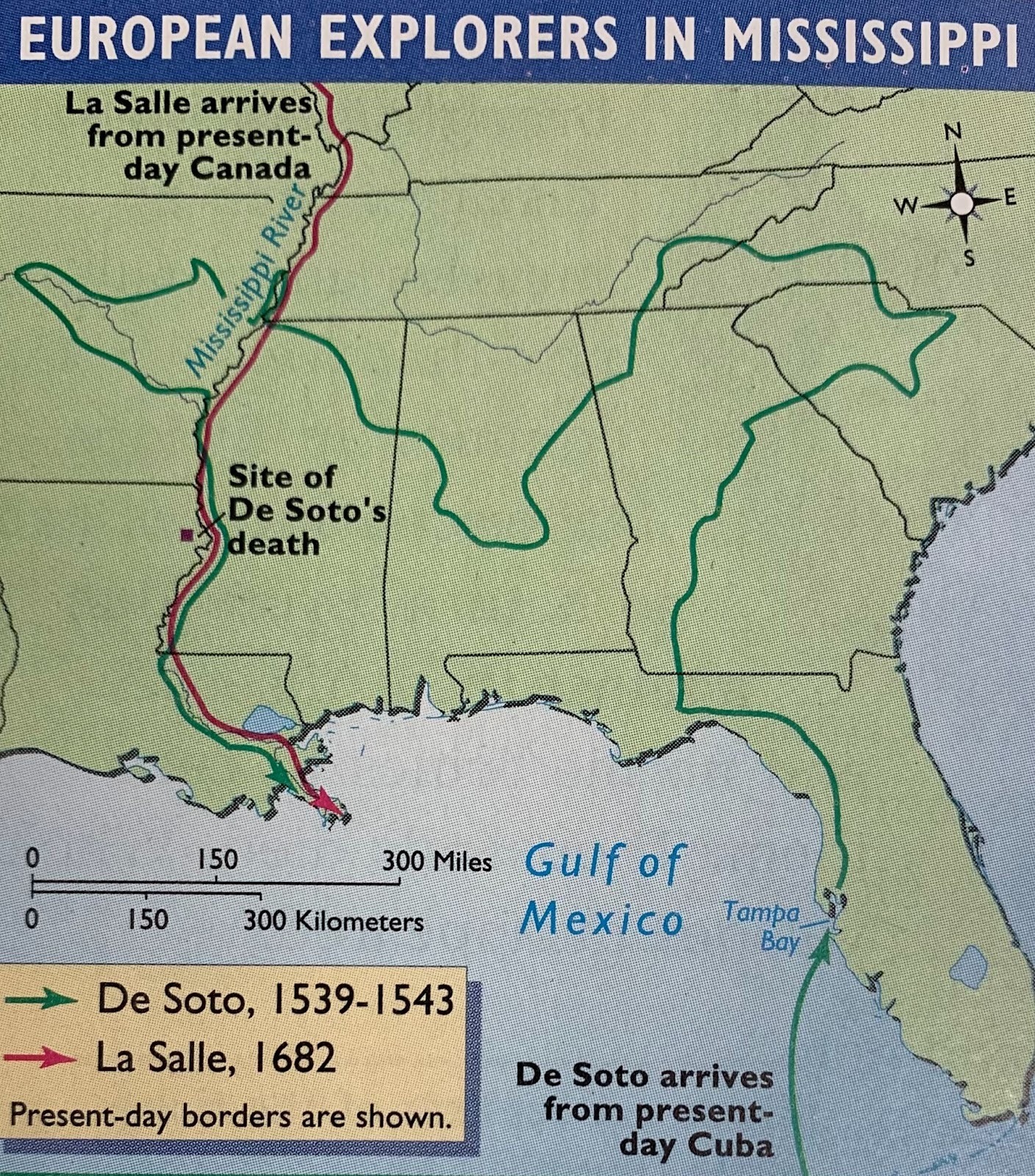
10) In April 1682 La Salle arrived at the mouth of the Mississippi River on the Gulf of Mexico. La Salle claimed the Mississippi River valley, which included land from the Great Lakes to the Gulf of Mexico, for Louis XIV. La Salle named the area Louisiana in honor of the king.
What word best replaces the word unfamiliar in paragraph 2? RI.4.4
What overall structure does the author use in the passage? RI.4.5
Which two quotations support the inference that the French and Native Americans enjoyed helping each other? RI.4.1
What point does the author make about Desoto’s journey? RI.4.8
How does the map help the reader understand the passage? RI.4.7
Which two choices tell why thousands of Native Americans died after DeSoto’s journey? RI.4.3
Is the passage a first hand account or second hand account? RI.4.6
What is the meaning of the word current as it is used in paragraph 5? RI.4.4
What is the main idea of the section, “DeSoto’s Search for Gold?” RI.4.2
Which quotation supports the inference that Christopher Columbus was mistaken about where he landed? RI.4.1