Look at the chromatogram.
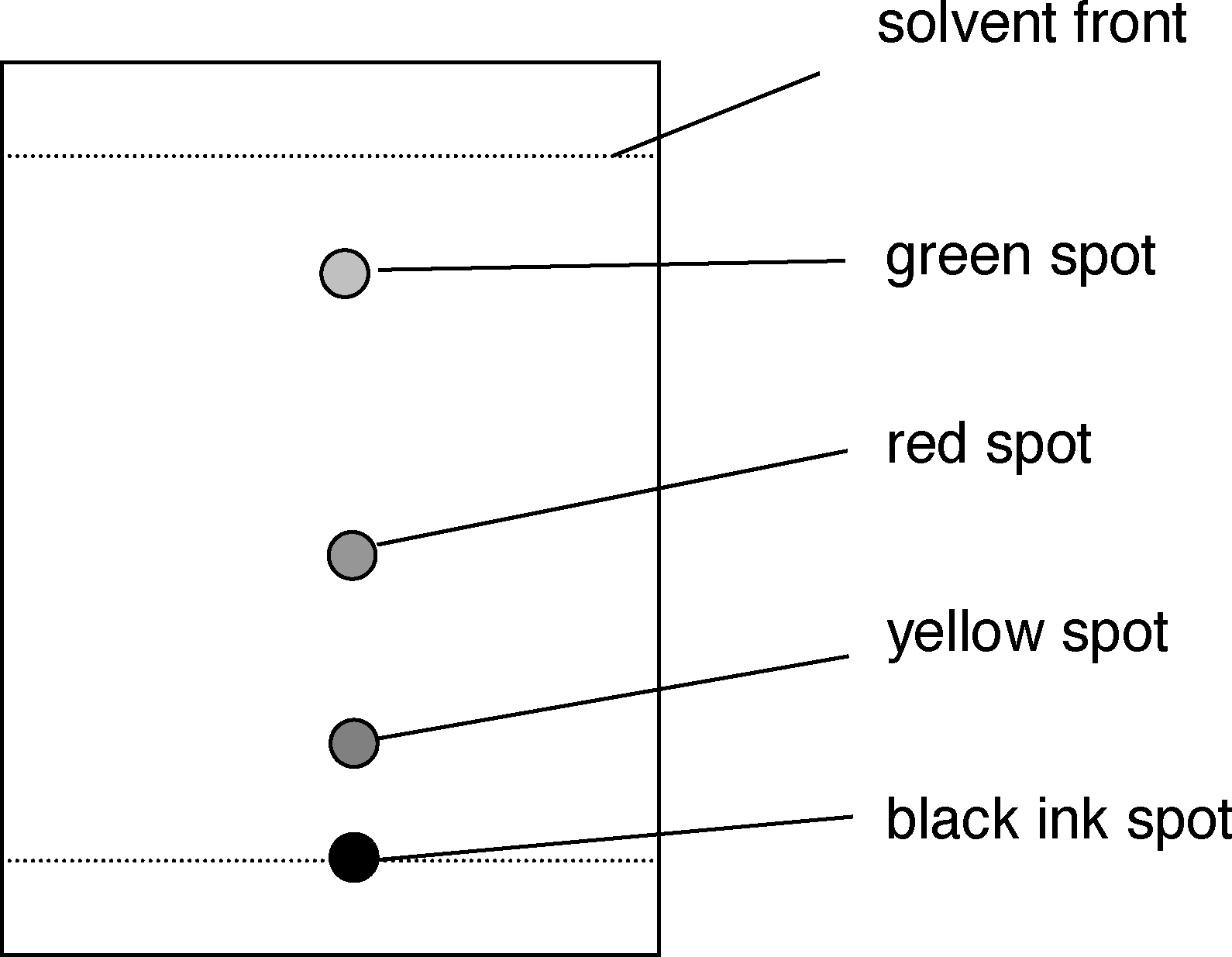
What is the R_f value of the green spot? Use a ruler to help you.
Look at the chromatogram.
Work through the questsions.
For any answers that you get wrong, write out the hint into your books.
(or a summary of the hint).
Some of these will be for topics you haven't done yet.
We call this "flipped learning"
Work through the questsions.
For any answers that you get wrong, write out the hint into your books.
(or a summary of the hint).
Some of these will be for topics you haven't done yet.
We call this "flipped learning"
What is the name of the gas made when magnesium reacts with sulfuric acid?
Which equation represents neutralisation?
Ethanol is a liquid at room temperature. It has a low melting point and boiling point. Why?
Which statement about covalent bonding is true?
Which statement correctly describes a pure substance?
What is the activation energy for a reaction?
Which is the best explanation of a concentrated acid?
Do not confuse concentrated with strong!
Which technique is the best for separating pure water from a solution of sodium chloride in water?
Which statement shows that lead is a metal?
When
What mass of C would burn to form
What is the relative formula mass of sodium carbonate, Na2CO3?
Look at the chromatogram.
What is the best description of the particles in a liquid?
Look at the energy changes in the reaction profile for the reaction between hydrogen and chlorine.
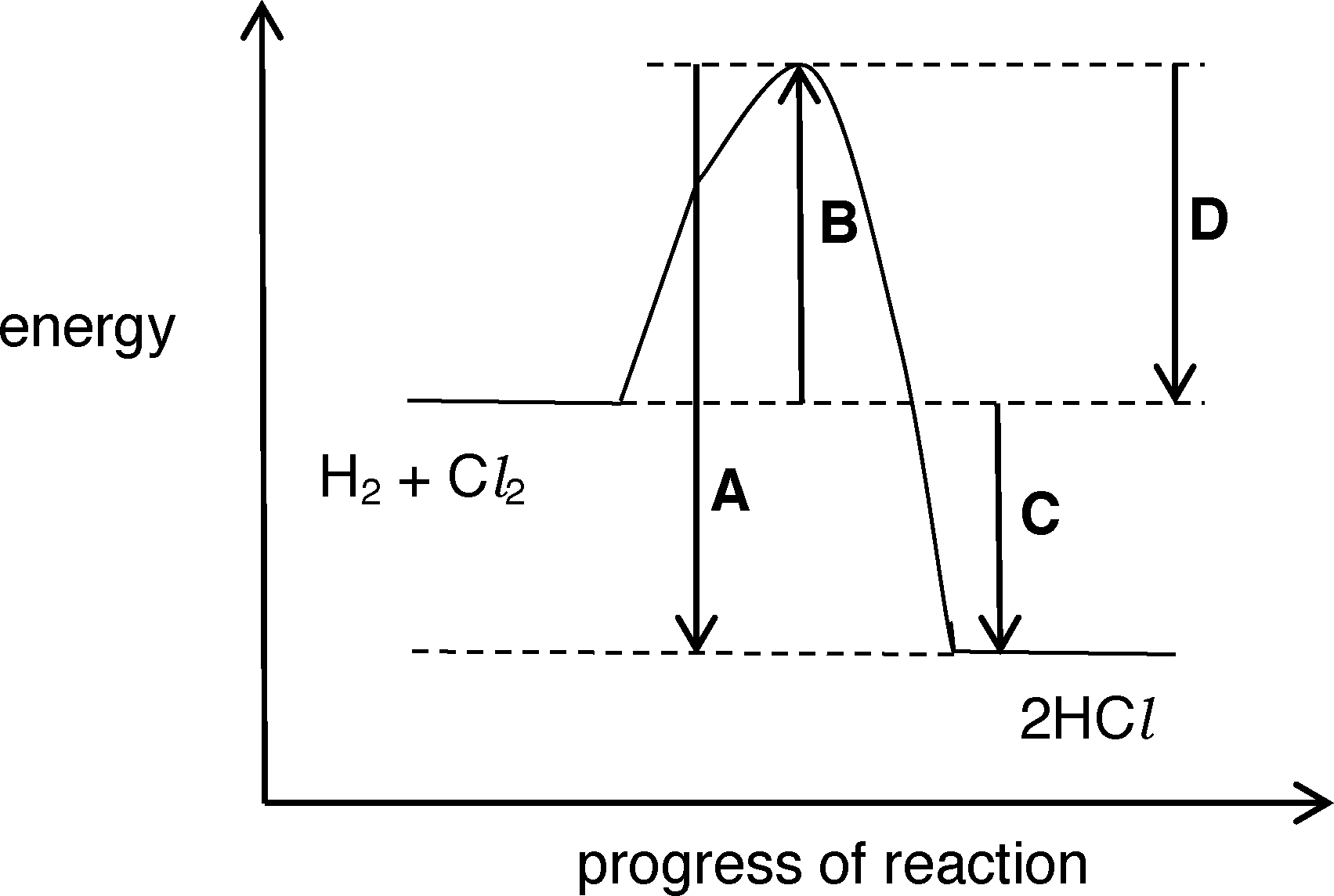
Which energy change shows the enthalpy change of reaction?
What is the empirical formula of decene?
Carbon dioxide exists as a simple molecule.
Why do simple molecules have low boiling points?
Mendeleev’s arrangement of elements led to our modern Periodic Table.
How did Mendeleev arrange the elements in his Periodic Table?
Carbon can form different allotropes. Which of these are allotropes of carbon?
The melting point of bromine is
How many oxygen atoms are in 0.25 moles of oxygen molecules?
Avogadros number = 6.01x10²³
Calculate the amount of carbon dioxide made when 6.4 g of methane is burnt.
Which of these substances has a giant covalent structure?
Magnesium is heated in a crucible. The mass of the crucible and magnesium increases.
Which statement is the best explanation for this?

15 Look at the diagram of a methane molecule.

Which statement about methane is correct?
Two isotopes of neon are

A student measures the pH on an acid and an alkali.
He adds magnesium metal to the acid and to the alkali.
What results should he expect?

Which row in the list shows the correct results?

What is the electronic structure of sulfur?

https://mmerevise.co.uk/app/uploads/2023/03/Edexcel-GCSE-Chemistry-Periodic-Table.pdf
During the electrolysis of molten lead bromide, bromine is made at the anode. Which half equation shows that bromine is made at the anode?