Summative #5
star
star
star
star
star
Last updated 6 months ago
22 Nsɛmmisa
by Fabiola Santiago
1 Carmen walked up to the silver water fountain in the hallway, her hands damp and her mouth as dry as an empty well. A new school day stretched before her, and Carmen had butterflies in her stomach again. Maybe a cool sip of water would help.
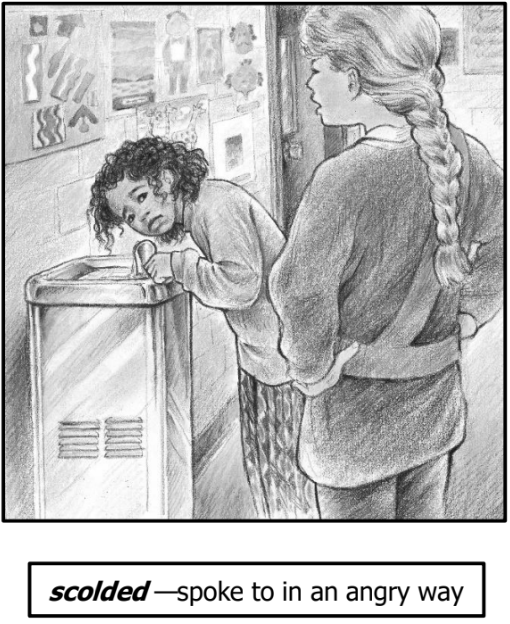 2 She tucked her curls behind her ears and bent to reach the chilly trickle when, out of the corner of her eye, Carmen saw an older girl walking her way. The girl wore a bright orange belt with a silver patch that said School Patrol.
3 “What are you doing in the hall?” the patrol girl scolded Carmen. “The late bell is about to ring!”
4 Carmen searched her brain for the right words in English. She wanted to explain that she had permission from Mrs. Smith to get a drink of water. But she knew that even if the words came to her lips, she could not make them sound as crisp as the American girl’s. This fear left her speechless. It was as if all her smart brain cells went to sleep every time she walked into her new school in the United States.
5 “I don’t speak good English. I’m a Cuban girl,” Carmen said slowly.
scolded —spoke to in an angry way
6 “You’re going to be in trouble if you don’t get to class on time,” the girl said, pointing her index
finger at Carmen.
7 Carmen dreamed of the day that she would open her mouth and the English words would flow in beautiful, musical tones. But every day in school she was reminded that she did not speak English well. Most of all she dreaded reading out loud in class.
8 Carmen always practiced at home, but when she had to speak in public, she became so nervous she couldn’t get those sh and ch sounds right. It was embarrassing being the only fourth-grader who was afraid to read from Mrs. Smith’s blackboard.
9 Oh, how Carmen wanted to go home to Cuba, her alligator-shaped island in the Caribbean Sea. She missed her old school, her friends, her teachers, and the soulful sound of Spanish, her parent’s language. In Cuba no one laughed at her because Carmen was the smartest girl in class.
10 Even her English had been good there! Señor Lopez, who had lived for a long time in the United States, gave Carmen English lessons every day. He thought Carmen would make a fine American. He told her so.
11 “Carmen, you will love the United States,” Señor Lopez had said. “You’re almost an American, you speak English so well.”
12 But now that Carmen was in America, her English didn’t sound so good. She didn’t want to go back to Mrs. Smith’s class. She wanted to close her eyes and wake up in Spanish at home!
13 R-i-i-i-n-g! The bell interrupted Carmen’s daydream.
14 The first notes to the song Carmen liked so much crackled over the loudspeakers, and the patrol girl hurried off. Whenever Carmen heard this song at the start of the school day, she forgot about her accent. Even if she didn’t know the words, she could enjoy the melody of the violins and hum along.
15 With the sound of the late bell, Carmen remembered that the school day was about to begin, and she hurried to her classroom. But Mrs. Smith stopped Carmen when she rushed into the room.
16 “You must stand in respect whenever you hear this song,” Mrs. Smith whispered, bending down to reach her ear. “It’s the national anthem of the United States.”
17 Carmen stood tall at attention. After the song had ended, she told Mrs. Smith how much she liked it.
18 “Will you teach me the words?” Carmen asked. Although she didn’t realize it, Carmen said this in pretty good English.
19 Mrs. Smith smiled sweetly, the way Carmen’s favorite teacher did in Cuba.
20 “Of course,” Mrs. Smith said. “I would be happy to teach you ‘The Star-Spangled Banner.’”
21 Right away, she gave Carmen the first line to learn.
22 “‘Oh, say, can you see,’” Mrs. Smith said slowly. “Repeat after me. ‘Oh, say, can you see.’”
23 Carmen spent all day saying the words until she knew them by heart. Mrs. Smith was so impressed with her effort that she asked Carmen to stay after school. Day after day, she taught her a new stanza until Carmen had learned the entire song.
24 Mrs. Smith said that Carmen had other talents: a crisp alto voice and a good ear to catch the melody. “How would you like to join our school chorus, the Stars and Stripes?” she asked.
25 At first, Carmen was a little scared to sing—in English!—in front of everyone. But she felt lucky to have been picked to sing her favorite American song with the chorus.
26 Now that she understood the words, whenever she sang “The Star-Spangled Banner,” Carmen felt proud of becoming an American.
Part A: What is the theme of the passage?
Part B: Which quotation from the passage supports the answer to Part A?
What does the author mean by the phrase “her mouth as dry as an empty well” in paragraph 1?
Why did Carmen feel better about being in her new school?
What does the author mean by the phrase “Carmen had butterflies in her stomach” in paragraph 1?
Which quotation supports the inference that Carmen refused to give up when learning the national anthem?
Which phrase from paragraphs 7-8 helps the reader understand the meaning of the word dreaded?
Read the sentence from paragraph 12.
She wanted to close her eyes and wake up in Spanish at home!
What does the author mean by the sentence?
Why did the patrol girl scold Carmen?
In which two ways was school different for Carmen in Cuba?
“From Scribbles to Spacious Skies”
by Donna D. Feeney
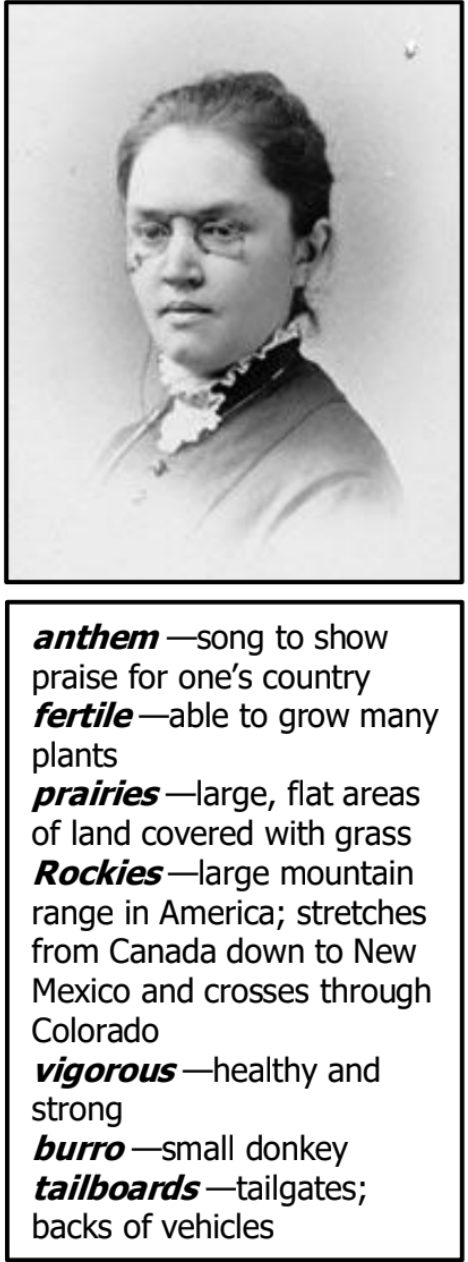 1 When Katie L. Bates was nine years old, her mother gave her a small red notebook. Katie’s first entry was, “I am writing, scribbling rather, just for fun.” She went on, “The lines are to short for good rhymes. Storys take up two many pages.”
2 As Katie grew up, she continued to write in notebooks and diaries. Her spelling improved. She even became an English teacher. And she wrote lots of rhymes and stories.
3 One of those rhymes became an anthem that we sing today— more than one hundred years after she wrote it. The song is “America the Beautiful.”
4 Bates wrote the poem in a notebook during her first trip west in 1893, when she was thirty-three years old. She was headed for Colorado College in Colorado Springs to teach a summer class. At that time, she was Miss Katharine L. Bates, a professor at Wellesley College in Massachusetts.
5 Traveling by train, she stopped in Chicago to visit a friend. By the fourth of July, Bates was in western Kansas. She noted its “fertile prairies” in her diary. When she finally arrived in Colorado, she wrote that she had begun teaching “under the purple range of the Rockies.”
6 Summer session lasted only a few weeks. When it was over, the teachers wanted to celebrate. What better way than to go to the top of nearby Pikes Peak, the best-known mountain in the Rockies?
7 Katharine Bates wrote that her group was “not vigorous enough to achieve the climb on foot nor adventurous enough for burro riding.” So they made their way huddled in prairie wagons.
8 On the tailboards of the covered wagons were signs saying “Pikes Peak or Bust,” the same slogan gold prospectors had used years before. Horses took the group halfway up the mountain. Mules pulled the wagons the rest of the way.
9 “We were hoping for half an hour on the summit,” wrote Miss Bates. But when the teachers got to the top, two of them became faint from the thin air. The group was quickly “bundled into the wagons” for the “downward plunge.”
10 Katharine Bates said that there was hardly any time on the peak for more than an “ecstatic gaze.” She added, however, “it was then and there, as I was looking out over the sea-like expanse of fertile country spreading away so far under those ample skies, that the opening lines of the hymn floated into my mind.”
11 By the time Bates left Colorado Springs, the four stanzas of “America the Beautiful” were penciled in her notebook.
12 When she returned home, she was so busy at school that she laid the notebook aside. It wasn’t until two years later that she submitted the poem for publication. It first appeared in The Congregationalist on July 4, 1895—a perfect date for a patriotic poem.
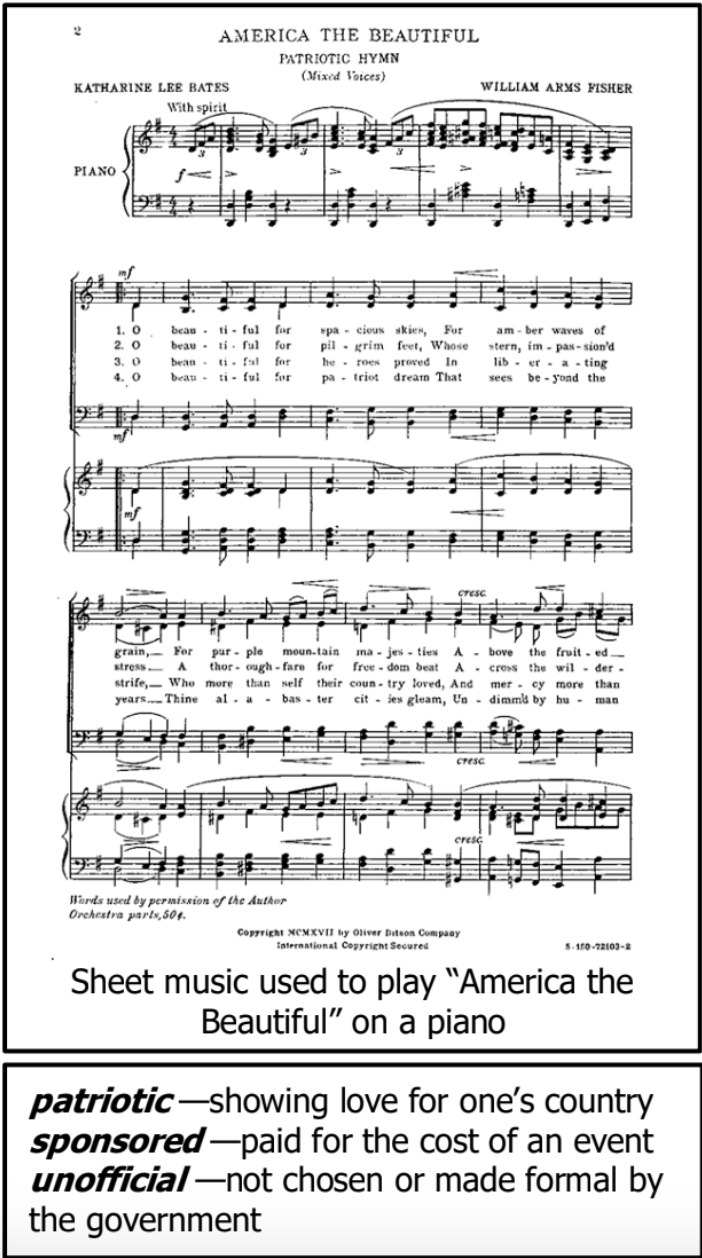 13 But that version isn’t exactly the same as the one we sing today. It began:
O beautiful for halcyon skies, For amber waves of grain, For purple mountain majesties Above the enameled plain!
14 Most people liked her poem, but some suggested changes. Miss Bates considered the ideas, which came from all over the United States. Over time, she rewrote parts of the poem. A new version was published in 1904. Later, changes were made to the third stanza, and “America the Beautiful” became the poem we know today.
15 Even as she was revising it, the poem was being sung to many different tunes. In 1926 a contest was sponsored by the past presidents of the National Federation of Music Clubs to find an appropriate melody for “America the Beautiful.” Almost nine hundred compositions were submitted, but none of them was selected.
16 The National Federation of Music Clubs and the National Hymn Society wanted the poem to become the country’s national anthem. But it was “The Star-Spangled Banner,” which had been sung by the public and the armed forces for many years, that became the official national anthem five years later, in 1931.
17 Today, “America the Beautiful” is usually sung to the hymn “Materna,” written by Samuel A. Ward. Ward, who lived from 1847 to 1903, was a church organist, choirmaster, and music-store owner in Newark, New Jersey.
18 Throughout her life, Katharine Lee Bates never stopped filling notebooks with her “scribbling.” She wrote many poems as well as travel books, textbooks, and children’s books.
19 But it is the poem she wrote that continues to remind Americans of the sweeping beauty and majesty of their country. It is no wonder that “America the Beautiful” has been called the unofficial national anthem of the United States.
patriotic- showing love for one's country sponsored- paid for the cost of an event unofficial- not chosen or made formal by the government |
|---|
What is the main idea of the text?
Why was Katharine Bates’s time at Colorado College important?
What does the author mean by the phrase “the sea-like expanse of fertile country” in paragraph 10?
Part A: What point does the author make about the poem “America the Beautiful”?
Part B: Which quotation from the text supports the answer to Part A?
What text structure does the author use in the text?
What can the reader infer about the tune for "America the Beautiful"?
Why do some people call "America the Beautiful" the unofficial anthem of the United States?
What does the phrase "the opening lines of the hymn floated into my mind" mean as it is used in paragraph 10?
Read the sentence from paragraph 12.
When she returned home, she was so busy at school that she laid the notebook aside.
What does the author mean by the phrase “laid the notebook aside”?
What does the word submitted mean as it is used in paragraphs 12 and 15?
Which two quotations support the inference that traveling up Pikes Peak was challenging?